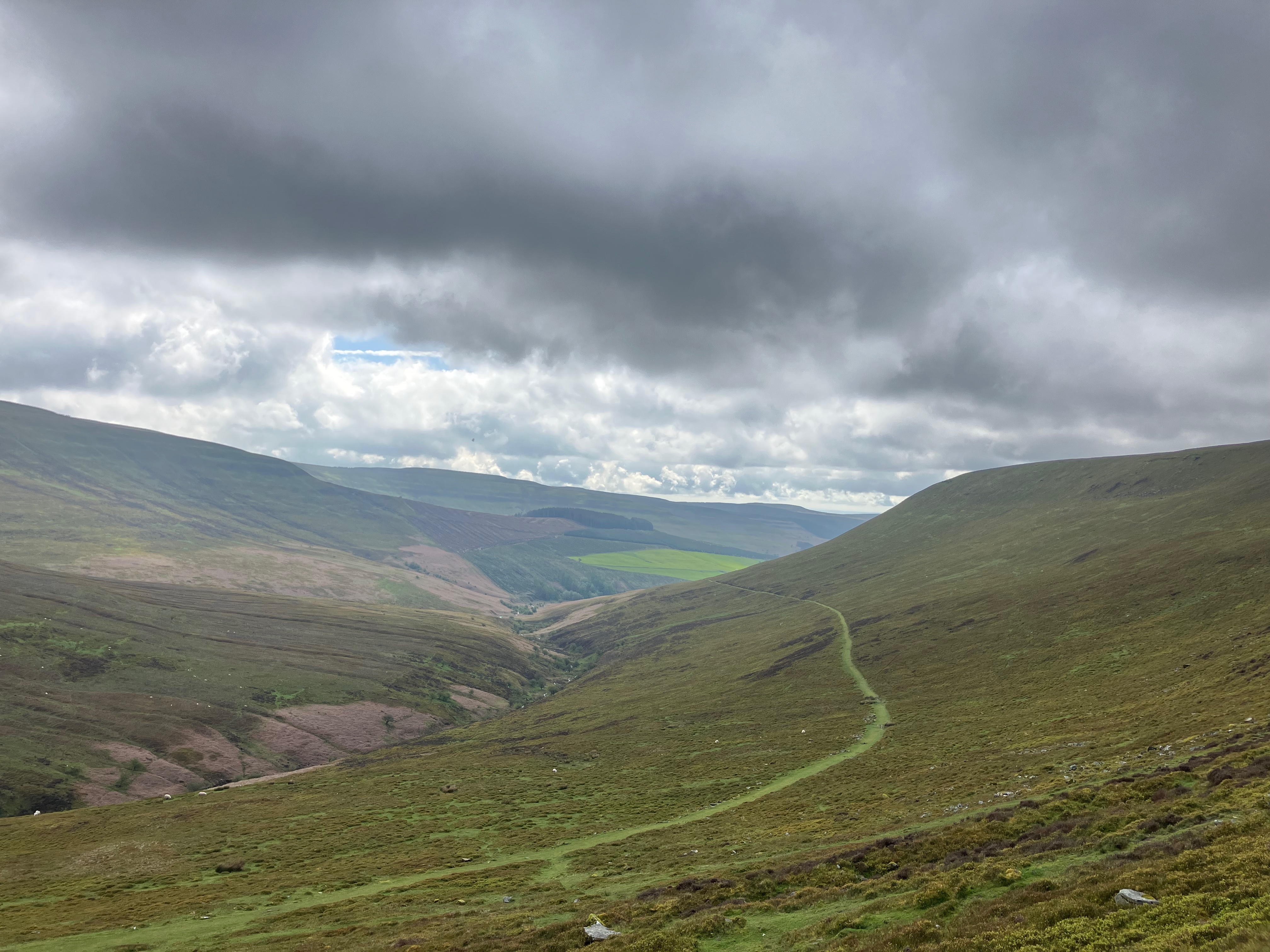
On my most recent excursion to the hills I have no new agenda following on from the ‘how long can you stay focused on anything at all’ theme, which, to be honest, turned out to be something of a red herring on the last two walks. I learned that I cannot focus on anything for very long at all and merely confirmed what I already suspected: my monkey mind settles with great difficulty. So I gave myself a break on this walk, and decided I would simply take in the landscape, breathe deeply, and put one step in front of the other. This proved to be a successful strategy (i.e. it was not a strategy at all, but simply a walk).
I set out early for the Grwyne Fechan valley, park the car near the bridge below Neuadd fawr farm and start walking, with nothing much on my mind, intent on following the forest track that continues along the western slope of Cwm Grwyne Fechan; then I will take Macnamara’s Way up to Mynydd Lleisiau, and on to Pen Twyn Glas, before descending back to my starting place, past the abandoned quarries above Cwm Banw.
The track that emerges out of Park Wood, above Darren farm, on the west bank of the Grwyne Fechan, is extremely boggy, even now, in May, with the effect of walking through deep sand. It is wearying, and you long for a hard surface; dry soil or gravel. It comes as a relief then, to reach Macnamara’s Way.
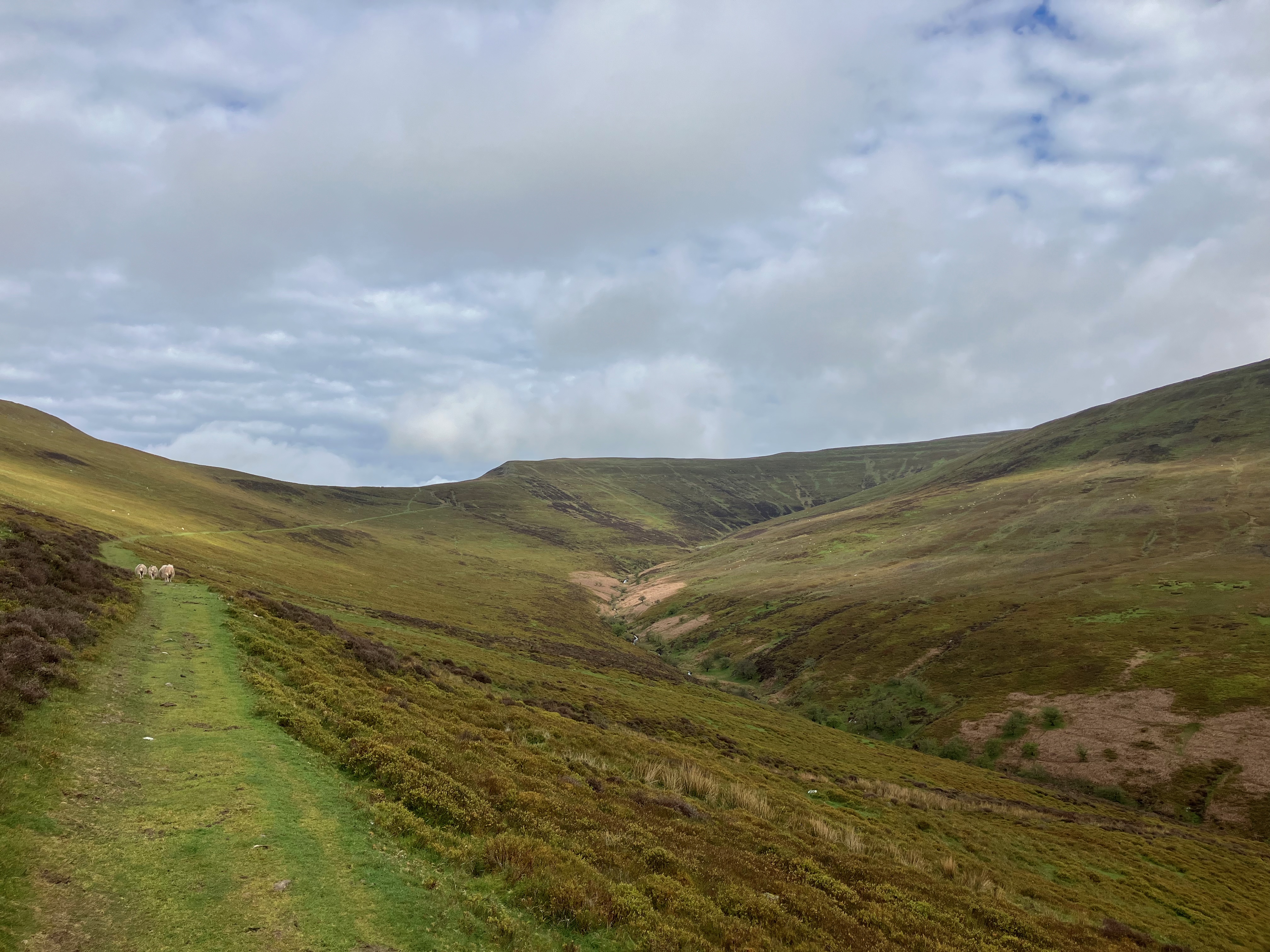
The ascent is not arduous, and by the time you arrive at the summit of Mynydd Lleisiau you are quite calm: the sun has appeared, and the way ahead is clear. At this point you observe, jogging towards you, the first human of the day, a youngish man in a safari hat and shorts, with a dog on a leash running somewhat reluctantly (or so it appears) alongside him. But what draws your attention is that the dog is carrying saddle bags. You are surprised by your own reaction, which is one of muted anger towards the man. You can understand, just about, why he might prefer to run along mountain trails rather than walk, but why must he inflict this passion on his poor dog? And why should the dog be forced to carry a backpack, as if it were a mule? I can feel my mood thickening as the man approaches, and calls out to me, without easing his pace, Good morning, how are we doing? Well, first of all, he clearly doesn’t require an answer, as he doesn’t stop, so why does he pose the question? And why the use of first person plural, the way certain people speak to invalids or persons of feeble mind? I understand that the question is rhetorical rather than functional, much like the local use of ‘orright’? But he is most definitely not a local and doesn’t pose the question as if it were rhetorical and nor does he stop to receive an answer. I am taken aback, put off my stride. I know I shouldn’t be affected this way, but I am. More so, in fact, when a hundred paces behind him, over the crest of a slight dip, appears his weary-looking partner, blond hair tied back and bunched in a tight knot, grimacing a little with the strain of keeping up, but stoical. She manages a greeting also (but without posing any questions, rhetorical or otherwise). I am relieved to observe that she hasn’t been obliged to carry a rucksack, that she is just allowed to plod along behind the Great Adventurer, in her tight fitting black joggers and expensive looking black top. I feel for her.
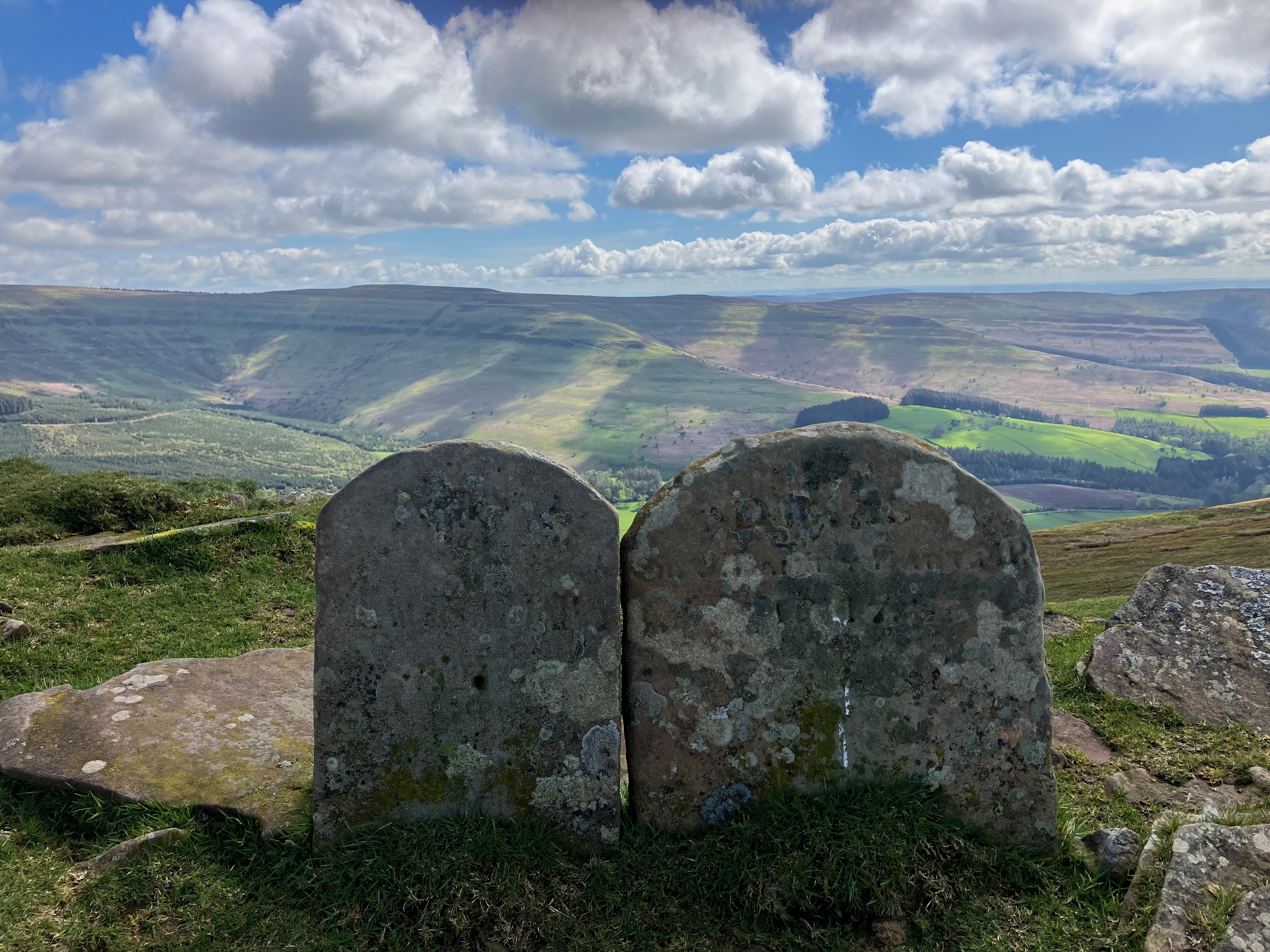
I stop off to eat my sandwich next to the boundary stones on the knoll near (but not on) the summit of Pen Twyn Glas, set there by the widow Mary Macnamara and Sir J. Bailey Bart, whose estates met at this point in the early to mid 19th Century. (See Graeme Adkin’s blog, ‘Black Mountains Walking’ at https://www.blackmountainswalking.co.uk/the-black-mountains-magic where he cites John Barber writing in The Beacon)
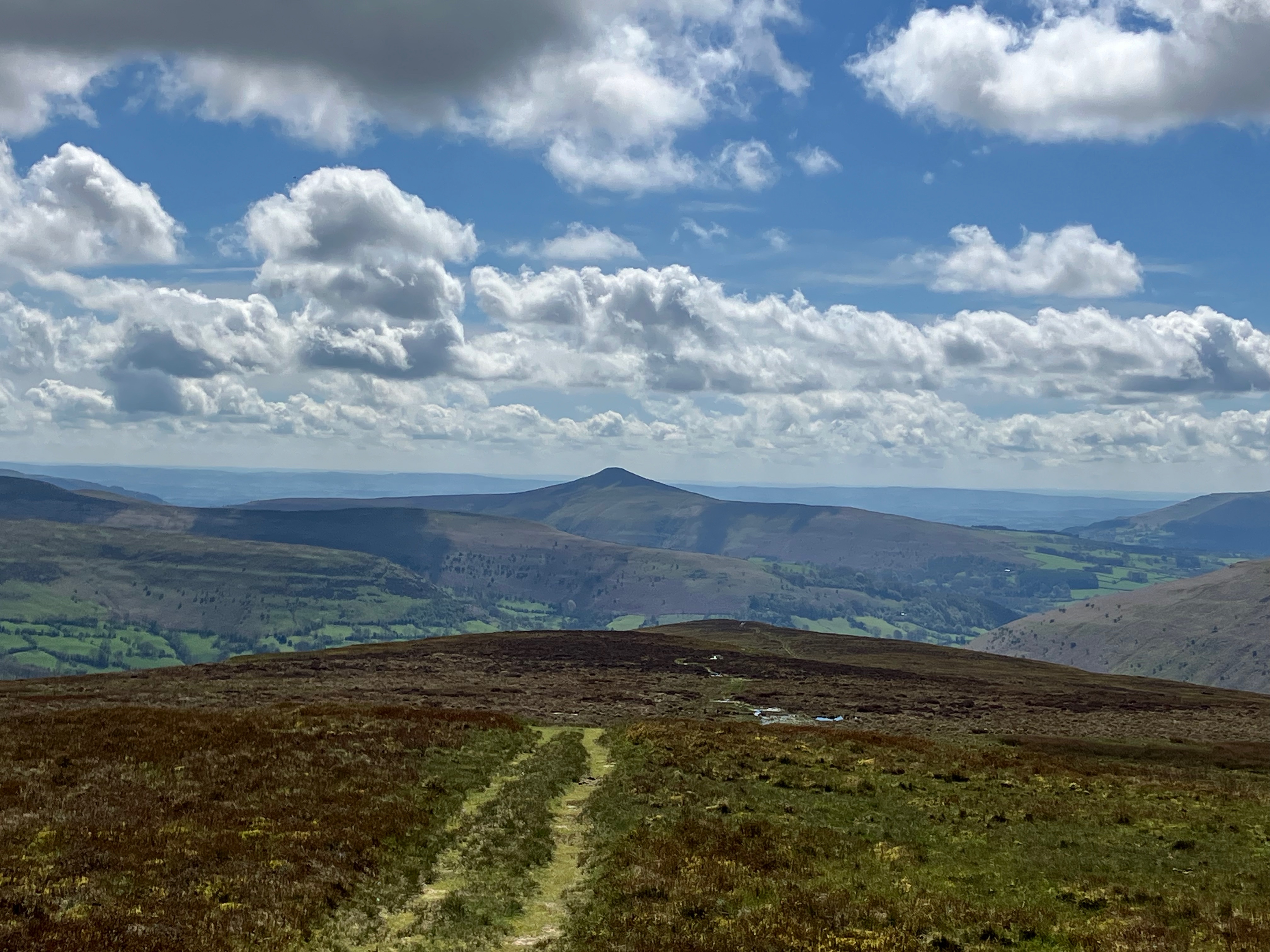
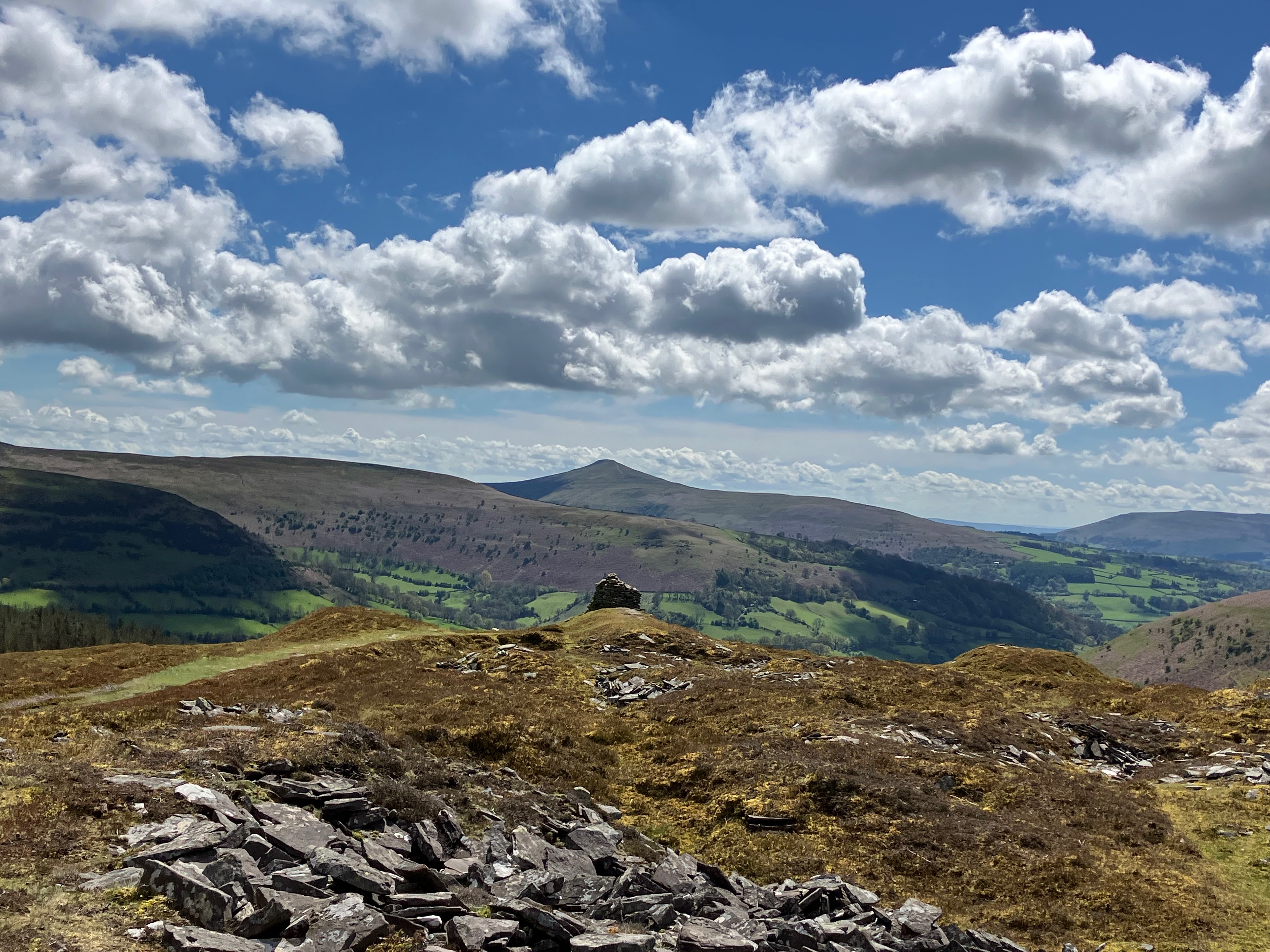
The descent from Pen Twyn Glas in the late morning sun is breathtaking, and there is the sublime joy of looking down over Cwm Banw to the right, and ahead to Pen y Fal. Quite why Cwm Banw and the Grwyne Fechan valley affect me in this way I cannot say, but I have an allegiance to the zone that feels arcane, ancestral, a thing of the blood. It is a passion I share with at least a few others. T.J. Morgan, a young University lecturer in Welsh, recalled his first visit to the Grwyne Fechan valley in January 1939, after a heavy snowfall, in tones of mystical reverence. The visit is recounted by his son, Prys Morgan, in the annual journal Brycheiniog and can be found in the back issues section, Volume 51 (2020) on pages 136-41.
‘He was immediately overwhelmed by the magical silence and beauty of Grwyne Fechan, all glittering in midday sunshine, and was humbled by a sense of awe. For the only time in his life, he felt part of something cosmic, filled with utter purity, a feeling of being part of a cosmos that was just being created and before the arrival of life’.
The purpose of Morgan’s trip to the valley was to track down and interview the last Welsh speakers. As his son writes:
‘There were five people in Grwyne Fechan who spoke Welsh, all over eighty, but none had spoken it to anybody else for many decades. The old man (John Williams y Felin) was astonished to hear Welsh from the lips of a young man; the language being something already belonging to the past.’
In the mid-19th century, we learn, all the families in Grwyne Fechan had been Welsh-speaking, apart from one family of Scots. Morgan managed to make a few recordings (notably of John Williams y Felin) but his plan to record all the octogenarians in the valley in 1939 was laid to rest by the outbreak of World War Two. The military commandeered all the BBC cables and private vehicles were to be taken off the roads. By the time the war had ended, six years later, all the elderly people in the Grwyne Fechan valley were dead.
Many of us have wondered what kind of Welsh was spoken by those last users of the language in the Black Mountains. The musician and writer Tom Morys, and his band Bob Delyn a’r Ebillion, have made poignant use of Morgan’s recording with their ballad Cân John Williams, which opens with the voice of Williams, as recorded in 1939. In a nice touch, Morys dedicated his song to the children at the new Welsh-medium school in Abergavenny, Ysgol Gymraeg Y Fenni. The voice echoes huskily across the chasm of the years, eliciting the sound of a remote rural community lost to time, but not to the imagination.


 Richard Gwyn
Thank you for this. It stirs many memories!
LikeLike