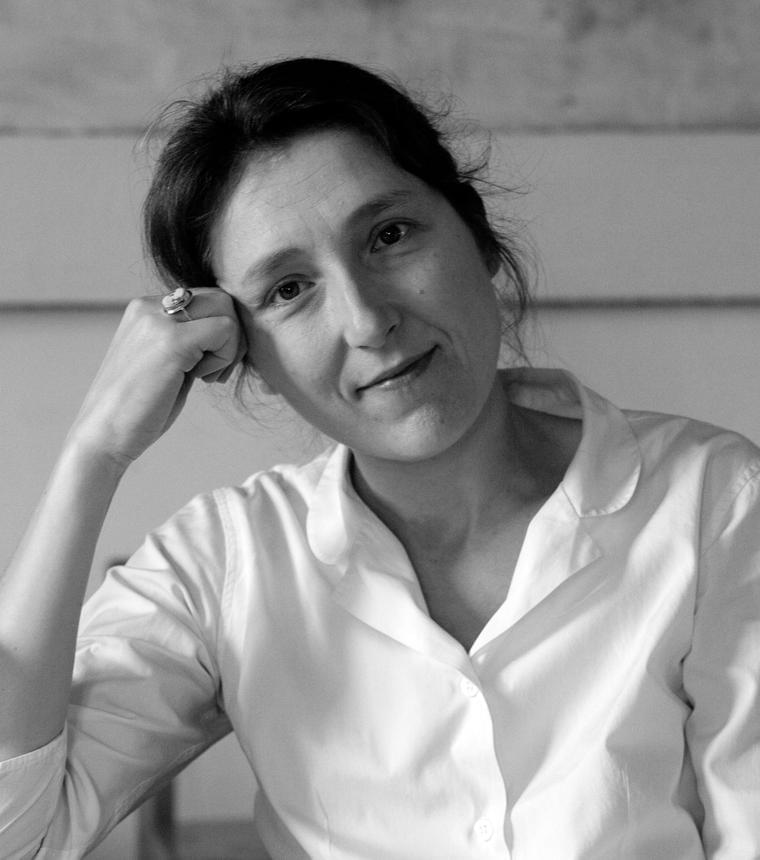
These words were cast before me by a triad of women writers, each of whom has had a significant influence on my thinking at one time or other: Marie Darrieussecq, Rebecca Solnit and Virginia Woolf.
Marie Darrieussecq opens the penultimate paragraph of Sleepless — her inspired, rambling study of insomnia — with a line from Virginia Woolf’s journal of January, 1915: ‘The future is dark, which is the best thing the future can be, I think.’
It is a sentence that has prompted a great deal of speculation over the years, including an essay by Rebecca Solnit, which Darrieussecq acknowledges in a footnote. But it was the first time I had come across the quotation, and I wondered at it, and wondered about it, and was pleased to find that I already had a copy of Solnit’s essay on the bookshelf next to my desk; but first I should recount what Darrieussecq has to say about the line, which was written in 1915 after Woolf had taken an overdose of veronal, a commonly prescribed barbiturate at the time. She locates that darkness, firstly, as seems proper, in Woolf’s own subjective experience; and then pans out, seeing the world that Woolf herself saw around her, but knowing — as Woolf did not know — that the horrors of World War One would continue for another three years, and would be followed by the global pandemic of Spanish Flu and, Darrieussecq reminds us, more years still of darkness, “if we count what will follow and what is simply the same sequence: ‘crisis’, fascism, war . . .” She completes her digression with a suggestion, or a remedy: “We can get through the shadows in the present, step by step. Do away with nostalgia for the future, the famous future of ‘progress’ that gleamed in my childhood, with its senseless promise of growth. Change the image of the future, even a tiny bit, shift ourselves ever so little, a small sidestep — that’s what literature is for. An enormous ambition, and yet a modest one — in order to wake up slightly different.”
And here is where I must pause, because of the shudder of recognition I felt with that line about progress, and what it means to Darrieussecq’s generation and my own and to most of the generations that have been born in recent centuries, at least since the idea of ‘progress’ became fashionable, some time in the Renaissance. And to link that notion with ‘darkness’ — now, in 2024 — seems interesting, to say the least. But then again, there is a lot we hold in common with the years immediately preceding World War One, not least of which is a profound and vague sense of impending catastrophe.
* * *
I have been reading, rather compulsively, everything I can find about the case of Lucy Letby, the neonatal nurse convicted of the murder of seven small babies, and of trying to murder six others. I started with the 13,000 word New Yorker article, which I accessed without difficulty since I am currently in Spain (it is impossible to access the article from the UK, except through VPN, as it has been subject to a special reporting restriction under the Contempt of Court Act). I mention this not out of any need to wilfully promote non-sequiturs but because the Letby case seems to me very relevant to a discussion about the future being dark, or darkness in general. For the parents of those dead babies the future has already been significantly darkened, and as for Lucy Letby, what could be darker than the prospect of a lifetime behind bars, with no possibility of reprieve, condemned not only to prison but subject to the hateful scrutiny of an entire nation? The murder of newborn babies might be seen as the most heinous of crimes, not simply on account of the innocence of the victims, but because throughout history human societies have regarded children as constituting the future, and consequently ‘hope for the future’. In a broken society, a society on its knees, with the remnants of a once proud Empire consigned to the refuse dump of history, with climate catastrophe at the doorstep, any sense of the future is fragile, to say the least, so the presumed murder of numerous infants takes on an especially tragic and symbolically laden aspect. The killer of children is a monster, murdering a future that is already of dubious status and therefore to kill small children is to kill the future twice over. Rather than concede that the cause of the infant deaths, horrible as they were, might reside, for example, with systematic failures in the administration of a hospital department within a health service on the verge of collapse, how much easier and more satisfying it is to point the finger at an individual, a single twisted individual, so cunning, it would seem, that she fails to possess any of the traits normally associated with serial killers, or even with expert actors, and appears to lead a normal, sociable life, popular with friends and loved by her parents. And how much simpler for the powerful men running the department of the hospital where she worked to blame an individual — a young woman, it should be emphasised — rather than concede that possibly, just possibly, the deaths might have been brought about by a combination of bad luck and errors of judgement in a neonatal department struggling with the pressures brought on by a chronic shortage of staff and funding . . .
Obviously I don’t know why those babies died, but it’s the uncertainty of the conviction that concerns me and many others. Certainly we don’t want to fall into the same trap as Lucy Letby’s accusers, and be overly assertive or accusatory, but we do need to look over the evidence again, with a better informed set of expert witnesses.
* * *
Let’s take another look.
“The future is dark, which is the best thing the future can be, I think,” Virginia Woolf wrote in her journal on January 18, 1915, when she was almost thirty-three years old and the First World War was beginning to turn into catastrophic slaughter on an unprecedented scale that would continue for years.”
So begins Solnit’s essay, ‘Woolf’s Darkness’. Solnit’s essay proceeds by locating Woolf within the context of her mental illness and the war, and declares that the sentence with which she opens “is an extraordinary declaration . . . a celebration of darkness, willing — as that “I think” indicates — to be uncertain even about its own assertion.”
Solnit goes on to remark on the associations we make with the dark and darkness. How many of us, especially children, fear the dark, and yet, at the same time, darkness forms “the same night in which love is made, in which things merge, change, become enchanted, aroused, impregnated, possessed, released, renewed.”’ We might add that as night falls, thoughts of death, our own death, are likely to emerge. We might even start thinking about death in the same moment, no, in the instant immediately preceding the moment in which we feel the desire to make love: the two things seem to be inseparable, as the ancients knew with the eternal dichotomy of Eros and Thanatos. But Solnit does not labour this point: instead she tells us how, when starting out on the essay we are now reading, she picked up a book on wilderness survival (suggesting, perhaps, that we often pick up books at exactly the right time) and found the following sentence: “The plan, a memory of the future, tries on reality to see if it fits.” This reminds her how, despite the warnings reality has to offer, we often dive into darkness, into oblivion, because we have made our minds up, we have made a plan, and we are prone to accommodating new information as simply confirming our pre-existing mental models. As she puts it: “under the influence of a plan, it’s easy to see what we want to see.” She quotes the book on wilderness survival (by Laurence Gonzales), which reports that “people tend to take any information as confirmation of their mental models” — which has a particular significance when we consider the Lucy Letby case, especially the evidence given by the consultant, Dr Ravi Jayaram who was the first to suggest that Letby might be a murderer. He described watching Letby as she stood by the end of the bed “doing nothing”, as blood oxgyen levels dipped but no monitor alarms sounded. Rather than allowing this moment of inaction to harbour other possibilities — thinking about what course of action to take being first among them — Letby’s inaction helped to confirm her as the murderer, presumably because the idea had already burrowed its way into the minds of her accusers, and of the jury, that she was to blame.
Solnit goes on to suggest that the darkness does not pertain merely to the future, but to the past as well. We cannot know exactly what happened in the past if we were not there, nor can we make authoritative claims about other cultures (and the past is another culture as well as another country). “Filling in the blanks replaces the truth that we don’t entirely know with the false sense that we do.” And “the language of bold assertion is simpler, less taxing, than the language of nuance and ambiguity and speculation.” (And how that sentence resonates when applied to the Lucy Letby case). Planning and the idea of the future (and planning out how the future should unfold) can cause an expectation in the present that may bear no resemblance to the way things actually happen, or happened in the past.
Perhaps there is not a lot more to be gleaned from Woolf’s enigmatic sentence (written, after all, in a private journal, where we often leave all kinds of half-formed and speculative sentences) other than the suggestion offered by Solnit that “we don’t know what will happen next, and that the unlikely and the unimaginable transpire quite regularly.” In this sense, ‘the future is dark’ does not seem such a daunting phrase. Perhaps (again) it simply means ‘the future is uncertain’. Both despair and optimism are grounds for non-action. From here it is an easy step to take (as Solnit does) and meet with John Keats walking home with some friends one night, for whom several things dove-tailed in (his) mind, and the phrase ‘Negative Capability’ came about, by which Keats meant when one “is capable of being in uncertainties, mysteries, doubts, without any irritable reaching after fact and reason.” In other words, life is not so much a problem to be solved, as a mystery to be experienced. It is significant too, in Solnit’s reading, that Keats’ discovery came out while walking, and that “wandering on foot can lead to the wandering of the imagination and to an understanding that is creation itself”, an assertion with which Woolf would no doubt have agreed, what with her own habit of wandering, made famous in such essays as “Street Haunting.”
And it is not only a wandering of the imagination that is prompted by such excursions, as Woolf makes clear in that same essay. In the evening hour, especially, the time that the French call l’heure bleue, we are granted a certain irresponsibility, a gift bestowed by darkness and lamplight, with the result that “we are no longer quite ourselves.”
Much of the rest of the essay is given over to various instances of Woolf stating that she doesn’t know things. At one point Solnit remarks: “By now you’ve noticed that Woolf says ‘I don’t know’ quite a lot.” But in that not knowing there is a great deal of wisdom, and that, I think, is the point.
That, and a kind of enthusiastic acceptance that there is always more to things than meets the eye, even if we do not know precisely what: “All Woolf’s work as I know it constitutes a sort of Ovidian metamorphosis where the freedom sought is the freedom to continue becoming, exploring, wandering, going beyond.” The catastrophe of climate change, the destruction of our Earth are due, in large part, to a failure of the imagination. Solnit’s plea is that we pay attention to what matters even if it cannot be seen, and that we become “producers rather than consumers of meaning, of the slow, of the meandering, the digressive, the exploratory, the numinous, the uncertain.”
And here, where darkness lies, the future opens up before us.
Let us hope, too, that Lucy Letby is given another chance to assert her innocence. The notion that she might have been wrongly convicted, and endured the most horrendous hate campaign in living memory, is awful beyond words, and a retrial is the very least that can be provided if there is even the slightest possibility that she might be innocent.


This is rich in thought. I’m fascinated with the links you have woven into each other. I’m saving this to read again. Meanwhile I’ll look at “the future is dark” with positive eyes, and work on opening up my compartmentalised mind. Thank you.
LikeLike
Thanks. At the moment it’s more like a series of loosely connected thoughts, but it’s good to have some positive feedback. Take care.
LikeLike
Pingback: Illustrious insomniacs: 4.00 o'clock or whatever time in the morning - Richard Gwyn