On 3rd December, 2024, I will be launching a Substack blog under this title.
I have been compiling Ricardo Blanco’s Blog since July 2011 and think that it’s time for a change. Which is where Raids on the Underworld comes in.
In the new blog I will be considering the craft of writing, and the ways in which writers make use of their own experiences to nourish their writing. But I will also be delving into mythology, and exploring notions such as alchemy, the latent power of objects, and synchronicity or objective chance, all of which might serve as resources for the writer (or the reader).
And I will also be posting random pieces to do with everyday life (especially walking in Wales and Catalunya), my travels, history, the world of fleeting shadows, reports from the hall of mirrors and much else besides. Though probably not a lot about shopping. Or contemporary politics. Or sport.
Everyone who is subscribed to Ricardo Blanco’s Blog – around 500 of you – will be re-subscribed to Raids on the Underworld, and will automatically receive an email with the first post. This blog will be free of charge, though after a few weeks there will probably be the option to pay a subscription for additional material.
If you do not wish to receive posts from this account, you can unsubscribe when you get the first email.
But I hope you don’t. If you enjoyed Ricardo Blanco’s Blog, the chances are you will like Raids from the Underworld.
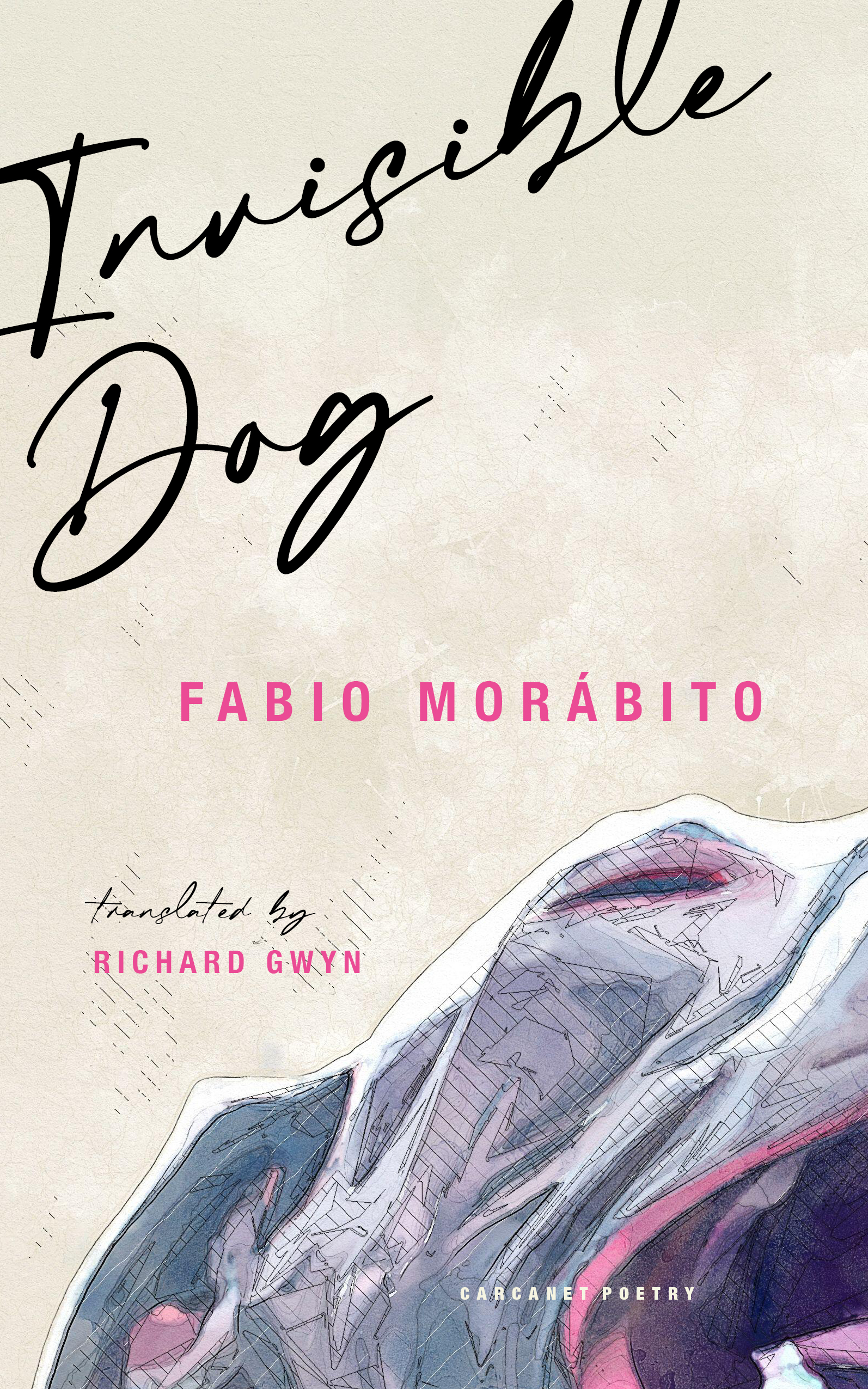
This month sees the publication of my latest book of translations, Invisible Dog, by the Mexican poet Fabio Morábito.
Many thanks to the team at Carcanet for their work in producing this handsome volume.
We did an online launch on 6 November, hosted by the excellent Curtis Bauer, and featuring the poet himself — and I did a short video for Carcanet in which I talked about the translation process, which can be viewed here. But best of all, those wishing to hear some of the poems might wish to come along to Little Man in Cardiff, at 18.30 on Tuesday 3rd December, where I will be doing a reading, with the support and collaboration of the wonderful Christina Thatcher.
To whet the appetite, I will leave you with a trio of poems from the collection, in their English translations, with the Spanish below:
To get to Puebla

So many years without knowing how to get to Puebla,
which junction of which artery you have to take
to get to Puebla,
only two hours distant!
People go to Puebla and return
the same day,
I myself have been to Puebla
(who hasn’t been to Puebla?)
and so many years without knowing how to get there!

Show me how to get to Puebla,
which is two hours distant,
and to believe in God,
who is so close that He can be reached
and returned from the same day.
I myself have believed in God
(who hasn’t believed in God?)
The same thing happens with Him as with Puebla,
I don’t know which junction of which artery to take.

What has become of my life
that I haven’t learned what everyone knows:
to speak with God and to visit and return from Puebla the same day?
I only know the road to Cuernavaca,
that’s the only way I know to leave this city.

Show me the road to Puebla,
show me how to leave, to believe, to go
and return the same day.


I haven’t loved

I haven’t loved chairs enough.
I’ve always turned
my back on them
and can hardly tell
one from the other
or remember them.
I clean those in my house
without paying attention
and only with an effort can I
bring to mind
certain chairs of my childhood,
ordinary wooden chairs
that were in the dining room
and which, when the dining room was renovated,
furnished the kitchen.
Ordinary wooden chairs,
although you never arrive at
the true simplicity
of a chair,
you can impoverish
the most modest chair,
always remove an angle,
a curve,
you never get to the archetype
of the chair.
I haven’t loved
almost anything
enough,
to notice what is really there
requires an assiduous connection,
I never pick up anything on the fly,
I let the friction of the moment
pass, I withdraw,
only when I immerse myself in something do I exist
and at times it’s already pointless,
the truth has gone to the bottom of
the most prosaic pit.
I have stifled too many things
to see them,
I have stifled the shine of a thing
believing it to be an ornament,
and when seduced
by the simplest things,
my love of depth
has hindered me.


Invisible dog

I have an invisible dog,
I carry a quadruped inside me
that I let out in the park
just as others do with their dogs.
When I bend down
to let him go free,
to play and run,
the other dogs chase him,
only their owners don't see him,
maybe they don't see me either.
It happens more and more with every outing
the other dogs get worked up into a state
and among the owners a disquiet grows
and they call their dogs
to prevent a pack from forming.
Maybe they don’t see me either,
sitting on a bench,
doubled over a little
with the effort of letting him go free,
and although they can’t see him,
perhaps they do see the dog
they carry inside,
invisible like my own,
the beast they never release,
the dog that they repress
while taking their dogs for a walk.
Para llegar a Puebla

¡Tantos años sin saber ir a Puebla,
a qué altura de qué arteria hay que salir
para llegar a Puebla,
que está a dos horas!
La gente va a Puebla y regresa
el mismo día,
yo mismo he estado en Puebla
(¿quién no ha estado en Puebla?),
¡y tantos años sin saber cómo ir!

Enséñenme a ir a Puebla,
que está a dos horas,
y a creer en Dios,
que está tan cerca, que se llega a Dios
y se regresa de Dios el mismo día.
Yo mismo he creído en Dios
(¿quién no ha creído en Dios?).
Me pasa con Él lo mismo que con Puebla,
no sé a qué altura de qué arteria hay que salir.

¿Qué ha sido de mi vida
si no he aprendido lo que todos saben:
hablarle a Dios e ir y volver de Puebla el mismo día?
Yo solo sé el camino a Cuernavaca,
es todo lo que sé para salir de esta ciudad.

Enséñenme el camino a Puebla,
enséñenme a salir, a creer, a ir
y regresar el mismo día.


No he amado

No he amado bastante
las sillas.
Les he dado siempre
la espalda
y apenas las distingo
o las recuerdo.
Limpio las de mi casa
sin fijarme
y solo con esfuerzo puedo
vislumbrar
algunas sillas de mi infancia,
normales sillas de madera
que estaban en la sala
y, cuando se renovó la sala,
fueron a dar a la cocina.
Normales sillas de madera,
aunque jamás
se llega a lo más simple
de una silla,
se puede empobrecer
la silla más modesta,
quitar siempre un ángulo,
una curva,
nunca se llega al arquetipo
de la silla.
No he amado bastante
casi nada,
para enterarme necesito
un trato asiduo,
nunca recojo nada al vuelo,
dejo pasar la encrespadura
del momento, me retiro,
solo si me sumerjo en algo existo
y a veces ya es inútil,
se ha ido la verdad al fondo
más prosaico.
He amortiguado demasiadas
cosas para verlas,
He amortiguado el brillo
creyéndolo un ornato,
y cuando me he dejado seducir
por lo más simple,
mi amor a la profundidad
me ha entorpecido.


Un perro invisible

Tengo un perro invisible,
llevo un cuadrúpedo por dentro
que saco al parque
como los otros a sus perros.
Los otros perros,
cuando al doblarme
lo dejo en libertad
para que juegue y corra, lo persiguen,
sólo sus dueños no lo ven,
tal vez tampoco a mí me vean.
Se ha ido dando a fuerza de paseos,
anima e inquieta a la perrada
y entre los dueños cunde la inquietud
y llaman a sus perros
para que no se forme la jauría.
Tal vez tampoco a mí me vean,
sentado en una banca,
doblado un poco
por el esfuerzo de dejarlo libre,
y aunque no pueden verlo,
tal vez sí ven al perro
que invisible, como el mío,
llevan dentro,
la bestia que no sacan nunca,
el perro que reprimen
llevando de paseo a sus perros.
Two more things emerged from stirring the 4.00 a.m. pot, an unsought consequence of which. last night, was a long bout of sleeplessness and some scribbled notes. A couple of these will serve as an addendum to yesterday’s piece.
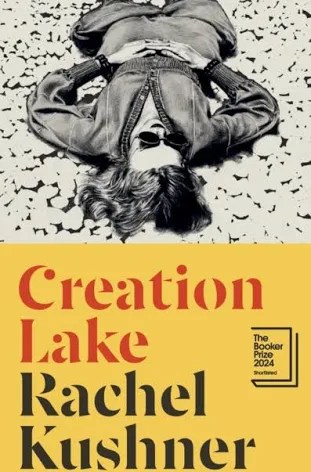
The first comes from Rachel Kushner in her new, Booker short-listed novel, Creation Lake.
At one point in her story (p. 209) Kushner’s narrator, Sadie Smith — an undercover agent provoking disruption at a protest by eco-activists in southern France — pauses to reflect on the notion of identity:
‘It is natural to attempt to reinforce identity, given how fragile people are underneath these identities they present to the world as “themselves.” Their stridencies are fragile, while their need to protect their ego, and what forms the ego, is strong.’
Her conclusions are striking:
‘People might claim to believe in this or that, but in the four a.m. version of themselves, most possess no fixed idea on how society should be organised. When people face themselves, alone, the passions they have been busy performing all day, and that they rely on to reassure themselves that they are who they claim to be, to measure their milieu of the same, those things fall away.
What is it people encounter in their stark and solitary four a.m. self? What is inside them?
Not politics. There are no politics inside of people.
The truth of a person, under all the layers and guises, the significance of group and type, the quiet truth, underneath the noise of opinions and “beliefs,” is a substance that is pure and stubborn and consistent. It is a hard, white salt.
This salt is the core. The four a.m. reality of being.’
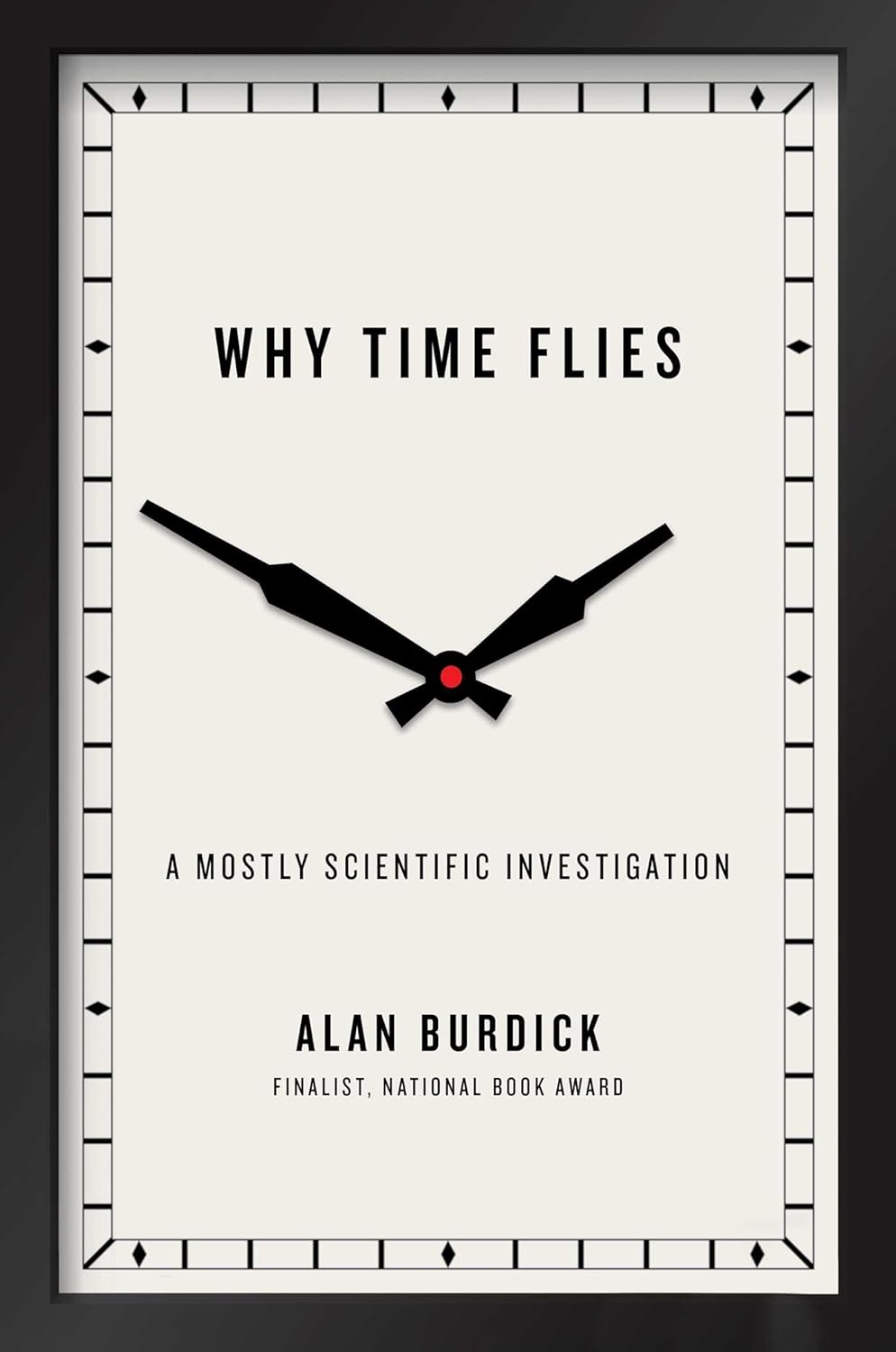
The second piece of feedback from the universe came in the form of an article inThe New Yorker, by Alan Burdick, writing in 2016. Burdick is also the author of the book Why Time Flies: A Mostly Scientific Investigation. In the extract that interests me, he is commenting on the uncanny way in which the seasoned insomniac — or anyone prone to sleep disruption — somehow knows what time it is when they awaken at night. Sometimes, or rather, often, to the precise minute. How does that work?
For Burdick, ‘it is always 4.00 a.m., or 4.10 a.m., or once, for a disconcerting stretch of days, 4.27.a.m.’ He quotes Proust, that maestro of insomnia, who wrote: ‘When a man is asleep, he has in a circle around him the chain of the hours, the sequence of the years, the order of the heavenly bodies. Instinctively he consults them when he awakes, and in an instant reads off his own position on the earth’s surface and the time that has elapsed during his slumbers.’
But, beyond the poetry of the heavenly bodies and our own instinct, just why do we awaken so consistently at precisely the same time?
Burdick, writing of his own case, says: ‘It may . . . be a simple matter of induction: it was 4.27 a.m. when I last woke at whatever hour this is, so that’s what time it is now. The surprise is that I can be so consistent. William James wrote, “All my life I have been struck by the accuracy with which I will wake at the same exact minute night after night and morning after morning.” Most likely it’s the work of the circadian clocks, which, embedded in the DNA of my every cell, regulate my physiology over a twenty-four hour period. At 4.27 a.m., I’m most aware of being at the service of something; there is a machine in me, or I am a ghost in it.’
Beyond that, it’s difficult, or even pointless to hypothesise. I continue to wake at precisely the same time for a stretch, until I don’t. And then, of course, whenever I notice it’s that time again — 3.45 in my case — I make a mental note of it, as if acknowledging someone we pass at the same place each day on the way into work, but never get to know.
It sometimes happens that, as soon as I decide to write about something, the universe sends me little pointers and reminders, as if to corroborate the idea. Call it serendipity or call it synchronicity; whenever an idea looks like having legs it will start to attract some kind of corroboration in the things I read or see or hear around and about me. No less a person than Goethe commented on this when he wrote that once one commits oneself throughly to a task, then Providence moves too: ‘All sorts of things occur to help one that would have never otherwise have occurred. A whole stream of events issues from the decision, raising in one’s favour all manner of unforeseen incidents, meetings, and material assistance which no man could have dreamed would have come his way.’
And if by chance Providence doesn’t move in my favour, I tend to forget about it, or rather, having committed myself to a certain kind of magical thinking, and not receiving any feedback from the universe (or Providence) I give up and choose another tack.
But 4.00 a.m. has proved a kind of anti-beacon, a proper misery magnet. Almost everyone has something to say about it; everyone, that is, who happens to be an insomniac. Because for insomniacs, 4.00 a.m. is Prime Time.
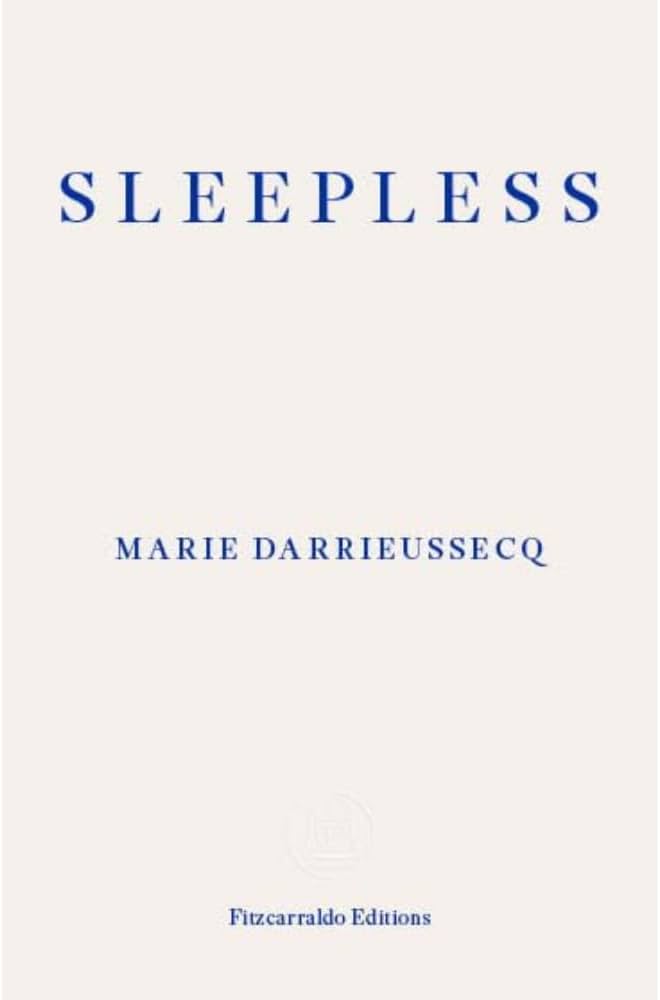
A quick scan of the literature supports this idea, and where better to begin than Marie Darrieussecq’s wonderful book, Sleepless, which I have mentioned before in these pages. In fact, a section of Sleepless is titled FOUR O’CLOCK OR WHATEVER TIME IN THE MORNING, which I have appropriated for this piece also.
The first insomniac on the guest list is Kafka, suffering ‘agonies in bed towards morning. Saw only solution in jumping out of the window’, swiftly followed by the ‘career insomniac’ Emil Cioran, whose notebooks contain similarly suicidal ideation: ‘Shocking night, At four in the morning I was more awake than in broad daylight. Thought about Celan. It must have been on a night like this when he suddenly decided to end it.’
Like a slow train chugging towards its unknown destination on a night of fog and rain, Marie Darrieussecq counts us down to zero hour: ’Two o’clock, three o’clock, four o’clock. Insomnia without end.’
Marguerite Dumas, another elite member of the literary insomniac gang (and an alcoholic whose routine intake of vin rouge in her heyday was seven bottles per diem) adds her piece: ‘During serious bouts of insomnia, one says to oneself: “If I died this instant, what a relief that would be.”’ And the worst time, she writes, ‘is around three or four in the morning.’ Christian Oser, meanwhile, muses that ‘to die at four in the morning, in the discomfort of insomnia, constitutes a form of temptation, the hope of bailing out and coming to terms with silence.’
There is, writes MD, no end to this four in the morning literature. F. Scott Fitzgerald, another insomniac (and another drunk — many of the most illustrious insomniacs have also been addicts of some kind) puts in his tuppence worth: ‘What if this night prefigured the night after death . . . I am a ghost now as the clock chimes four.’
And as for music . . . in one of those instances of serendipity that I referred to at the start when the 4.00 a.m. idea was only a twinkle in my eye, someone played a recording of Mike Oldfield’s 1983 song Moonlight Shadow (performed by Maggie Reilly) which contains the tautology ‘Four a.m. in the morning’ (when else would it be?) . . . except 4.00 a.m. isn’t exactly the morning, it’s more of an island in time, a non-place, but a place visited, or rather squatted, by innumerable insomniacs. And another musical reference is, of course, the opening of Leonard Cohen’s Famous Blue Raincoat: ‘It’s four in the morning, the end of December, I’m writing you now just to see if you’re better . . . ’, a song that accompanied me on my most tormented nights as an angst-struck teen.
In my novel The Blue Tent, the insomniac narrator is visited in his library at precisely a quarter to four by his mysterious house-guest, Alice. This specificity, I may as well confess, came about because at the time I was working on the story I was prone to waking at exactly 3.45 myself, and I wondered whether by turning it into fiction, it might stop happening (it did). Magical thinking in action.
These words were cast before me by a triad of women writers, each of whom has had a significant influence on my thinking at one time or other: Marie Darrieussecq, Rebecca Solnit and Virginia Woolf.
Marie Darrieussecq opens the penultimate paragraph of Sleepless — her inspired, rambling study of insomnia — with a line from Virginia Woolf’s journal of January, 1915: ‘The future is dark, which is the best thing the future can be, I think.’
It is a sentence that has prompted a great deal of speculation over the years, including an essay by Rebecca Solnit, which Darrieussecq acknowledges in a footnote. But it was the first time I had come across the quotation, and I wondered at it, and wondered about it, and was pleased to find that I already had a copy of Solnit’s essay on the bookshelf next to my desk; but first I should recount what Darrieussecq has to say about the line, which was written in 1915 after Woolf had taken an overdose of veronal, a commonly prescribed barbiturate at the time. She locates that darkness, firstly, as seems proper, in Woolf’s own subjective experience; and then pans out, seeing the world that Woolf herself saw around her, but knowing — as Woolf did not know — that the horrors of World War One would continue for another three years, and would be followed by the global pandemic of Spanish Flu and, Darrieussecq reminds us, more years still of darkness, “if we count what will follow and what is simply the same sequence: ‘crisis’, fascism, war . . .” She completes her digression with a suggestion, or a remedy: “We can get through the shadows in the present, step by step. Do away with nostalgia for the future, the famous future of ‘progress’ that gleamed in my childhood, with its senseless promise of growth. Change the image of the future, even a tiny bit, shift ourselves ever so little, a small sidestep — that’s what literature is for. An enormous ambition, and yet a modest one — in order to wake up slightly different.”
And here is where I must pause, because of the shudder of recognition I felt with that line about progress, and what it means to Darrieussecq’s generation and my own and to most of the generations that have been born in recent centuries, at least since the idea of ‘progress’ became fashionable, some time in the Renaissance. And to link that notion with ‘darkness’ — now, in 2024 — seems interesting, to say the least. But then again, there is a lot we hold in common with the years immediately preceding World War One, not least of which is a profound and vague sense of impending catastrophe.
* * *
I have been reading, rather compulsively, everything I can find about the case of Lucy Letby, the neonatal nurse convicted of the murder of seven small babies, and of trying to murder six others. I started with the 13,000 word New Yorker article, which I accessed without difficulty since I am currently in Spain (it is impossible to access the article from the UK, except through VPN, as it has been subject to a special reporting restriction under the Contempt of Court Act). I mention this not out of any need to wilfully promote non-sequiturs but because the Letby case seems to me very relevant to a discussion about the future being dark, or darkness in general. For the parents of those dead babies the future has already been significantly darkened, and as for Lucy Letby, what could be darker than the prospect of a lifetime behind bars, with no possibility of reprieve, condemned not only to prison but subject to the hateful scrutiny of an entire nation? The murder of newborn babies might be seen as the most heinous of crimes, not simply on account of the innocence of the victims, but because throughout history human societies have regarded children as constituting the future, and consequently ‘hope for the future’. In a broken society, a society on its knees, with the remnants of a once proud Empire consigned to the refuse dump of history, with climate catastrophe at the doorstep, any sense of the future is fragile, to say the least, so the presumed murder of numerous infants takes on an especially tragic and symbolically laden aspect. The killer of children is a monster, murdering a future that is already of dubious status and therefore to kill small children is to kill the future twice over. Rather than concede that the cause of the infant deaths, horrible as they were, might reside, for example, with systematic failures in the administration of a hospital department within a health service on the verge of collapse, how much easier and more satisfying it is to point the finger at an individual, a single twisted individual, so cunning, it would seem, that she fails to possess any of the traits normally associated with serial killers, or even with expert actors, and appears to lead a normal, sociable life, popular with friends and loved by her parents. And how much simpler for the powerful men running the department of the hospital where she worked to blame an individual — a young woman, it should be emphasised — rather than concede that possibly, just possibly, the deaths might have been brought about by a combination of bad luck and errors of judgement in a neonatal department struggling with the pressures brought on by a chronic shortage of staff and funding . . .
Obviously I don’t know why those babies died, but it’s the uncertainty of the conviction that concerns me and many others. Certainly we don’t want to fall into the same trap as Lucy Letby’s accusers, and be overly assertive or accusatory, but we do need to look over the evidence again, with a better informed set of expert witnesses.
* * *
Let’s take another look.
“The future is dark, which is the best thing the future can be, I think,” Virginia Woolf wrote in her journal on January 18, 1915, when she was almost thirty-three years old and the First World War was beginning to turn into catastrophic slaughter on an unprecedented scale that would continue for years.”
So begins Solnit’s essay, ‘Woolf’s Darkness’. Solnit’s essay proceeds by locating Woolf within the context of her mental illness and the war, and declares that the sentence with which she opens “is an extraordinary declaration . . . a celebration of darkness, willing — as that “I think” indicates — to be uncertain even about its own assertion.”
Solnit goes on to remark on the associations we make with the dark and darkness. How many of us, especially children, fear the dark, and yet, at the same time, darkness forms “the same night in which love is made, in which things merge, change, become enchanted, aroused, impregnated, possessed, released, renewed.”’ We might add that as night falls, thoughts of death, our own death, are likely to emerge. We might even start thinking about death in the same moment, no, in the instant immediately preceding the moment in which we feel the desire to make love: the two things seem to be inseparable, as the ancients knew with the eternal dichotomy of Eros and Thanatos. But Solnit does not labour this point: instead she tells us how, when starting out on the essay we are now reading, she picked up a book on wilderness survival (suggesting, perhaps, that we often pick up books at exactly the right time) and found the following sentence: “The plan, a memory of the future, tries on reality to see if it fits.” This reminds her how, despite the warnings reality has to offer, we often dive into darkness, into oblivion, because we have made our minds up, we have made a plan, and we are prone to accommodating new information as simply confirming our pre-existing mental models. As she puts it: “under the influence of a plan, it’s easy to see what we want to see.” She quotes the book on wilderness survival (by Laurence Gonzales), which reports that “people tend to take any information as confirmation of their mental models” — which has a particular significance when we consider the Lucy Letby case, especially the evidence given by the consultant, Dr Ravi Jayaram who was the first to suggest that Letby might be a murderer. He described watching Letby as she stood by the end of the bed “doing nothing”, as blood oxgyen levels dipped but no monitor alarms sounded. Rather than allowing this moment of inaction to harbour other possibilities — thinking about what course of action to take being first among them — Letby’s inaction helped to confirm her as the murderer, presumably because the idea had already burrowed its way into the minds of her accusers, and of the jury, that she was to blame.
Solnit goes on to suggest that the darkness does not pertain merely to the future, but to the past as well. We cannot know exactly what happened in the past if we were not there, nor can we make authoritative claims about other cultures (and the past is another culture as well as another country). “Filling in the blanks replaces the truth that we don’t entirely know with the false sense that we do.” And “the language of bold assertion is simpler, less taxing, than the language of nuance and ambiguity and speculation.” (And how that sentence resonates when applied to the Lucy Letby case). Planning and the idea of the future (and planning out how the future should unfold) can cause an expectation in the present that may bear no resemblance to the way things actually happen, or happened in the past.
Perhaps there is not a lot more to be gleaned from Woolf’s enigmatic sentence (written, after all, in a private journal, where we often leave all kinds of half-formed and speculative sentences) other than the suggestion offered by Solnit that “we don’t know what will happen next, and that the unlikely and the unimaginable transpire quite regularly.” In this sense, ‘the future is dark’ does not seem such a daunting phrase. Perhaps (again) it simply means ‘the future is uncertain’. Both despair and optimism are grounds for non-action. From here it is an easy step to take (as Solnit does) and meet with John Keats walking home with some friends one night, for whom several things dove-tailed in (his) mind, and the phrase ‘Negative Capability’ came about, by which Keats meant when one “is capable of being in uncertainties, mysteries, doubts, without any irritable reaching after fact and reason.” In other words, life is not so much a problem to be solved, as a mystery to be experienced. It is significant too, in Solnit’s reading, that Keats’ discovery came out while walking, and that “wandering on foot can lead to the wandering of the imagination and to an understanding that is creation itself”, an assertion with which Woolf would no doubt have agreed, what with her own habit of wandering, made famous in such essays as “Street Haunting.”
And it is not only a wandering of the imagination that is prompted by such excursions, as Woolf makes clear in that same essay. In the evening hour, especially, the time that the French call l’heure bleue, we are granted a certain irresponsibility, a gift bestowed by darkness and lamplight, with the result that “we are no longer quite ourselves.”
Much of the rest of the essay is given over to various instances of Woolf stating that she doesn’t know things. At one point Solnit remarks: “By now you’ve noticed that Woolf says ‘I don’t know’ quite a lot.” But in that not knowing there is a great deal of wisdom, and that, I think, is the point.
That, and a kind of enthusiastic acceptance that there is always more to things than meets the eye, even if we do not know precisely what: “All Woolf’s work as I know it constitutes a sort of Ovidian metamorphosis where the freedom sought is the freedom to continue becoming, exploring, wandering, going beyond.” The catastrophe of climate change, the destruction of our Earth are due, in large part, to a failure of the imagination. Solnit’s plea is that we pay attention to what matters even if it cannot be seen, and that we become “producers rather than consumers of meaning, of the slow, of the meandering, the digressive, the exploratory, the numinous, the uncertain.”
And here, where darkness lies, the future opens up before us.
Let us hope, too, that Lucy Letby is given another chance to assert her innocence. The notion that she might have been wrongly convicted, and endured the most horrendous hate campaign in living memory, is awful beyond words, and a retrial is the very least that can be provided if there is even the slightest possibility that she might be innocent.
We are moving, after nearly 30 years in our family home. We are sad to leave the old place but also joyful to have so many memories of good times spent together. And at least we have a new house to go to, which is not yet a home, but will become so.
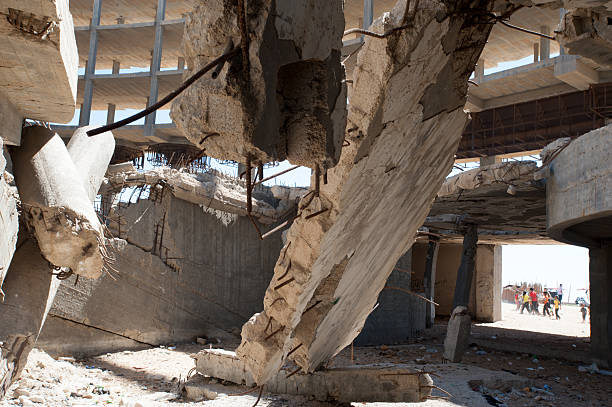
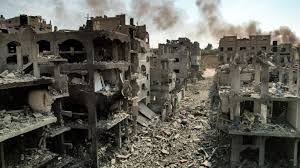
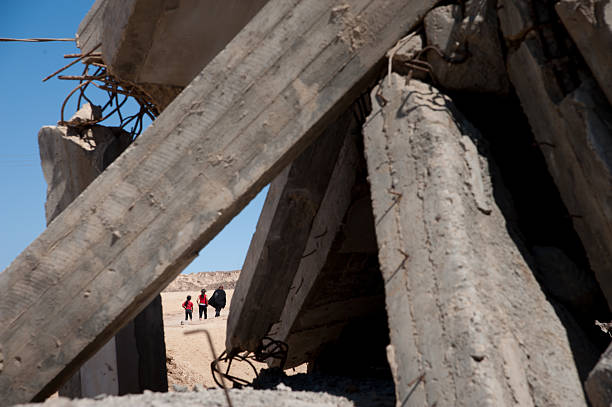
And all this time we have been packing our belongings into large cardboard boxes for the removals company to pack away in their truck and deliver to the new place, we have been witness to the images of devastation and misery in Gaza, imposed by a ruthless policy of state terrorism on the part of Israel, of annihilation and the murder of innocents.
We have a new house to go to, which will become a home, but for the 1.7 million displaced Palestinians, there is nowhere safe to go, and no homes to return to, because their homes have been blasted out of the ground, reduced to rubble; and often, beneath that rubble, lie the remains of those they loved, and of all the things that these people held precious and that gave their lives meaning.
We can pack up our belongings in an orderly way, have them delivered safely to our new house, which will become a home, but for the 1.7 million displaced Palestinians, there is nowhere safe to go. There is no home to return to. Their homes have been destroyed by bombs.
I reflect on the unbearable onrush of images on the television, those images that too easily become meaningless in their sameness: the wrecked block of flats, the traumatised children sitting wide-eyed, staring out at nothing, clutching a toy or a doll. These images will be the abiding memory of departure, along with our inability to do anything to stop it. They call it a war, but a war usually involves two factions (at least) fighting each other. On those terms, this is hardly a war, more like an all-out assault on a civilian population, a massacre of the unarmed innocents who have been ordered to evacuate to ‘safe’ places that are anything but safe. It is a wholesale destruction, an annihilation; yes, a genocide. Not a war, as such. Which is presumably why Al Jazeera refers to the conflict as the ‘War on Gaza’ rather than the ‘War in Gaza’.
So, as we prepare to leave one house and move to another, I must also reflect on our good fortune in having the freedom to move when and where we want, to be close to the ones we love without worrying whether we shall see them in the morning.
But I am also troubled by guilt, survivor guilt, I suppose it is, even though I was not there, am not there, because in an endlessly recursive series of What Ifs, all of this could have been prevented, and all those people need not have died. And in this, perhaps, we are all responsible, all complicit, because at some level, just within the bounds of comprehension, what happens to one murdered child in Palestine happens not only to that child but to all children, everywhere.
I will end this post with a poem written by the Palestinian-American poet Naomi Shihab Nye. By speaking simply of kindness, it evokes more than I could ever hope to say.
Kindness
Naomi Shihab Nye
Before you know what kindness really is you must lose things, feel the future dissolve in a moment like salt in a weakened broth. What you held in your hand, what you counted and carefully saved, all this must go so you know how desolate the landscape can be between the regions of kindness. How you ride and ride thinking the bus will never stop, the passengers eating maize and chicken will stare out the window forever.
Before you learn the tender gravity of kindness you must travel where the Indian in a white poncho lies dead by the side of the road. You must see how this could be you, how he too was someone who journeyed through the night with plans and the simple breath that kept him alive.
Before you know kindness as the deepest thing inside, you must know sorrow as the other deepest thing. You must wake up with sorrow. You must speak to it till your voice catches the thread of all sorrows and you see the size of the cloth. Then it is only kindness that makes sense anymore, only kindness that ties your shoes and sends you out into the day to gaze at bread, only kindness that raises its head from the crowd of the world to say It is I you have been looking for, and then goes with you everywhere like a shadow or a friend.
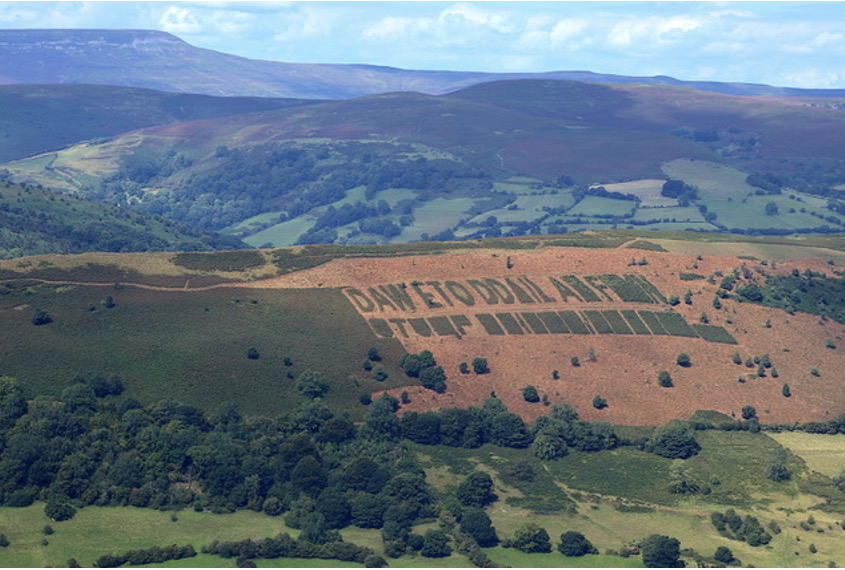
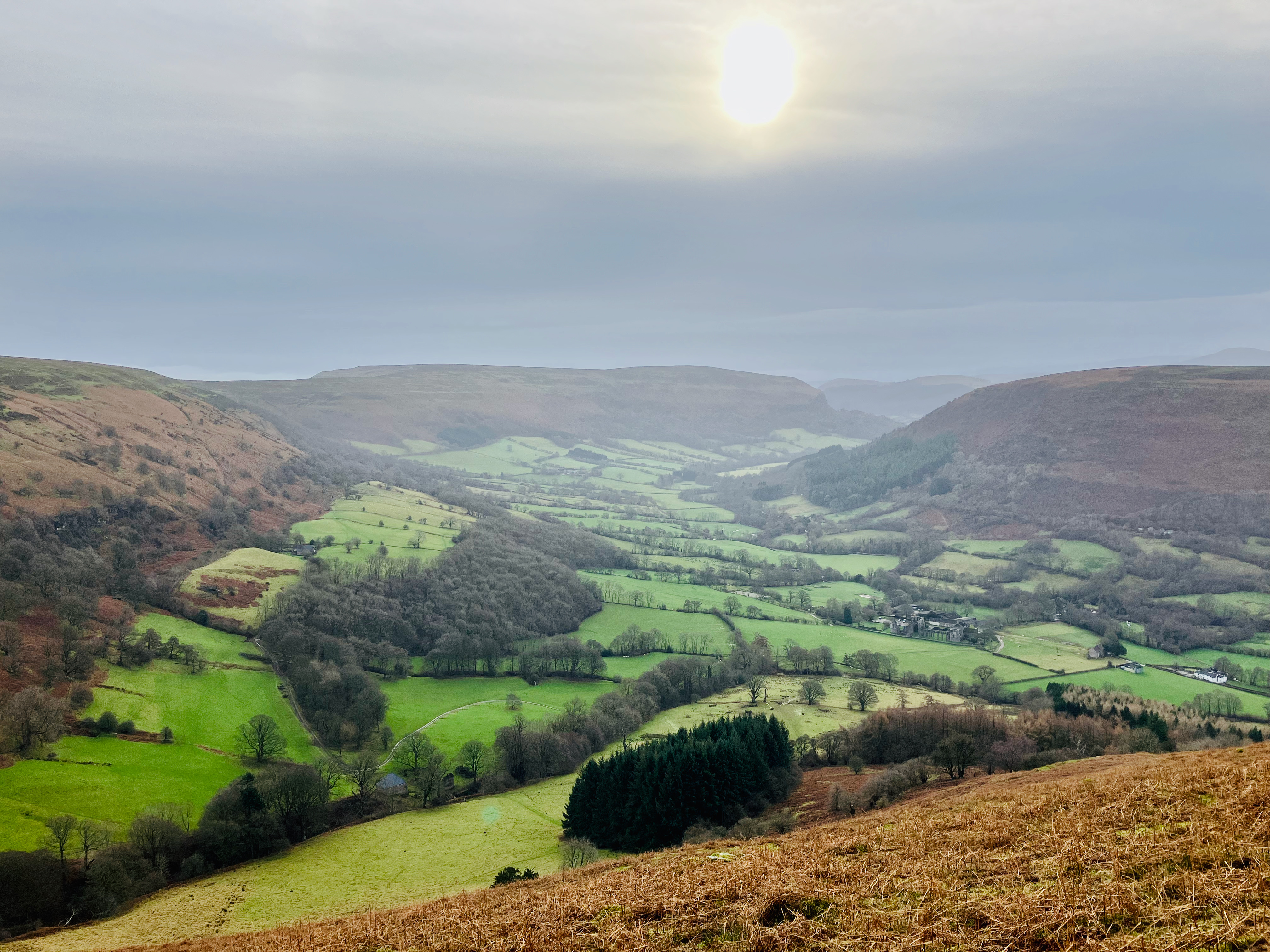
I have driven past Bryn Arw countless times on my way to the Vale of Ewyas and Llantony, but only became aware of it as a separate entity about three years ago when a graffito appeared on the hillside, carved, as it were, into the ferns: ‘Daw eto ddail ar fryn’ — which means ‘There will be leaves on the hill again.’ The line is a play on words, intentionally mis-quoting a line of poetry popular across Wales during lockdown – ‘Daw eto haul ar fryn’, meaning ‘There will be sunshine on the hill again’. The words were carved into the hillside by a local charity called ‘STUMP UP FOR TREES’ / ‘CEINIOGI’R COED’ who are intent on an ambitious replanting programme that will help improve biodiversity in the area. They hope to plant one million trees on hillsides and marginal agricultural land across the area.
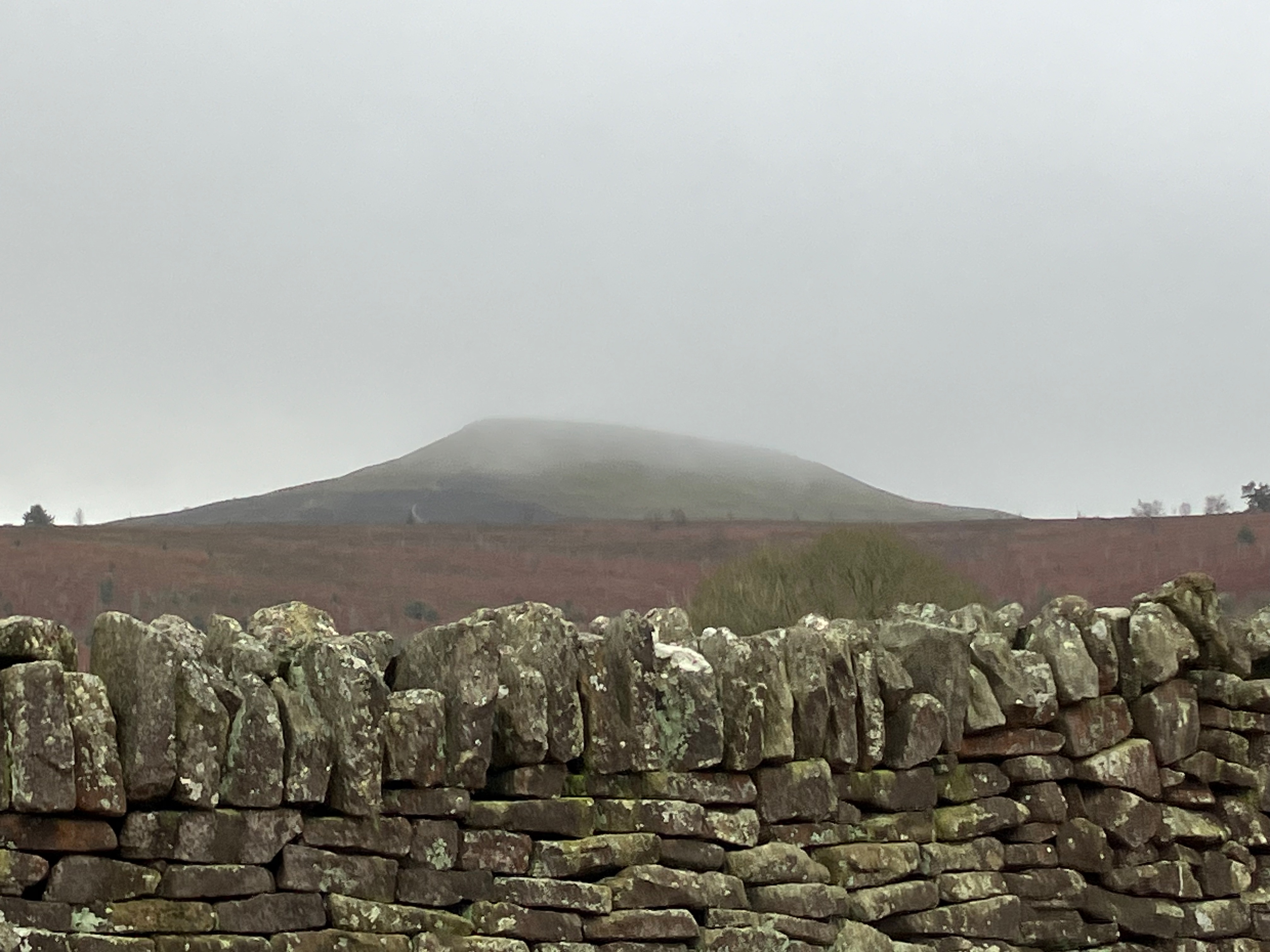
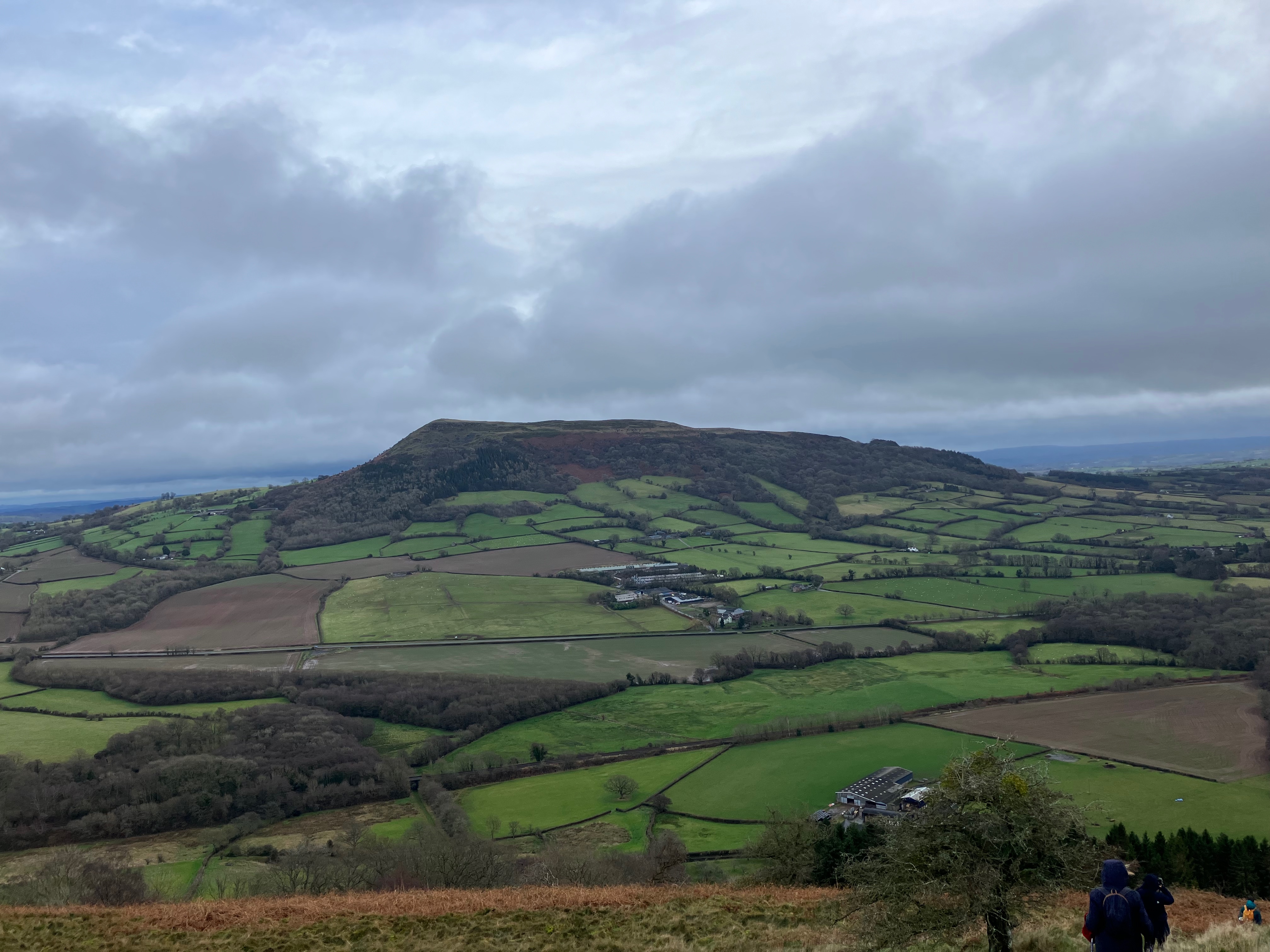
I walked Bryn Arw for the very first time last Christmas Eve. It turned out to be the windiest of days, and I set out along with a few family members and a borrowed dog, a scruffy but amiable mutt named Bluey. We all needed to get out of the house before Christmas indolence melted our brains. First we hugged the lower reaches of Pen-y-fal, or the Sugar Loaf, before turning east and climbing to the long ridge of Bryn Arw. Here we were so buffeted by the southwesterly wind that it felt almost as if the next gust might lift our bodies from the ground and drive us high into the air, depositing somewhere in the green fields of Herefordshire.
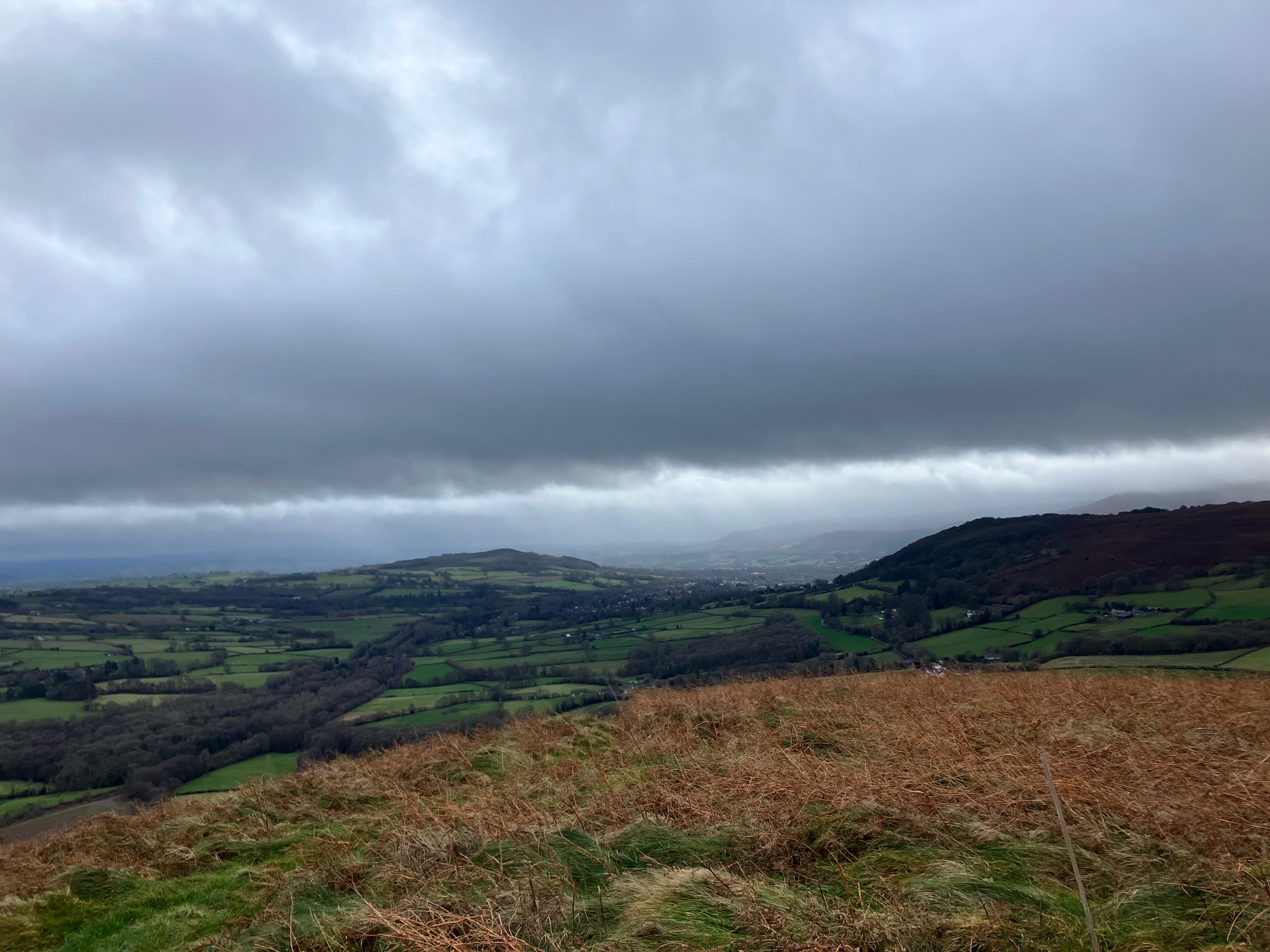
The strange thing about walking Bryn Arw is that, never having walked it before in this lifetime, I have no memories of it, unlike almost all the other walks I do around these hills. And that, I realise before we are half way up, makes a difference. When I am walking around Llantony or Capel or Ffin or the Grwyne fechan valley, I am brushing up against the countless versions of myself left hanging around from previous excursions. At times a sense memory washes over me of having been present at this spot many times before, and that makes a difference. How does it make a difference? How does it ‘feel different’ on Bryn Arw to being in a place you know intimately? ‘The difference is that on Bryn Arw I am, after a fashion, a new version of myself and have no comparators. I am aware of being in a new place with distinct perspectives and views of the hills around about. For example, looking out towards Partrishow hill and Crug Mawr behind it, I am looking at places I know well from a new angle, and that seems to correlate precisely — albeit in a rather minor way — with occupying a distinct version of myself from the one on previous visits.
In hisMeditations, Marcus Aurelius considers it a virtue “to be always the same man” , which suggests to me as much a Roman adherence to manly qualities as an insistence on a continuity of self. But in order to be always the same person one needs to be in possession of a sense of self in the first place, one that is continuous over time. However, it seems clear to me when considering an event or series of occurrences in my past, that the ‘I’ that is doing the remembering in the present is not the same ‘I’ that is being remembered. Or, to put it slightly differently — and following on froman argument famously put forward by Galen Strawson — they might have happened to Richard Gwyn but they didn’t happen to me, as I am in this moment.
This perception of ‘myself’ is further complicated by the fact that at key, or seemingly pivotal points in my life I have always experienced a strong sensation that I am detached from myself in a significant way, as though looking on from a slight distance as ‘I’ — the physical entity I recognise as RG — undergoes stuff happening. Thus I am these two distinct entities — the experiencing self and the detached disembodied thing that is also ‘I’ but somehow independent, ‘above’ or ‘outside’ of me, and yet simultaneously the most intrinsic, innate version of ‘me’ (at least as far as I can tell: it is quite possible that within the lifeworld of that more intimate, innate ‘me’ lurks yet another more intrinsic version, and so on, peeling away the versions like onion skins). When looking in the mirror, for example, the physical form that looks back at me — RG, to others — is somehow ‘not me’, but the form or person that I temporarily inhabit. This corresponds with the idea that sometimes I am observing myself thinking, and even observing myself as if from outside myself, as described at one or two points in these posts. I imagine this is fairly common, but I don’t know or whether its increasing frequency in my life might be accounted for by my historical consumption of mind-altering drugs, or some other cause, such as the recurrent insomnia from which I have suffered for much of my life. Perhaps this is significant. Insomnia brings about a sense of detachment, an impression that nothing is quite real. I was reminded of this, coincidentally, by watching the movie Fight Club the other night, when the narrator comes out with the line: ‘With insomnia nothing is real. Everything is far away. Everything is a copy of a copy of a copy.’
I’m sure we have all had similar moments, when our sense of detachment from the body — or even the ‘person’ inhabiting that body — is more pronounced, even to the point of feelings strangers to ourselves. On a certain level this happens to us incrementally as we get older.
And I am wondering, as we prepare to move home: how does being in a new place affect not only awareness of your surroundings but also, correspondingly, self-awareness? We often slip into complacency, or a kind of non-seeing when in familiar places, but in a new place — as a tourist, or walking in an unfamiliar landscape — we tend to be more alert, taking in details of our surroundings with a heightened intensity. In some ways, this perception of familiarity versus strangeness carries over into our perception of ourselves within those spaces also. It is as though we harbour the ability to be more aware, or more mindful when the circumstances demand it, or else when we choose to be. And this is something that is useful for writers. When I taught writing classes I would sometimes send students out to write at a cafe in Cardiff market or in one of the arcades, and imagine that they were seeing the scene before them for the first time — as a stranger or a ‘foreigner’, in the extreme sense of the world (someone with no bonds of belonging, someone truly lost). To write from the perspective of one who sees everything for the first time.
Curiously — as though this were a recurring obsession — when I was nineteen, I wrote a short story about such a person, a man who each night forgets everything about himself, his life and his surroundings. But I lost the story or else threw it out. It turned out there was not a lot to say about this man other than that he forgot everything. As such, I was pulling the rug of storytelling from under the feet of my protagonist before I started, since all storytelling resides in memory.
On my most recent excursion to the hills I have no new agenda following on from the ‘how long can you stay focused on anything at all’ theme, which, to be honest, turned out to be something of a red herring on the last two walks. I learned that I cannot focus on anything for very long at all and merely confirmed what I already suspected: my monkey mind settles with great difficulty. So I gave myself a break on this walk, and decided I would simply take in the landscape, breathe deeply, and put one step in front of the other. This proved to be a successful strategy (i.e. it was not a strategy at all, but simply a walk).
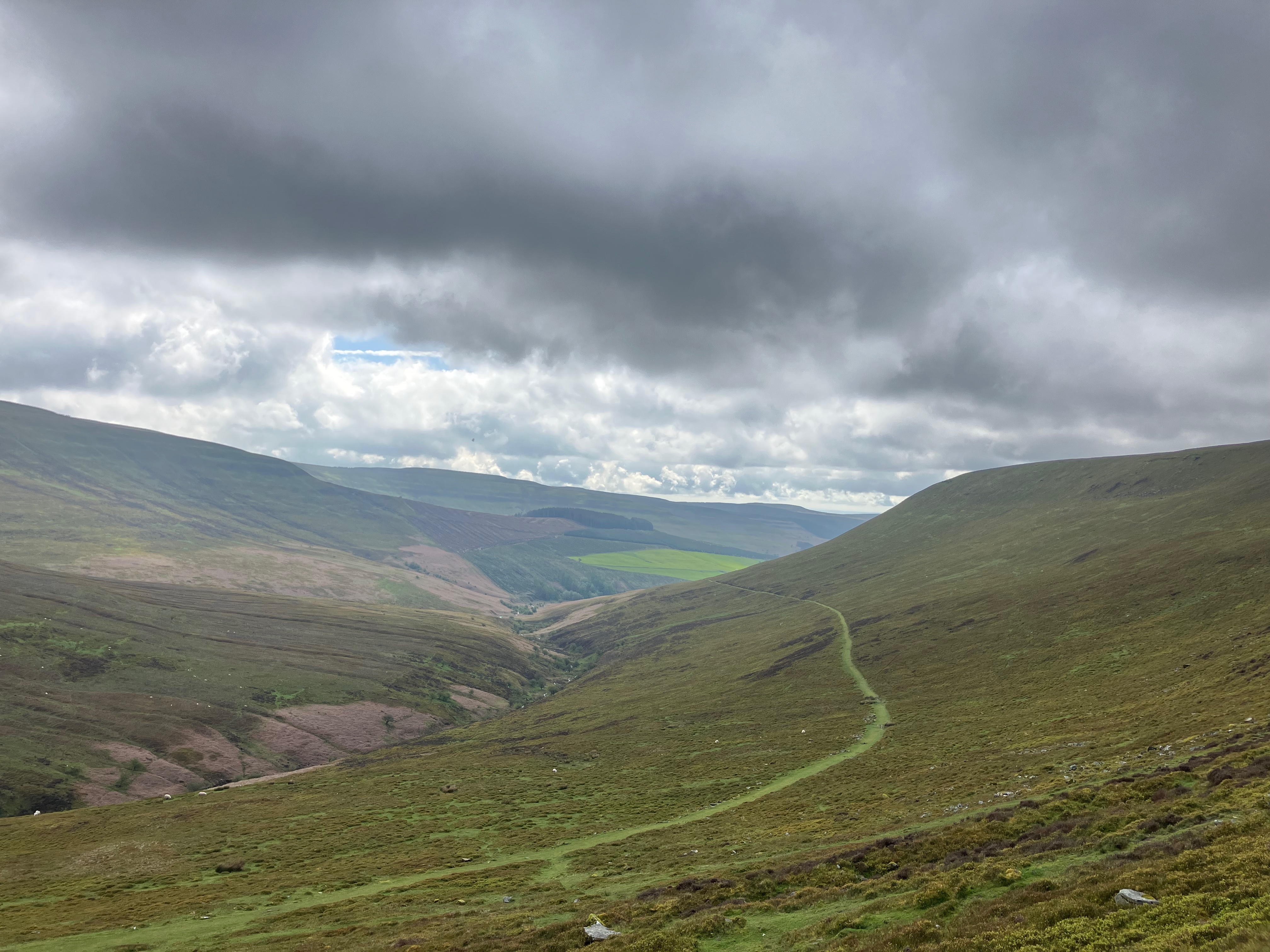
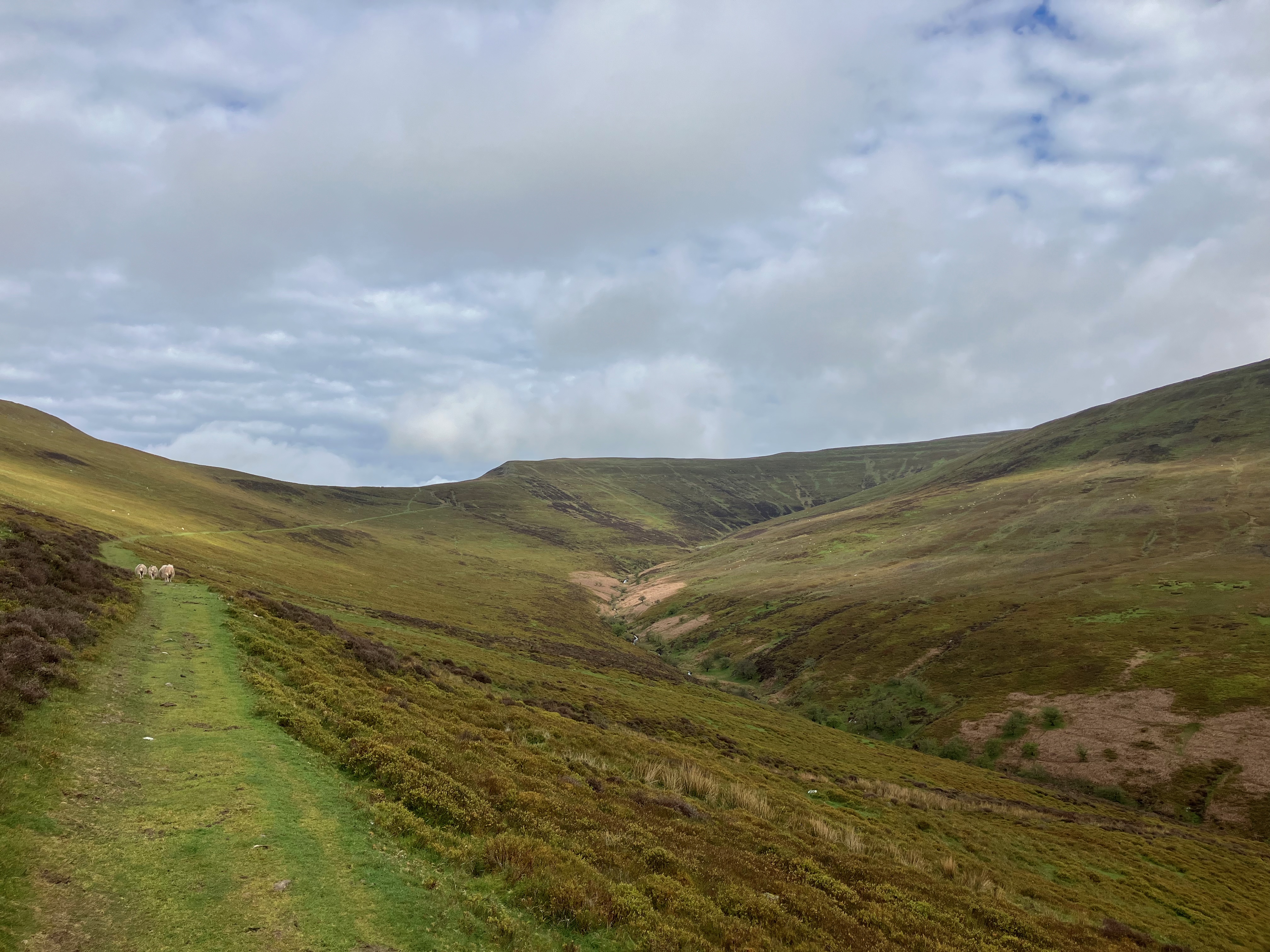
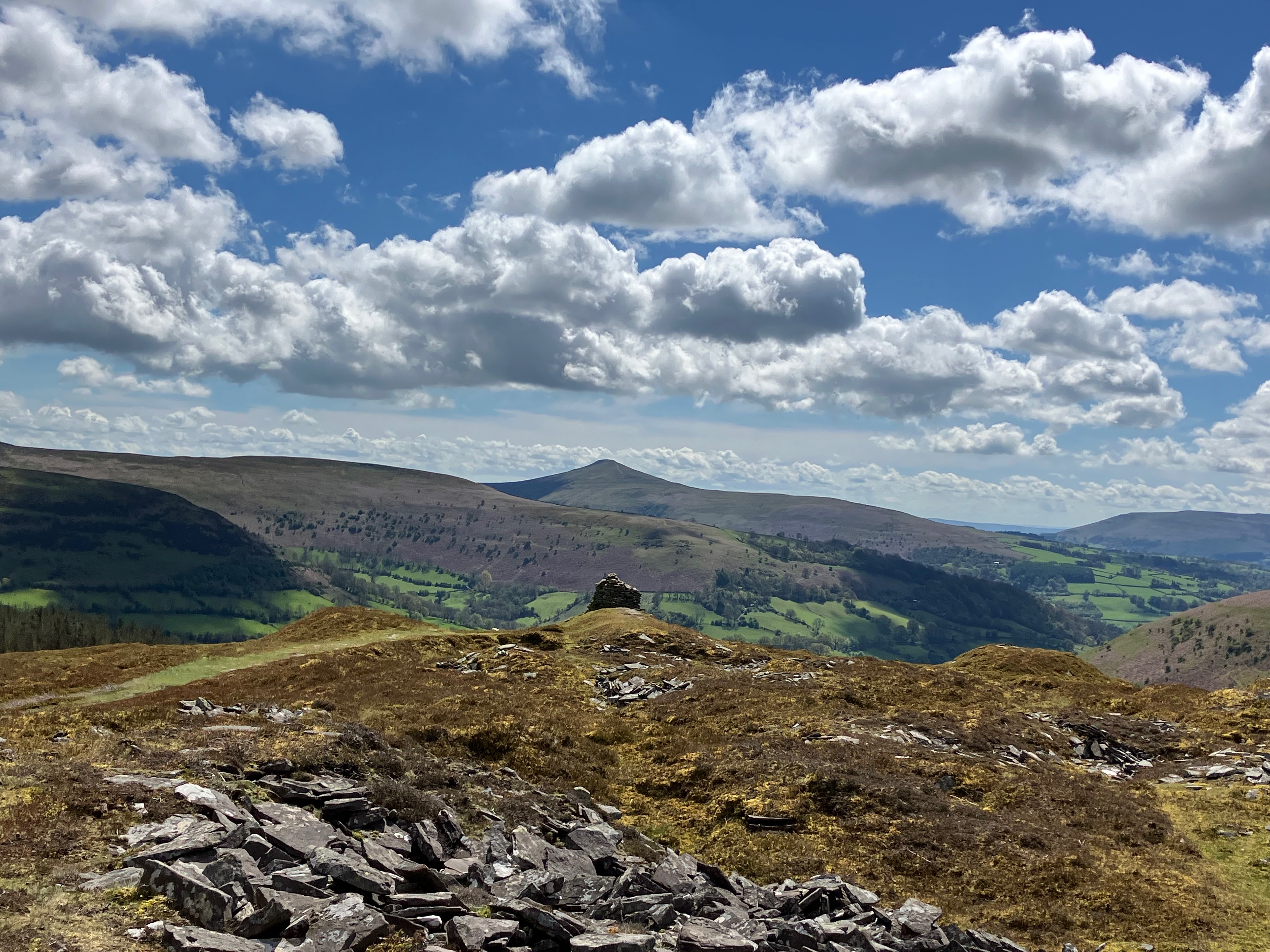
I set out early for the Grwyne Fechan valley, park the car near the bridge below Neuadd fawr farm and start walking, with nothing much on my mind, intent on following the forest track that continues along the western slope of Cwm Grwyne Fechan; then I will take Macnamara’s Way up to Mynydd Lleisiau, and on to Pen Twyn Glas, before descending back to my starting place, past the abandoned quarries above Cwm Banw.
The track that emerges out of Park Wood, above Darren farm, on the west bank of the Grwyne Fechan, is extremely boggy, even now, in May, with the effect of walking through deep sand. It is wearying, and you long for a hard surface; dry soil or gravel. It comes as a relief then, to reach Macnamara’s Way.
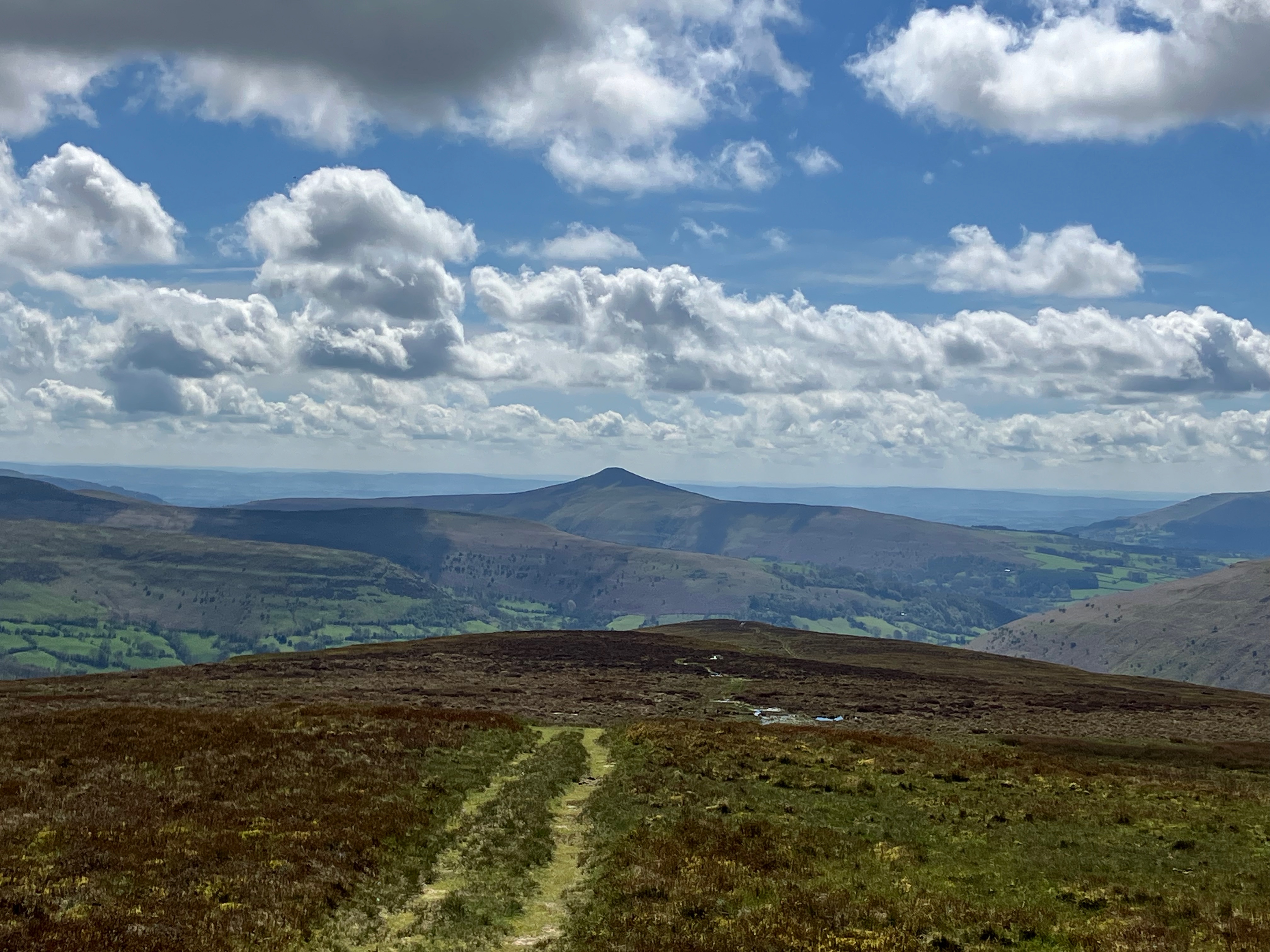
The ascent is not arduous, and by the time you arrive at the summit of Mynydd Lleisiau you are quite calm: the sun has appeared, and the way ahead is clear. At this point you observe, jogging towards you, the first human of the day, a youngish man in a safari hat and shorts, with a dog on a leash running somewhat reluctantly (or so it appears) alongside him. But what draws your attention is that the dog is carrying saddle bags. You are surprised by your own reaction, which is one of muted anger towards the man. You can understand, just about, why he might prefer to run along mountain trails rather than walk, but why must he inflict this passion on his poor dog? And why should the dog be forced to carry a backpack, as if it were a mule? I can feel my mood thickening as the man approaches, and calls out to me, without easing his pace, Good morning, how are we doing? Well, first of all, he clearly doesn’t require an answer, as he doesn’t stop, so why does he pose the question? And why the use of first person plural, the way certain people speak to invalids or persons of feeble mind? I understand that the question is rhetorical rather than functional, much like the local use of ‘orright’? But he is most definitely not a local and doesn’t pose the question as if it were rhetorical and nor does he stop to receive an answer. I am taken aback, put off my stride. I know I shouldn’t be affected this way, but I am. More so, in fact, when a hundred paces behind him, over the crest of a slight dip, appears his weary-looking partner, blond hair tied back and bunched in a tight knot, grimacing a little with the strain of keeping up, but stoical. She manages a greeting also (but without posing any questions, rhetorical or otherwise). I am relieved to observe that she hasn’t been obliged to carry a rucksack, that she is just allowed to plod along behind the Great Adventurer, in her tight fitting black joggers and expensive looking black top. I feel for her.
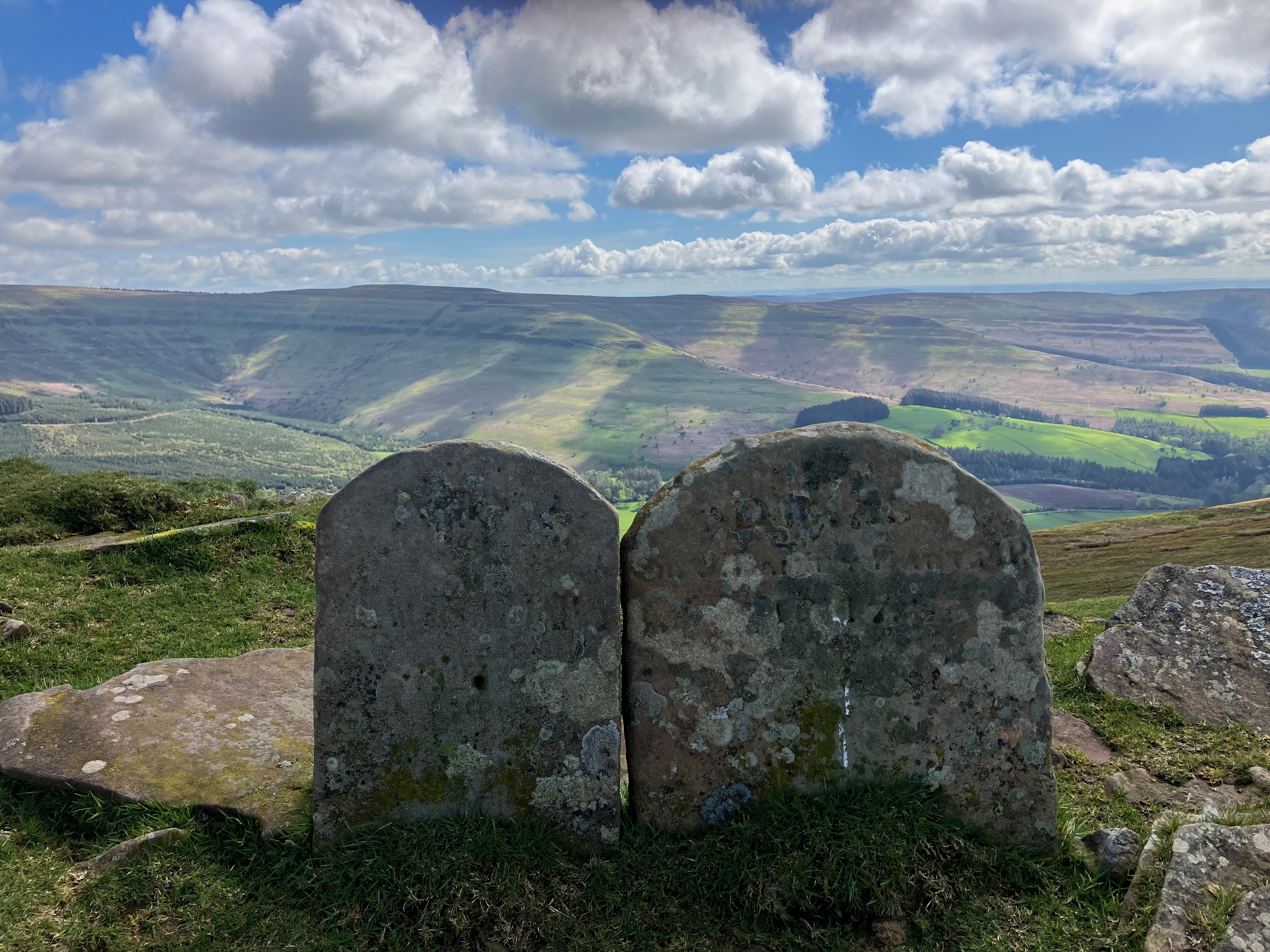
I stop off to eat my sandwich next to the boundary stones on the knoll near (but not on) the summit of Pen Twyn Glas, set there by the widow Mary Macnamara and Sir J. Bailey Bart, whose estates met at this point in the early to mid 19th Century. (See Graeme Adkin’s blog, ‘Black Mountains Walking’ at https://www.blackmountainswalking.co.uk/the-black-mountains-magic where he cites John Barber writing in The Beacon)
The descent from Pen Twyn Glas in the late morning sun is breathtaking, and there is the sublime joy of looking down over Cwm Banw to the right, and ahead to Pen y Fal. Quite why Cwm Banw and the Grwyne Fechan valley affect me in this way I cannot say, but I have an allegiance to the zone that feels arcane, ancestral, a thing of the blood. It is a passion I share with at least a few others. T.J. Morgan, a young University lecturer in Welsh, recalled his first visit to the Grwyne Fechan valley in January 1939, after a heavy snowfall, in tones of mystical reverence. The visit is recounted by his son, Prys Morgan, in the annual journal Brycheiniogand can be found in the back issues section, Volume 51 (2020) on pages 136-41.
‘He was immediately overwhelmed by the magical silence and beauty of Grwyne Fechan, all glittering in midday sunshine, and was humbled by a sense of awe. For the only time in his life, he felt part of something cosmic, filled with utter purity, a feeling of being part of a cosmos that was just being created and before the arrival of life’.
The purpose of Morgan’s trip to the valley was to track down and interview the last Welsh speakers. As his son writes:
‘There were five people in Grwyne Fechan who spoke Welsh, all over eighty, but none had spoken it to anybody else for many decades. The old man (John Williams y Felin) was astonished to hear Welsh from the lips of a young man; the language being something already belonging to the past.’
In the mid-19th century, we learn, all the families in Grwyne Fechan had been Welsh-speaking, apart from one family of Scots. Morgan managed to make a few recordings (notably of John Williams y Felin) but his plan to record all the octogenarians in the valley in 1939 was laid to rest by the outbreak of World War Two. The military commandeered all the BBC cables and private vehicles were to be taken off the roads. By the time the war had ended, six years later, all the elderly people in the Grwyne Fechan valley were dead.
Many of us have wondered what kind of Welsh was spoken by those last users of the language in the Black Mountains. The musician and writer Tom Morys, and his band Bob Delyn a’r Ebillion, have made poignant use of Morgan’s recording with their ballad Cân John Williams, which opens with the voice of Williams, as recorded in 1939. In a nice touch, Morys dedicated his song to the children at the new Welsh-medium school in Abergavenny, Ysgol Gymraeg Y Fenni. The voice echoes huskily across the chasm of the years, eliciting the sound of a remote rural community lost to time, but not to the imagination.
A conversation with an old friend, while driving to Bristol airport earlier this month, led me back along the wild mountain tracks of memory, and an introduction to what psychologist Martin Conway refers to as the self-memory system (SMS) model of autobiographical memory.
In an article published in 2005 titled ‘Memory and the Self’, Conway argues that two of the central concerns of memory are correspondence and coherence. Correspondence refers to the essential accuracy of what we recall, and how we remember (or at least recount) our experience. Coherence, on the other hand, is the requirement to make our memories consistent with our current goals, beliefs and self-image. Conway’s insight lies in reminding us how personal memory is as often as not a trade-off between the distinct but competing demands of coherence and correspondence, between adhering to our contrived self-image at the same time as (supposedly) telling the truth about our past. This can often be an uncomfortable compromise. If the self-image is threatened by the inconvenient fact of contradiction, what is a person to do? It is easy to see how the serial fantasist simply invents new stories in order to bridge the gap between who they think they are and what actually happened.
Thinking about all of this, I am reminded of what Javier Marías terms El horror narrativo (narrative horror), the way in which one’s status, as well as one’s accomplishments and merits, can be tainted or destroyed by a single misfortune or a single moment of disgrace — when we have committed some deed for which we will never be forgiven, and for which we might not even be responsible, but which has been imposed or inflicted on us by others. Either way, every aspect of our life story’s, carefully nurtured up till then, can be overturned, thrown into question, or brutally exposed and ridiculed, all in an instant. The most obvious example of this, according to Marías, might be the way that a public figure, overly self-conscious of being such a big shot, might worry about events in their past lives and the way they might appear to others, if discovered — to such an extent that they live in terror that a moment of narrative horror might descend upon them and reveal to the world just what an abject individual they really are, how ill-suited they are to public office, and of how their lovingly tended self-portrait will be forever tainted by some indiscretion that ends their career. Sometimes, Maríasreminds us, this can happen posthumously, for example when secrets are discovered that were kept safe during the individual’s lifetime. But as much as anything else, narrative horror overcomes us when the factors of correspondence and coherence do not meet up, and we are left with our narrative torn apart and shown to be an utter fiction after all.
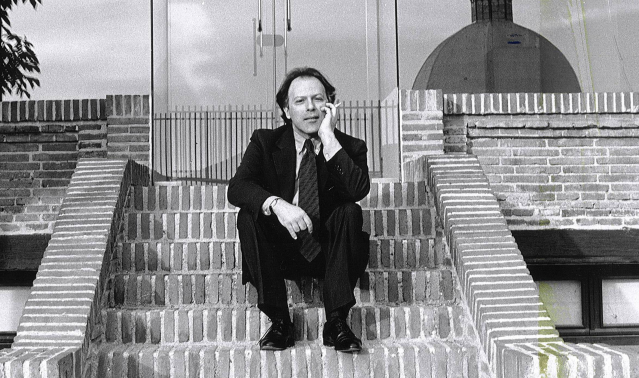
Javier Marías (1951-2022)
For me, narrative horror can extend into other areas, specifically the constant narrating done to ‘tell and tell’ something (of which, like most writers, I have no doubt been culpable myself). My awareness of this notion was probably brought about by a passage from Marías’ early novel The Dark Back of Time, which he begins with the words: “I believe I’ve still never mistaken fiction for reality, though I have mixed them together more than once, as everyone does, not only novelists or writers but everyone who has recounted anything since the time we know began, and no one in that known time has done anything but tell and tell, or prepare and ponder a tale, or plot one.” This passage inspired the rant that follows its citation in my memoir, The Vagabond’s Breakfast, when I wrote:
“This eternal recounting, this need to tell and tell, is there not something appalling about it – and not only in the sense of whether or not we consciously or intentionally mix reality and fiction? Are there not times when we wish the whole cycle of telling and recounting and explaining and narrating would simply stop – if only for a week, or a day; if only for an hour? The incessant recapitulation and summary and anecdotage and repetition of things said by oneself, by others, to others, in the name of others; the chatter and the news-bearing and the imparting of knowledge and misinformation and the banter and explication and the never ending, all-consuming barrage of blithering fatuity that pounds us from the radio, from the television, from the internet, the unceasing need to tell and make known? And whenever we recount, we inevitably embroider, invent, cast aspersion, throw doubt upon, question, examine, offer for consideration, include or discard motive, analyze, assert, make reference to, exonerate, implicate, align with, dissociate from, deconstruct, reconfigure, tell tales on, accuse, slander or lie.”
We are forever subject — or victim — of the stories we tell about ourselves. All the more reason to remain silent, keep schtum, never breathing a word to anyone about it, that thing that happened and which no one else knows about, but which keeps returning to you in the dead of night . . .
I will leave the last words on narrative horror to Marías, fromFever and Spear, the first book in his trilogy, Your Face Tomorrow, superbly translated by Margaret Jull Costa.
“Narrative horror, disgust. That’s what drives him mad, I’m sure of it, what obsesses him. I’ve known other people with the same aversion, or awareness, and they weren’t even famous, fame is not a deciding factor, there are many individuals who experience their life as if it were the material of some detailed report, and they inhabit that life pending its hypothetical or future plot. They don’t give it much thought, it’s just a way of experiencing things, companionable, in a way, as if there were always spectators or permanent witnesses, even of their most trivial goings-on and in the dullest of times. Perhaps it’s a substitute for the old idea of the omnipresence of God, who saw every second of each of our lives, it was very flattering in a way, very comforting despite the implicit threat and punishment, and three or four generations aren’t enough for Man to accept that his gruelling existence goes on without anyone ever observing or watching it, without anyone judging it or disapproving of it. And in truth there is always someone: a listener, a reader, a spectator, a witness, who can also double up as simultaneous narrator and actor: the individuals tell their stories to themselves, to each his own, they are the ones who peer in and look at and notice things on a daily basis, from the outside in a way; or, rather, from a false outside, from a generalised narcissism, sometimes known as “consciousness”. That’s why so few people can withstand mockery, humiliation, ridicule, the rush of blood to the face, a snub, that least of all … I’ve known men like that, men who were nobody yet who had that same immense fear of their own history, of what might be told and what, therefore, they might tell too. Of their blotted, ugly history. But, I insist, the determining factor always comes from outside, from something external: all this has little to do with shame, regret, remorse, self-hatred although these might make a fleeting appearance at some point. These individuals only feel obliged to give a true account of their acts or omissions, good or bad, brave, contemptible, cowardly or generous, if other people (the majority, that is) know about them, and those acts or omissions are thus encorporated into what is known about them, that is, into their official portraits. It isn’t really a matter of conscience, but of performance, of mirrors. One can easily cast doubt on what is reflected in mirrors, and believe that it was all illusory, wrap it up in a mist of diffuse or faulty memory and decide finally that it didn’t happen and that there is no memory of it, because there is no memory of what did not take place. Then it will no longer torment them: some people have an extraordinary ability to convince themselves that what happened didn’t happen and what didn’t exist did.”
Regular readers of these posts — and if you do not already subscribe to the email, please do so in the space provided on the right — will have noticed that last week I dropped the moniker Ricardo Blanco’s Blog, and adopted instead (or reverted to) the identity of Richard Gwyn, which, I feel, simplifies matters. Not only is this my name, but I am aware that there is a distinguished Cuban American poet named Richard Blanco, who read at Obama’s second inauguration, as well as a host of other Ricardo (or Richard) Blancos about the place. Not that this is an insurmountable problem, but I do not want to give the impression that I am someone I am not, and have, in the past, received messages from readers who thought I was the other Blanco, an understandable error, and one that actually feeds into this week’s theme quite neatly . . .
It might be argued that there are other Richard Gwyns also, including the respected Canadian journalist (who passed away in 2020) and — most famously — the Welsh Saint of that name, a poet and teacher, who was hung drawn and quartered at Wrexham in 1584, for being a Catholic.
The notion of calling this series of writings Ricardo Blanco’s Blog was enhanced, or fortified, by the fact that this title formed an example of Cynghannedd sain, which in Welsh formal poetry is a line of verse in which the first and second parts of a line rhyme (in this case the final vowels of Ricard-o Blanc-o) and the third section repeats the consonantal patterns of the second (Blanco’s Blog). My thanks to the Cymraeg poets Mererid Hopwood and Karen Owen for pointing this out to me, many years ago, on a tour of Patagonia. However, my concerns as a writer then — 2013 — were largely to do with my work as a translator; the preparation of my anthology of Latin American poetry, The Other Tiger, and the writing of a book which I regard as its twin (or double), Ambassador of Nowhere, which was ten years in the making and was finally published last month. And it seems appropriate, that with the publication of Ambassador, the persona of Ricardo Blanco fade into the background (or perhaps the Nowhere of the book’s title). I am not killing him off altogether — that, after all, would amount to suicide — but Blanco’s concerns are no longer my own. Either that, or else we have merged completely. In any case, things have moved on
Back to the present: I would like to continue posting meditative pieces about walking and the reflections brought about on these excursions, usually (but not always) in the Black Mountains of south-east Wales. These posts will often pursue a literary, philosophical and/or alchemical theme, and may, with time, make up the contents of a book. The next of these posts will go up on Thursday, and Thursdays will remain the regular day for all new pieces.
Continuing my series of Walks in the Black Mountains. Content warning: alongside description of the actual walks, these extracts also contain my thoughts about writing as well as an amateur’s excursions into the study of consciousness, philosophy of mind and other ontological concerns.
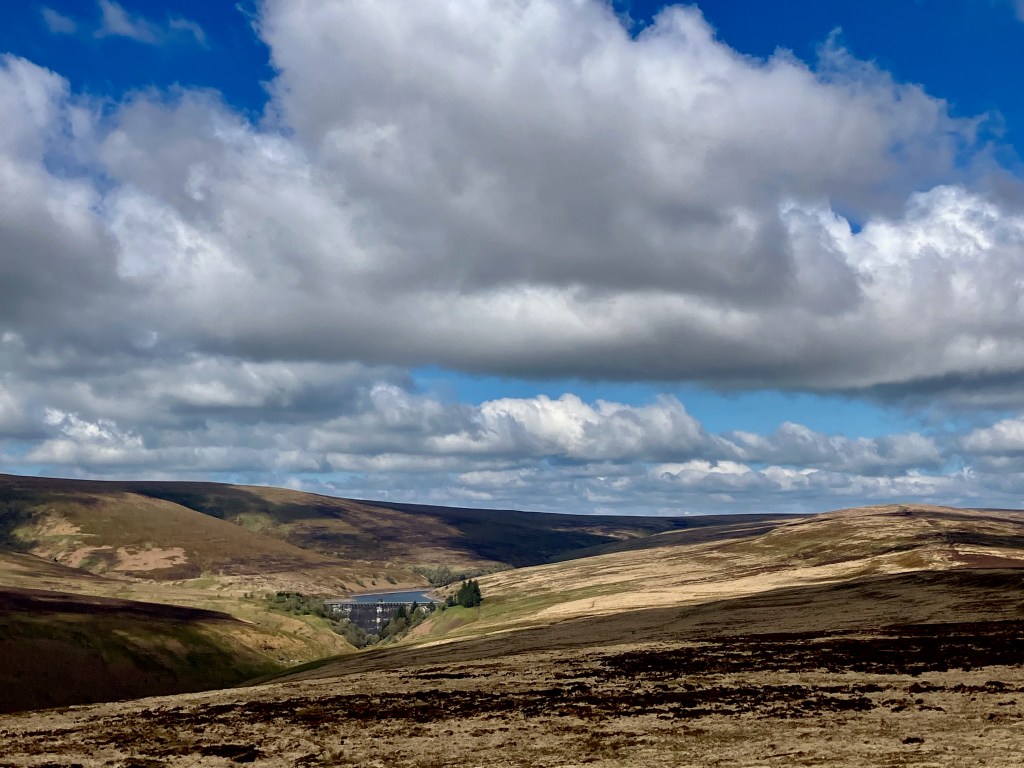
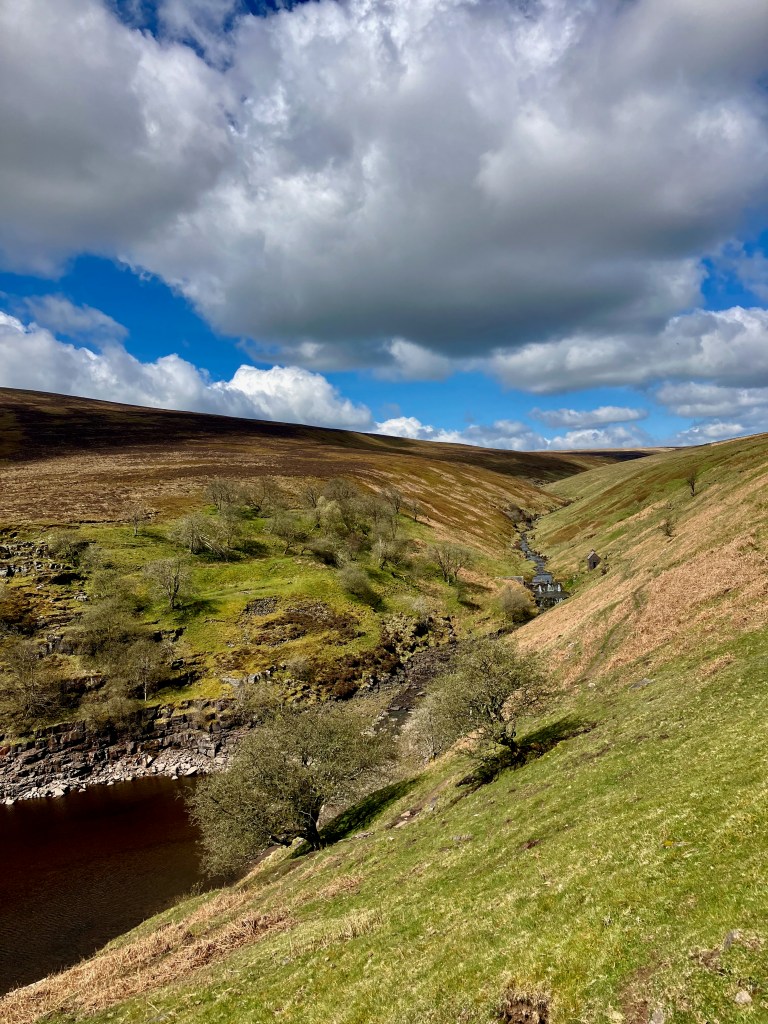
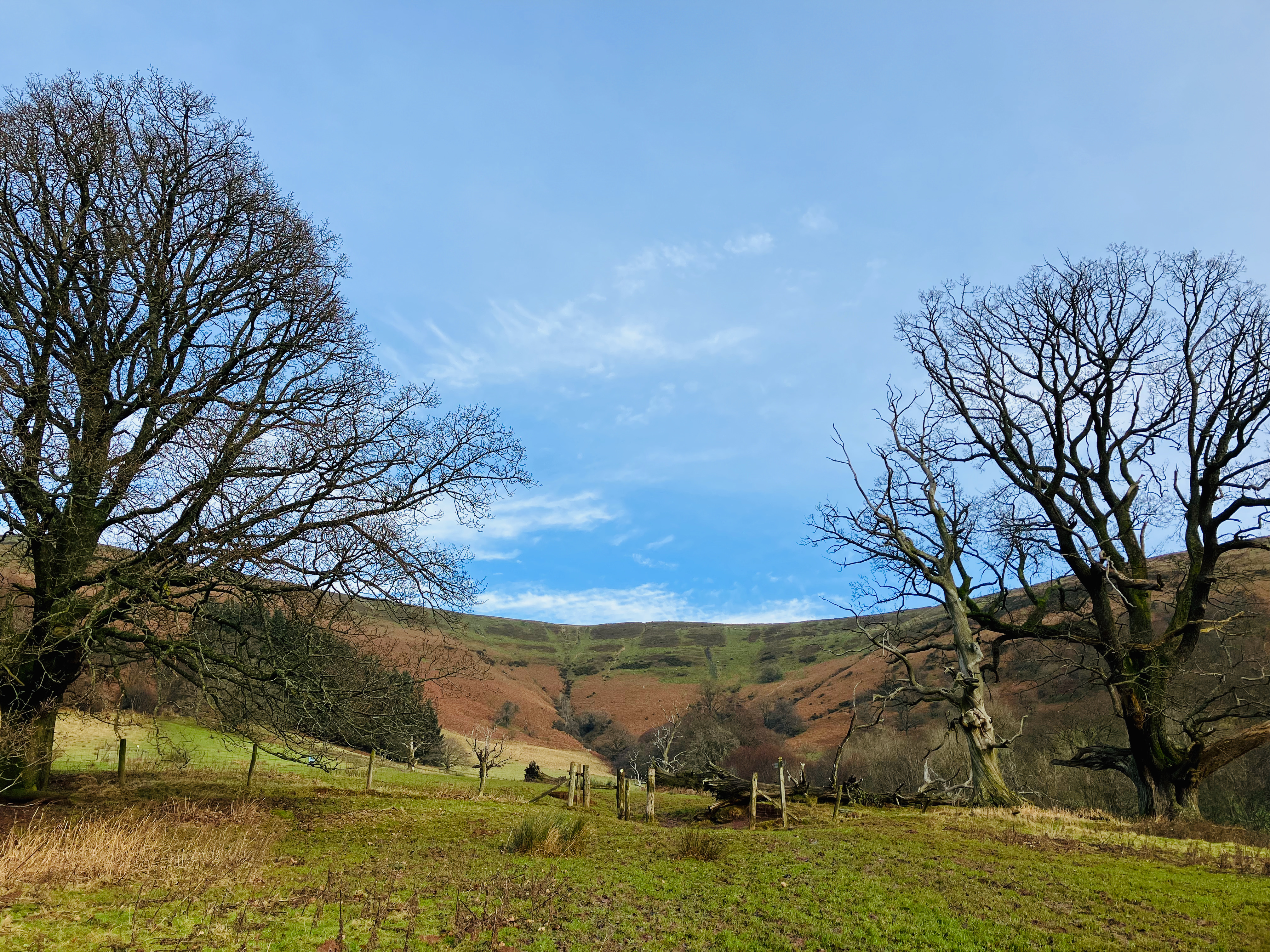
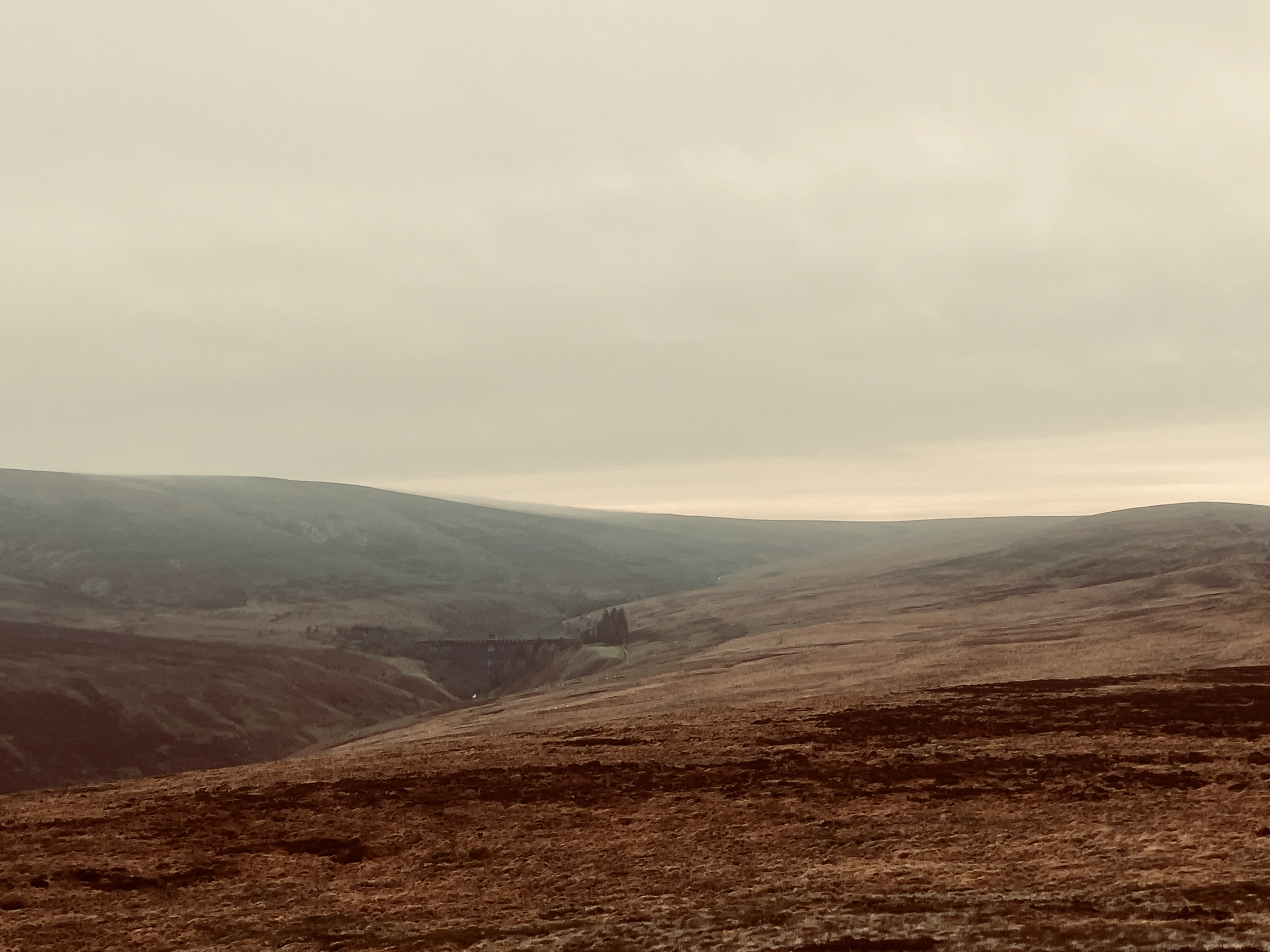
On a Sunday in April, on which, for once, very little rain is forecast, I climb from Capel y Ffin to the Ffawyddog. When I reach the Blacksmith’s Anvil, I rest and eat a breakfast of two small bananas. Now that I am stationary, a hiker, of whom I have been dimly conscious at my rear for a while, catches up. At first I think this will be a repeat of my last walk in these parts, and half expect to see the man from Capel y Ffin, but it is not, although he bears a certain fleeting similarity to that person. He greets me with a comment about the weather having turned out fine, which it has, after a fashion, though it is cold for April, and I am wearing layers, a woollen hat and gloves. The Blacksmith’s Anvil grants a wide-angle view of the moorland before me, and the familiar sight, nestled within sloping hillsides, of the Grwyne Fawr reservoir.
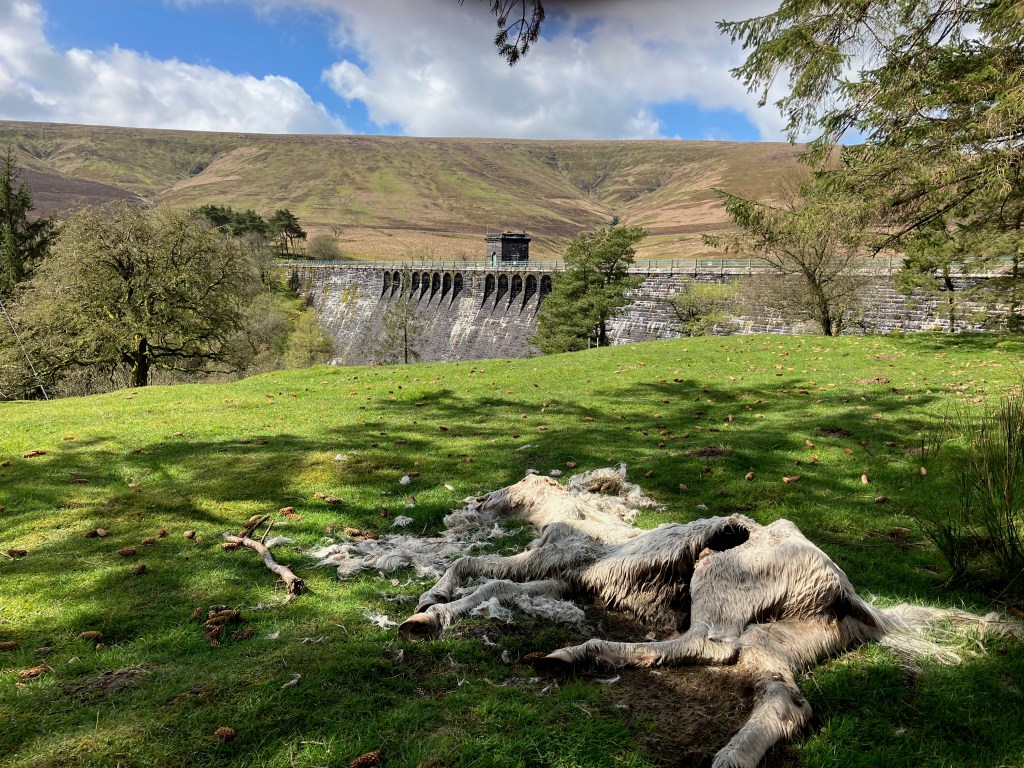
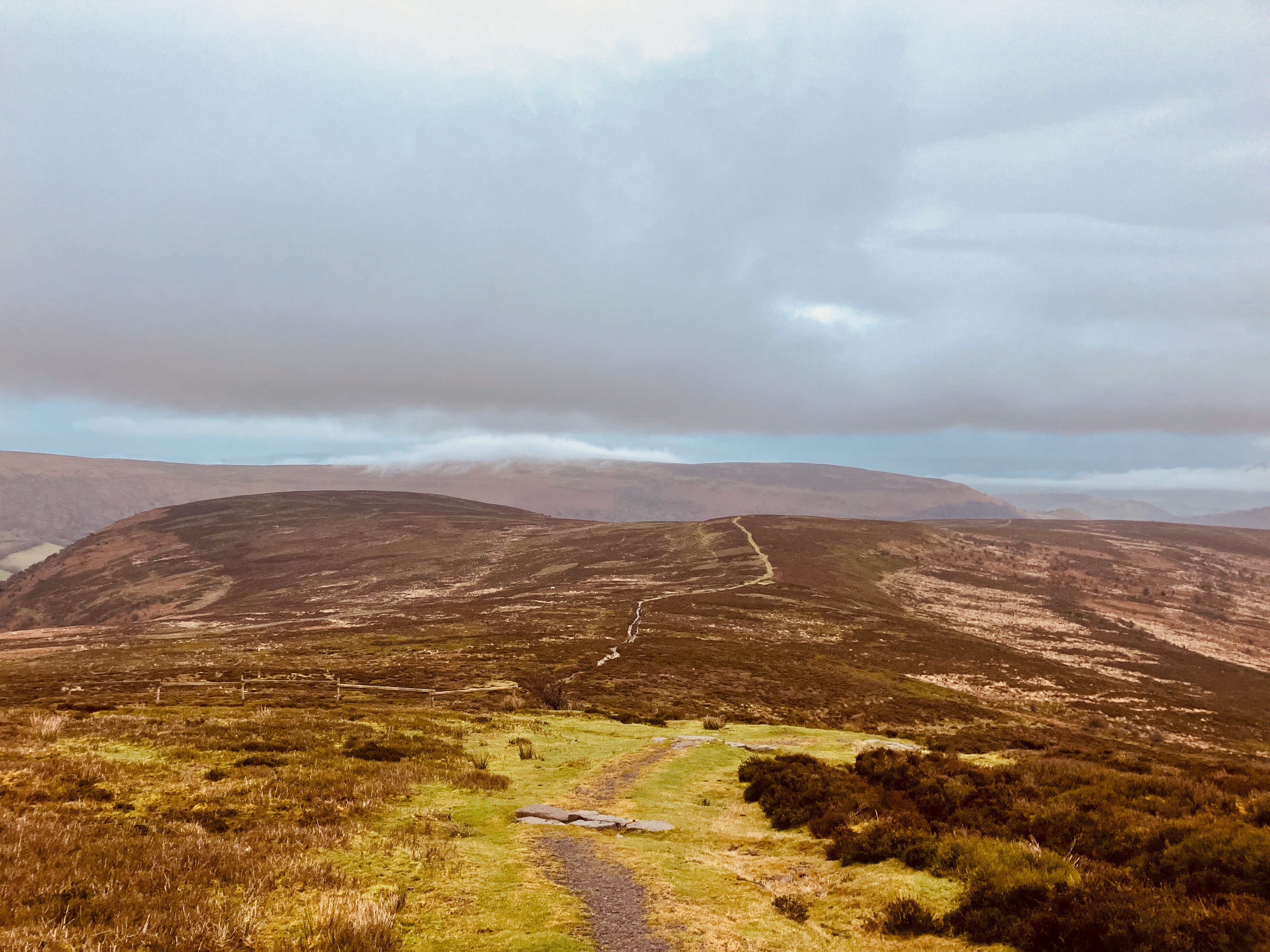
I set off along the narrow gravel path that now defines the crest of the Ffawyddog, turning off at a diagonal (10 o’clock) to the left to pursue the boggy track down towards the reservoir. Near the dam lies the sad, excavated remains of a young pony, a common enough sight hereabouts.
Following the stony banks of the reservoir (the water level is low, which casts into doubt the enormous amount of rainfall we have received these past eight months) I encounter two men in baseball caps, fishing, casting out into the placid deeps. When he sees me, one of them waves in a cheery fashion. There is no evidence of any catch, they don’t even have bags in which to carry fish, no gear, nothing. How on earth did they get here? It occurs to me that they are the ghosts of lost fishermen, or visitors from another world. I dismiss the thought, but not without some resistance.
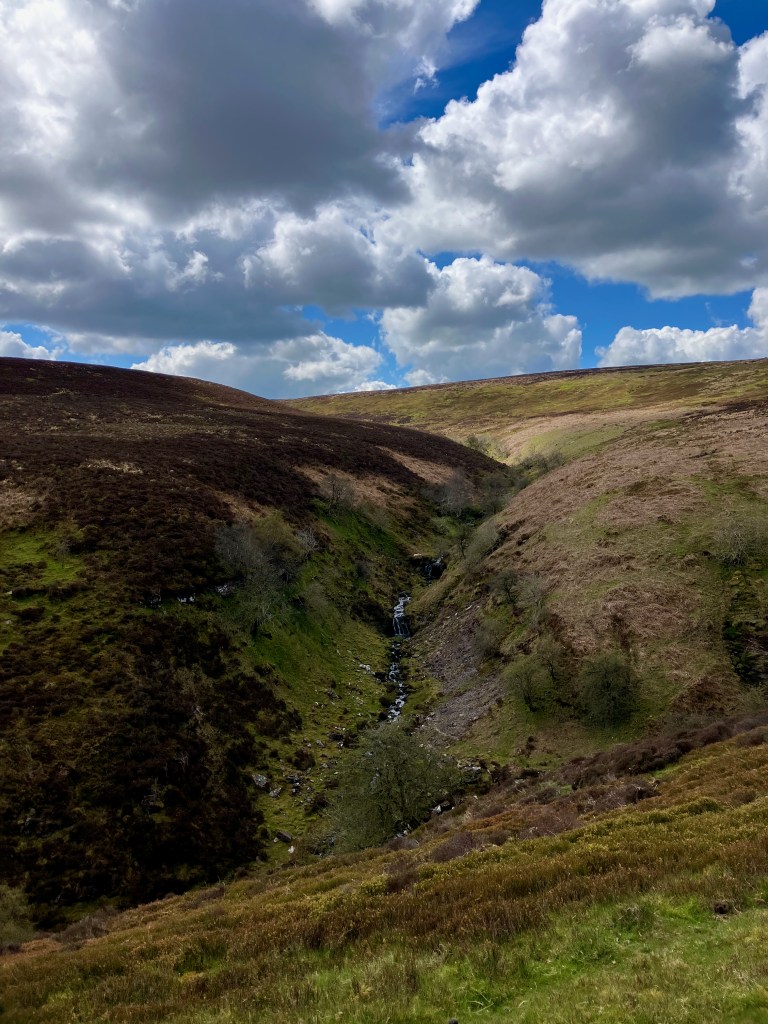
So I continue the gentle climb upstream towards the source, and there are no more people on this lonely, lovely stretch of the Grwyne Fawr, and I stop to eat my sandwich near the spot where two summers ago I ruminated on the meaning of Providence, and thence (pursuing the analogy of the Black Mountain massif as a hand) to the heel of the palm, more specifically Pen Rhos Dirion, and it is a short walk to the Trig point, at which I arrive precisely as do three middle aged hikers, two male, one female, one of whom, a bulky man with a Midlands accent, has an irritatingly loud voice, a forceful and insistent bellow (why does he need to shout as he walks along these hill tracks, attuned almost exclusively to scattered birdsong, the whistling of the wind and near-silence; why must he shout so? Why does he believe his voice is so worth listening to?) And I hasten my steps, break into a loping canter as I descend the slope towards Rhiw y Fan, and when I turn south-east, following the nascent stream called Nant Bwch, I am relieved that the loudmouth and his companions do not follow.
A solitary red kite circles, guardian at the portal of this narrow valley. With the familiar descent, and the comfort it brings you now that you are alone again, apart from the pipit and the chiffchaff and some other bird you cannot name, you return once more (almost in spite of yourself) to the perennial questions of who you are (or who you were) and what you are doing, especially with regard to what you write, and remember that the writer who has given you most pause for thought on this subject in recent weeks is M. John Harrison, who begins his ‘anti-memoir’, Wish I was here, with these words:
‘When I was younger I thought writing should be about the struggle with what you are. Now I think it’s the struggle to find out who you were.’His use of the past tense is telling.
Harrison talks a fair bit about the notebook, the writer’s journal, and its function. He makes the astute claim that as a means of recording events, keeping a notebook doesn’t really help (‘writing things down helps less to close that distance than you’d think’) — while conceding that ‘notes make good source material, and when you keep notebooks they eventually begin to suggest something. About what, is not clear. But something, about something.’
I like his vagueness, and at the same time, vaguely distrust it.
As an adolescent, like Harrison, I had nothing set in place, no strategy for achieving adulthood. I suspect that some of my contemporaries had; at least a few of them had absorbed or internalised what was expected of them, but I did not. It was a condition that pursued me long into adulthood itself, exacerbated no doubt by my extravagant intake of alcohol and psychotropic drugs, which, somewhat ironically, I perceived as means of achieving greater self-knowledge, or even as aids on a spiritual quest of sorts. They were not, except as a means of learning that sobriety would serve me better. I would say I did not have a clear, or even any idea of who I was until my own children were born, or shortly afterwards.
Harrison, in his book, returns many times to the notion of his own identity, when he writes of his seventeen-year-old self: ‘I was dying to be someone but I didn’t know how’.
(These are perfectly reasonable thoughts to be having at seventeen, but at 37, or, God forbid, 67? You discover, however, that such thoughts are nor unusual, at any time of life. Some of us are permanently and persistently in search of ourselves. Time, or rather age, helps with one thing: accepting that we might not be a single, cohesive story. We might be many stories, some of which contradict or cancel out others, but all of which are valid; all of them constitute an element of the multifaceted and fragmented self.)
Later in the book, Harrison returns to the theme, always in relation to his writing: ‘The problem of writing is always the problem of who you were, always the problem of who to be next. It is a game of catch-up, of understanding that what you’re failing to write could only be written by who you used to be. Who you are now should be writing something else: what, you don’t know until you try.’
Well, that rings a bell, and for me it resonates with the notion of always starting out, always just beginning, everything feeling new, about which I might, if I were minded to, quote Saul Bellow, who wrote “I have the persistent sensation, in my life . . . that I am just beginning.” This side of things, the ‘feeling new’ side, is, more than anything else, what keeps us going as writers. It is also a feature of certain meditation practices; that one is only ever setting out from the present moment. That there is, in a certain sense, no other time than the present.
Do we ever, though, truly inhabit our own skin? Are we not always at a slight remove from ourselves, one way or another? Experiencing the ‘self’, the person that stuff happens to at a slight distance? Isn’t this key to what you are doing as you walk and as you write? (If you have decided these two activities are the things that define you best).Is it not an examination of walking as the thing you do to keep moving, keep going, one step in front of the other, in rhythm with the breath? Left foot, right foot; breathe in, breathe out.
Cerdded in Welsh is to walk. Cerdd is poetry and/or song. You have long held this correspondence in mind, and it is one that seems the key to a kind of understanding. To walk, to breathe, to write, to sing: could there be a sweeter, simpler way of resolving the matter — at least for the present moment — of who or what you are? It is with this thought in mind that I can be free, or at least temporarily less bothered by such concerns as the one posed by Harrison, that ‘the problem of writing is always the problem of who you were’ — because it needn’t be.
I have been wondering about the capacity of the mind to focus on anything for more than a few seconds at a time. A lot has been published on this topic in recent years, especially relating to children’s use of the internet and social media. An article I read somewhere suggested that the maximum attention span is around eleven minutes, but that seems optimistic: when engaged in mindfulness meditation, for example, it can be difficult to maintain focus on one’s breath for more than eleven seconds.
Nevertheless, and despite all evidence to the contrary, I decided one day to try and focus only on my breathing and on taking one step after another, over the course of a twelve mile walk. I would impersonate a being with no mental baggage, with ‘nothing extra’, as Shunryu Suzuki puts it. Despite the fact that I have tried this before, and failed, I want to see whether I can maintain a sustained awareness of myself as only a walking, breathing entity — or at least a being with this intention, which may or may not be the same thing — over the course of the entire walk. I know that I am setting myself up to fail again, but I will do it anyway, just to see . . .
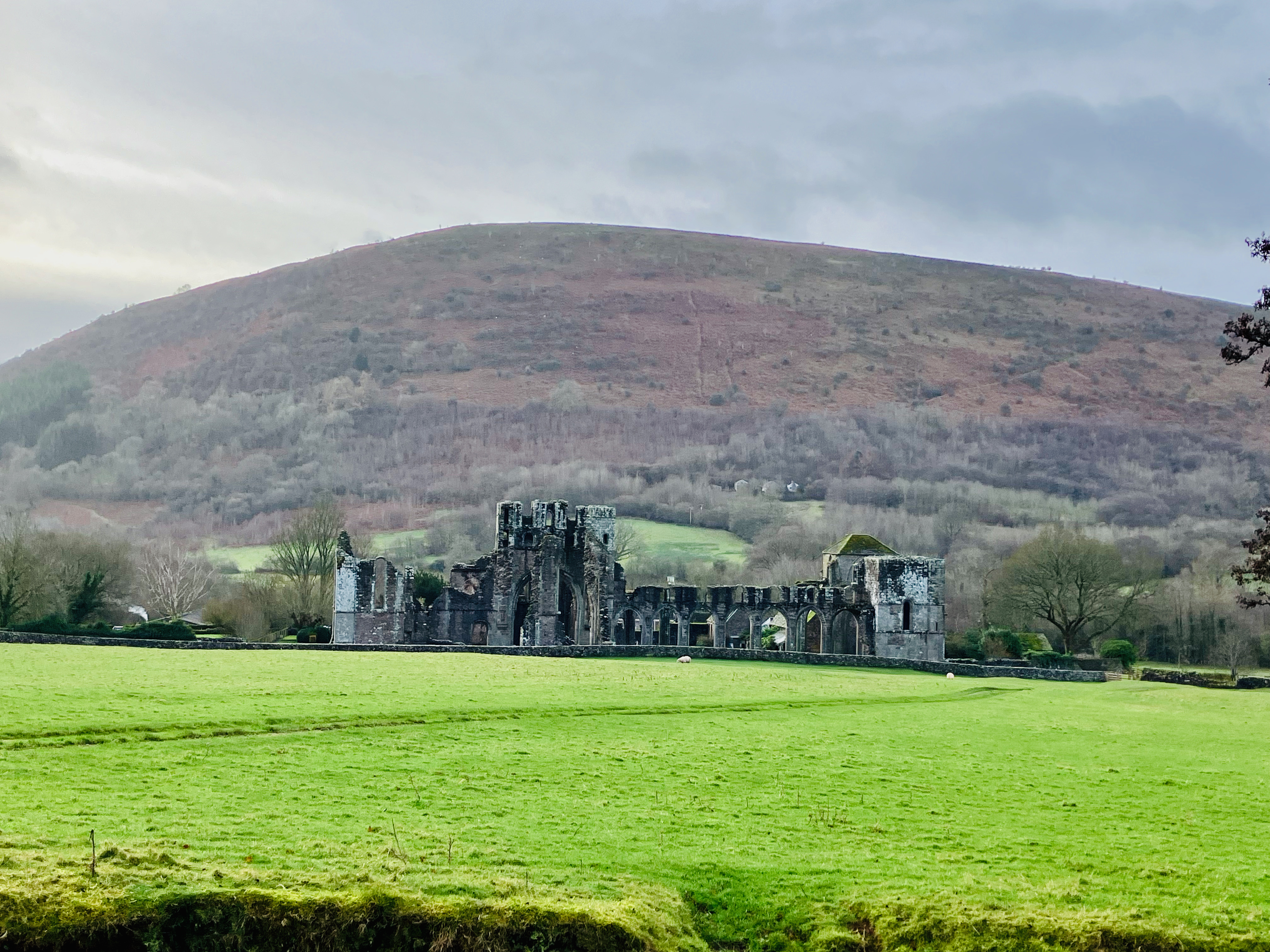
So, on a January morning in 2024 — the first day of the new year on which it is not pelting with rain — I set off on a circular walk from Llanthony Priory. My plan is to climb up to the Offa’s Dyke trail, follow it for a couple of kilometres, turn west down the steep track towards The Vision farm, take a right along the lane to Capel y Ffin, climb to the Ffawyddog (which separates this valley from Cwm Gwyne Fawr) and follow the ridge down to Bal Mawr and thence down Cwm Bwchel, back to Llanthony. Twelve miles, give or take. Six hours including picnic lunch and stops.
Before I get to the first turning, on the relatively flat stretch along the Offa’s Dyke path, I am doing pretty well. I am practising in the same way as I meditate, by breathing and focusing on my breath, step after step. I lose myself from time to time, of course, the monkey mind turns somersaults in the usual way, and I slip into the internal monologue occasionally, but I am doing OK, although, of course, I am not ‘getting anywhere’. Nor do I want to. There is, needless to say, nowhere particular to get to, except one step after another, one breath at a time.
But the fact is, however much I try to convince myself otherwise, I am crap at this. My mind is playing jumping jacks. Within minutes I am all over the place. I have no sense of being a consistent individual, a single thinking feeling entity for more than thirty seconds at a time, maximum. The fundamental thing that distinguishes me from the moorland pony with the swollen belly that I pass along the way is that while the pony is no doubt conscious, I am conscious that I am conscious, and I rather doubt that she is. I am conscious that I am conscious, and that is why I am putting myself through this pointless exercise. I’m not saying that the pony, or the walker’s dog that I see approaching on the far horizon is a lesser being, but I am pretty damn sure that neither of them is spending their time worrying about the permutations of their consciousness, or their failure to keep their attention on one thing at a time.
As I walk, I am getting a sense that there are two distinct ways of regarding the self, or one’s own inner personhood. The first type of consciousness is that I am aware of myself as a physical human being, a human being considered as a whole. This is the human being I encounter in the mirror when brushing my teeth or shaving, the one who looks back at me, and whom I dimly recognise as the same human being I have always been, albeit with obvious differences from the person I was, say, forty years ago, and with minor variations from the person I was yesterday. Let’s call this one the outer self.
The other type of self is, in Galen Strawson’s words, an ‘inner mental presence’, one who has the ability to observe and record the antics of the outer self. This ‘inner mental presence’ is the one I am trying to keep track of as I walk, and finding it incredibly difficult to do so. And, as I have (unthinkingly) just written ‘I’, this poses the question of a third participant, the ‘I’ that is monitoring the ‘inner mental presence’ as it, in turn, attempts to stay focused. Does this suggest three constituent parts to my identity? — (i) the physical body striding over the moor, (ii) the inner mental presence experiencing thoughts and feelings, and (iii) the ‘I’ making a note of all this, monitoring the ‘inner mental process’? Or are there more, an infinitely recursive number of selves, each of them monitoring the one within the adjacent ‘layer’ of selfhood? This is precisely the kind of conundrum posed by reading Borges for the first time, or by studying fractals, or taking LSD or magic mushrooms . . . and yet it is a valid mode of thought, because otherwise I would not be thinking it, surely?
Clearly, I have strayed from the original plan to stay focused on nothing but my breath and putting one foot in front of the other (was that the plan?). I now have to contend with the overwhelming issue of multiple selves, and how to select one among many . . .
Perhaps the most striking thing I can say about this inner mental presence is that, at best, one is in a state of constant renewal. As I mentioned inlast week’s post, the poet Harold Brodkey says “our sense of presentness usually proceeds in waves, with our minds tumbling off into wandering . . . This falling away and return is what we are.” How true this feels, I think, as I pound the turf, the familiar muddy turf of these red sandstone hills. Despite the permanent feel of the place, and of my place within it, I cannot help but feel that something is always just beginning, and — whatever I am — I am a part of it. And yet, and yet . . . my mind keeps ‘tumbling off into wandering’, an awkward phrase that at once brings to mind the errant perambulations of a lost soul.
I turn off Offa’s Dyke path towards the valley and the descent gets pretty steep, and because of the rain, the track is slippery. As I near the bottom of the hill I look back and see a figure high above me on the same path, silhouetted against the skyline, utterly unmoving. It seems to be the figure of a man. The image reverberates with me in a curious way, almost as though it were lifted from a Caspar David Friedrich painting. It feels somehow prescient, as though this figure were not only observing me, but had also registered me observing him. The irrational thought occurs to me that this figure, this personage, is somehow significant, or will become so. It is one of those moments when you half-grasp a sense of something about to happen imminently, but in only the vaguest way. Half an hour later, at a gate that opens onto a field close to the valley road, the figure on the hill catches up with me. He is about the same age as me; that is, getting on in years. Without necessarily intending it, we fall into conversation. Neither of us, I suspect, is much given to chatting while on a walk: the very reason one does a walk like this is (often) that one wishes to be alone. Also, I sense — correctly, as it turns out — that he, if not exactly in a hurry, has somewhere to get to, which I do not. Not in the short term, anyway.
I see the road — he says, pointing at the lane that runs from Llanthony to Capel y Ffin — has finally been fixed. The stretch he is indicating has been under repair for many years. A sign proclaiming that the road is closed has warned motorists coming down (or up) the valley to that effect almost for as long as I care to remember. Oh good, I reply, adding that I have never taken any notice of the ‘Road Closed’ sign anyway. Ah, so you’re local, then, he retorts, with a lopsided grin. Well, kind of, I say. I grew up nearby but live in Cardiff . . . and you? It transpires he is from Capel itself, but has lived in Abergavenny for many years. It turns out he knew my father. ‘A legend’, he says. I let the comment hang there a while. I’m curious, but I don’t ask. Recognising some kind of kinship, perhaps, we talk about the different valleys of the Black Mountains, and their respective qualities. It turns out his own father had a special affection for the Grwyne fechan valley, as did mine. He enjoyed the quiet there, says the man.
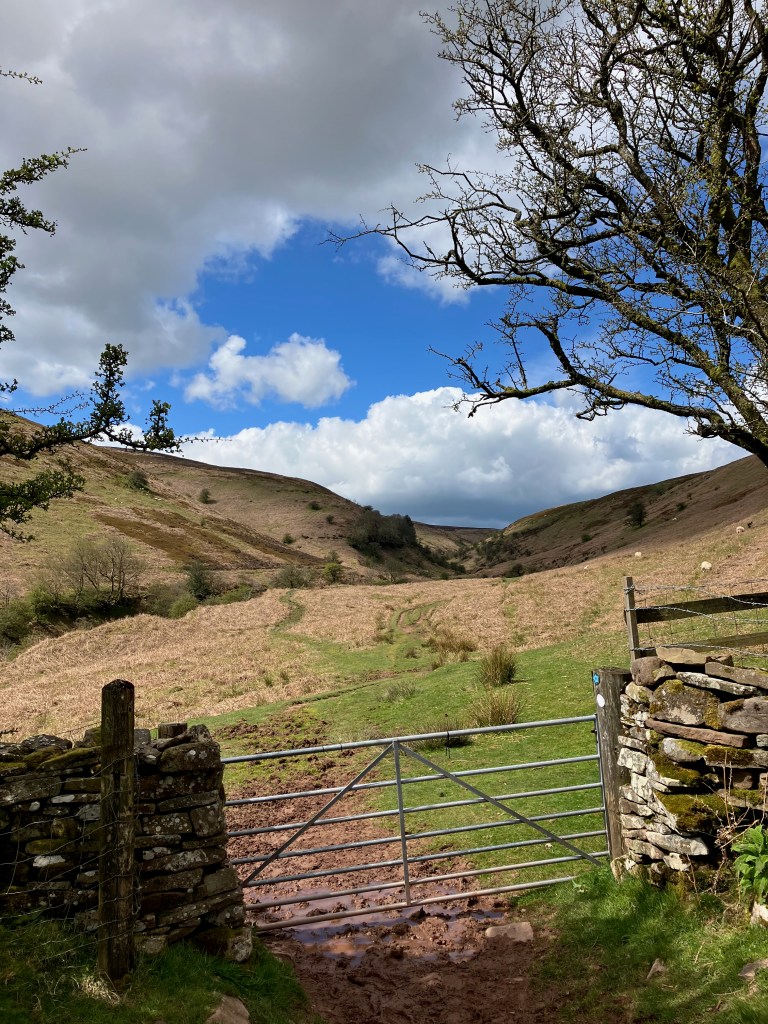
We pass a cottage, once a farm, now a second home, like many other places in the valley. When we were children, the man says, we used to come carol singing here at Christmas — here and the other farms. He sounds happy at the memory rather than sorrowful at the fact that nearly all the farms hereabouts have been bought up by strangers from across the border, people from London and Bristol. But it makes me sad; no, it also makes me angry, but my anger is pointless, and not directed at any particular individuals, just at the disappearance of a way of life, sadness at the death of a small community, fragile as it was.
We approach the Grange, a large house and pony trekking centre, and the man explains that he has arranged to stop off for tea with an elderly relative who lives there. I continue alone, and climb to the Ffawyddog, where I take a break at a rock called the Blacksmith’s Anvil, sit and eat my sandwich, drink tea, and enjoy the view over the moor towards the Grwyne Fawr reservoir.
Within fifteen minutes, the man reappears, climbing the hill behind me. He has caught up with me, as I guessed he would, and stays a while longer, munching on a sandwich of his own. I tell him I wrote a novel set in the valley — The Blue Tent — and he expresses interest, and surprise, because he thought he had read everything published about the place. I tell him I’ll send him a copy, and he scribbles out his address in pencil, on a small notebook he carries with him. The taking of pencil and notebook on a walk in the hills reveals something about a person, I feel. My handwriting has improved since I retired, he comments, with a wan smile, although I have said nothing. I assume, correctly, that he will want to continue on his own, as he is a fast walker — ‘no one keeps up with me except my brother’ — and he needs to be at the Llanthony car park at 4.15 pm for his lift. There’s no way I could keep up with him, although I am no slouch myself. I let him leave, and within a couple of minutes he is almost out of sight. He stops still, briefly, near the rocks at Chwarel y fan, and it is a replay of the first time I saw him, above me on the hillside across the valley, silhouetted again the sky, statuesque, looking about him. And he vanishes into the amber light of the ebbing day.






 Richard Gwyn