To be always the same person
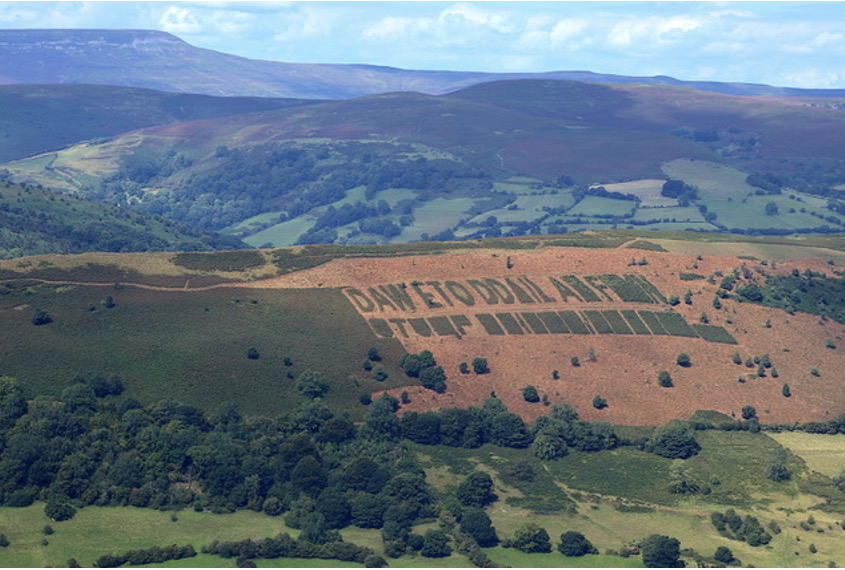
I have driven past Bryn Arw countless times on my way to the Vale of Ewyas and Llantony, but only became aware of it as a separate entity about three years ago when a graffito appeared on the hillside, carved, as it were, into the ferns: ‘Daw eto ddail ar fryn’ — which means ‘There will be leaves on the hill again.’ The line is a play on words, intentionally mis-quoting a line of poetry popular across Wales during lockdown – ‘Daw eto haul ar fryn’, meaning ‘There will be sunshine on the hill again’. The words were carved into the hillside by a local charity called ‘STUMP UP FOR TREES’ / ‘CEINIOGI’R COED’ who are intent on an ambitious replanting programme that will help improve biodiversity in the area. They hope to plant one million trees on hillsides and marginal agricultural land across the area.
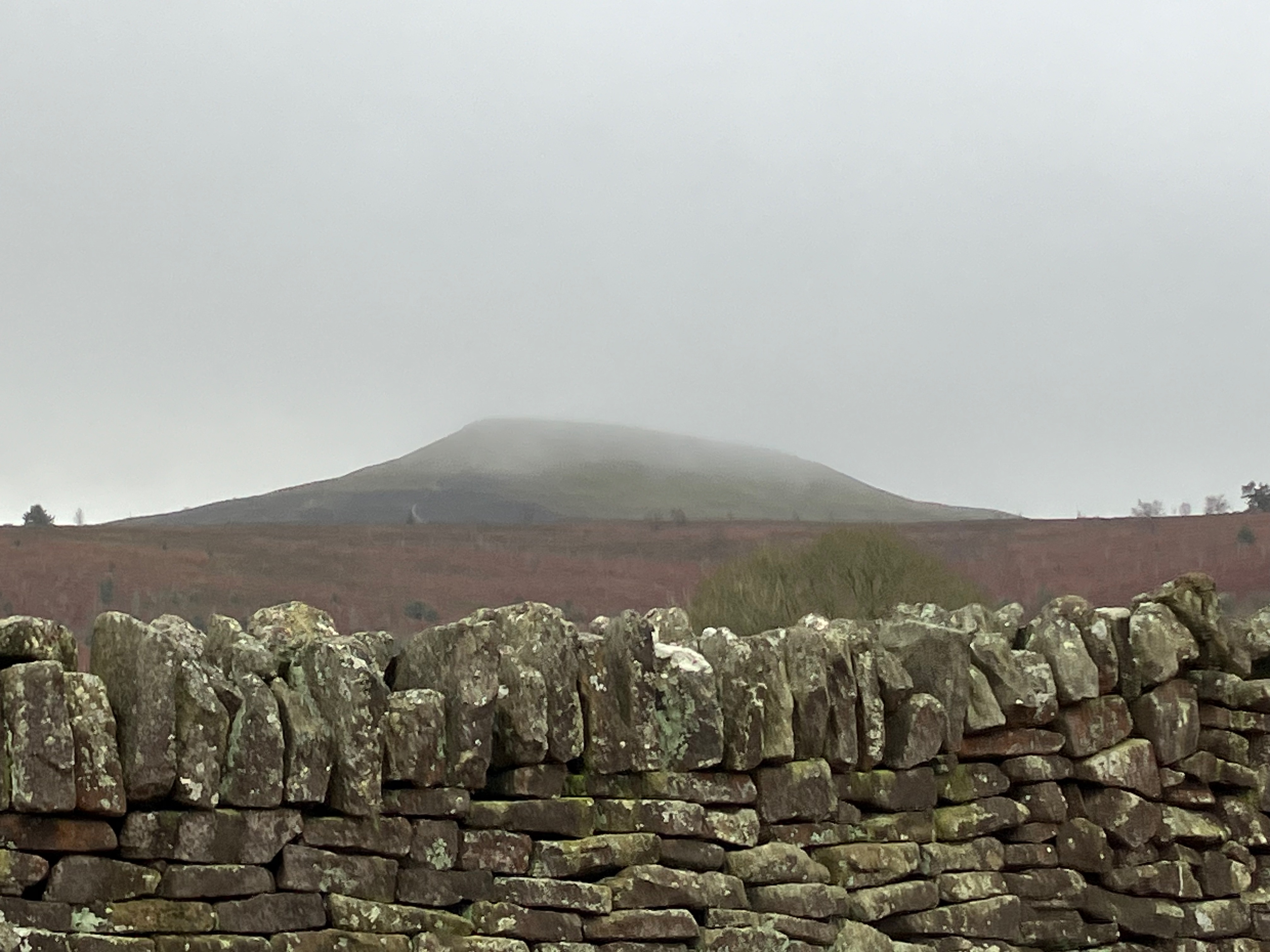
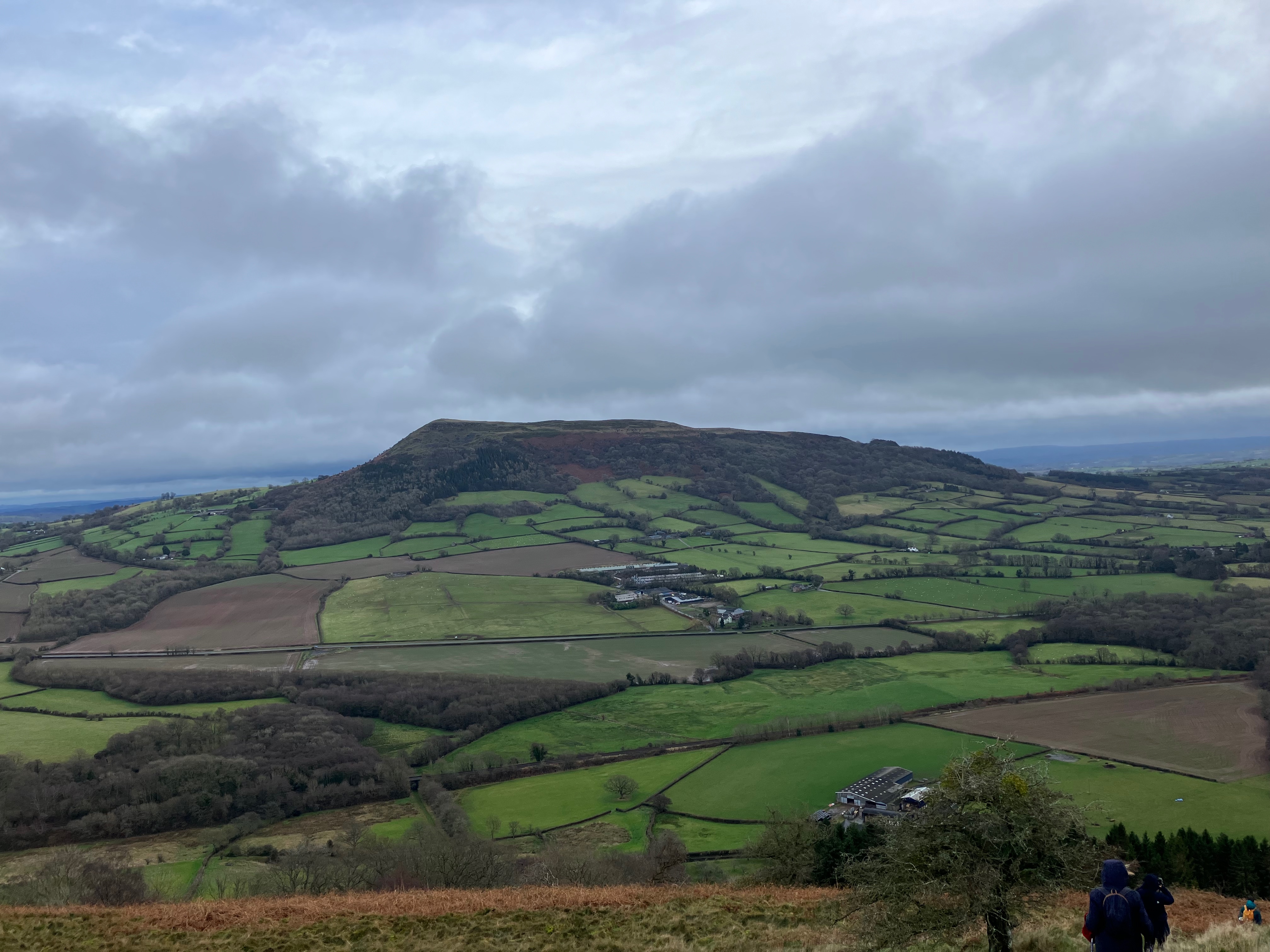
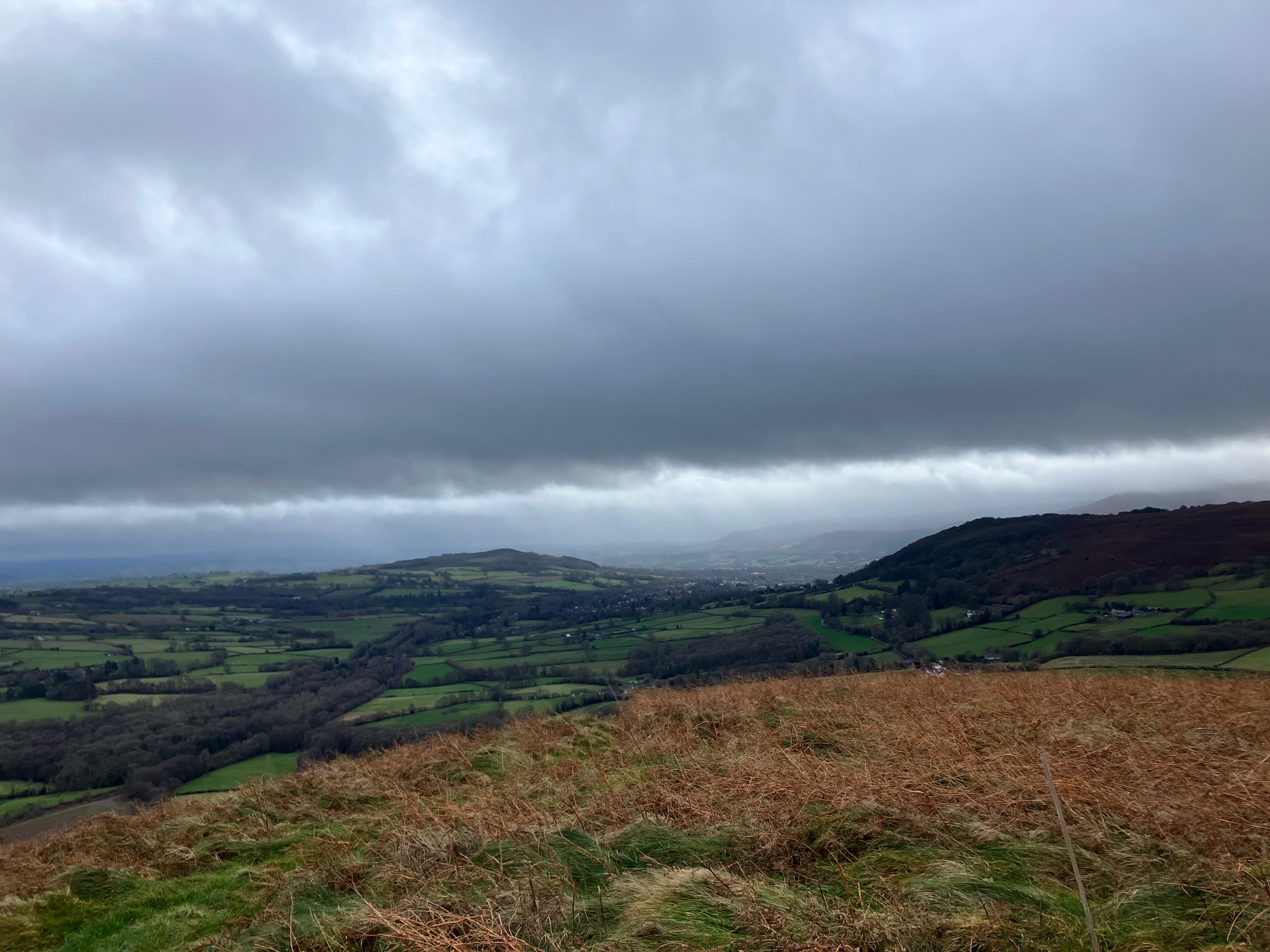
I walked Bryn Arw for the very first time last Christmas Eve. It turned out to be the windiest of days, and I set out along with a few family members and a borrowed dog, a scruffy but amiable mutt named Bluey. We all needed to get out of the house before Christmas indolence melted our brains. First we hugged the lower reaches of Pen-y-fal, or the Sugar Loaf, before turning east and climbing to the long ridge of Bryn Arw. Here we were so buffeted by the southwesterly wind that it felt almost as if the next gust might lift our bodies from the ground and drive us high into the air, depositing somewhere in the green fields of Herefordshire.
The strange thing about walking Bryn Arw is that, never having walked it before in this lifetime, I have no memories of it, unlike almost all the other walks I do around these hills. And that, I realise before we are half way up, makes a difference. When I am walking around Llantony or Capel or Ffin or the Grwyne fechan valley, I am brushing up against the countless versions of myself left hanging around from previous excursions. At times a sense memory washes over me of having been present at this spot many times before, and that makes a difference. How does it make a difference? How does it ‘feel different’ on Bryn Arw to being in a place you know intimately? ‘The difference is that on Bryn Arw I am, after a fashion, a new version of myself and have no comparators. I am aware of being in a new place with distinct perspectives and views of the hills around about. For example, looking out towards Partrishow hill and Crug Mawr behind it, I am looking at places I know well from a new angle, and that seems to correlate precisely — albeit in a rather minor way — with occupying a distinct version of myself from the one on previous visits.

In his Meditations, Marcus Aurelius considers it a virtue “to be always the same man” , which suggests to me as much a Roman adherence to manly qualities as an insistence on a continuity of self. But in order to be always the same person one needs to be in possession of a sense of self in the first place, one that is continuous over time. However, it seems clear to me when considering an event or series of occurrences in my past, that the ‘I’ that is doing the remembering in the present is not the same ‘I’ that is being remembered. Or, to put it slightly differently — and following on from an argument famously put forward by Galen Strawson — they might have happened to Richard Gwyn but they didn’t happen to me, as I am in this moment.
This perception of ‘myself’ is further complicated by the fact that at key, or seemingly pivotal points in my life I have always experienced a strong sensation that I am detached from myself in a significant way, as though looking on from a slight distance as ‘I’ — the physical entity I recognise as RG — undergoes stuff happening. Thus I am these two distinct entities — the experiencing self and the detached disembodied thing that is also ‘I’ but somehow independent, ‘above’ or ‘outside’ of me, and yet simultaneously the most intrinsic, innate version of ‘me’ (at least as far as I can tell: it is quite possible that within the lifeworld of that more intimate, innate ‘me’ lurks yet another more intrinsic version, and so on, peeling away the versions like onion skins). When looking in the mirror, for example, the physical form that looks back at me — RG, to others — is somehow ‘not me’, but the form or person that I temporarily inhabit. This corresponds with the idea that sometimes I am observing myself thinking, and even observing myself as if from outside myself, as described at one or two points in these posts. I imagine this is fairly common, but I don’t know or whether its increasing frequency in my life might be accounted for by my historical consumption of mind-altering drugs, or some other cause, such as the recurrent insomnia from which I have suffered for much of my life. Perhaps this is significant. Insomnia brings about a sense of detachment, an impression that nothing is quite real. I was reminded of this, coincidentally, by watching the movie Fight Club the other night, when the narrator comes out with the line: ‘With insomnia nothing is real. Everything is far away. Everything is a copy of a copy of a copy.’
I’m sure we have all had similar moments, when our sense of detachment from the body — or even the ‘person’ inhabiting that body — is more pronounced, even to the point of feelings strangers to ourselves. On a certain level this happens to us incrementally as we get older.
And I am wondering, as we prepare to move home: how does being in a new place affect not only awareness of your surroundings but also, correspondingly, self-awareness? We often slip into complacency, or a kind of non-seeing when in familiar places, but in a new place — as a tourist, or walking in an unfamiliar landscape — we tend to be more alert, taking in details of our surroundings with a heightened intensity. In some ways, this perception of familiarity versus strangeness carries over into our perception of ourselves within those spaces also. It is as though we harbour the ability to be more aware, or more mindful when the circumstances demand it, or else when we choose to be. And this is something that is useful for writers. When I taught writing classes I would sometimes send students out to write at a cafe in Cardiff market or in one of the arcades, and imagine that they were seeing the scene before them for the first time — as a stranger or a ‘foreigner’, in the extreme sense of the world (someone with no bonds of belonging, someone truly lost). To write from the perspective of one who sees everything for the first time.
Curiously — as though this were a recurring obsession — when I was nineteen, I wrote a short story about such a person, a man who each night forgets everything about himself, his life and his surroundings. But I lost the story or else threw it out. It turned out there was not a lot to say about this man other than that he forgot everything. As such, I was pulling the rug of storytelling from under the feet of my protagonist before I started, since all storytelling resides in memory.


 Richard Gwyn