Elephants in the Alberas
- Other than an early family holiday and a single trip to Barcelona in my early twenties, my first real taste of Catalunya was in 1984. Penniless and without purpose, I was walking down the coastal road from Port Bou to Llança on a June afternoon, when I was caught in a terrific rainstorm. A car pulled in and gave me a lift. The driver was the painter Lluís Peñaranda. So began a friendship that lasted until his death last December.
- I went to an exhibition of paintings by Lluís the year that we met and was astonished by his representations of the landscape of the Ampurdan, that rocky edge of the Pyrenees that flattens out into a plain flanking the Costa Brava. His work is pervaded by an elemental iconography of dark cypresses, multicoloured fish, silver moons. It is a parallel, but distinct landscape to the one the world knows through the work of another son of the Ampurdan, Salvador Dalí.
- Barcelona’s Gothic Quarter. I returned to live in Catalunya in 1988, and settled in Barcelona. The city was preparing for the Olympic games, held in 1992. There was a chaos of excitement that little more than a decade after emerging from the dictatorship of Franco, Barcelona was presenting the new Spain to the world, or rather, the new Catalunya.
- Catalunya used the Olympics to inform the world that it was not Spain. Its policies of linguistic ‘normalization’ (the term used for the dominance of Catalan in all public documents and undertakings) and the fact that all state-funded education took place through the medium of Catalan created a new atmosphere: perceived as legitimate self-assertion by the Catalans; regarded less favourably by many other Spaniards.
- I left Barcelona in 1990, but returned many times over the summers that followed, staying with my young family at different houses in the Ampurdan area.
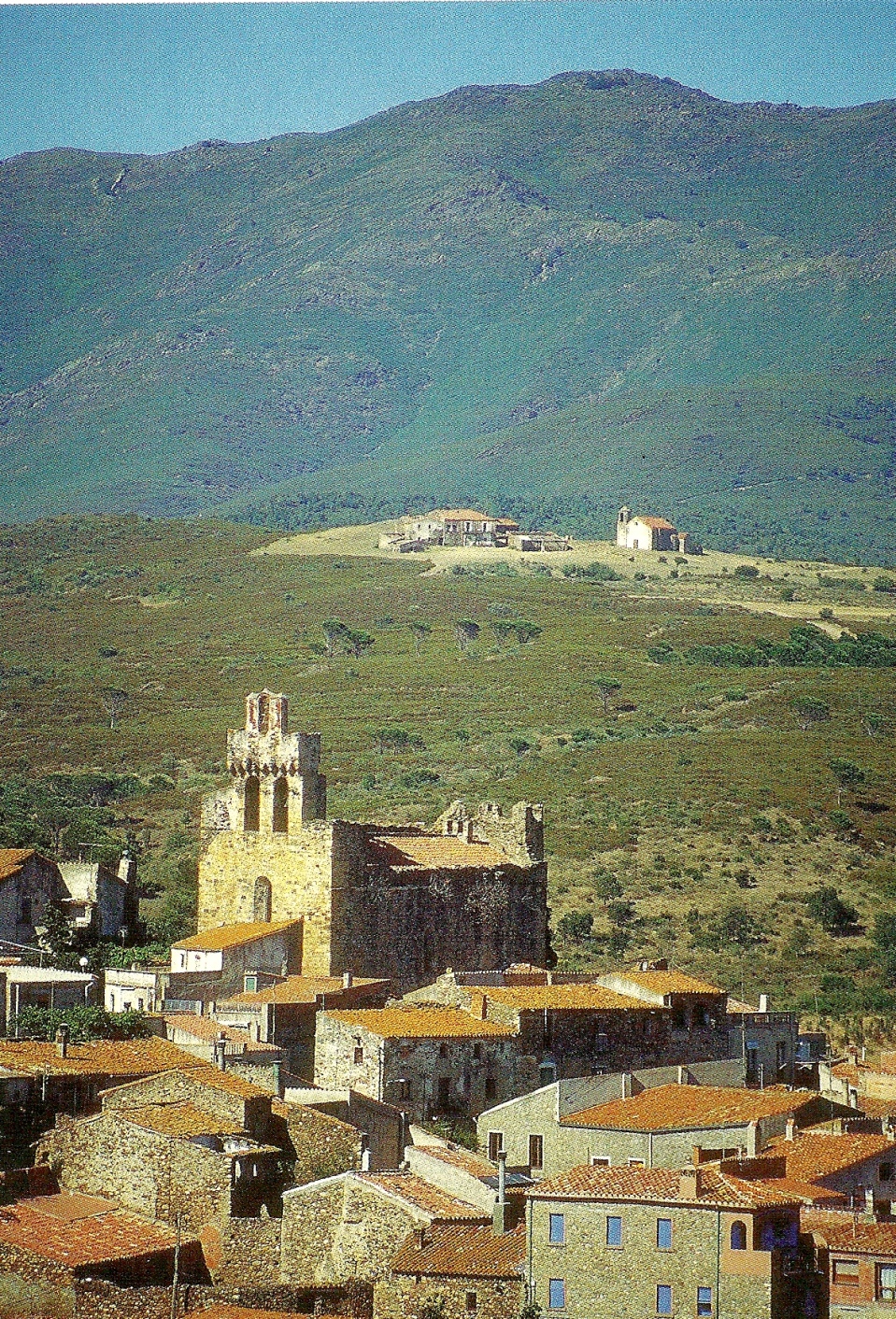
- In 2002-3 we moved to a small hill-village in Ampurdan near the French border (picture above). My daughters attended the local Catalan School and I worked on my novel, The Colour of a Dog Running Away. The following year we bought an old and run-down property in the village. Linguistically and culturally, this area is very proudly Catalan (in contrast to the international and largely Spanish-speaking city of Barcelona). Since I had been coming to the area for twenty years, I had made friends with Catalan writers and artists and got to discover more about the history and culture of this small corner. The Albera Mountains, that extend from the High Pyrenees towards the sea, falling away towards the coast at the northern end of the Costa Brava, are home to many Neolithic remains, notably standing stones (menhirs) and a profusion of burial chambers. I am very fond of a burial chamber, although I have no wish to be buried in one.
-
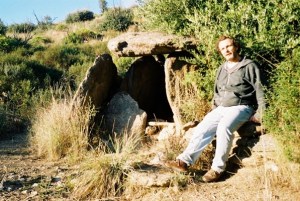
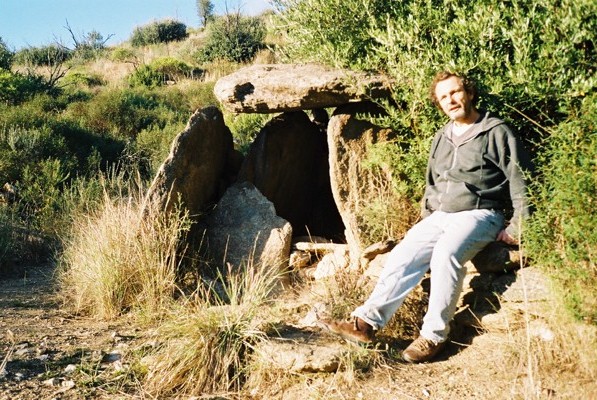
Portly man by Burial Chamber
There were many Jews in this part of Spain before the expulsions of 1492. Many of them converted at that time, and there is a widespread belief that Catalans carry a significant charge of Sephardic blood, whatever that means. Blood is blood. There are no races, only ideas about races, which are mostly based on wrong information or the contrasting prejudices of boastfulness (e.g. a proud Celt) and bigotry (too many examples to cite) . In any case, I like the idea of a dedicated ‘Village of Jews’ in the heart of the Alberas, on the edge of the Cap de Creus.
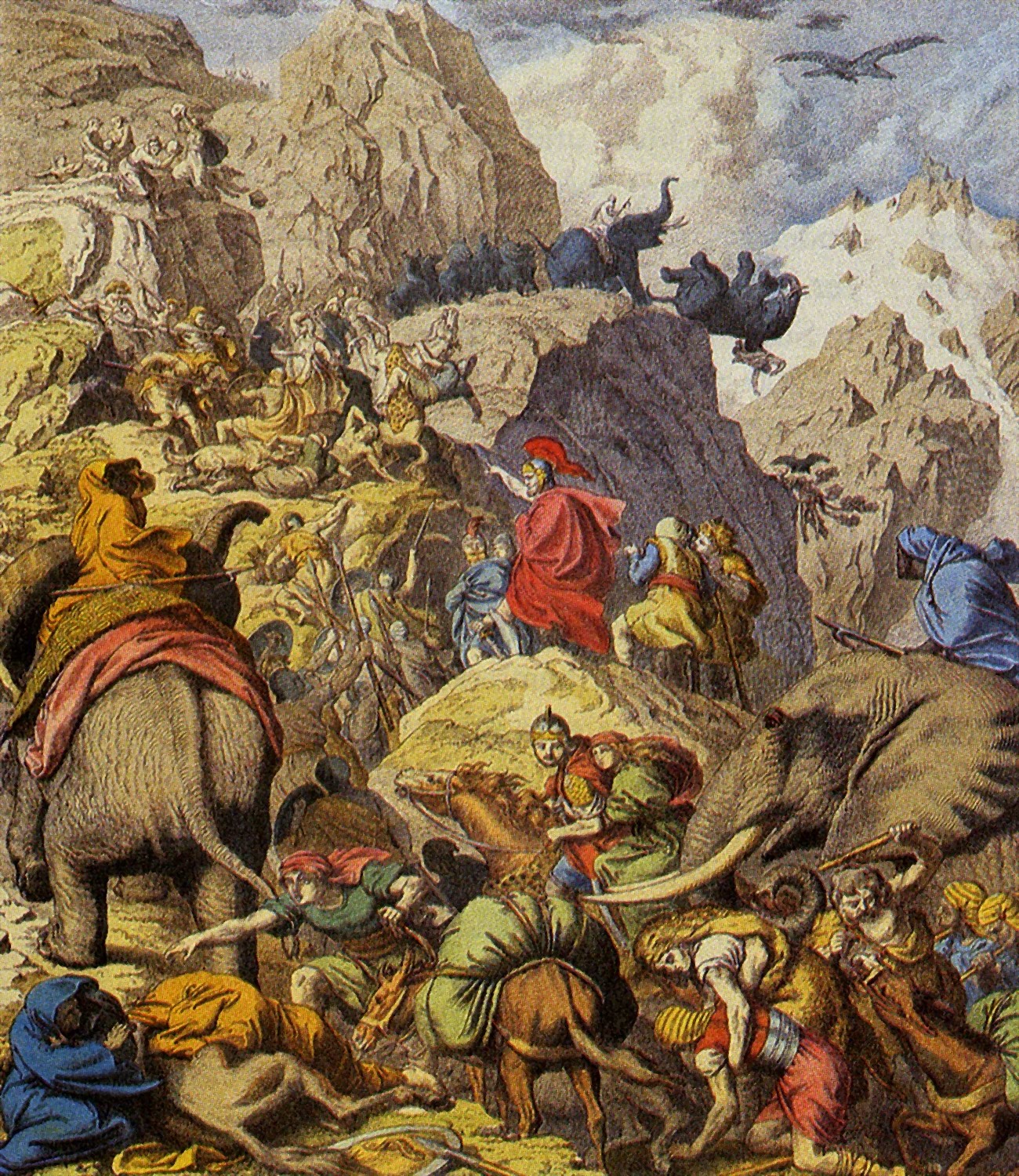
- Further back in time, Hannibal must have crossed these hills on his way to Rome from Carthage. With his many elephants. I find the thought staggering. How did the Celto-Iberian tribespeople view these enormous lumbering beasts and their fierce drivers? The thought led to notes towards a poem a few years ago, not one that I have ever thought to publish, but perhaps it contains the germ of another, better poem, which I will write one day:
Elephants
Elephants passed this way. The children, once their initial terror had passed, stared big-eyed, while clutching their mothers’ skirts, pointing at the swinging trunks as the beasts lumbered across cornfields.
Warriors rode on the elephants, but paid scant attention to the villagers who lined this section of their route.
What were the elephants doing in this well-tended land? Where were their riders’ leading them?
It was said by some that they were heading towards a distant war.
Why would an elephant go to war?
Because they are driven there by the riders.
But how? The elephants are so big and strong. The riders are so puny.
The elephants go where they are driven because that is what they are accustomed to.
The elephants so large.
The riders so small.
The children of this hillside village will tell the tale of the elephants to their grandchildren. It will become myth.
The elephants will never be seen again. They will cross the mountain pass and head into the plains beyond, until they become an improbable vision on the horizon. Specks on a vast green canvass.
The elephants will not return.
Bareback Riders
Sorting through photos on my laptop, intending to send some off for printing, I come across two pictures from February this year, on a trip to Mombacho, in Nicaragua. They are of a very poor quality, but on recognizing them I remember the expression of exhilaration on the faces of the bareback riders.
We had been delivered to the volcano, ascending through a tropics of livid growth, lush greenery, past the coffee plantations, up into the cloud forest; seen the salamanders and monstrous beetles and butterflies and the rare orchids, one of which, Mombachensis, is named after this mountain. Then the long drive down, and as we finally hit the flatlands, two boys, one around ten years old, the other younger, appear out of the bush on horseback. The boys ride bareback and are shoeless, and they are grinning and shouting and yahooing. Their exuberance is contagious even through the windows of the minibus. For a few seconds they are galloping alongside us, before the driver accelerates away. By the time I have my phone out they have fallen behind, and the young riders through the rear window are nothing more than shapes in the road, the sun behind them, the distance between us growing.
The Surprising Lizard
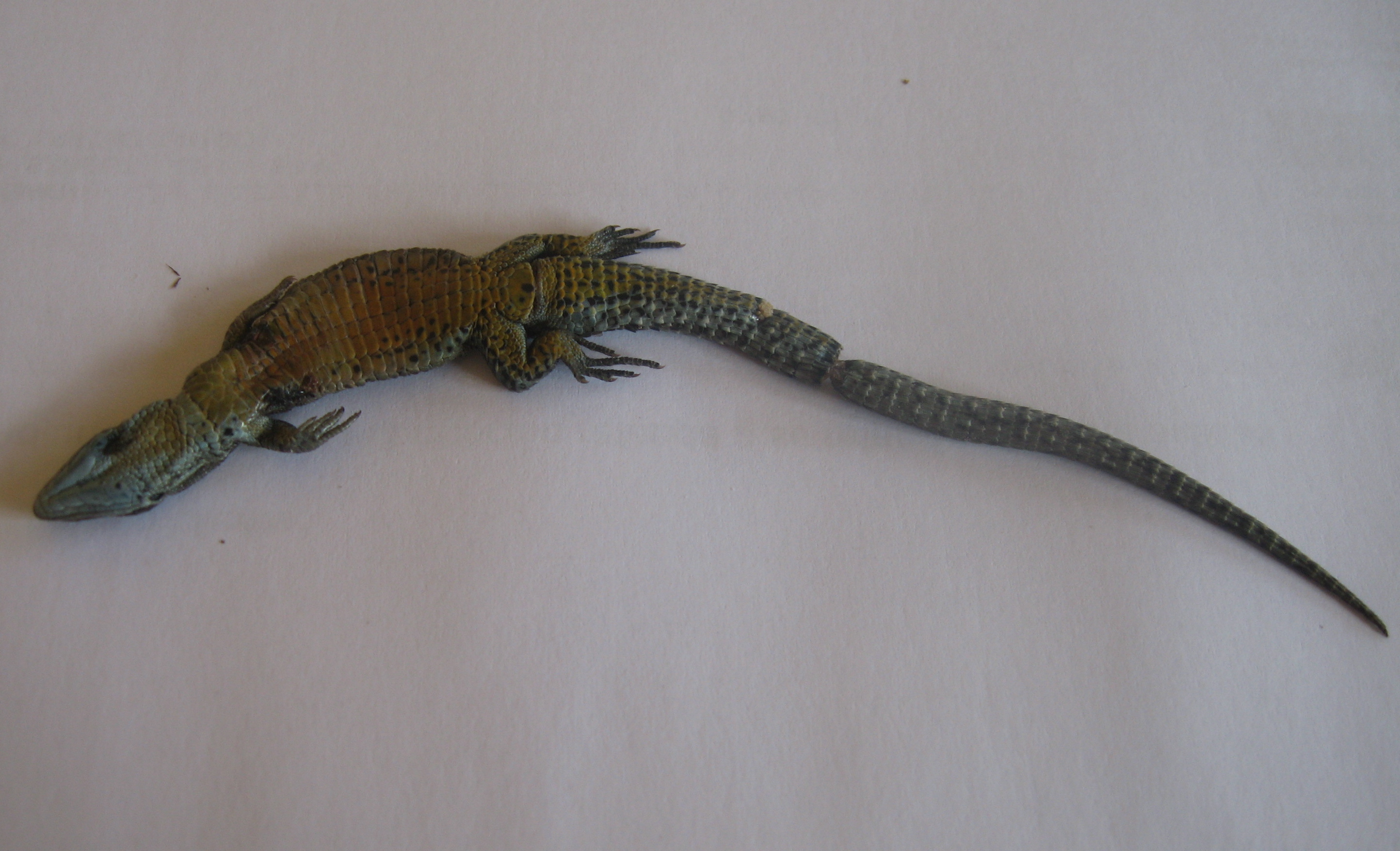
Walking in the Black Mountains I find a dead lizard, belly-up on the gorse. What is it doing here? It is a surprising lizard. I am walking along a long ridge of moorland, with the Ewyas Valley to my right and the Grwyne Fawr reservoir (see picture) to my left.
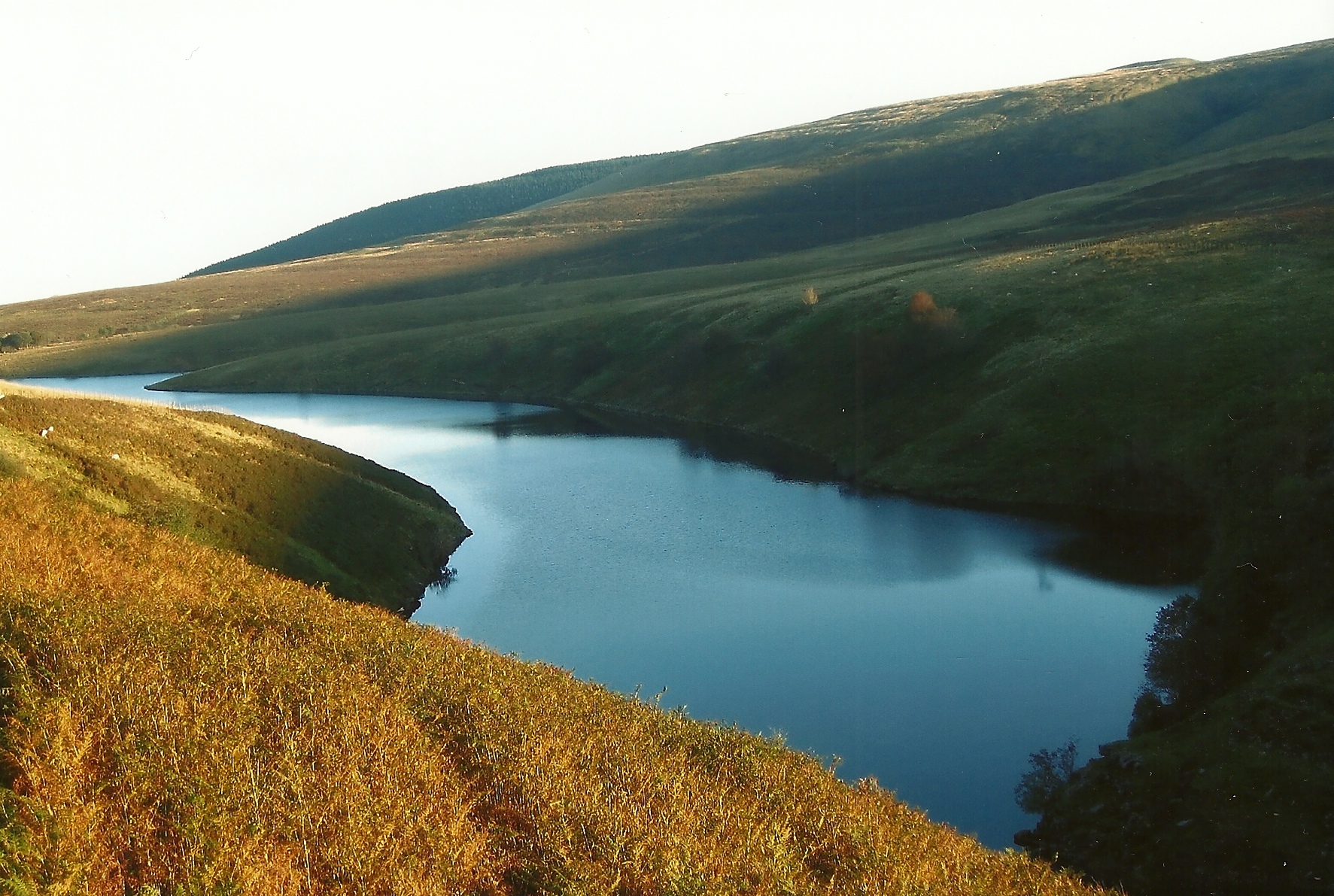
I have never seen a lizard here before, and I grew up nearby, and spent much of my childhood and teen years tramping around these hills. Are they even indigenous to this part of the world, to these islands? In my mind the lizard should live in more southerly zones.
These mountains lie beneath international flight paths. Is it possible the lizard was hitching a lift on an aircraft, lodged inside a crevice in the undercarriage or wheel-well, and was dislodged during the flight, falling many thousands of feet to land in a heap of gorse on the wide stretch of moorland marked on ordnance survey map 161 simply as ‘Y Fan’? Did it climb on board in some sunny lizard-friendly country only to be cruelly ejected over Wales?
I put it in my pocket, and when I get home its tail has broken off, which is upsetting. I place the two parts of the lizard on a sheet of paper to photograph, and try and put the broken-off piece of lizard back where it belongs, but you can see the crack in its tail. Checking out the website ‘Reptiles and Amphibians of the UK’ I discover that ‘you may find one almost anywhere from gardens, heathland, wooded glades, disused railway tracks, open meadows to the banks of ditches and along hedgerows’. They are also a protected species, and it is therefore an offence to kill, harm or injure them, sell or trade them in any way.
I have to confess, that my lizard bears a close resemblance to the male viviparous lizard (left) in the illustration below:
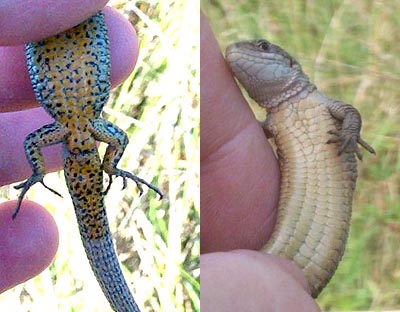
The viviparous or common lizard is one of the three lizard species native to the UK, the other two being the sand lizard and the slow worm, but it is with some reluctance that I abandon the lizard-stuck-to-the-undercarriage-or-trapped-in-the-wheel-well of a plane theory. Does this reflect a need always to prefer an obscure or exotic explanation when a more straightforward one is available?


 Richard Gwyn