Continuing my series of Walks in the Black Mountains. Content warning: alongside description of the actual walks, these extracts also contain my thoughts about writing as well as an amateur’s excursions into the study of consciousness, philosophy of mind and other ontological concerns.
On a Sunday in April, on which, for once, very little rain is forecast, I climb from Capel y Ffin to the Ffawyddog. When I reach the Blacksmith’s Anvil, I rest and eat a breakfast of two small bananas. Now that I am stationary, a hiker, of whom I have been dimly conscious at my rear for a while, catches up. At first I think this will be a repeat of my last walk in these parts, and half expect to see the man from Capel y Ffin, but it is not, although he bears a certain fleeting similarity to that person. He greets me with a comment about the weather having turned out fine, which it has, after a fashion, though it is cold for April, and I am wearing layers, a woollen hat and gloves. The Blacksmith’s Anvil grants a wide-angle view of the moorland before me, and the familiar sight, nestled within sloping hillsides, of the Grwyne Fawr reservoir.
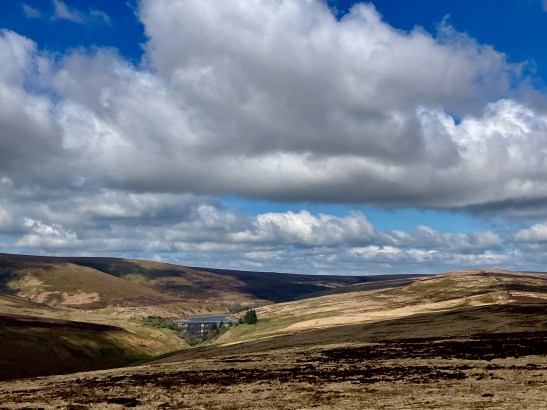
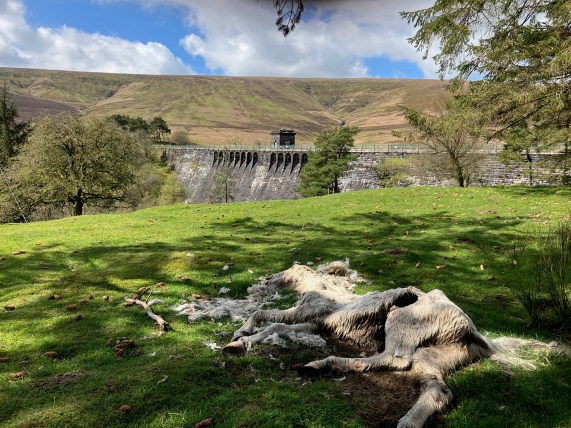
I set off along the narrow gravel path that now defines the crest of the Ffawyddog, turning off at a diagonal (10 o’clock) to the left to pursue the boggy track down towards the reservoir. Near the dam lies the sad, excavated remains of a young pony, a common enough sight hereabouts.
Following the stony banks of the reservoir (the water level is low, which casts into doubt the enormous amount of rainfall we have received these past eight months) I encounter two men in baseball caps, fishing, casting out into the placid deeps. When he sees me, one of them waves in a cheery fashion. There is no evidence of any catch, they don’t even have bags in which to carry fish, no gear, nothing. How on earth did they get here? It occurs to me that they are the ghosts of lost fishermen, or visitors from another world. I dismiss the thought, but not without some resistance.
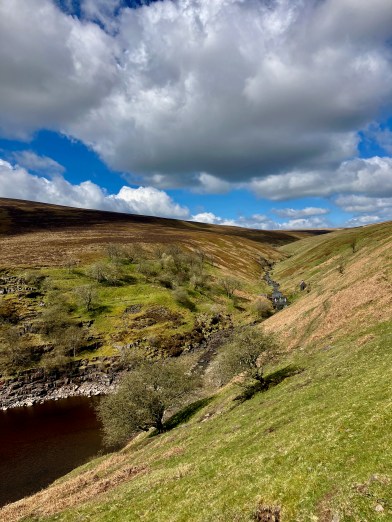
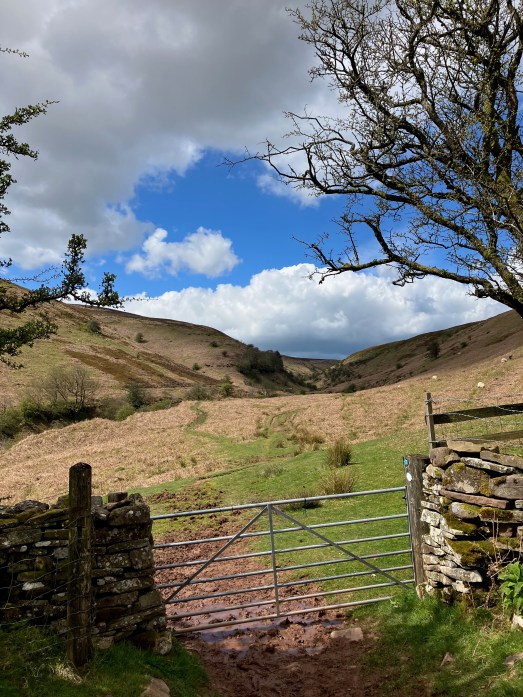
So I continue the gentle climb upstream towards the source, and there are no more people on this lonely, lovely stretch of the Grwyne Fawr, and I stop to eat my sandwich near the spot where two summers ago I ruminated on the meaning of Providence, and thence (pursuing the analogy of the Black Mountain massif as a hand) to the heel of the palm, more specifically Pen Rhos Dirion, and it is a short walk to the Trig point, at which I arrive precisely as do three middle aged hikers, two male, one female, one of whom, a bulky man with a Midlands accent, has an irritatingly loud voice, a forceful and insistent bellow (why does he need to shout as he walks along these hill tracks, attuned almost exclusively to scattered birdsong, the whistling of the wind and near-silence; why must he shout so? Why does he believe his voice is so worth listening to?) And I hasten my steps, break into a loping canter as I descend the slope towards Rhiw y Fan, and when I turn south-east, following the nascent stream called Nant Bwch, I am relieved that the loudmouth and his companions do not follow.
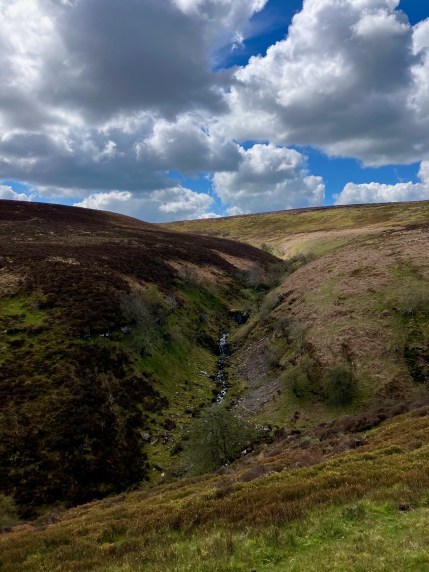
A solitary red kite circles, guardian at the portal of this narrow valley. With the familiar descent, and the comfort it brings you now that you are alone again, apart from the pipit and the chiffchaff and some other bird you cannot name, you return once more (almost in spite of yourself) to the perennial questions of who you are (or who you were) and what you are doing, especially with regard to what you write, and remember that the writer who has given you most pause for thought on this subject in recent weeks is M. John Harrison, who begins his ‘anti-memoir’, Wish I was here, with these words:
‘When I was younger I thought writing should be about the struggle with what you are. Now I think it’s the struggle to find out who you were.’ His use of the past tense is telling.
Harrison talks a fair bit about the notebook, the writer’s journal, and its function. He makes the astute claim that as a means of recording events, keeping a notebook doesn’t really help (‘writing things down helps less to close that distance than you’d think’) — while conceding that ‘notes make good source material, and when you keep notebooks they eventually begin to suggest something. About what, is not clear. But something, about something.’
I like his vagueness, and at the same time, vaguely distrust it.
As an adolescent, like Harrison, I had nothing set in place, no strategy for achieving adulthood. I suspect that some of my contemporaries had; at least a few of them had absorbed or internalised what was expected of them, but I did not. It was a condition that pursued me long into adulthood itself, exacerbated no doubt by my extravagant intake of alcohol and psychotropic drugs, which, somewhat ironically, I perceived as means of achieving greater self-knowledge, or even as aids on a spiritual quest of sorts. They were not, except as a means of learning that sobriety would serve me better. I would say I did not have a clear, or even any idea of who I was until my own children were born, or shortly afterwards.
Harrison, in his book, returns many times to the notion of his own identity, when he writes of his seventeen-year-old self: ‘I was dying to be someone but I didn’t know how’.
(These are perfectly reasonable thoughts to be having at seventeen, but at 37, or, God forbid, 67? You discover, however, that such thoughts are nor unusual, at any time of life. Some of us are permanently and persistently in search of ourselves. Time, or rather age, helps with one thing: accepting that we might not be a single, cohesive story. We might be many stories, some of which contradict or cancel out others, but all of which are valid; all of them constitute an element of the multifaceted and fragmented self.)
Later in the book, Harrison returns to the theme, always in relation to his writing: ‘The problem of writing is always the problem of who you were, always the problem of who to be next. It is a game of catch-up, of understanding that what you’re failing to write could only be written by who you used to be. Who you are now should be writing something else: what, you don’t know until you try.’
Well, that rings a bell, and for me it resonates with the notion of always starting out, always just beginning, everything feeling new, about which I might, if I were minded to, quote Saul Bellow, who wrote “I have the persistent sensation, in my life . . . that I am just beginning.” This side of things, the ‘feeling new’ side, is, more than anything else, what keeps us going as writers. It is also a feature of certain meditation practices; that one is only ever setting out from the present moment. That there is, in a certain sense, no other time than the present.
Do we ever, though, truly inhabit our own skin? Are we not always at a slight remove from ourselves, one way or another? Experiencing the ‘self’, the person that stuff happens to at a slight distance? Isn’t this key to what you are doing as you walk and as you write? (If you have decided these two activities are the things that define you best). Is it not an examination of walking as the thing you do to keep moving, keep going, one step in front of the other, in rhythm with the breath? Left foot, right foot; breathe in, breathe out.
Cerdded in Welsh is to walk. Cerdd is poetry and/or song. You have long held this correspondence in mind, and it is one that seems the key to a kind of understanding. To walk, to breathe, to write, to sing: could there be a sweeter, simpler way of resolving the matter — at least for the present moment — of who or what you are? It is with this thought in mind that I can be free, or at least temporarily less bothered by such concerns as the one posed by Harrison, that ‘the problem of writing is always the problem of who you were’ — because it needn’t be.


 Richard Gwyn
Beautifully said. I long for those slopes I have never walked.
LikeLike