Richard Gwyn

Brief from Nicaragua

At four in the morning there is a noise of riotous celebration from the nearby square, but I cannot be bothered to make it to the balcony to discover its source. Then there is an hour or so of quiet before the deafening screech of birdsong that signals both the beginning and the end of daylight in the tropics. From the trees circling the park hundreds of birds dance, joust, leap and dive in a frenzied avian fiesta.

 

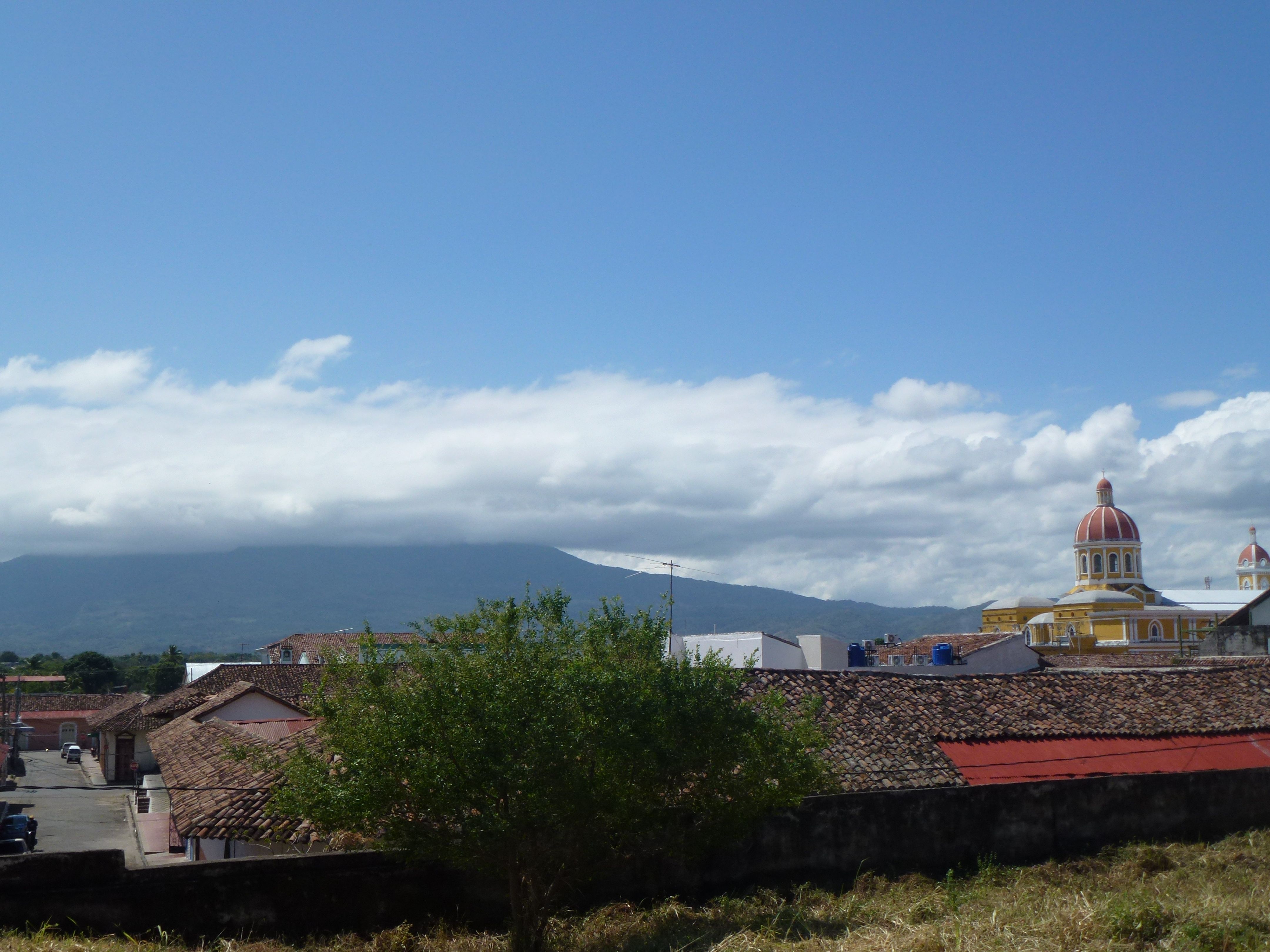
Cloud forest at Mombacho


Yesterday began with an excursion to the cloud forest volcano of Mombacho – in which we saw howler monkeys

 

howler monkey from rear


and many birds, including the black headed trogon (trogón cabecinegro, in Spanish) pictured here,

 

Black headed trogon


after visiting two coffee plantations, sampling their delicious brews, and witnessing a possum asleep in a bucket

 

Possum in a bucket
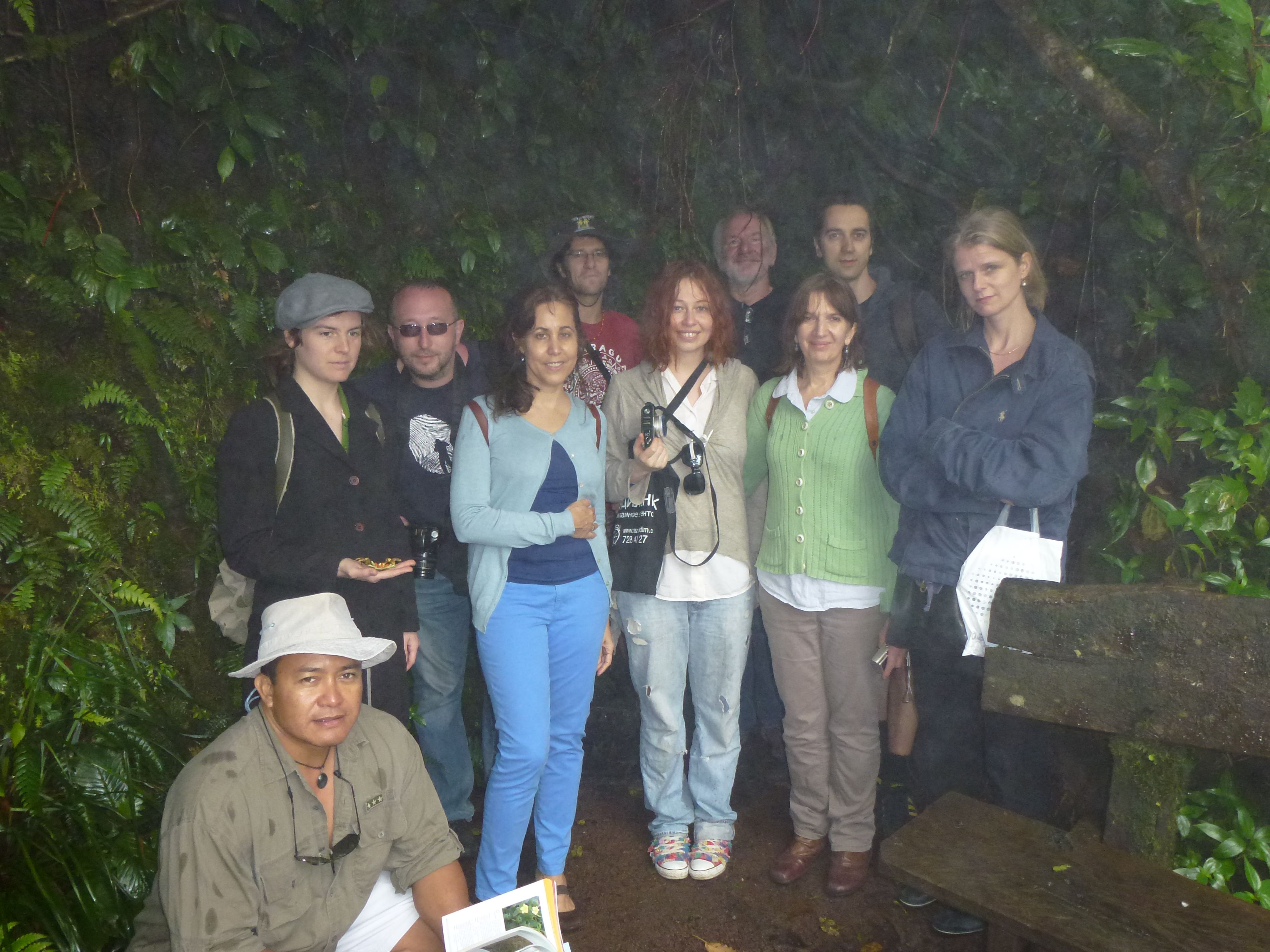
Our excellent guide José, and friends, at Mombacho


– and concluded with an interminable poetry reading, extremely mixed in quality, but beginning with a single (new) poem by Ernesto Cardenal on the sacking of the museum of Baghdad, and ending with Derek Walcott, again reading a single poem, Sea Grapes. Between these two octogenarian maestros – and with one or two exceptions – a number of distinctly indifferent poets went on for far too long, though I will refrain from mentioning the worst offenders.

Granada is an extraordinary festival, which is growing in importance and recognition, but which needs reining in and the exertion of greater balance in the selection of invited poets. This year, like last, I have met some wonderful individuals, made new friends, and learned a lot, but have also had to listen to far too much bad poetry. Fortunately, Walcott’s Sea Grapes does not fall into this category.


 Sea Grapes

That sail which leans on light,
tired of islands,
a schooner beating up the Caribbean

for home, could be Odysseus,
home-bound on the Aegean;
that father and husband’s

longing, under gnarled sour grapes, is
like the adulterer hearing Nausicaa’s name
in every gull’s outcry.

This brings nobody peace. The ancient war
between obsession and responsibility
will never finish and has been the same

for the sea-wanderer or the one on shore
now wriggling on his sandals to walk home,
since Troy sighed its last flame,

and the blind giant’s boulder heaved the trough
from whose groundswell the great hexameters come
to the conclusions of exhausted surf.

The classics can console. But not enough.


Or you can listen to Walcott reading it here.


Filibuster in Nicaragua

Of all countries of the world, there is a special place for those that have endured a suffering and a struggle for definition against powerful enemies both from within and without. Some of the struggles and mortifications that a people endure have become almost mythic and have come to stand as an example of human suffering that stretches beyond the countries concerned: they become, in a sense representative and definitive. Over the past couple of centuries there have been countless examples of the extremes of human conduct, in which small groups of people inflict their will on the majority. Nicaragua, although relatively small, must be counted among the most afflicted of countries in this respect. A series of dictatorships here have condemned the bulk of the population to obscene levels of poverty over generations, but less well known is the role played by influential foreigners. Few can compare in this respect with William Walker, the subject of an epic poem by Nicaragua’s great poet Ernesto Cardenal.

William Walker, the American son of a Scottish banker, exemplified a type of expansionist vision of what North Americans might make of their back yard, and he was evidently a scoundrel of the first order. He set out for Nicaragua in June 1855 with a small force of mercenaries and his plan was to colonise the country as a new slave state, to be settled by North American Anglos, who would own the land and the plantations, and import black slaves – who would do all the work. Eventually he planned to settle and colonise all of Central America as a slave-based empire to compensate for the abolitionist tendencies that were to drive the United States towards civil war a few years later.

His plans went well at first, his well-armed battalion of troops taking on the local army from Granada, which he made his base, before launching attacks into Leon and other regions. Walker declared himself president, invented a new flag for the country, confiscated all the lands owned by those who opposed him, made English the official language of business, and gained the recognition of the US government as head of an official state. His apparent invincibility came to an end when the Nicaraguans decided they’d had enough and rose up against him. After several bloody battles, he fled Granada by steam-boat, across Lake Nicaragua to the Caribbean, but not before his mercenaries had raped and massacred to their fill in a drunken killing spree,   and burned Granada to the ground.


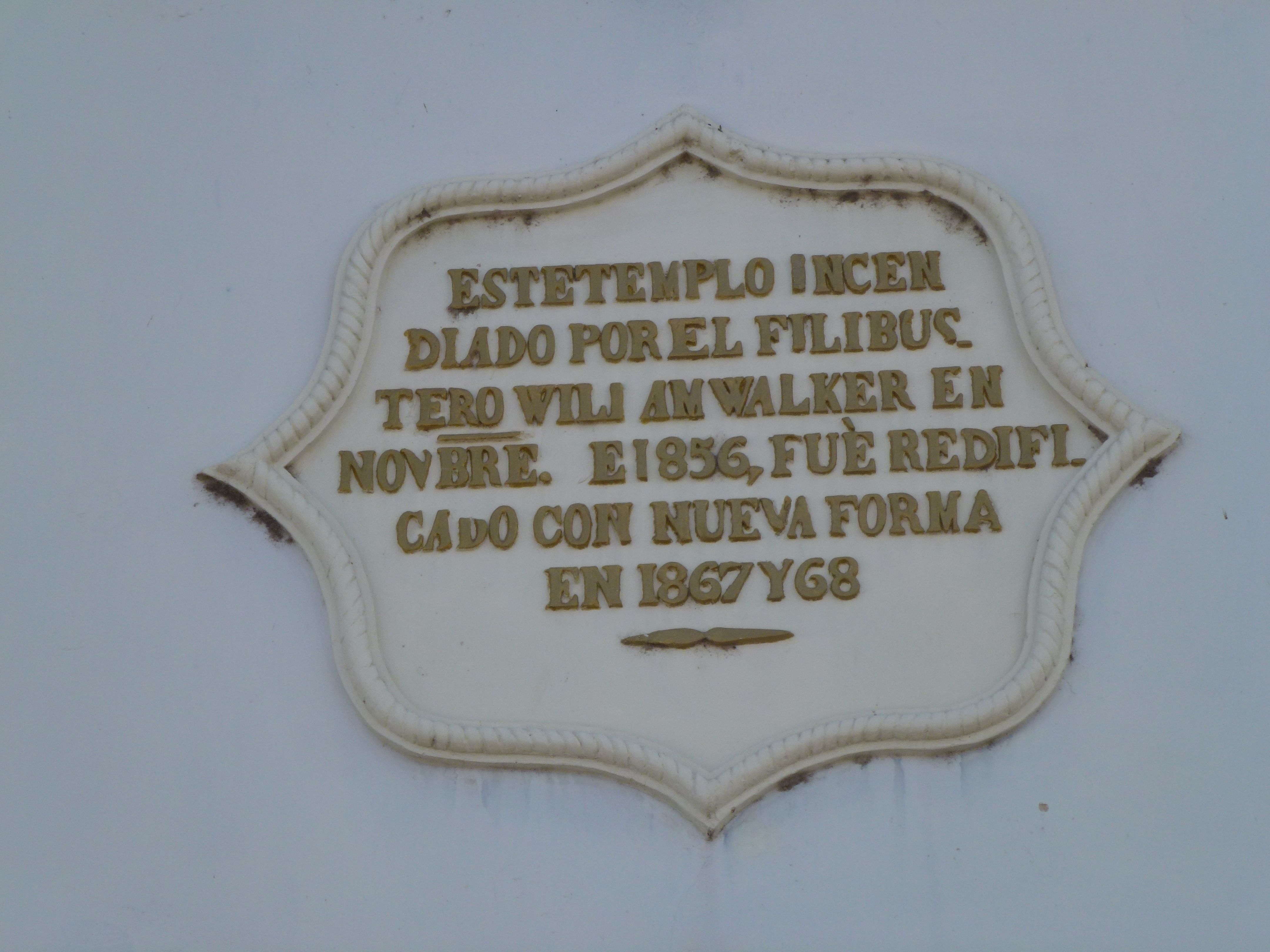
According to the plaque, the church of San Francisco was re-built in 1867, twelve years after the filibuster (delightfully, filibustero in Spanish) William Walker left Nicaragua. He had another throw of the dice in Honduras, but was captured by a British naval officer, Captain Salmon, and handed over to the Honduran authorities, who had him shot, an action that was long overdue.


The Monstrous Encumbrance


I’m not sure if there’s a suitable analogy in human terms, but imagine if ninety-five per cent of your perceptual faculties were concentrated in your snout, and then someone came along and stuck a bloody great fence around said snout, detaching your sensory facilities from the rest of your body and from the world. You would be distraught, would you not?

This is what occurred to Bruno the dog yesterday, following an operation on his front paw for an infected nail. Once the bandage was removed it was imperative that he refrain from licking his foot, the only task that interested him in the world now that he was unable to leap around and chase things.

Once we had secured the monstrous apparatus, the giant cone, around Bruno’s neck, he was so bewildered, so outraged at what had befallen him that he remained standing in the same position for three hours, without moving a muscle. For a creature that is normally a frenzied mover, an animal that proceeds with life at ninety miles an hour during all waking hours, this was some achievement. It was as if, cut off from everything that he knew and could identify, he were suddenly suspended in a kind of isolate hell. I had to go out to deliver some papers to the university, and have a swim, and when I came back, he was still there, stock still, waiting for the world to return to a recognizable form, for this ghastly hiatus to be terminated, for normal time to resume.

During the night a mournful howling awakened us, the embodiment, in sound, of infinite sorrow, and I stumbled downstairs to find Bruno in a state of abject misery. This is a dog that has never howled at night, even as a puppy. I grabbed a spare duvet and came and slept on the sofa, to keep him company, and he calmed down. I guess it must seem like some kind of torture to him. What is more, today he has to go to kennels, and quite obviously all the other dogs are going to laugh at him, I mean it’s only natural. They are like humans in that respect; mock the afflicted.

I woke up at a quarter to six after a few hours’ poor quality sleep, knowing that at four o’clock tomorrow morning Mrs Blanco and I are due to set out on a twenty-four hour trip, involving flights from Cardiff to Amsterdam, Amsterdam to Panama – what kind of person flies the dodgy-sounding Panama-Amsterdam route? I will tell you some time, but it’s not pretty – and finally Panama to Managua: I’ve done it before and it’s a bastard of a journey, though it beats going through the US homeland security farce.

So, I woke up at stupid o’clock obsessing about the giant cone attached to my dog’s neck. During my slumber, the appalling encumbrance had become an allegory, had taken on almost spiritual dimensions, and once you begin obsessing there’s nothing to do, of course, other than sit up and start writing about it.

I realise that not all my readers are going to be interested in canine matters, but that is not the point; this is not about dogs, this hideous appendage is a metaphor for just about every encumbrance we put between ourselves and self-realisation. It is about ontological crisis, a state of pure existential terror. Think about it. Pity poor Bruno.

Not unrelatedly – everything seems related some days, don’t you think? – I found myself watching a Top of the Pops from 1977 last night. Musicians featured included Thin Lizzy, David Soul and the hideous Gary Glitter, gurning and winking at the camera as he implored someone (no doubt a nine-year old Vietnamese) to hold him close. I shuddered. And how weird everyone looked: did we all look like that back then? Did 1977 really happen?  Now, Gary Glitter, he would look good in one of those collar contraptions, and a padlocked gold glittering jockstrap . . . and there’s an image to travel with . . .


Burying poverty and misery


The banner photograph at the top of Blanco’s Blog was taken last year in Granada, Nicaragua at the VII International Festival of Poetry, towards the end of a rather hectic afternoon, on which misery and poverty were cast into Lake Nicaragua, encased in a coffin. Whether or not it worked I am yet to see, but am returning to Granada this weekend, with Mrs Blanco, so may find out. I doubt very much whether Daniel Ortega’s re-election as president will have secured the objectives aimed for by the coffin-carrying devils of last year, pictured here by the Scottish poet Brian Johnstone, but next Wednesday, apparently, Las Lágrimas del desamor or the ‘tears of indifference’ will be done away with and buried. We’ll see how that goes.

But to return to the photo on the blog’s banner, a couple of people have pointed out how the black-masked demon pops up behind the three amigos: he is easy to miss, as he seems an integral part of the background. This picture has haunted me for a long time, and I have practically no memory of taking it; everything was happening very quickly, and I certainly didn’t notice the reaper coming up on the left.

The Festival is held every February in the ancient city of Granada, supposedly the first to be built by the Spanish on the American mainland. Poets are invited from around the world: last year over fifty countries were represented by around a hundred poets.  My main interest is concerned with a project I have been working on for the past eighteen months: I am putting together an anthology of contemporary Latin American poetry.  This year, apart from the many poets from Latin America who will be attending, there are big names from the English-speaking world: Derek Walcott and Robert Pinsky (as well, of course, as my other Scottish compadre, Tom Pow).

More will follow.

The resentment and insecurity of the poet


Pedro Serrano points me towards an article in the current New York Review of Books, about William Carlos Williams. In it, Adam Kirsch mentions Williams’ sense – whether it was true or not – of having been scorned by Pound, and other acquaintances, writing: “I ground my teeth out of resentment, though I acknowledge their privilege to step on my face if they could.” T.S. Eliot comes in for some particularly harsh judgement: “Maybe I’m wrong”, he wrote to Pound, “but I distrust that bastard more than any writer I know in the world today.”

And yet, Kirsch, reminds us, “If you look at the lingua franca of American poetry today – a colloquial free verse focused on visual description and meaningful anecdote – it seems clear that Williams is the twentieth-century poet who has done most to influence our very conception of what poetry should do, and how much it does not need to do.” It might be added that D.H. Lawrence carried out a very similar seminal role in British poetics.

There is much else that is good to think with in this article, some of it coming from Randall Jarrell, an acute reader of Williams, whom he considered “an intellectual in neither the good nor the bad sense of the word.” I think I know what that means, but maybe not . . .

In his autobiography Williams claims that what drove him to write was anger – somewhat like Cervantes – and his anger was clearly kept warm by his self-doubt and insecurity, his dislike or loathing of certain contemporaries (especially Eliot, of whom he claimed, late in life, to be “insanely jealous”) and his fear that he was not considered an ‘important’ poet.

How terrible the tribulations – real or imagined – of the poet, how fragile the music.


Politicians

Politicians are not needed, but they convince us that we need them to resolve the problems which, without them, would not exist.

Fernando Sanchez  Dragó

Old Ideas by Leonard Cohen

A new collection of Leonard Cohen songs is a rare event, and Old Ideas, which recycles some familiar themes from the archive, does not disappoint. Throughout Cohen speaks or intones, in his trademark gravelese, not really venturing to follow a tune anymore. Not surprisingly there is a weariness here at times – the guy is 77, after all – reflected in a handwritten scribble in the liner notes: ‘coming to the end of the book / but not quite yet / maybe when we reach the bottom.’ Whether or not this is the last recording by the Magus of Montreal, it has certainly been worth the wait.

If you come to this album expecting all the songs to be of the very highest quality you will be disappointed: they are uneven and the overriding effect is of mood music, Cohen-style, but there are three or four beauties. My favourites are tracks two and three, Amen and Show me the place, in which the singer enacts the role of slave in some religio-sexual psychodrama of the kind we have come to associate almost uniquely with the work of Leonard Cohen. There are also some wonderful, ironic self-references, beginning with the opening lines of the opening song: ‘I love to speak with Leonard / he’s a sportsman and a shepherd’.

‘Amen’ has a familiarity to it, one of those songs you feel you’ve heard before, a song that has always been around . . . I can’t make out whether it is because it bears an uncanny resemblance to a previous Cohen song, and therefore the circling melody and the slow-riding rhythm are so familiar, or simply, as so often with this writer, there is something archetypal in the song itself, as though Cohen were singing from the very bowels of the Judaeo-Christian tradition, brimming over with guilt or nostalgia for things that may or may not have happened. The lyrics alone barely do justice to the slowly churning melody, but I will copy them anyway, and follow it with a clip (unfortunately not from a live performance):


Tell me again

When I’ve been to the river

And I’ve taken the edge off my thirst

Tell me again

When we’re alone and I’m listening

I’m listening so hard that it hurts

Tell me again

When I’m clean and I’m sober

Tell me again

When I’ve seen through the horror

Tell me again

Tell me over and over

Tell me that you want me then

Amen


The Lottery in Babylon

In Borges’ story The Lottery in Babylon, narrated by an exile from that place, we learn that there had once been a regular lottery in Babylon, in which only the winners were announced, but that it began to lose popularity because it had no moral force or purpose, and so the old lottery was replaced by one in which there was a loser for every thirty winners. This small adjustment titillated the public interest and people flocked to buy lottery tickets. The penalty was at first a fine – which, if the loser could not pay, was replaced by a prison term – but then, as you can imagine, the desire for punishment and the administration of retribution on selected individuals became the driving force of the enterprise. Crowds love a victim: look at the stocks in medieval English towns, public hangings at Tyburn in the eighteenth century, or the popularity of public stonings and other barbarities in those places that still practice such things. In Borges’ Babylon the Company – i.e. those who administered the lottery, took control of the society and acquired omnipotence within it: the lottery came to rule the lives of all those who lived in Babylon.

Borges might well have been thinking of the role of the Catholic Church – or of any other autocratic system – when he wrote this story, but it seems to me to have a horrible contemporary relevance. Terror and misery emerge as being just as essential to human survival as the pursuit of some idiotic and unachievable happiness; the kind of elusive happiness that is offered by our own, commonplace lottery, for example, and which is announced on those absurd little TV slots where some moronic interlocutor commentates on the coloured balls as they whizz through the transparent tubes. The lottery for us is the gateway to a realm inhabited by those who have attained ‘celebrity’. Celebrity, of one kind or another, is the only good worth achieving, and the Company – interpret this as you will, but its omnipotence is terrifying – uses celebrity as a reward, but also, as we have so forcefully been reminded by the News of the World phone tapping scandal – as a punishment. Hell, of a kind: not the imprisonment or tortures endured by the losers in Borges’ story, but the pernicious and constant attentions of paparazzi and a culture of intrusion that renders the lives of all who live in the public eye (what a lovely expression) to be satirized, ridiculed and denigrated. Celebrity has replaced the religious status of the elect once occupied by bishops and popes and medieval saints, but has magnified their sufferings and their ecstasies and placed them all in the public eye. And all of it is registered, every hair of the head counted by an all-surveying Company, its cameras at every street corner.

In Borges’ story there is even ‘a sacred latrine called Qaphqa (pronounced ‘Kafka’) which gave access to the Company. In other words, there were CCTV cameras in the lavatories also.


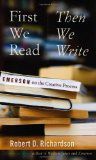
First We Read, Then We Write

This incontrovertible statement is the title of a book I have just read about the work and ideas of Ralph Waldo Emerson – why is no one called Waldo anymore? – and a very fine book is it too, though it might not be to everybody’s taste, dwelling, as it does, on the concerns and obsessions that beset the writer going about the daily business of writing: a messy business, as a rule.

Robert D. Richardson clearly knows Emerson like no other; he swims with nimble strokes through the waterways of Emerson’s thought, and leaves you with a definite feeling for the measure of the man. I, for one, knew practically nothing of Emerson, and now, although I will find out more, my conception of him will always be coloured by the things I have learned from Richardson.

I suppose in many ways Emerson is the closest thing to an American Montaigne. Reading was his passion, but like many writers, he read ‘almost entirely in order to feed his writing’ – which is more or less the same thing as saying the two activities are contiguous upon each other: writing is simply an extension of reading, and vice versa. But reading needs to be conscious and creative: ‘Reading long at one time anything, no matter how it fascinates, destroys thought as completely as the inflections forced by external causes.’ The advice is to take only what one needs from reading, to stop as soon as it becomes a drudge or an obligation, and to read selectively, casting the dross aside.

He gave advice to many young writers on how best to keep up a journal, to be watchful and to process the material of the world like a tide mill ‘which thus engages the assistance of the moon, like a hired hand, to grind, and wind, and pump, and saw, and split stone, and roll iron.’

As for the planning of a work of fiction, his advice is right up my street: ‘You should start with no skeleton or plan. The natural one will grow as you work. Knock away the scaffolding. Neither have exordium or peroration.’

This is much what E.M. Forster meant, with the words: ‘How do I know what I think until I see what I say?’ Or Coleridge, with his appeal to ‘organic form’.

Writing should be a process of surprising oneself. If I had a plan, down to the last detail, of what my story will be, what would be the point of writing it? I mean, what is in it for me if I know precisely what is going to happen and what my characters are going to think and say and do? It would simply be a matter of typing.

So, Richardson says, ‘If Emerson’s writing does not always, or even usually, proceed in a straightforward, logical manner, it is not because he couldn’t write that way, but because he didn’t want to, and was after something different.’

Other grand quotes from Emerson:

Consistency is the hobgoblin of little minds.

An institution is the lengthened shadow of one man.

Our chief want in life is somebody who shall make us do what we can.

Hitch your wagon to a star. (yeah, well, I thought it was Lee Marvin too)

People do not deserve to have good writing, they are so pleased with bad . . . Give me initiative, spermatic, prophesying, man-making words.

Every hero becomes a bore at last.

The maker of a sentence like the other artist launches out into the infinite and builds a road into Chaos and Old Night.

There is so much here that rings familiar: that we are essentially bound to nature and that all we touch and see is, at some profound level, a metaphor for ourselves. ‘The Universe is the externalisation of the soul’ – all stuff that would not have sounded odd coming from Blake. There’s a lot to take on board, which is how Emerson would have liked it. None of it is easy. Take it or leave it, but for me these writers, like Montaigne, de Quincey, Emerson, Stevenson, Proust, Borges, for whom writing was some kind of epic night journey, are almost always the most rewarding.

And what a motto (even if, like me, you have to look one of them up): Neither have exordium or peroration!


Médecins Sans Frontières in Libya

I receive an email from Médecins Sans Frontières saying that the Libyan National Army Security Service in Misrata are sending them people to treat who have been tortured, simply to patch them up into a state where they can be tortured some more. This is shocking, but I suppose we shouldn’t be surprised. The fact that people who have endured violent oppression are likely to inflict exactly the same kind of treatment on their oppressors – now they have become their captives – seems sad but horribly predictable.

According to The Guardian:

The aid agency Médecins Sans Frontières has added its voice to the chorus of concern by announcing that it had halted work in the coastal city of Misrata because staff were being asked to patch up detainees during torture sessions. “Patients were brought to us in the middle of interrogation for medical care, in order to make them fit for more interrogation,” said MSF’s Christopher Stokes. “This is unacceptable. Our role is to provide medical care to war casualties and sick detainees, not to repeatedly treat the same patients between torture sessions.”

I rarely use this blog for notices of this kind, but because I support MSF this captured my attention, and I thought I would share it. Not that there’s a lot anyone can do.


How American TV portrays the British

Blanco was a big fan of The Wire, David Simon’s epic account of life among the drug dealers of West Baltimore, with its startling portrayal of a city going under the cosh as the forces of unrestrained capitalism are let loose on the poorest and the most vulnerable sections of society. Series 4, on education, has to be the most astonishing and powerful thing I’ve ever seen on television. The part taken by British or Irish actors is not insignificant either: Dominic West, Idris Elba and Aiden Gillen all have major roles in the show.

The other night I watched the first episode of David Simon’s latest offering, Treme, which we have had hanging around the house for months, but have not got round to viewing. It begins, like The Wire, in a wholly unintelligible manner (subtitles help, but not too much). Simon claims he does difficulty on purpose, so as not to appeal to the lowest common denominator: “Fuck the average viewer” is the precise phrase he expressed on a BBC2 Culture Show interview.

Anyhow, a few minutes into episode 1, a scene takes place between Creighton Bernette, a real-life activist played by John Goodman, and a TV journalist, who is supposed to be British, but whose enunciation leads me to think he is an American actor doing a bad British accent. Plummy, stuck-up, arrogant: the type that American audiences love to hate. There is a batch of them in Madmen also: the Bad Brits, the Redcoats, the Enemy. All of them sound like superannuated aristos on a whisky binge. They are coarse, creepy and cruel. I don’t get it. If this is the common perception of US TV producers, then this is the cultural stereotype that the American public most wants to see, and they clearly don’t like us much. So much for the ‘special relationship’. It also seems incredibly outdated, a bit like a British equivalent of grossly overweight and ignorant Americans wearing check trousers, chewing gum and driving enormous, gas-guzzling chevvies.

But the weirdest moment of all in The Wire is when old-Etonian Dominic West is required to do a ‘British’ accent (as if there were such a thing) in series 2 , because he goes to work undercover in an illegal brothel. It is hilarious, because West, rather than doing the accent naturally, enacts an American doing a Brit. Extraordinary. Here is the moment when the idea, as usual the brainchild of the cop played by Clark Peters (himself a British resident for many years) comes about:


Big John Toshack

Imagine my surprise last Thursday when, standing sardine-packed on the bus that was to take me and my fellow Easy Jetters to our plane at Barcelona airport, I realised that the man into whose coat my nose was pressed was none other than John Toshack O.B.E., once Liverpool’s top striker and twice (rather briefly) manager of Real Madrid, and now . . . coach of Macedonia. Anyhow, I didn’t give it any more thought until the other evening, when watching the highlights of Swansea City’s defeat of Arsenal on TV, I saw Tosh in the stand, wearing the same rather nasty coat he had on the bus.

Now I don’t want to cast aspersions, but other than beings a truly awful Wales manager (admittedly a thankless job) Toshack has always struck me as a particularly morose figure, and he may have good reason, but it makes you wonder how he inspires his players if he speaks to them with the same enthusiasm that he conveys in interviews. And I mean, christ, does he ever smile? (Actually there are a few pictures of him smiling on the Facebook John Toshack page, but most of them are from his days as a player). Not that smiling is obligatory for football managers, after all they have to spend their lives catering to the whims and wiles of their overpaid moronic prima donna players; but Tosh makes Fergie (Sir Alex Ferguson to those of you who don’t follow football, or soccer) look like Mister Happy.

Of course Swansea was Toshack’s first project as a manager, and a very good job he made of it too, bringing the club from the old Fourth Division to the First in successive seasons. Then he went to Portugal, and then was scooped up by the San Sebastian club Real Sociedad, where he was very successful (as well as being hugely popular with the Basque supporters) before Real Madrid signed him for the first time and from then it was mostly downhill.

Which kind of explains why he was flying Easy Jet. You can’t imagine José Mourinho flying Easy Jet from Barcelona to Bristol, can you? (Actually you can’t imagine Mourinho flying from Barcelona to anywhere). But that is really no excuse for such a glum face. He might, after all have been flying Ryanair.