Richard Gwyn

The first hundred days

WordPress stats informs me that visitor number 10,000 clocked in to the blog on the day of post number 100. Not a bad start. Thanks to you, dear reader, for your support. Tell your friends about the multifarious pleasures of Blanco’s Blog!

Blistering Blue Barnacles!

Buckwheat pancakes with maple syrup and bacon (the latter a rare commodity in the Blanco kitchen these days) all washed down with lashings of coffee made with real beans: what a way to start a Sunday. Not only that, but today’s is the ONE HUNDREDTH (100th) POST SINCE BLANCO BEGAN BLOGGING ON SUNDAY 10TH JULY THIS YEAR. HUZZAH!

Last night we went to see the Spielberg/Jackson production of Tintin (The Adventures of). Mrs Blanco and I were agreed that Captain Haddock (played by Andy Serkis with a magnificent quasi-Scots drawl) and Snowy (aka Milou) the dog stole the show. Tintin is always so damned earnest, but more alarmingly for me, bore an uncanny resemblance to a young Welsh novelist of my acquaintance, and he returned in a more complex hybrid form later, to haunt my dreams, a sort of Tintinesque literary prodigy ploughing the astral plains in search of Ultimate Literary Truth. God help us.

The Tintin stories, for all their being imperialist and racist (charges which no one in their right minds would dispute) created in young readers of my generation – long before the advent of gap years hanging loose on Thai beaches or trekking in the Andes – an ambition to see the world, to become an explorer of worlds. And this is what excited me from an early age. A Dutch student of mine once told me that her grandmother said that children who love the Tintin books will become travellers as adults, and those that don’t won’t. I have a suspicion that something of the kind might be true.

In the meantime I must refrain from embarrassing myself and my dear ones by coming out with exclamations like ‘Great Snakes!’ or ‘Blistering Blue Barnacles!’.


On a quite unrelated theme, I see the film of Owen Sheers’ novel Resistance will be out shortly, with an introductory talk by the author/scriptwriter at Chapter Arts Centre in Cardiff on Saturday 26th November, which I will miss as I am off to Mexico that weekend. In fact I was invited to Mexico along with the same Mr Sheers, who is clearly otherwise engaged – but I share with Owen a childhood fantasy – we grew up a few miles (but two decades) away from each other in the Black Mountains – both playing games that involved charging around in the bracken and ferns evading Nazis, something which I discovered quite by accident while chatting to Owen when we were doing a series of readings together in New York (and where Resistance – the novel – was getting its U.S. launch). What a perennial occupation this Nazi obsession must have been for boys growing up in the decades following World War 2: is it still? I have no idea. But how profoundly the mythology of Nazism has infiltrated our psychological as well as our historical agenda.

And this leads me to the third topic of the day, or the fourth if we include breakfast: the front cover of the Vintage paperback edition of The Kindly Ones by Jonathan Littell.

The picture shows a solitary German soldier walking down a country road in what I imagine is some part of the Soviet Union. If, as the acknowledgement claims, the photo was taken in 1943, the soldier is probably in retreat. In the background and to his side, across a field, are other soldiers, themselves walking alone. There is snow on the ground, and it is either still snowing or else there is a mist. The soldier is walking purposefully, and carrying a rifle over his soldier, so is not in a state of combat. I am fascinated by the photograph, and am trying to work out why. Is it to do with the solitary status of the soldier, knowing as we do the vast numbers of troops involved in the invasion of Russia and in its defence, the huge tallies of the dead that Littell’s protagonist Dr Max Aue recites ad absurdum in the introduction to his story? From what source does the poignancy of this image derive, and why does it affect me so?

I think the focus on the individual soldier is meant to reinforce Max Aue’s refrain that yes, he is responsible, he did the things which he recites, but that he was an individual in a chain of command, an infinitesimal cog in a massive destructive machine, and his question is, simply, what would you have done?

Or, more succinctly, in Aue’s words, it is “a fact established by modern history that everyone, or nearly everyone, in a given set of circumstances, does what he is told to do; and pardon me, but there’s not much chance that you’re the exception, any more than I was. If you were born in a country or at a time not only when nobody comes to kill your wife and your children, but also nobody comes to ask you to kill the wives and children of others, then render thanks to God and go in peace. But always keep this thought in mind: you might be luckier than I, but you’re not a better person. Because if you have the arrogance to think you are, that’s just where the danger begins.”

The Kindly Ones, fastidiously researched (Littell spent many years on the project and read over two hundred books on the German occupation of the USSR alone) is without doubt one of the most extraordinary novels of recent times: I would place it, together with Roberto Bolaño’s 2666 as one of the two most significant pieces of literary fiction in the 21st century, at least that I’m aware of. 2666 was written in Spanish, obviously, but Jonathan Littell’s book was first published in French as Les Bienveillantes in 2006 and won the Prix Goncourt. It is marvellously translated by Charlotte Mandell, and maybe I will write about it when I have finished (I am not quite half way through its 960 pages, but will stand by my current appraisal nonetheless), but in the meantime I am fascinated by the cover picture, poorly reproduced here, because I could not find a copy of the original, despite searching online through the Keystone/Getty archive, who apparently hold the original. If any readers know anything at all about this photograph, please let me know.


The forlorn penis of Michel Houellebecq

Michel Houellebecq, illustrating his unique cigarette-wielding technique

The publication in English of a new novel by Michel Houellebecq, The Map and the Territory, causes me to reflect for a moment on that author, and it occurs to me that whenever I put down a book by Houellebecq I almost immediately forget all about it, until I pick up the next one, which probably says something about how deeply I engage with him as a writer. So what I am about to recount might come as something as a surprise.

Earlier this year I went to a conference: ‘Myth and Subversion in the Contemporary Novel’. I hardly ever attend academic conferences, mostly because they are very tedious affairs, but I felt compelled to go to this one because the title of the conference was so very appealing: who could resist it? Moreover it took place in Madrid, at the Universidad Complutense, in springtime. My hastily written paper was called ‘Promethean Variations: From Wells to Houellebecq’ but it is worth considering what else I might have called it: ‘Michel Houellebecq and the paradigm of eternal youth’ was an early option, and so was ‘The forlorn penis of Michel Houellebecq’. The latter phrase got wedged in my thoughts (there are worse places it might have become wedged) and I could not remember whether I had truly invented it (or dreamed it, rather an awful thought) or had simply read it somewhere and forgotten where. I tried googling the phrase but without success. And yet this title, whether my own or someone else’s, is perhaps most apt. ‘The forlorn penis of Michel Houellebecq’ allows a vicarious and not altogether unfair insight into Houellbecq’s contribution to the erotics of literature – the tragic denouement of his invariably disappointed, frustrated, put-upon, self-absorbed and eventually flaccid male protagonists. And yet, joking aside, what interested me, at least in part, and what impressed me on first reading Houellebecq’s novels – which I came to only recently – was brought about by one of the most dreadful Reality TV shows I have ever had the misfortune to watch, and which I endured with growing consternation one evening in the summer of 2010 while staying at a hotel in Orléans.

The premise of this particular show was unusually inventive, even by the absurd standards of Reality TV. It involved a man in his mid forties – classical Houellebecq material – being set up to meet two ex-girlfriends; one from 25 years earlier, the other, rather ludicrously, from 35 years before, when the protagonists were only 10 years old. Harry – in spite of his years he had retained boyish good looks and a mane of white hair – was not only looking for love, but looking for someone with whom he could parent a fourth child.

Myrtle, his first true love, who went out with him when they were both 19, now lives in Los Angeles, works as a model and does not want children. Laurence, whom he last saw skiing in Chamonix in 1976, works as a gymnastics instructor at a big tourist resort in Turkey. Both of these middle-aged French women are fitness fanatics, trying to retain their youth, while Harry is actually attempting to re-live his youth. The whole premise of the show is like a televisual encapsulation of a Houellebecq novel, without the sex. Because when Harry finally settles on Myrtle and flies over to stay with her in LA she tells him he has to sleep on the sofa, and that she does not want children, definitively, ever. Harry is distraught. He has blown it with Laurence and cannot turn back. Although she is open to the idea of having a child with Harry, she looks her age, and this seems to put Harry off. By choosing Myrtle, who looks much as she did at 19, thanks to her fitness regime and some choice plastic surgery, he feels he can reclaim his youth, in spite of the fact that he has absolutely nothing in common with her and shares none of the same ambitions. Perpetual youth is the sole objective. As Houellebecq puts it in his most successful novel, Atomised: ‘sexual desire is preoccupied with youth’ and, as Isabelle, Daniel’s first wife in The Possibility of an Island remarks: All we’re trying to do is create an artificial mankind, a frivolous one that will no longer be open to seriousness or to humor, which, until it dies, will engage in an increasingly desperate quest for fun and sex; a generation of definitive kids.

Unfortunately, the text of my paper disappeared along with the hard drive of my old macbook (see post for 2 September), so I cannot regale you with the intricate arguments I made in support of my (by no means original) notion that Houellebecq’s fictions are guided by the delusional quest for the fount of eternal youth, and therefore, in some respects, embody the myth of continuous self-renewal symbolised by Prometheus. Nor can I review his new book, not having read it, but I am encouraged by reports that it marks a new departure for an author who was in danger of repeating himself interminably (it also won the Prix Goncourt, which must count for something). But here is a clip of the incorrigible Monsieur Houellebecq, being interviewed by poor old Lawrence Pollard of the ‘Culture Show’, which is apparently a TV programme, not a reggae band. My favourite quote from the interview: ‘As soon as I start talking about my life I start lying straightaway. To begin with I lie consciously and very quickly I forget that I’m lying’. How fortunate, gentle reader, that the same cannot be said of Blanco, blogging bloodhound of Ultimate Truth, or la vérité ultime as we say in France.


A State of Wonder, Part Two: Johann Sebastian Bach’s Goldberg Variations and Glenn Gould

I have two recordings of Glenn Gould playing Bach’s Goldberg Variations on the piano. The first was made in 1955, the year before I was born, and the second in 1981, shortly before the pianist’s death, the same year that I left London and went to live in Crete. The second version is quite different from the first, and lasts several minutes longer. I think of the earlier recording as a day-time piece, and the second as nocturnal. They are both sublime, but in the first Gould is the young concert pianist on a mission, and he dazzles with his technical brilliance, his impeccable sense of timing. By the time he made the later recording he had nothing to prove, he had achieved everything a virtuoso pianist might reasonably be expected to achieve and more, and while there is no trace of complacency to the playing, it exudes a certain detached or entranced quality. Possibly the second version is more exacting, more profound, he lingers over the notes of the first variation with a confidence that is not to be confused with arrogance, a confidence that conveys a total acquaintance with, and mastery of, the music, a familiarity with every phrase, every musical innuendo, the fruit of years of study, and he is able to hover, and to hoist the listener into a space above and beyond the music, to linger there in a state of wonder, a phrase the pianist himself made use of. The album notes carry a quote from Gould: “The purpose of art is not the release of a momentary ejection of adrenalin but rather the gradual, lifelong construction of a state of wonder and serenity.”

There are two photographs of the artist, taken in the respective years the recordings were made. In the first he is young, quite handsome even, or dashing, his hair flopping over his eyes, while in the later photo his hair has thinned and he is wearing glasses. In both pictures his concentration is almost palpable, and in both his mouth is open, not significantly, not gawping, but open, as though he was concentrating so hard that he had forgotten to close it, or had opened it to say something, and forgotten his lines – or to groan (his recordings are marked by these occasional groans, which should be disturbing, but are not).

Glenn Gould’s recordings of Bach keep me company for long hours, while I sit at my desk. He is a faultless companion, especially when I am struggling to impose order on my thoughts. I would like to catch some of the fallout from his playing, inform my own thought with some of that rigour, that clarity of intent, employ his music as a force-field against the fatigue that overtakes me as I type away, as a weapon against the viral dance, against the affliction of sleeplessness, in an inverse sense to the one in which they were first intended: for, ironically, Bach is supposed to have written the Goldberg Variations around 1741 to ease his patron, Count Keyserling’s nights of insomnia.


From The Vagabond’s Breakfast pp 133-4


Beethoven and all that jazz

After recent posts on Leonard Cohen, Tom Waits and Jazz it is time for a quick note on Beethoven. For years I didn’t listen to Beethoven at all, finding too much of his orchestral music overdramatic, overstated, overblown. Then, a few years back I acquired a version of the recordings made by the Busch Quartet in the 1930s (recordings made before and after the quartet’s re-location from Germany to London, and then to New York during World War Two). Despite the audible crackling (this was before they were digitally remastered in 2008, and the interference removed) the recordings convey an astonishing degree of sensitivity and pathos. Pathos is a word that seems most apt with regard to Beethoven, a man who supposedly died while raging against the dying of the light, fist raised to the heavens – and during a thunderstorm for good measure. To which end, here is an animated bar-graph score of the Grosse Fuge op. 133.


The other night I caught the opening episode of new TV series that focuses on the history of the symphony (and is titled, helpfully, Symphony), that ultimate collision of form and content that emerged with Haydn and Mozart and was taken by the scruff of the neck and booted into the nineteenth century by Beethoven with his Eroica symphony in 1804. Beethoven was a republican (but not in the American sense) and an early supporter of Napoleon (but not once he had proclaimed himself Emperor) and reputedly told one of his patrons: “There are and will be a thousand princes; there is only one Beethoven.” Quite a self-believer then.

When I was a wild young thing, thumping out Beethoven and Brahms fiercely and passionately but with negligible technique, my piano teacher once played me a section of the opus 111 piano sonata and told me to listen how, with its double-dotted rhythms it pre-empted jazz (or ragtime) figures that only emerged a century later. I don’t know how accurate his analysis was,  but whenever I listen to those crazy lilting rhythms now – which break in after nearly seven minutes of the clip below – I can’t help wondering what the audiences of his day must have made of this music: they can’t ever have heard, or even imagined, anything like it. And that is something that we miss altogether, as we have the whole of intervening musical history acting as a kind of barrier, and what we hear, we hear through the filter of all the music that has been composed and played since his time.

Historically, Beethoven has been best remembered for his symphonies (as the current TV series illustrates), for the fabulous unifying Ode to Joy from the ninth and ironically (since we were at war with his fatherland) for the famous introduction to the fifth symphony, now forever linked to the wartime speeches of Winston Churchill. But it is the last quartets and sonatas that I, as a listener, return to, although more and more I prefer to listen to jazz.


Tom Waits, Leonard Cohen, Shane MacGowan, Charles Bukowski and all

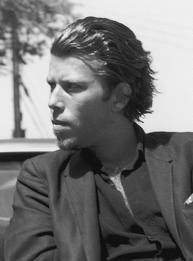
Young Tom Waits

Can you do a music review before listening to the music? Let’s see.

Yesterday I received through the post the new CD by Tom Waits, though I have not had the nerve to play it yet. I am not sure I even want to. I do not know quite how I feel about Mr Waits. There is an element of the showman about him that I don’t quite trust.

Unlike Mr Dylan, who can get away with the line “Me, I’m just a song and dance man” because he is so evidently much more, with Waits one might be forgiven for suspecting that such a self-diagnosis would be spot on. The talent is undeniable, and so is the musical range, the technical understanding and the skilful use of genre. The intense and earthy songs of heartbreak and loss on the album Heart attack and Vine once provided me with the perfect music to get miserably drunk to, alone and gloriously despairing, and there have been hundreds of versions of the same songs since. He does slow and sad and he does loud and fast. Both are good, though with the latter he does tend to shout.

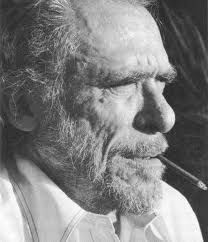
Charles Bukowski

I am willing to accept, perhaps, that my difficulty with Tom Waits is that I over-identified with his music for too long, and the problem lies with me rather than with him. And of course I cannot forgive the fact that he was never the real down-and-out he sang about (although he did sing about the lifestyle well). He is linked forever with Bukowski in the mythology I spun about myself in the 1980s (when I was in my twenties) and I cannot read a single line of Bukowski these days, I just find it laughable.  Quite apart from his having a face like a jam doughnut. Waits and Bukowski, the dream team (though oddly, Bukowski’s favourite singer-songwriter was Randy Newman, who I liked in my teens but afterwards found rather tame). All these blokes, trying to prove how close to the edge they lived. Maybe I never took either Waits or Bukowski that seriously, they just summed up a lifestyle, but failed to go much deeper.

Shane MacGowan of course, he was another. Maybe he still is. Someone props him up every now and then and he stumbles onto a stage and sings a few songs in an increasingly incomprehensible and strangulated voice, but Christ he had a gift, as a songwriter if nothing else. I met him once, in a bar in Camden. I was always bumping into famous people when I was a drunk. He seemed a decent enough bloke, just fed up with the attention, enjoying a bit of quiet time, I could respect that.  His songs with The Pogues became the anthems of my treks on foot across Spain towards the end of the eighties, just as Waits and Dylan had provided the lyrics of my hikes earlier in the decade, across Greece and Italy and France. Roberto Bolaño loved The Pogues too.

And what about Lennie? Leonard Cohen, I mean. I listened to him ardently when I was fourteen, fifteen, then went right off him until I rediscovered his music in my forties. I found out that his best songs can survive multiple replays in ways that Waits’ can never stand up to. And his concert at the Cardiff Arena a few years ago was one of the three best concerts (along with Lila Downs at Peralada and Mariza at Palafrugell) that I have seen in well, the last decade (and that includes two concerts by Dylan himself). I might have a Leonard Cohen song playing at my funeral  – yes, I’ve thought about that, such is the dreadful urge towards oblivion, guided by Cohen singing, now which was it, ‘Dance me to the end of love’ or ‘Take this waltz’? I can never decide. Not that I’ll be listening.


But Tommo? He seems very together. Something that you could hardly claim for Cohen, whose biography I read a few years ago and who came across as terminally screwed up, for all the Zen stuff. Or maybe not. Maybe that is just an asinine remark, maybe we are all screwed up, and that part of Cohen’s beauty (and his charm) is that his pain has so indelibly marked him that we are touched, as it were, by the fall-out from his own menagerie of perfume, lace and broken violins, and we can sink into a delectable narcotic haze of suffering by proxy. Certainly the teenage girls in bedsits who were deemed to be his early audience were not alone. This teenage boy was spellbound through long nights with Songs from a Room. And, if I am honest, still can be. He offers just that much more: I’ll call it a flake of the ineffable, because it sounds kind of Cohenesque.

But as for Tom, my internal critic just won’t shut up. Blanco likes the songs, enjoys the ironic melancholy, loves the stuff about drunken sailors and jumping ship to Singapore – and, as an aside, in many of the songs from Rain Dogs, Waits’ best album to date, there are strong personal associations with Thomas Pynchon’s fabulous novel V. which, along with Burroughs’ Cities of the Red Night, was another of Blanco’s travelling companions from the 1980s but he has problems incorporating Waits into the same illustrious hall of greatness at which Dylan and Cohen hold court. Maybe Blanco will stand corrected after a few listens of Bad as Me. I kind of hope so now. Will report back.


Sarkozy eaten alive by bear

A Black Bear

A French President


This morning I emerge from a waking dream in which President Sarkozy is being eaten by a black bear. Quite a fitting end, I would think, for this preening bantam cock of a man, to be gobbled up in a couple of mouthfuls by Murder Bear. I can imagine George Papandreou looking on with pleasure, perhaps passing the bear the tzatziki.

Bears have had a role in literature for hundreds of years. Their appearance in folk tales of eastern European origin has filtered into a wider, and more infantilised role, since the appearance of Winnie the Pooh in the 1920s, when bears underwent a perceptual shift, from being a wild threat from the woods to becoming cuddly companions. The Goldilocks story held a particular fascination for Blanco as a child. Is it helpful to inform my reading public of such things, I wonder?


In the film The Edge (1997) one of the characters gets eaten by a bear, quite graphically, and I remember being shocked at the time, not so much by the violence, but by the impact on the imagination of watching someone being eaten alive by another creature. It was one of the most disturbing things I can remember seeing. So I will have to share it with you.


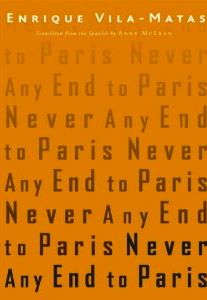
Never any end to Paris

Enrique Vila-Matas.

Enrique Vila-Matas

Extraordinary as it might seem to his many readers worldwide, Enrique Vila-Matas is practically unknown in the UK, another startling blemish on the blinkered, xenophobic, utterly predictable tastes of the British publishing industry, for which anything that deviates from a well-worn mainstream formula is treated as toxic.  The only two of Vila-Matas’ twenty-eight books to appear in English up till now have been Bartleby & Co (2004) and Montano (2007). In fact the book I wish to discuss here is not yet available in the UK: I have been reading the American New Directions edition, published in September.

Formally, the closest that most British readers will have come to Vila-Matas, might be W.G. Sebald, if only in the sense that Sebald was also the author of fictions presented as documentaries, or documentaries presented as fictions. But Vila-Matas actually makes me laugh, which counts for more than the sardonic smiles evinced by Sebald. And he shares a great deal too with Roberto Bolaño, with whom he became close friends in the last few years before the Chilean’s death in 2003. It is rumoured that Vila-Matas had more than just a hand in the final version of ‘The Part about Archimboldi’, the last (and best) section of 2666, Bolaño’s posthumous masterpiece.

Born in Barcelona in 1948 (and not 1931 as the back cover of this book informs us), Vila-Matas is, like Eduardo Mendoza, a Catalan who has chosen to write in Castilian. He grew up during the Franco dictatorship, and while still at law school, escaped to Paris to try and make his way as a writer, lodging, while he was there, in the garret of the house belonging to Marguerite Duras. And this is the topic of his new book, Never any end to Paris, its awkward title manifestly an acknowledgment of Hemingway’s memoir, A moveable feast. But whereas Hemingway claimed of his Paris years in the 1920s that he was ‘poor but happy’, Vila-Matas’ experience fifty years on was, he claims, both ‘very poor and very unhappy’. But he exaggerates, of course, and at least comes out of it with a wonderful book, first published in Spanish in 2003.

The story begins with Vila-Matas entering the annual Key West Ernest Hemingway look-alike contest, and being disqualified outright for an “absolute lack of physical resemblance to Hemingway”. Having set up his initial trope, the author leads us back in time to 1974, when he was living in Paris, intent on following Hemingway’s lead, researching and writing his first novel in his cold chambre, drinking the nights away with other young artists and poets. (Strangely enough, young Blanco stayed in Paris in the summer of 1974, just before his eighteenth birthday, on his first Big Adventure. Who knows, we might have met).

Later (again like Blanco) the young Vila-Matas is seduced by the teachings of situationism, dressing in black from head to foot, “converted” as he puts it “into the prototype of the secretly revolutionary, poetic intellectual. But in fact, being a situationist without having read a single line of Guy Debord, I was on the most radical extreme left, but only through hearsay. And . . . I didn’t practise, I devoted myself to feeling extremely left-wing.”

He is disheartened by how many of his fellow Spanish expatriates and exiles are ground down by heroin or cheap Spanish wine, and struggles to find the right role models for his own literary apprenticeship. Among them, needless to say, is his landlady, Marguerite Duras, who scares the living daylights out of the young Vila-Matas with her ‘superior French’ (he can’t understand a word she says to begin with), delivering him a sheet of notepaper with a list of thirteen points on how to write a novel (which he helpfully includes).

The aspiring writer attends parties, meets Roland Barthes, tries to hit on a young Isabelle Adjani (who spurns him icily), makes a fool of himself as a matter of course, takes acid at the top of the Eiffel Tower and is convinced by his demonic girlfriend, Kiki, that if he jumps he will probably land safely, ‘but it won’t be in Paris’.

At the party for the screening of Duras’ film, India Song, he tells how Alain Robbe-Grillet approached Duras to tell her that, as with all her films, he had enjoyed this one very much, to which she replies, without drawing breath, that “she was very sorry she couldn’t say the same about his films.” Vila-Matas (who was clearly impressed) comments: “I had never in my life heard anyone speak with such frankness, and perhaps for this reason the words etched themselves deep in my memory. What’s more, I have imitated this kind of frankness on a few occasions in my life, always with bad results . . .”

An often hilarious recital of his serial miseries, this gratifyingly unflattering self-portrait leads the reader through the ‘three lectures’ of which the book is composed (although we never learn where one lecture ends and another begins, nor indeed if we or some invisible others constitute the audience, nor where the ‘lectures’ are taking place). Indeed, Vila-Matas (or his narrator) at one point early in the narrative asks of himself (or us) ‘Am I a lecture, or a novel?’ (we do not receive a reply).

Vila-Matas’ narratives often proceed in just such an uncertain way, finding by going, as it were, where they have to go. Later in the story he writes: “When people ask me if I have my texts organized in my head before I write them or if they develop as they go, surprising even me, I always reply that infinite surprises occur in the writing. And that it’s lucky it’s like that, because surprise, the sudden change of direction, the phrase that appears at a precise moment without one knowing where it comes from, are the unexpected dividends, the fantastic little push that keeps the writer on his toes.”

On the same theme, in a recent interview, when asked how much in his texts is fiction, how much autobiography, Vila-Matas replied (with quite a dollop of irony): “The broad passageway that joins fiction and reality is cool and well-ventilated, and the air within blows about with the same natural ease with which I mix biography and invention.”

There is much to commend this book, its leaps and its insights, its portrait of the excruciating self-consciousness of the emerging writer, as well as some profound moments, and a sense of true respect for his landlady, the phenomenal Marguerite Duras. Here is his accolade to her, which, I feel, might, with time, be applied to him:

“I remember she embodied all the monstrous contradictions to be found in human beings, all those doubts, that fragility and helplessness, fierce individuality, and a search for shared grief, in short, all the great anguish we’re capable of when faced with the reality of the world, that desolation the least exemplary writers have in them, the least academic and edifying ones, those who aren’t concerned with projecting a right and proper image of themselves, the only ones from whom we learn nothing, but also those who have the rare courage to literally expose themselves in their writing – where they speak their minds – and whom I admire deeply because only they lay it on the line, only they seem to me to be true writers.”


Birds of Sorrow


You cannot stop the birds of sorrow from flying overhead and crapping on your head, but you can stop them from nesting in your hair.


Faster than the speed of light

An article in the Guardian online alerts me to the fact that I am quite out of touch with things on a quantum level. It would seem that some wild Neutrinos have been identified speeding down the runway at Cern at sixty billionths of a second faster than the speed of light. Ah, the wee tearaways.

I can remember speeding down the road on holiday with my dad when I was about five with the window open and seeing the speedometer nudge sixty miles an hour and thinking that was fast.

But those Neutrinos would have left my dad’s old Zephyr standing. No, sorry, they would have arrived at the beach and come back to read me a story before I went to bed the night before.

The discovery, if validated, could turn Einsteinian physics on its head. I mean, the whole caboodle of special relativity will be up for grabs.

Which demands a replay of the Neutrino joke I saw on facebook the other night. “We don’t allow faster-than-light neutrino’s in here!” said the barman. A Neutrino walks into a bar.

That’s it. Terrible, I know.

So as not to get too left behind (geddit?) I have started following Matt Strassler’s blog, which contains a sort of ‘particle physics for idiots’ link, so I can pick up a few key phrases to bandy about next time I go down the local. A Neutrino walks into a bar. So they build this bar… Et cetera, ad infinitum.


The Handless Maiden (conclusion)


We leave the beach and set off up a path through a narrow gorge, Goril walking ahead with the French, Kurt following her like a puppy. It is night now, but the moon has risen and we have no trouble finding our way. In a sheltered spot, a greyish puddle of wet, viscous mud lies below a small waterfall, space enough for two or three to bathe. Goril and Ana take off their clothes and do not need to exercise much persuasion to get Kurt to do the same, Germans will strip off at any opportunity; even so, the girls give him a hand pulling off his pants and the three of them plunge into the soggy bath, falling about and smacking each other with dollops of gloopy clay. I cannot help but notice that Kurt has an erection, which he tries ineffectually to protect with a hand at first, but is soon so covered in wet clay that it barely matters, and the three of them lollop like imbeciles in the pool, shrieking, hooting and plastering each other with sticky mud.

With a jolt, I feel the effects of the potion rise through my body, bubbling through my veins, and I am lifted bodily to a place where everything has the semblance of itself but is undeniably other; the rocks, the cliffs, the faces of my friends, the strange mutt belonging to the French couple (which seems to be sporting an oversize Gallic moustache); everything has been replaced by a simulacrum of itself, and I too, am a new and alien version of me, and all my sense receptors, sight and touch and hearing and smell, are lodged not in me but in this impostor who has occupied the zone I once thought of as my body. So long as I keep calm, I tell myself, everything will be all right. I glance over at Callum, who, like me, has kept his clothes on. He smiles vacantly in my direction but I can tell, or think I can tell, that he is going through his own epic moment, and I decide (or whatever it is that has commandeered my brain decides) that, for now, language is something I might try and avoid. But Callum is edging over to me and is speaking, or rather, he is making sounds I cannot hope to understand. The three mud-creatures in the pool are clambering over each other, slithering like hideous aquatic lizards through the slime. I notice how long and red Ana’s tongue seems, and how it ululates as she makes strange noises in the round ‘o’ of her mouth, and how that orifice is enveloped by a grey carapace of mud on her face and in her hair and how this might reasonably be expected to diminish my attraction to her but in fact produces the opposite effect; the three of them have grey slimy bodies but red tongues and blue eyes, and the whites of those eyes are flashing horribly in the moonlight. Goril and Ana are kneeling, facing each other, and they begin to kiss, slowly and lasciviously, and Kurt is lying on his belly, flat out in the muck, staring at them, his pupils massively dilated, and then he turns on his side and begins to masturbate, mechanically, never taking his eyes off the girls. Goril looks up and sees what he is doing, cannot help but notice him thrashing away, and she shrieks, reaches for a handful of mud and throws it at Kurt, and Ana joins in, hurling fistfuls of sludge at Kurt, who rolls over and moans, in sorrow or delight, I can’t tell, he wears an expression of demented, anguished joy while the two women, who are no longer laughing, stand over him, pelting him with slushy missiles as he cowers and grovels at their feet, and I observe this macabre scene without much concern, and I hear, in the distance, the sound of a conch, blasting a hole in the petrified night air.

On cue, the assault ends, and someone, it might be me, suggests a swim and we all run back down to the beach, and the three naked mud-people race to get to the sea first, the rest of us jogging behind. The French have gone home, no doubt wishing to protect their child and dog from further scenes of depravity. Then I am very slowly stepping out of my jeans and laughing uncontrollably, which makes it hard to keep my balance, and Ana and Goril and Kurt are standing by the water’s edge, caked in the dried mud, and as I wade into the sea, the water closes around me with a lovely cool feeling, like acquiring a shiny new skin, and I am impossibly high, floating on my back beneath the moon and the stars, being swallowed up by the unimaginable vastness of the sky, and afterwards I find my blanket and curl up by the fire and weep, although with no sense of sadness, and Ana joins me and both of us sit wrapped in the blanket weeping and looking at the flames, and then Kurt is running up, also in tears, but his are unmistakeably tears of despair, he is yowling, yelping, running up to us and then running off down the beach, out of his head with grief, as well as simply out of his head, returning and asking us where is Goril and us saying, Kurt we have no idea where she is but Kurt keeps asking us where is Goril, then running off, sobbing, then coming back and begging, pleading with us to help him find Goril, he cannot live a moment longer without knowing where is his darling Goril, and when he has gone Ana turns to me and we kiss, and then a minute, or a hundred years later, I look up, and Goril is standing there, her arm around Callum’s waist, head on his shoulder, and Kurt is by the fire, silent at last, but in seething suppressed rage, and we are all tired of this performance and Ana tells Kurt to get a grip, to please, for God’s sake, just get a grip and fuck off and go to sleep.

In the morning I make a pot of coffee and decide to look around. Antonio and Pedro are asleep by the remains of the fire. I find Goril and Callum under a blanket in one of the abandoned houses, and there is no trace of Kurt. We spend all morning combing the beach and searching the gorge but do not find him. What more can we do? Ana says she refuses to feel guilty on Kurt’s behalf, and Goril agrees: that’s life, she says, that’s the way it goes, I mean, no one invited him. Callum and I are silent and uncomfortable. The Andalucians mooch, and we all smoke weed.

Later that afternoon we hear that the body of a young man has been washed up on the beach in the nearby town where we went for beers and tapas. Somehow, no one is surprised.

That same evening, I am emerging from the sea after a swim, with Ana, and we see a column of Guardia Civil moving quickly down the distant cliff path, on foot, a snake-trail of green uniforms, six of them. They must have found Kurt’s car. We rush back up the beach to warn the others.

We arrive at the house that Goril and Callum have occupied, just before the guardia. Goril is naked, and as a young officer, a lieutenant, comes into the room with two of his men, she takes her time, carelessly pulls on a shirt, one of Callum’s, from a pile on the floor, but doesn’t bother buttoning it, sits with the shirt half-open, honey-coloured legs stretched towards the lieutenant, crossed at the ankle, and she talks to him. Without prior agreement, she has become our spokesperson, answering all the questions on our behalf in near-perfect Castilian. The lieutenant is handsome and dark-eyed, interrogates her in a civil, professional manner, scribbling in a notebook as he stands, and smiles at her once, a little too freely, and he tells Goril we were seen by the bar owner talking to Kurt, were seen leaving in his car, and she says yes Capitán, we met him, but this is all we know: he was distraught, broken-hearted after a love affair, we tried to help him, we tried talking to him, to comfort him, but he must have wandered off during the night, he must have walked into the sea. She shakes her head sadly. The young guardia allows his gaze to linger, casts his eyes over her without expression, snaps his notebook shut.


The Handless Maiden (Part One)

Datura Stramonium


Following a surprise visit yesterday from Iwan Bala, and a moment in which we discussed the profound influence of the Mabinogion stories on both of us, I fell into that state of reflection, or daydream, in which different ideas coalesce or merge. Iwan had mentioned how the ancient Welsh tribes among whom the stories in the Mabinogion emerged – they were part of an oral storytelling tradition long before they were set first down as texts in the eleventh century – sustained a shamanic tradition whose adepts almost certainly used hallucinogens of some kind; magic mushrooms and quite possibly the datura plant, the properties and effects of which I describe in section 29 of The Vagabond’s Breakfast.

Shamans would, in the cultures such as those of the British Celtic peoples of this period, provide the core transcendental experiences on behalf of the tribe, or group, which would involve visions and engagements with the ‘other world’, the place described as Annwn in the Mabinogion stories. Among such cultures the veil between worlds was perhaps not quite so thick as it has since become.

It was brought to my attention by a recent re-reading of Margaret Attwood’s Negotiating with the Dead that among certain indigenous peoples the shamanistic journey follows well-trodden paths, and overcoming an encounter with the ghost-like creatures of the kind I describe in the VB is a not uncommon feature of the Shaman’s necessary accomplishment. I found this strangely reassuring.

But this was not the only adventure that I have recounted in relation to the deadly and secretive datura plant. Another encounter with datura forms the basis of a very loosely autobiographical short story set in Andalusia. Browsing the internet, I find photos of the very deserted village in which the story is set (which I call Las Perdidas) but is actually San Pedro, in the Cabo de Gata peninsular of Andalusia.
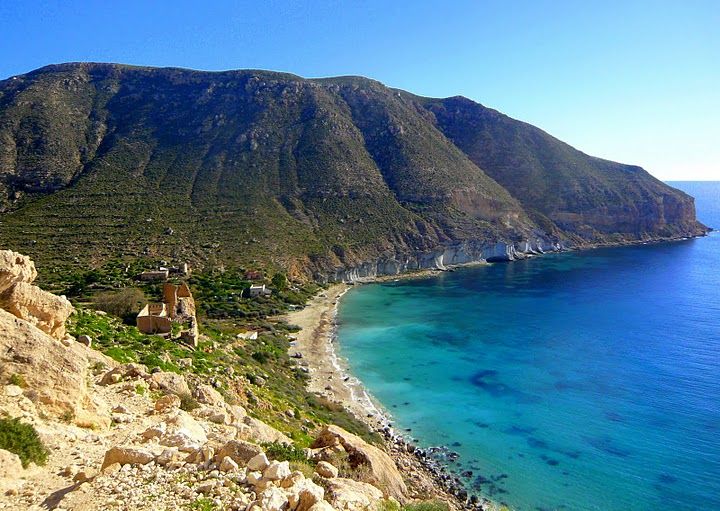


The brief for the story was, very broadly, the theme of the handless maiden, a story that has haunted me over the years, and which appears in many versions, perhaps most famously that of the Brothers Grimm, which can be found here. It is a deeply poignant story of female disempowerment, which in my version becomes inverted; that is to say the central female character, Goril, might be a handless maiden – and is most certainly damaged – but she has taken control of her life in the only way she knows, with dramatic and, in turn, damaging consequences.

The story was first published last year in the book Sing Sorrow Sorrow (Ed. Gwen Davies, Seren, 2010). I will post the first part today, and the conclusion tomorrow.

THE HANDLESS MAIDEN

She comes in through the window, where I am enjoying a game of chess on the floor with Callum (there is no furniture in the squat) as though it were the standard way of entering a building, sidling under the half-open wooden frame, and swinging her legs over the sill, before alighting, like a cat, on the wooden floor, within inches of the chess-board. She is wearing very short cut-off denim jeans and a man’s white vest, and she springs across the room towards Ana, who lives in the house, and in whom (without going into unnecessary detail) I have an interest, before the two of them disappear out of the door and along the corridor, to Ana’s room, talking in Norwegian.

Callum (tall, Scottish, a slacker) gazes after the newcomer, admiringly. She looks as if she has emerged from an illustrated edition of Oliver Twist, a saucer-eyed urchin, small and slim, with a mess of short, wheat-coloured hair.

Goril is nineteen, perhaps the most accomplished hustler I have met, and over the next few days, due to her friendship with Ana – they knew each other back in Oslo – I get to see her in action. With her sweet, innocent face, few would suspect that her mere presence in a public place constitutes an immediate threat to any carelessly guarded wallet or handbag, which items, in her company, are likely to vanish without trace.  Unlike the other vagrants here in Andalucia, she never begs, nor does conjuring tricks, nor plays a musical instrument, yet she manages to extract money and goods from people with amazing facility; tourists, bar-owners, even, alarmingly, drug-dealers – to the extent that within a week of turning up, she comes to the house one morning with a thick wad of bank notes and offers to take everyone to the seaside. She says she has been given the money by the Norwegian consulate, in order to procure a ticket home before the Guardia Civil incarcerate her for the greater good of the citizenry. I don’t know if she is telling the truth, I don’t even know if there is a Norwegian consulate in Granada, nor do I care. In the idle way that associations are formed and dissolved among vagabonds, she has become a member of our gang, although Goril is most certainly not a joiner.

The place to which we are headed is an abandoned village on a remote and undeveloped outcrop of land jutting out into the Med, east of Almeria. It is called Las Perdidas, which means The Lost Women, and I should have known better than to go there in the first place, but am intrigued by the possibilities. Among which, of course, I include Ana, who looks like a young Björk, and whose feelings towards me are a mystery, due to her apparent reluctance to engage in conversation. There are rumours of natural hot springs and healing mud baths. It sounds like paradise, and as such might provide the ambience for our relationship to blossom.

We take the morning bus to Almeria and have a two-hour wait before our connection. Antonio, along with his friend Pedro, the local boys in our little band, has the idea of buying a yearling lamb, which he acquires off some guy in the nearby market, ready-skinned. Antonio has it wrapped in preserving herbs and sacking for the bus journey to the coast. We have to carry the thing with us, but it’s going to be worth it, Antonio says: this is real food. Goril pays for the bus, the meat, everything.

Las Perdidas, it transpires, is way off the beaten track. The bus stops at a nearby town and we walk along an unsurfaced road for an hour before descending a narrow mule-path down the cliff face towards a jumble of stone cottages near the beach. Some of the buildings look as if they were deserted a century ago and are beyond repair, but others even have roofs, and a semi-permanent settlement of hippies or friquis live in the more robust houses, which are perched at a slight elevation, overlooking the sea. These inhabitants have become accustomed to a drifting population occupying the lower, more ruinous houses, or sleeping rough on the beach, and pay us no attention as we file by, the six of us, carrying our possessions, sleeping bags or blankets, and several plastic containers filled with wine.

When we arrive on the beach, we immediately set about collecting driftwood and scrub for a fire. I make up a search party with Ana, Callum and Goril, and after assembling a small mountain of fuel, we strip off and go for a swim, and although it’s April, the water is not as cold as I expect it to be; perhaps the shape of the cove protects Las Perdidas from cooler currents. Afterwards, Goril stands naked at the water’s edge, vigorously drying herself with a scrap of towel. She suggests we return to the small town where the bus dropped us off, to ‘score some beers and tapas.’ That’s how she talks. Her English, like Ana’s, is fluent, but sprinkled with a gratuitous sampling of time-warped hippy jargon. Perhaps it amuses her to talk this way. The treat will be on her, she says, or rather, on the king of Norway. Long live the King, chimes Callum. Ana, in an unprecedented demonstration of affection, links arms with me. She hasn’t honoured me with one of her rare and random excursions into conversation yet today, but this, at least, is progress. The four of us move up the beach to explain our plan to our Spanish friends.

The beach fire is going strong but will need to burn down before Antonio can start cooking the lamb on his improvised spit, and it’ll be a few hours before the meat is cooked. He and Pedro have a bag of grass and are happy to stay and tend the fire. We have a smoke with them before leaving. By now it’s late afternoon.

We’re on our fourth round of beers when Goril falls into conversation with a young German who is drinking on his own at the bar. He’s a tourist, rather than a traveller. His name is Kurt. He’s predictably blonde and red-faced, but seems friendly enough and a little lonely. Goril buys him a drink and Kurt buys us all drinks in return; in fact we can’t stop him buying us drinks, even if we were inclined to, he seems so happy to have people to talk with in his faltering English. He is staying at the hotel attached to the bar, and has just driven the length of France and Spain, as he tells us, until the land runs out, in order to get over heartbreak with a woman, pronouncing the absurd phrase with such Teutonic sincerity that Callum splutters into his beer (fortunately he is facing me, and Kurt does not seem to notice the indiscretion, although Ana does: she glares at Callum). Travel, says Callum, trying to make amends, in case he has offended Goril also, is a great healer. Travel, and alcohol. Especially alcohol. You are doing the right thing, my laddie. Drink up and forget your troubles. You’re among friends. When Kurt, bewildered by Callum’s accent, enquires of Callum and myself where we are from, he seems delighted by our reply: Ah, the Celtic peoples, he says, this I like. Myself I am a Wandal. From the Germanic tribe, you know, of Wandals.

He beams at us and we smile obligingly. But Kurt is harmless, and generous with his cash, and is obviously enamoured of our blonde Scandinavian talisman, who might be providing him with a glimpse of redemption after his experience with heartbreak woman. So it comes as no surprise that he offers to drive us back along the track in his smart BMW, parking the car where the road ends, and insists on descending with us to the beach at Las Perdidas. The light is fading but the earth is still warm, and there is the edge of a cool breeze from the sea.

The lamb is cooked to perfection, but before we get stuck in, Pedro, who is a connoisseur of plants and wildlife (as well as narcotics) tells us he has brewed a concoction, as an aperitif, he adds, thoughtfully. He seems reluctant, at first, to explain in any detail what is in the drink, but on being pressed, tells us it is made from the hallucinogenic seeds of a plant which grows abundantly in these parts. He passes around a cup filled with the brew. It tastes vile but everyone drinks some; we are a hardened band of psychotropic adepts. When it comes to Kurt’s turn, he looks questioningly at Goril. Pedro has given his explanation in Spanish, which Kurt neither speaks nor understands. Goril nods her head, saying something to him that I cannot hear; and maybe I am the only one to notice this, but she turns towards Ana, and she winks. Kurt knocks back the drink and passes the cup to Pedro to be re-filled. Everyone is in a fine mood. Antonio cuts slabs of flesh from the legs and shoulders of the lamb, and there is more to eat than the seven of us can possibly manage. A young French couple, who live in the hippy colony, venture down to the beach with their baby and attendant mongrel, following the scent of cooking. We tell them to go and get the other hippies, but they say that most of the residents are vegetarian, and would not wish to participate in this carnivorous feast. More fool them, scoffs Pedro. How could anyone resist the gorgeous smell of lamb roasting on a spit? Kurt, having demanded a translation of this exchange, agrees. He tells a vegetarian joke, very badly. He tells us we are a great bunch of guys. We help ourselves from the platter that Antonio has piled high with meat, and tear at hunks of bread and help ourselves to wine, swigging from plastic bottles or squirting the stuff into our faces from the wineskin that Antonio hands around.

Ana, I am pleased to report, is sitting at my side, and she leans close and speaks quietly.

You know, she says, glancing over at Goril, when she was about thirteen, back in Oslo, her father locked her in a room and fed her on raw meat, raw reindeer meat. For three months. And someone found out, a neighbour, he heard her howling like a dog, and called the police. When she got out, and her dad was taken away, she wouldn’t eat anything else, just raw meat.

Hell, I say, and what happened?

She got sick, says Ana.

Is that it? I ask.

Yup, she says, and smiles, pleased with herself for this little foray into anecdote.

I feel a great affection for Ana, but am startled by her story.

Didn’t she have a mother? I ask, didn’t she have someone to look after her?

Ana shakes her head. Her mum died when she was small. Her dad was a junkie. He was very bad news. She grew up on the streets. My mother, she adds, hesitating, said she was a handless maiden.

She did? I ask, curious: why did she say that?

Well, says Ana, it means her father made a devil’s bargain, like he sold her soul. In the story, the girl’s father is a miller and he makes a deal with the devil, because he is greedy, because he wants more grain from his mill, more gold, and the devil cuts off the daughter’s hands and she is left to wander in the forest. That, according to my mum, was what happened to Goril. That’s why she’s the way she is.

I watch Goril for a minute, sitting cross-legged between her admirers, Callum and Kurt. She is eating ravenously. She consumed several substantial tapas not long ago, but she launches into the meat and bread as if she has not eaten for a week.

Although Callum has the hots for Goril, I am pretty certain he will not make the first move, which is probably wise. Kurt, to her left, is picking at his meat between soulful glances at Goril, then looking around to see if anyone has noticed. While I am musing on this tableau, Goril looks up and stares straight at me, as though her radar has picked up on my surveillance. For a split second her eyes spell out an icy, impassive warning, then her face melts into a smile. She makes a little wave at me, fluttering the fingers of her hand, then turns to the French couple and asks them to show us where the mud baths are, the famous mud baths.

(to be continued)