Life as an act of translation
Many and varied are the approaches to translation, and numerous its unsought consequences. There are those who become obsessed by the process even at the cost of progressing to the end of a piece of work. It doesn’t matter: before very long, everything becomes an act of translation.
So, after four days, we translate ourselves to the coastal park, the Reserva Costera Valdiviana, for the weekend. The land is given over to the Mapuche people and building is prohibited within the park zone. There are eight of us on the trip, and the plan is to rent cabins for the weekend. We arrive on Friday evening where we are greeted by our hosts, Teodora and Julio, who prepare pulmay, a dish cooked in layers of pork, chicken, sausage, chorizo, potatoes, and topped off with a thick layer of a shellfish called cholgas and choritos. This is a very good start.
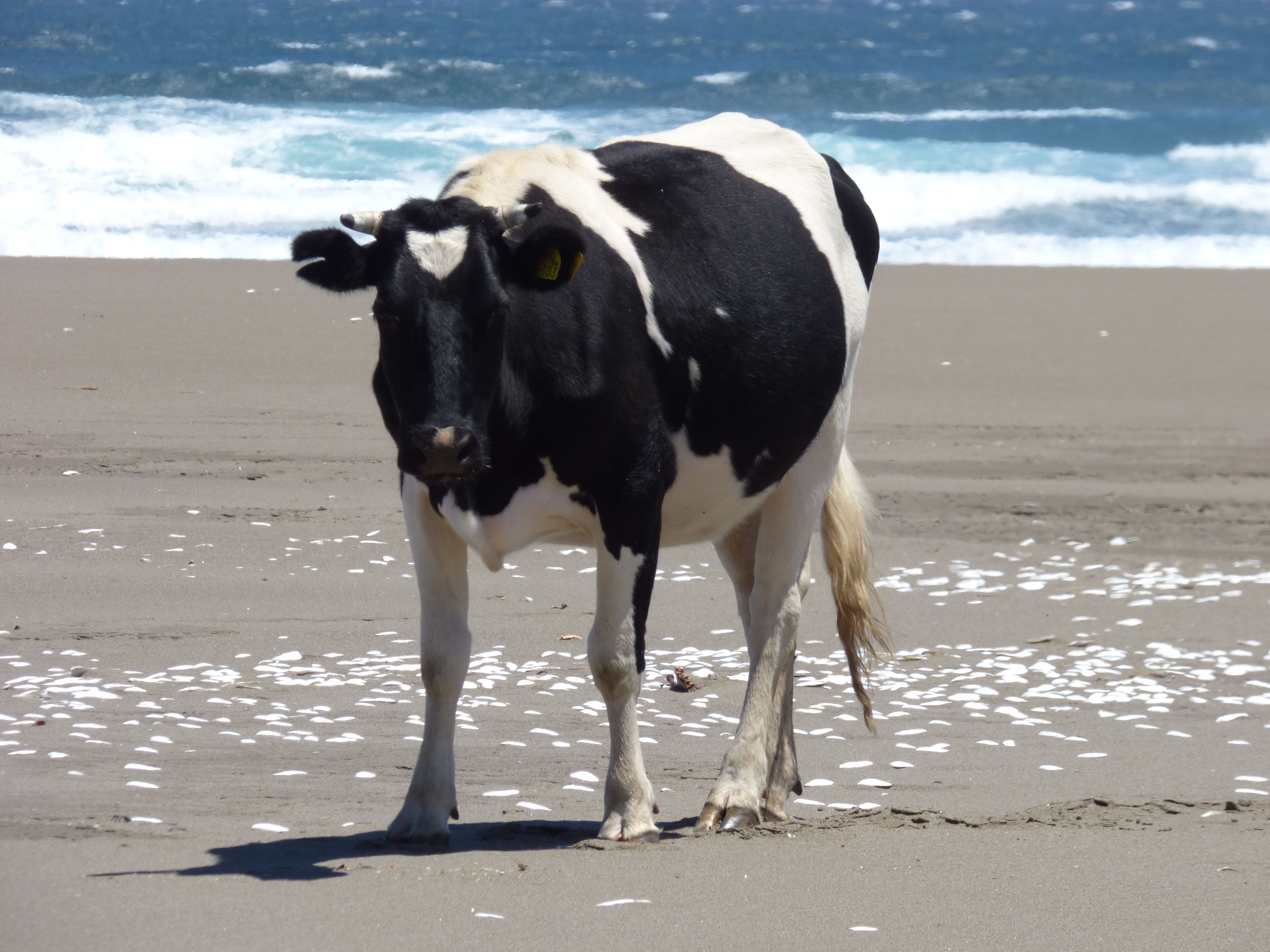
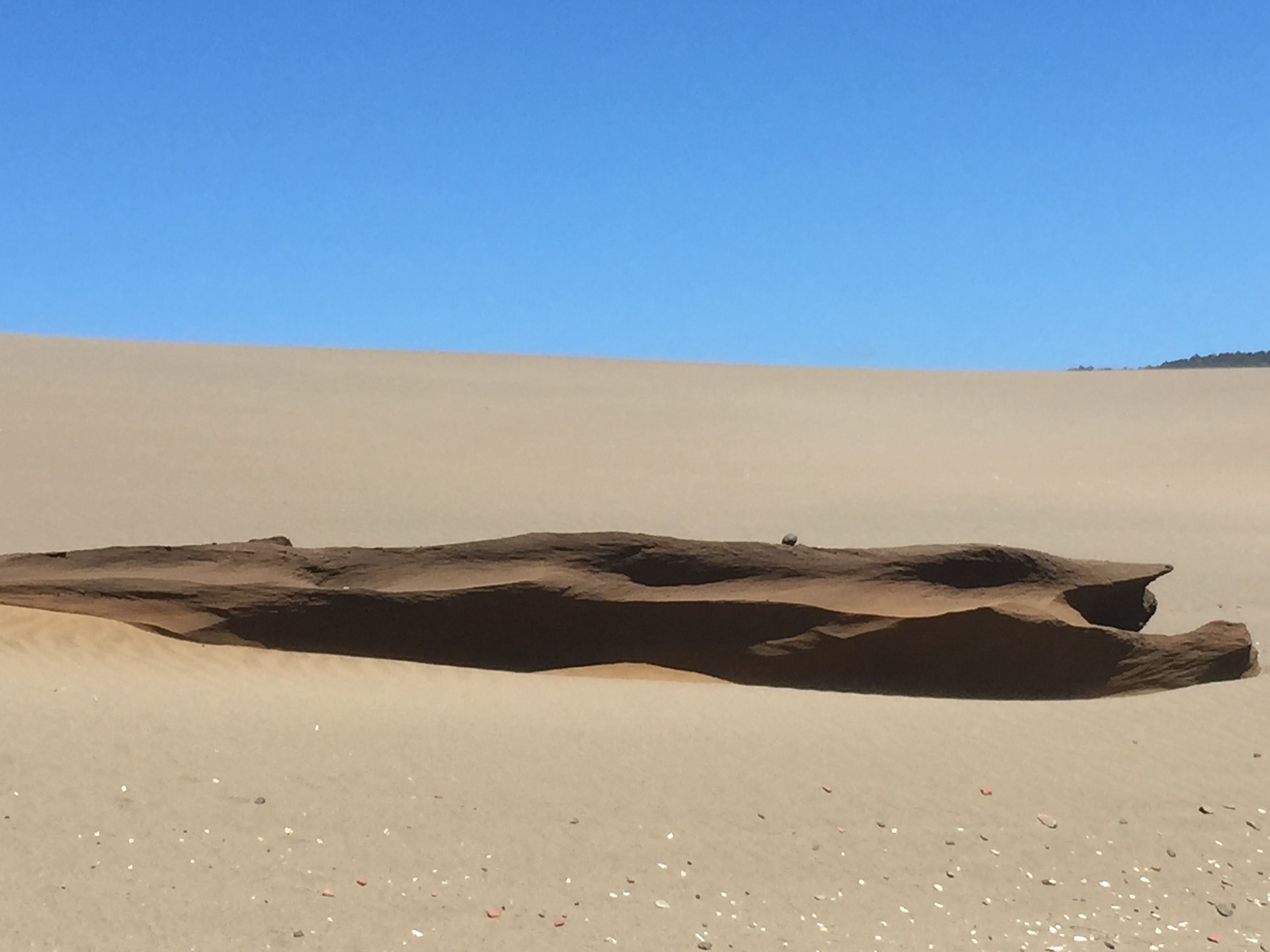
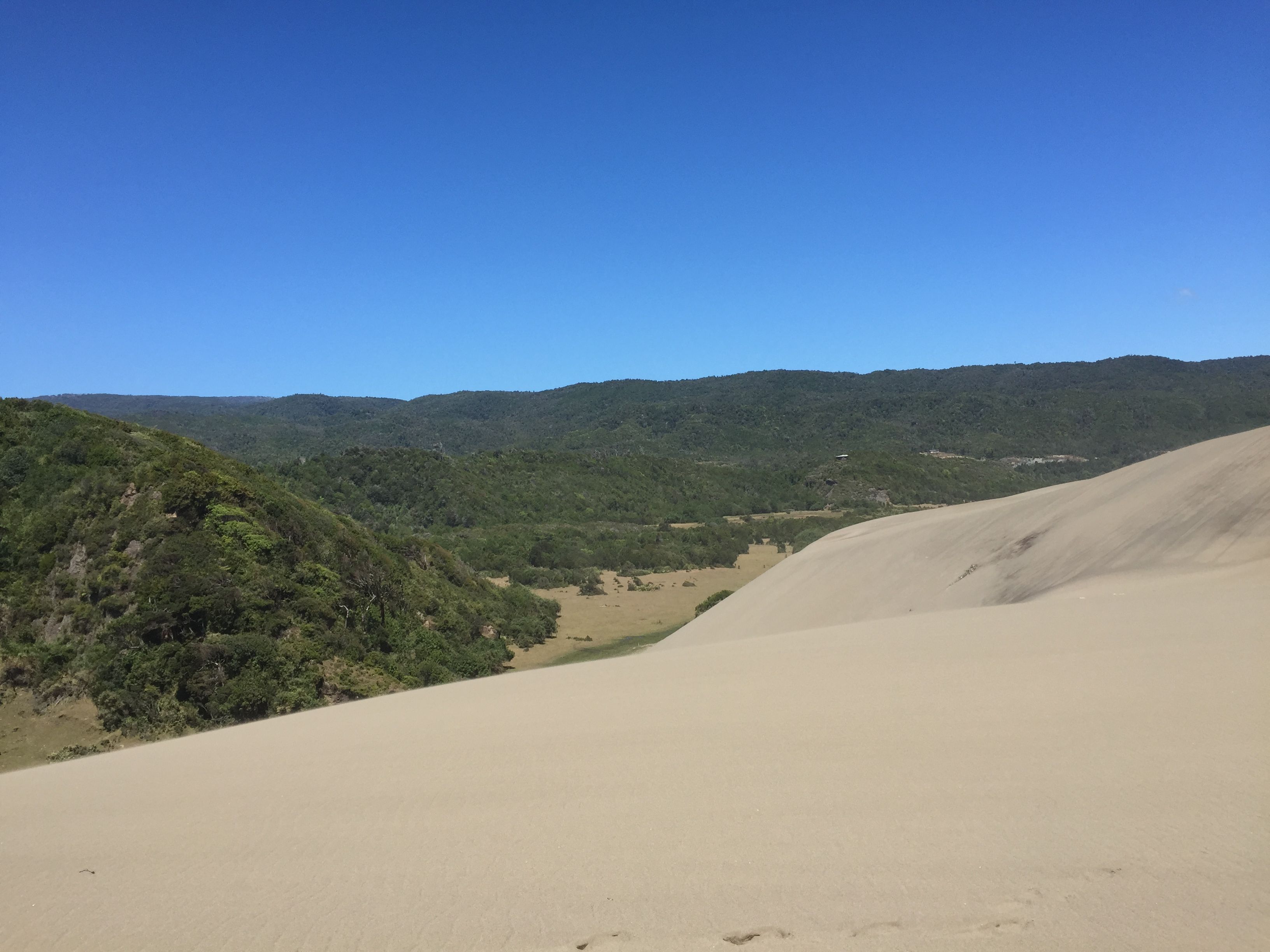
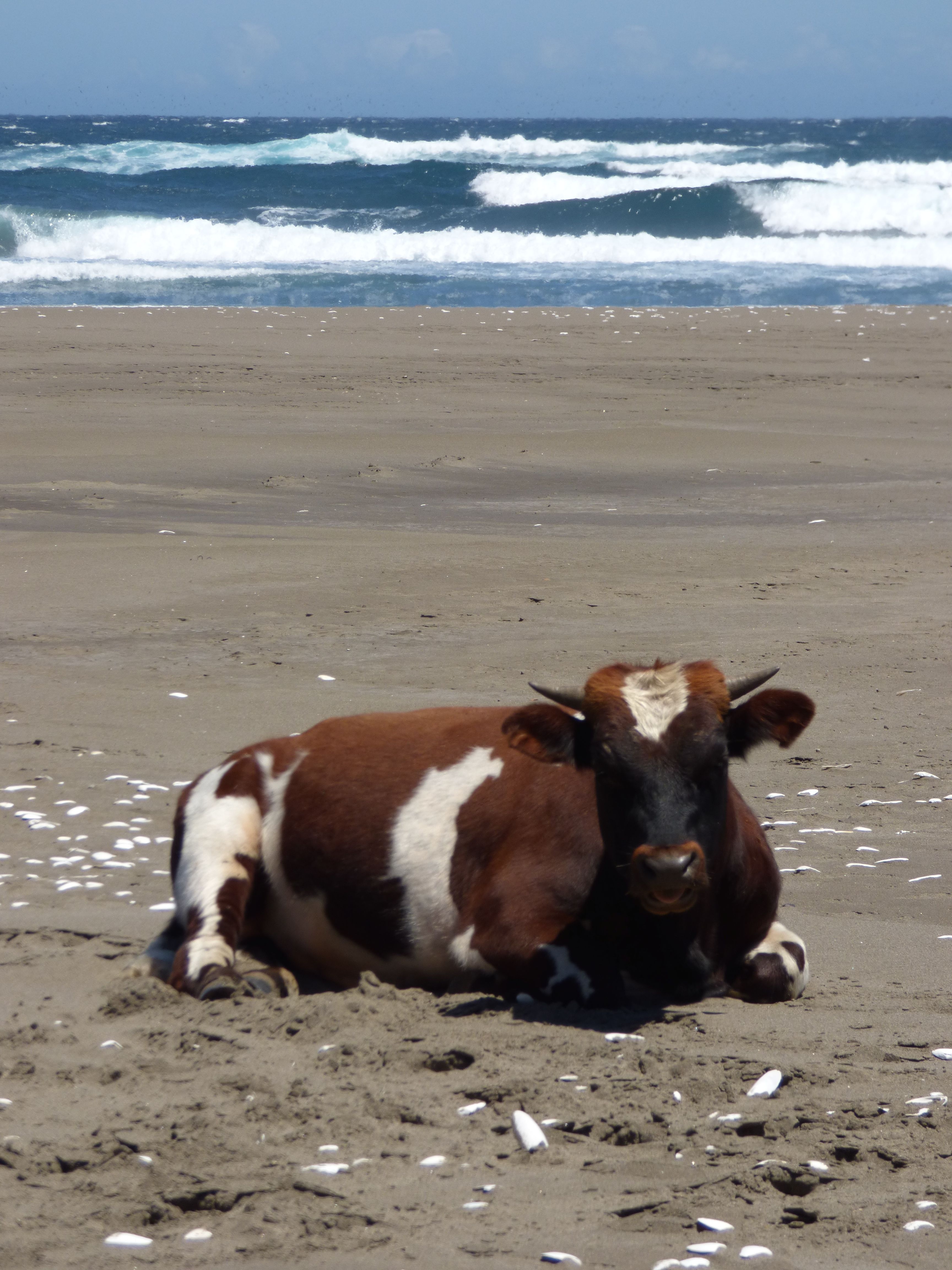
In the morning we drive to Chaihuín, then south towards Laguna Colún along an unmade forest road for an hour, having to stop several times to move logs across the track, where the mud has piled thick. When the road runs out we walk through the forest, curving down towards a broad expanse of high dunes, overlooking the sea. There is practically no one here. Miles of unspoiled, empty beach. But what I hadn’t counted on were the cows, grazing, it would seem, on the beach, except that there is no grass, only sand. They come there for the algae, of which there are two main kinds hereabouts, cochayuyo (the large octopus kind) and lugo. The cows look pretty relaxed on the beach, even though they don’t seem to be making much effort to find the seaweed, of which there is plenty along the shore.
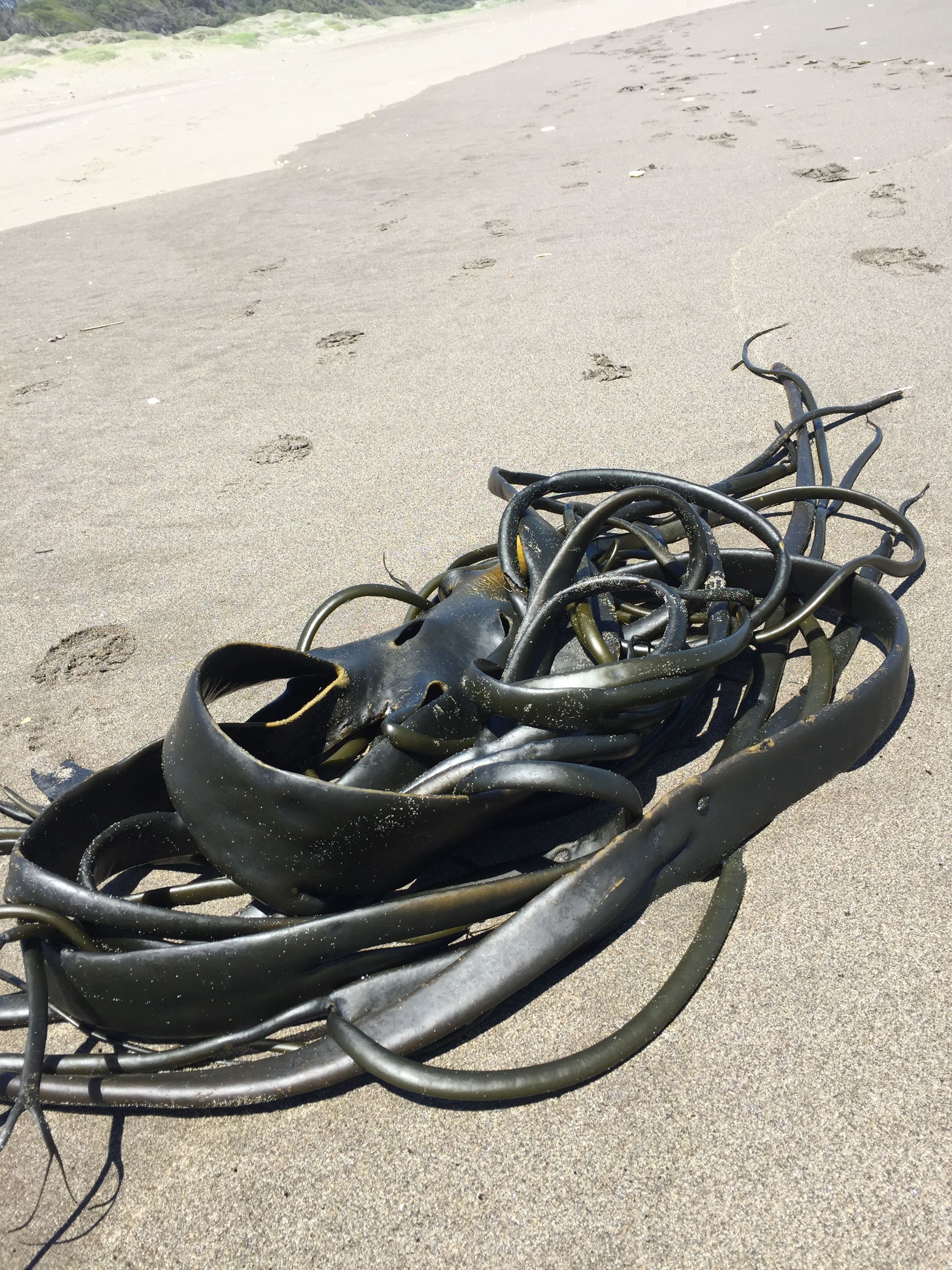
Cuchaluyo seaweed disguised as an octopus to distract the cows
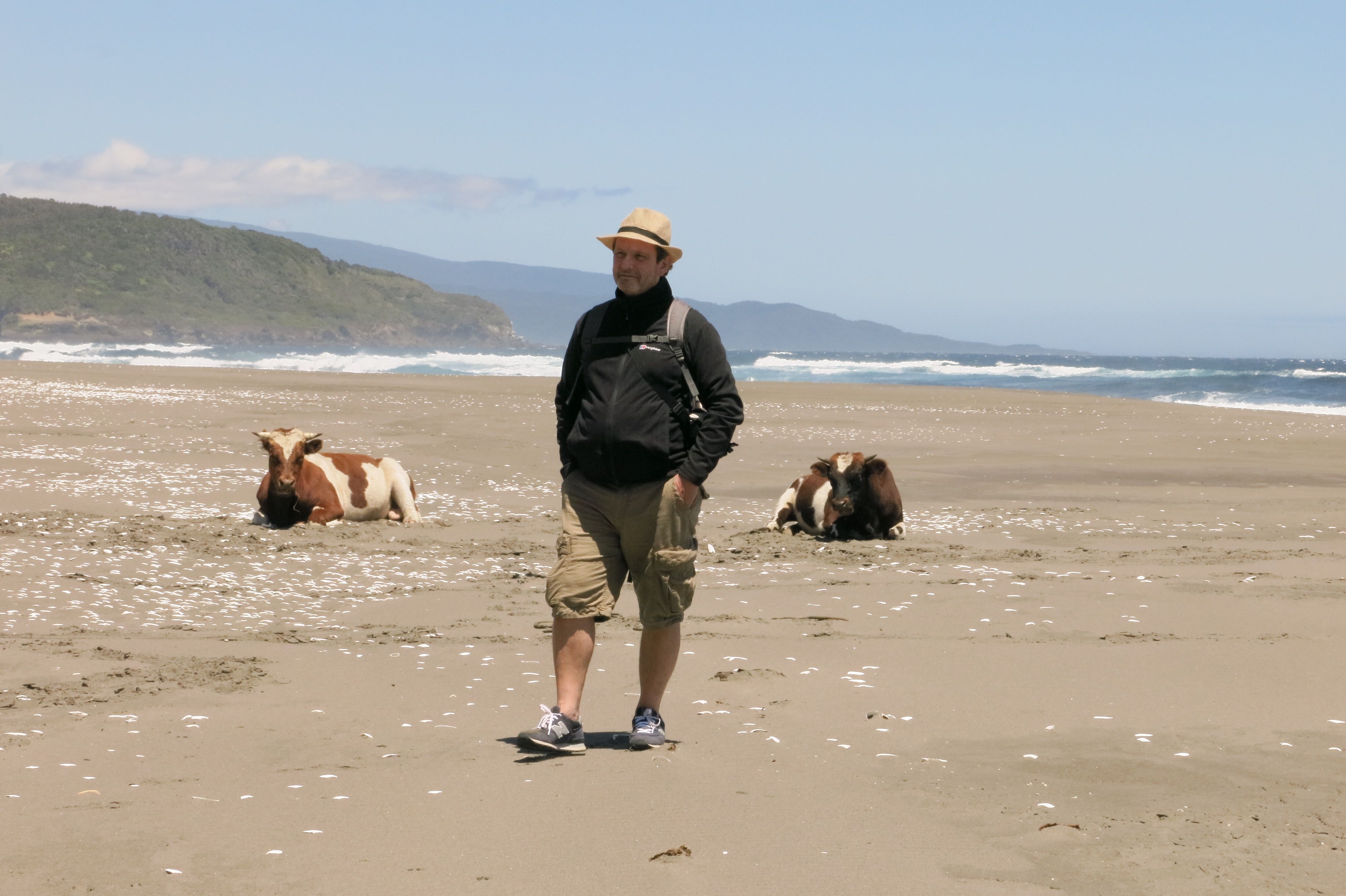
Blanco with bored cattle on beach
The only inconvenience is the flying insect known as the tábano negro, and colloquially as coliguacho. You must not wear dark clothes: if you do they will hunt you down and harass you for the whole journey. If you wear white, they will ignore you altogether. Almost every beautiful place seems to harbour some resident bug whose only purpose is to persecute and sting people. I have foolishly brought a navy blue fleece, but I take it off soon enough, and my pale t-shirt holds no interest for them.
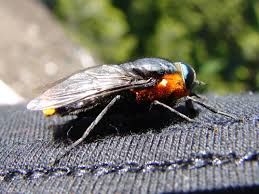
Coliguacho or Tabano Negro (Scaptia lata).
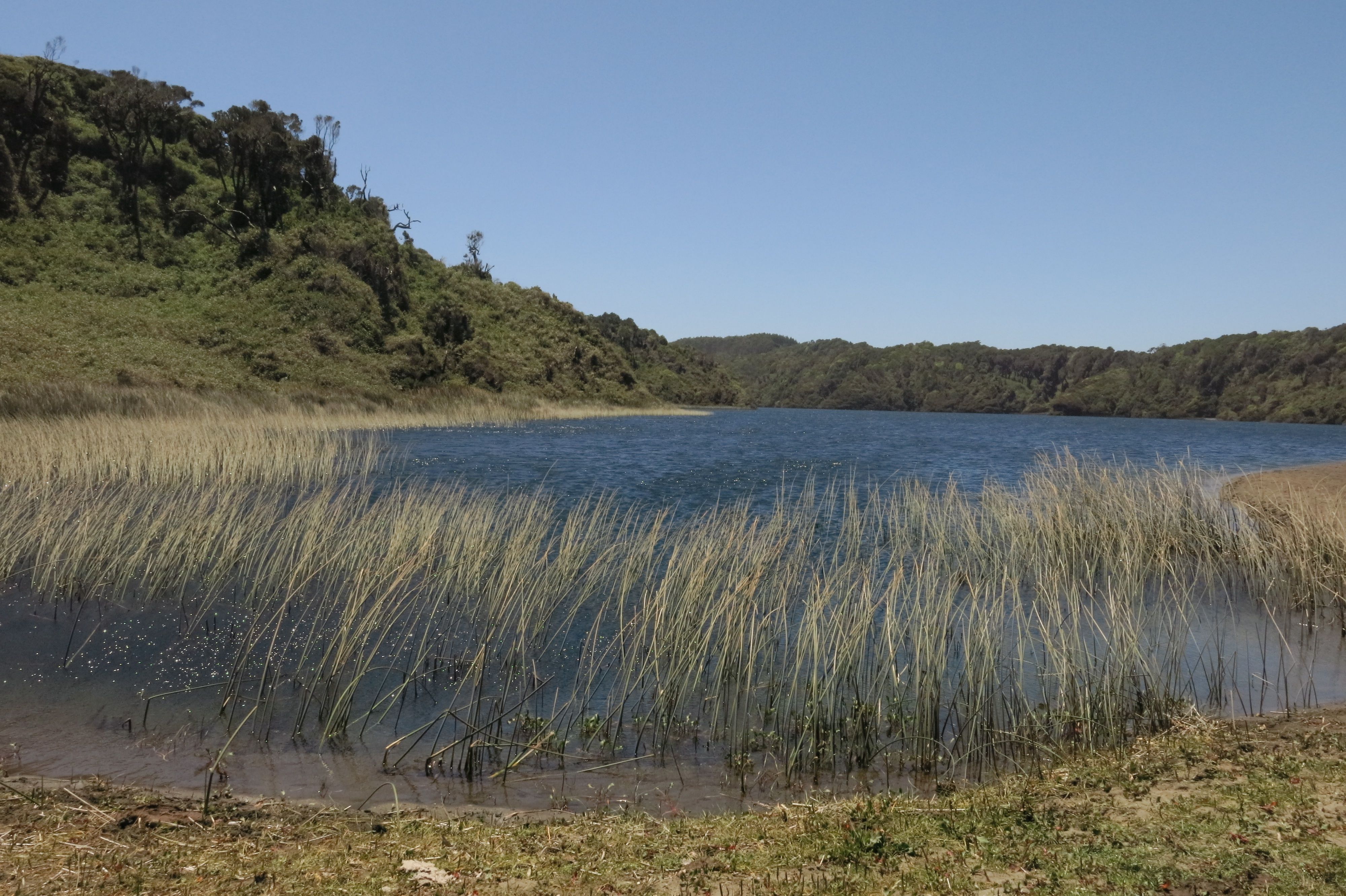
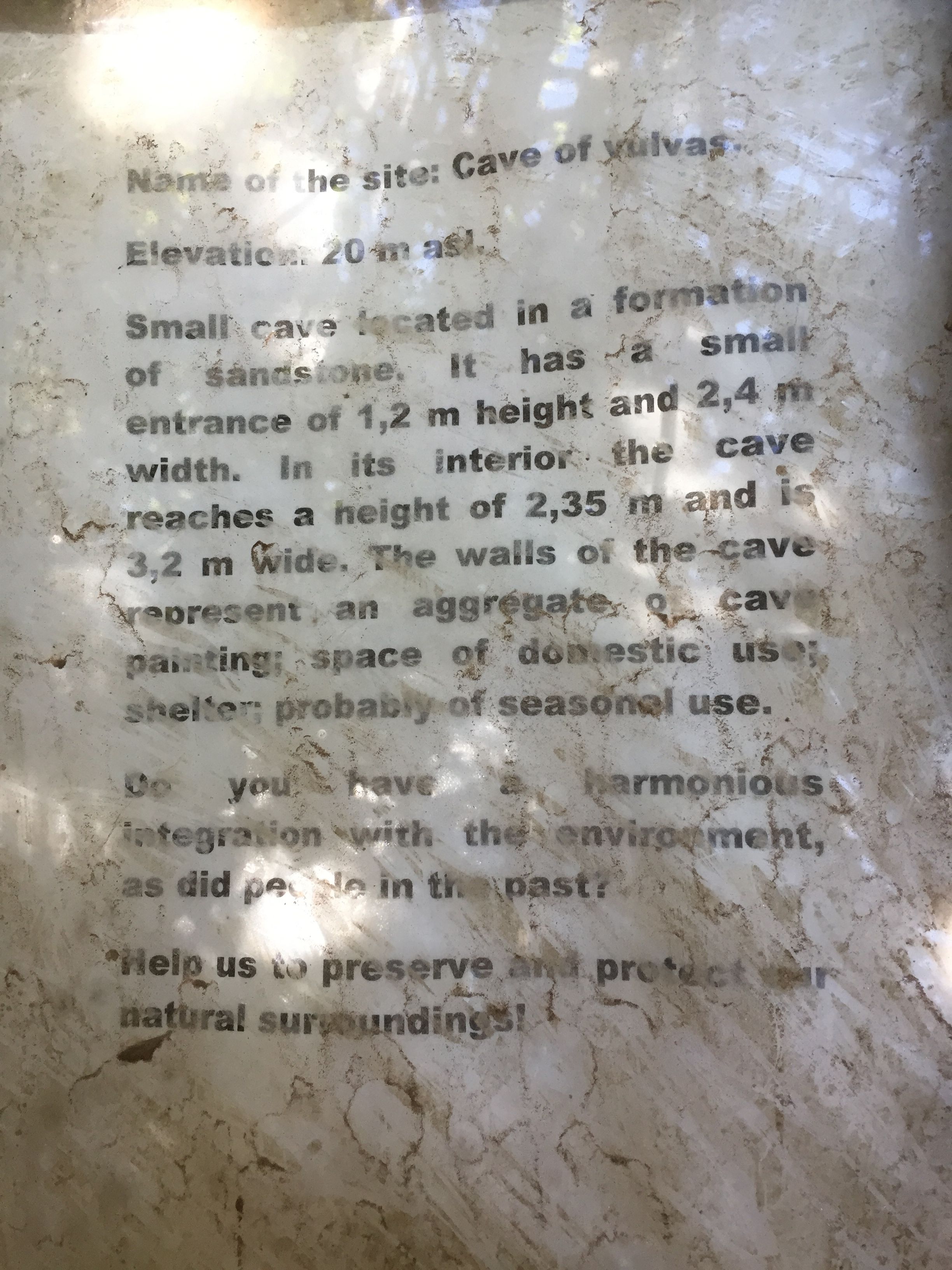
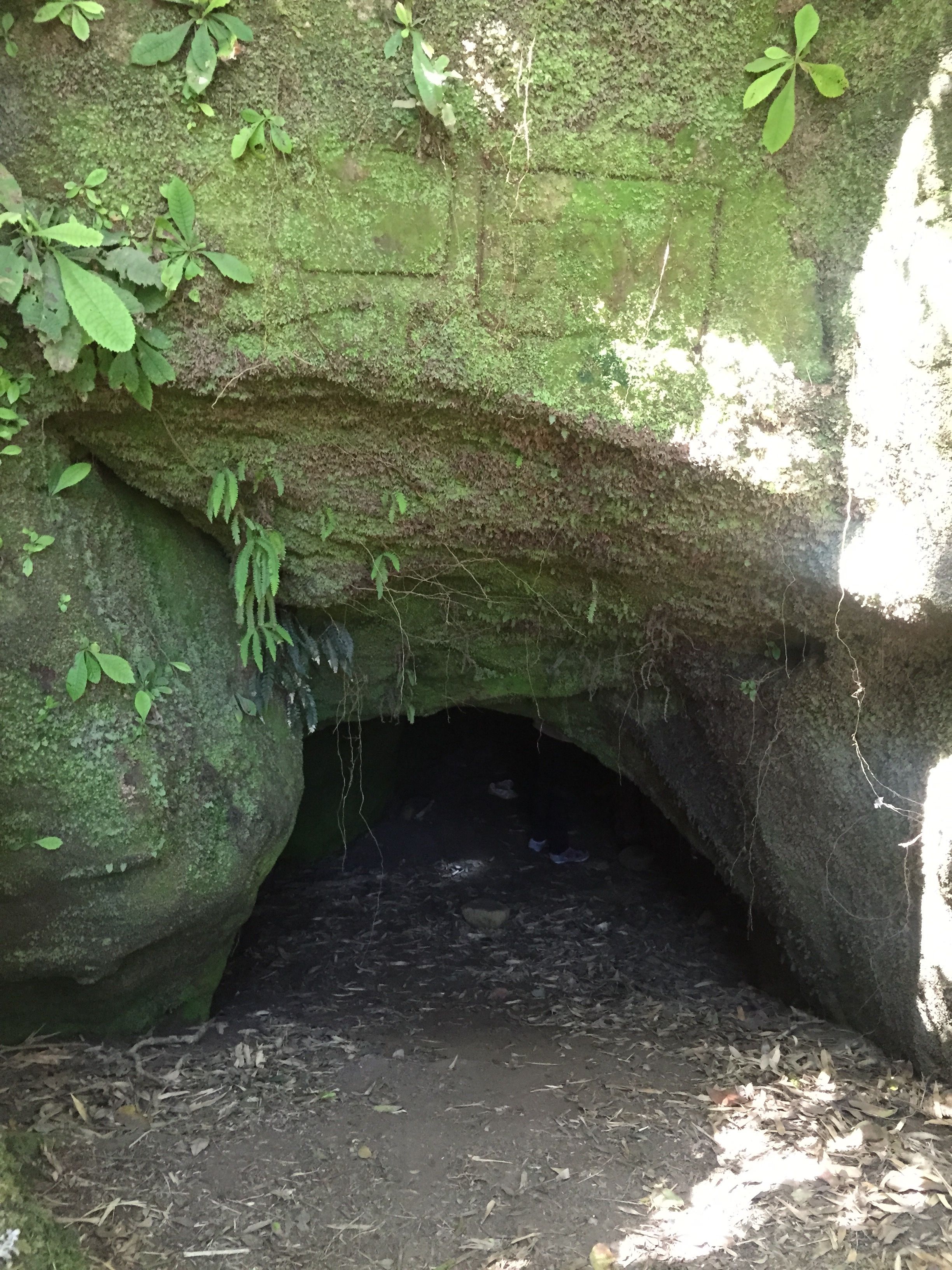
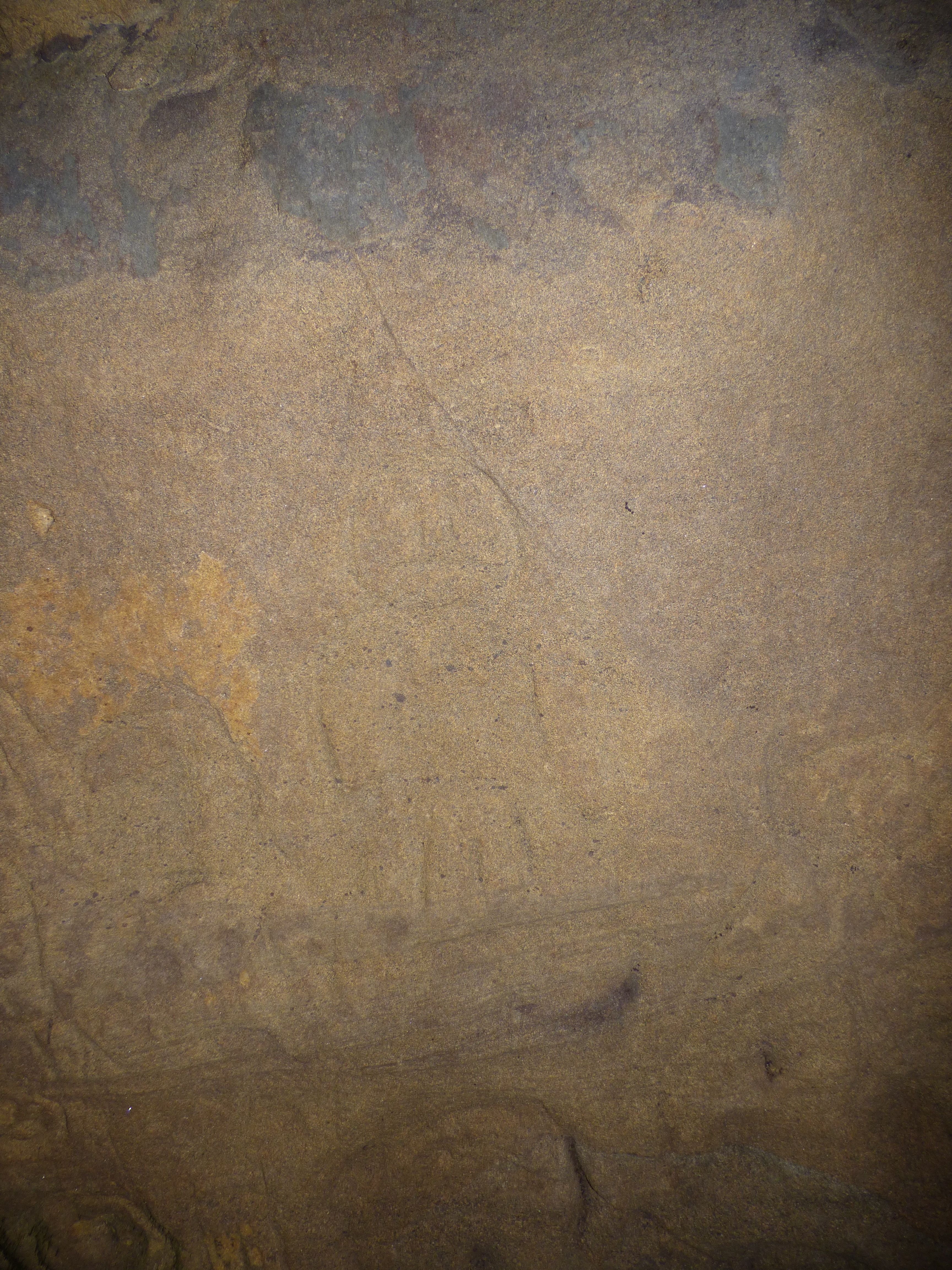
We turn inland in the direction of an inland lagoon named Colún, where the plan is to swim, although, in the event, it is far too cold and windy. So our self-appointed guide tells us we have to cross more dunes – a frustrating and exhausting venture in which you slide down two metres for every one you climb, then – after a traipse along the summit of the dunes – towards green pastures; in fact, towards a grotto, somewhat alarmingly called the cave of the vulvas. The cave turns out to be more or less what it says on the label: a dark cavern filled with fissures carved into the rock and some aboriginal art. A battered lectern outside surprisingly provides information in both Spanish and English translation, but omits to inform who originally made the drawings and carvings inside the cave, or why. The place has not yet been properly researched or carbon dated. One of my companions says it was used as an initiation chamber by the indigenous people of these parts in pre-Hispanic times, but I no longer know what to believe. Climbing the dunes and sliding down the other side only to enter the cave of vulvas has made me dizzy. And there is still a long walk back, past the still motionless cows.

The collapsing world
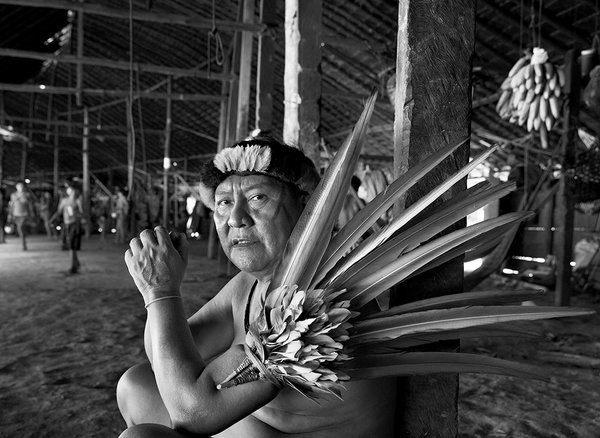
Shaman Davi Kopenawa
In a recent review of The Falling Sky: Words of a Yanomami Shaman, I learn that in a creation myth of the Yanomami people, the original world – the world that was here before – was “crushed by the collapse of the sky, hurling its inhabitants into the underworld. The exposed ‘back’ of the previous sky became the forest where the Yanomami emerged.” A new sky was set up and “held in place by metal foundations set deep in the ground by the demiurge Omama. Yet the new sky is under constant assault by the forces of chaos, and Yanomami shamans work tirelessly with their spirit allies, the xapiri, to avert a new apocalypse. A diaphanous third sky already lies waiting, high above, in case the current one collapses and the world once again comes to an end.”
The fragility of the known world is a theme that emerges also in Juan José Saer’s book The Witness (see post from 30 November). The nameless cabin boy who is adopted by a tribe living on the banks of a South American river is returned to the invading Spaniards ten years after his capture. Eschewing public attention, he holes up in a Spanish monastery for several years, under the tutelage of a sagacious monk, who teaches him Latin, Greek and Hebrew. On his protector’s death, he leaves the monastery and lives as a vagrant, before eventually he joins up with a group of actors, and – to great public acclaim – tours the cities of Europe, performing a drama of his ‘life among the savages’, in which he acts himself. It is only in his old age that he settles down to write his account of those years.
And here he returns to the theme of the precariousness of the world, and all that is in it. The Indians among whom he lived all those years ago considered themselves and the world they inhabited to be coterminous. Outside they do not feel on safe ground.
“Even though they [the Indians] took for granted the non-existence of others, their own existence was in no way irrefutable . . . For them the main attribute of all things was precariousness.” This belief has a linguistic base: there is no equivalent word in their language for ‘to be’. The closest equivalent they have means ‘to seem’. “But ‘seems’ has more of a feeling of untrustworthiness than sameness. It is more a negative than a positive. It implies an objection rather than a comparison. It does not refer to a known image but rather tends to erode perception and diminish its force. The word used to designate appearance also means exteriority, a lie, an eclipse, enemy. Everything that presented itself clearly to the sense was for them formless and had a vague and sticky underside against which the darkness beat.” The people among whom our narrator lives, nevertheless, regard themselves as the custodians of this fragile and terrifyingly insubstantial world. “In their hands lay the precarious fate of all perishable life. It would take only a moment’s inattention for it all to collapse, taking them with it.”
I do not regard this attitude towards the imminent collapse of all reality to be that unreasonable. After all, those of us who grew up in the sixties came to consciousness under a not entirely dissimilar mythology of imminent extinction: in our case it was thermonuclear war. Now it is the destruction of the ozone layer and climate change. It is no surprise that environmentalists have adopted the Shaman Davi Kopenawa, co-author of The Falling Sky, as a spokesperson for those many peoples whose habitat is under constant environmental threat from loggers and miners, or from the effects of climate change. Davi Kopenawa has taken on this mantle, appearing at events worldwide on behalf of his people, and others like them. According to the New York Review article, “he finds echoes of Yanomami notions in Western environmental thought, but with an important caveat: “Since the beginning of time, Omama has been the center of what the white people call ecology…. In the forest, we human beings are the ‘ecology.’”
A short walk in Valparaíso
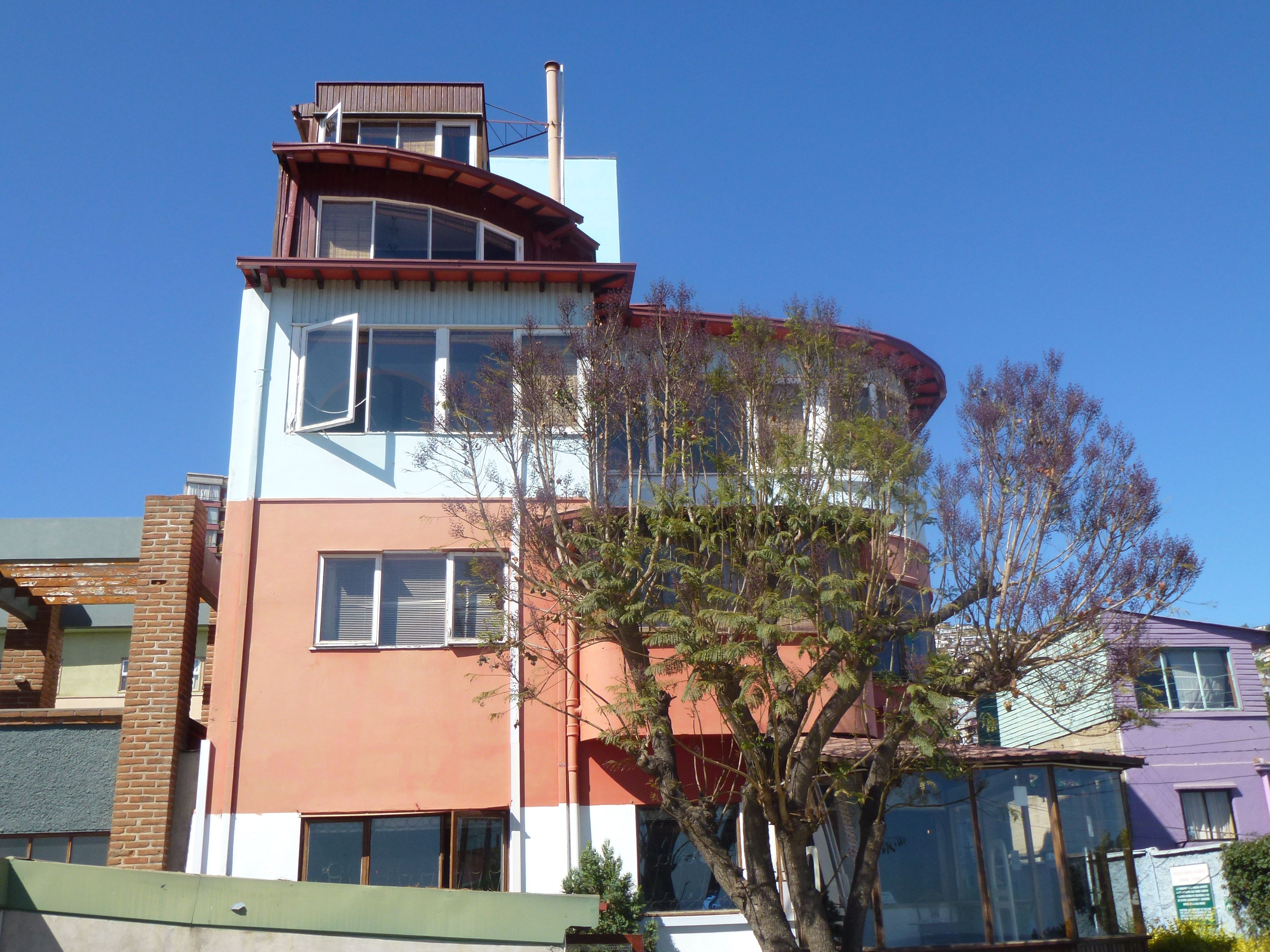
Neruda’s house, ‘La Sebastiana’.
I first came across the name Valparaíso via Neruda’s poem dedicated to Don Asterio Alarcón, the clockmaker of that city, many years ago. Neruda’s house is a fabulous creation, built on five stories, most of the rooms having large windows that look out over the bay. Not to be missed, whatever you think of the poet (or bis personal life).
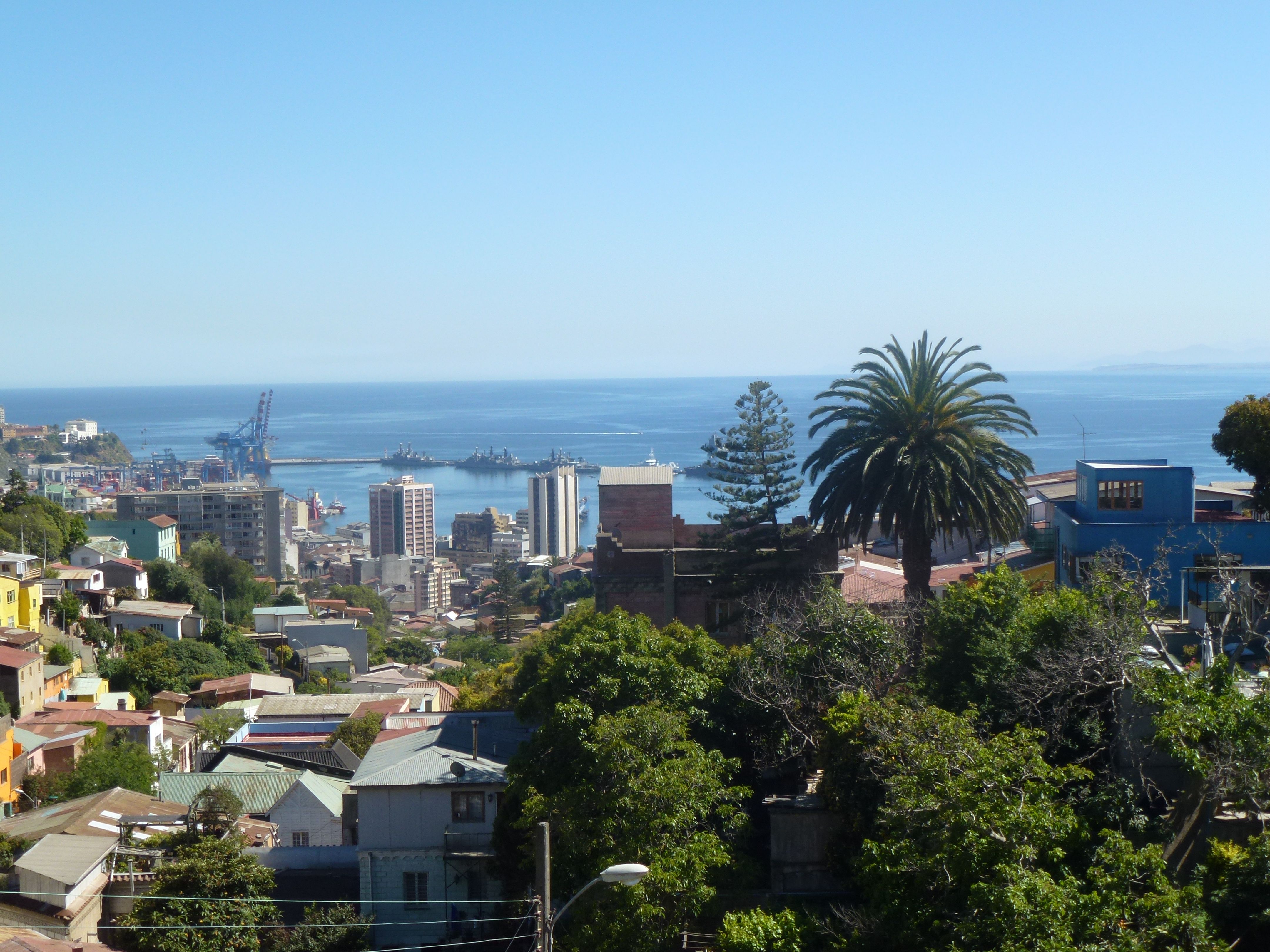
Valparaíso was the most important port on the Pacific seaboard of the Americas until the creation of the Panama canal. It lies on several hill, or cerros, cluttered with houses of every shape, many of them built from adobe covered with tin sheeting salvaged from ships, and painted in bright colours. I had the good fortune to be shown around town by the young poet Enrique Winter, and walking is the only way to see Valparaíso as it is a labyrinth of alleys and stairways – and also boasts a series of antique lift or elevators, some of them actually working.
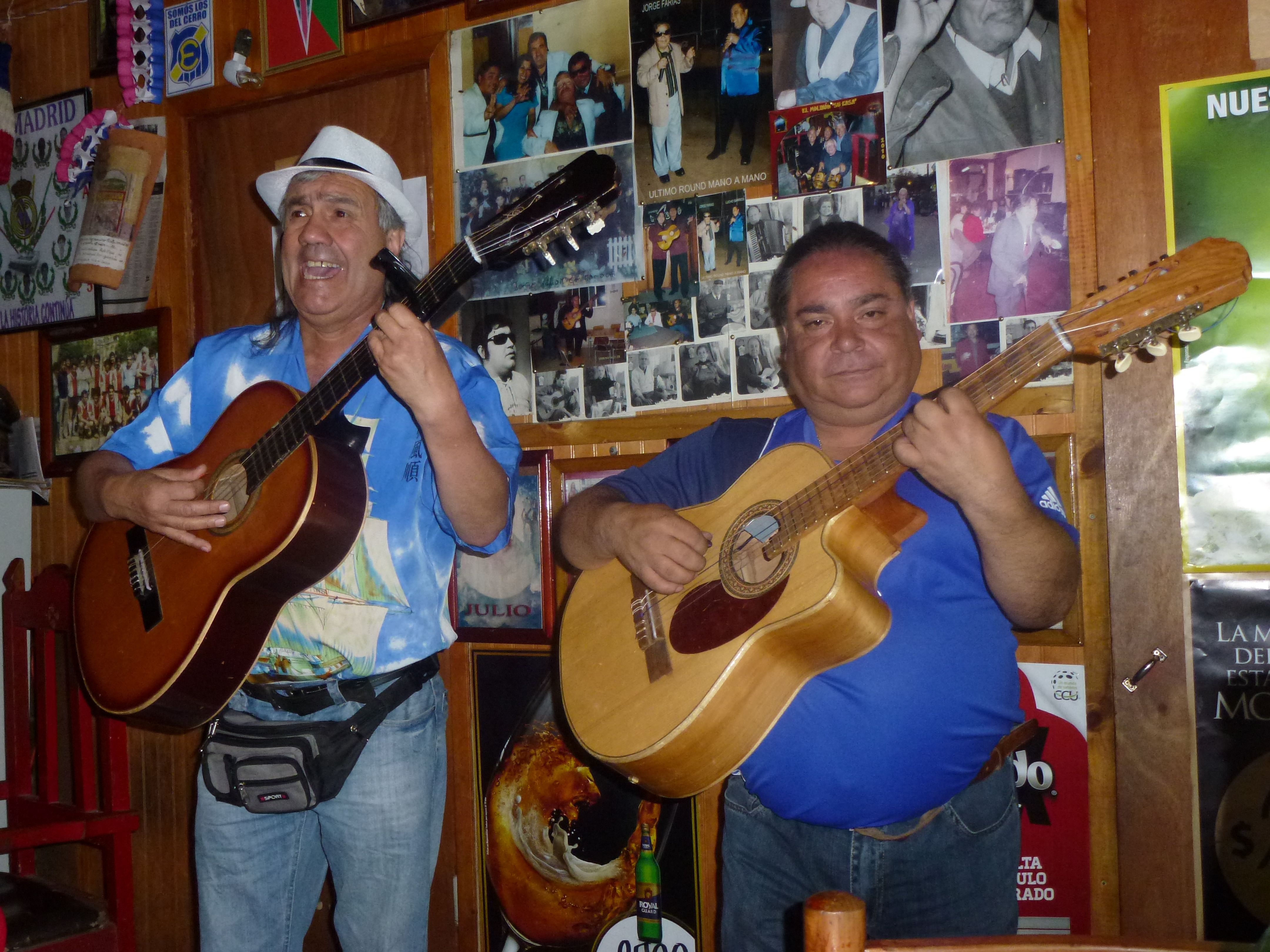
Valaparaíso is still a working port, and the main base of the Chilean navy. In the early evening we visited a place where old sailors come to die, called Liberty. We had not been there long when a French TV film crew came in and wanted to film two gentlemen (depicted below) sing a couple of songs. They wanted us to move tables. ‘Why’, asked Enrique, ‘don’t we look Chilean enough for you?’ The French TV producer very kindly offered to pay our bill, so we acceded to his request and moved to another table. When the music ended there was a lot of hooting and rowdy behaviour from the local clientele, which included a 1970s football star from the town’s once glorious team (football was introduced to the city by British sailors).
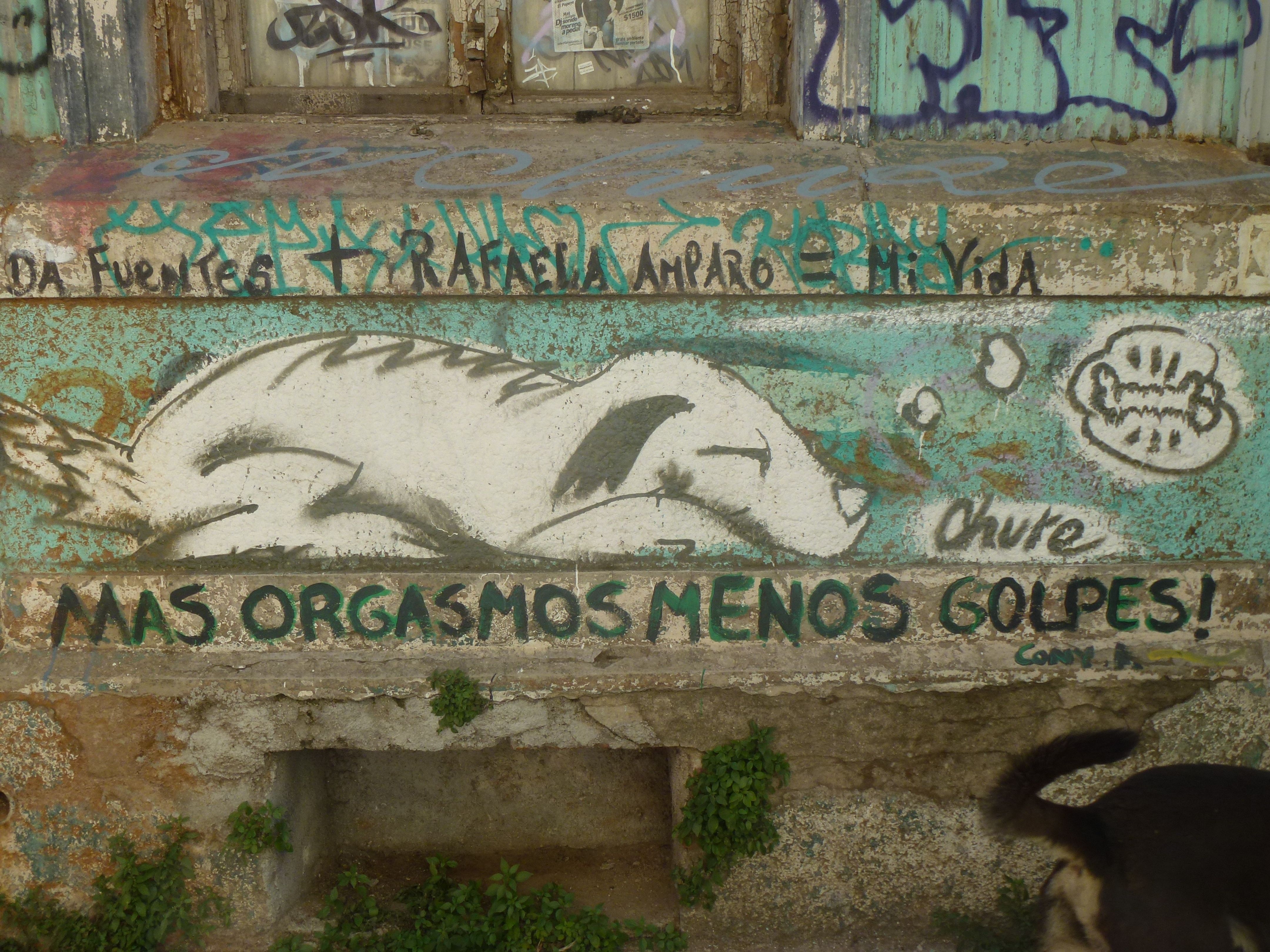
After dinner, returning to Enrique’s house, I acquired an escort of four black dogs, of varying sizes. All I needed was a cape and I could have stepped straight out of an Iron Maiden song.
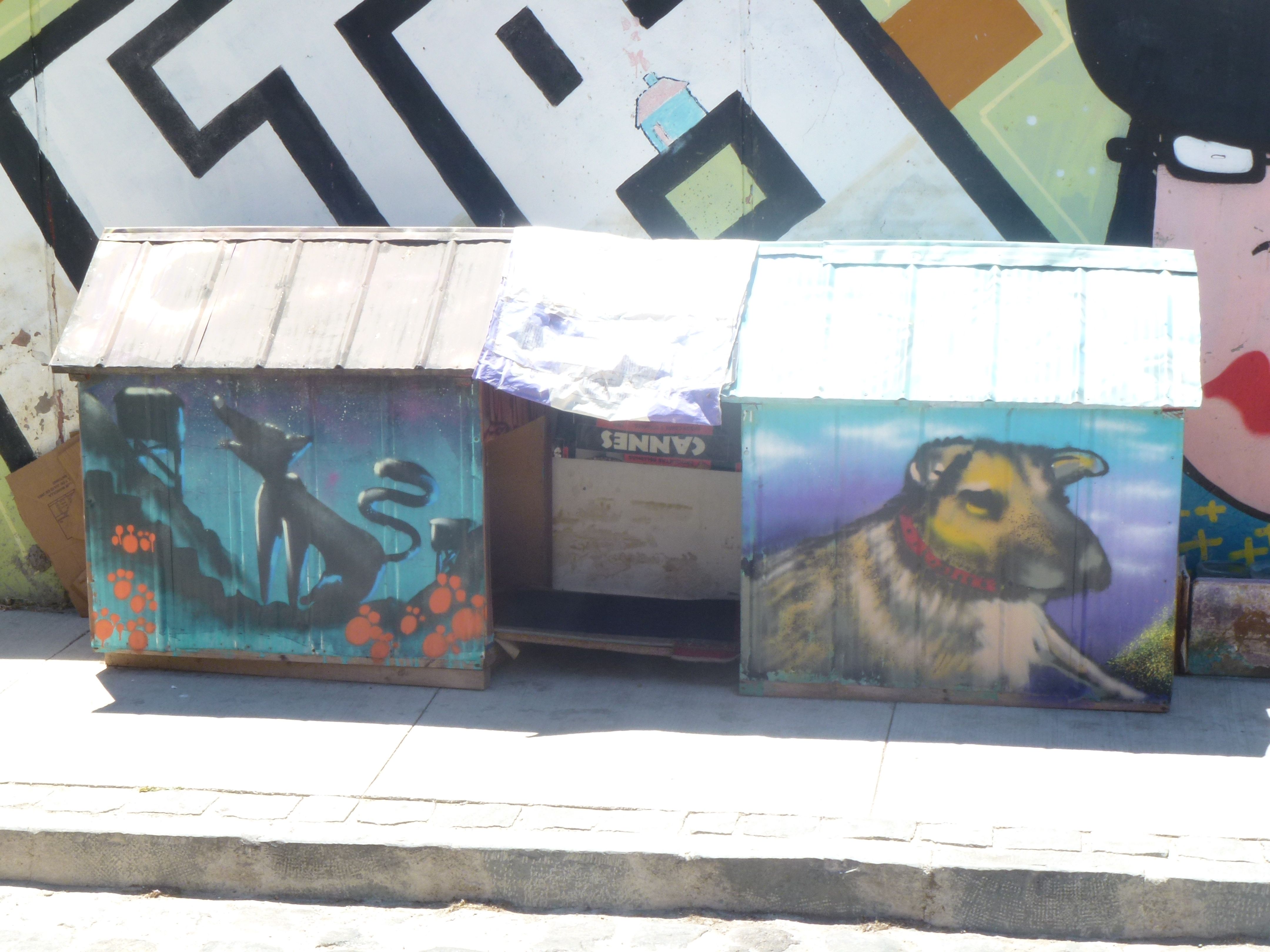
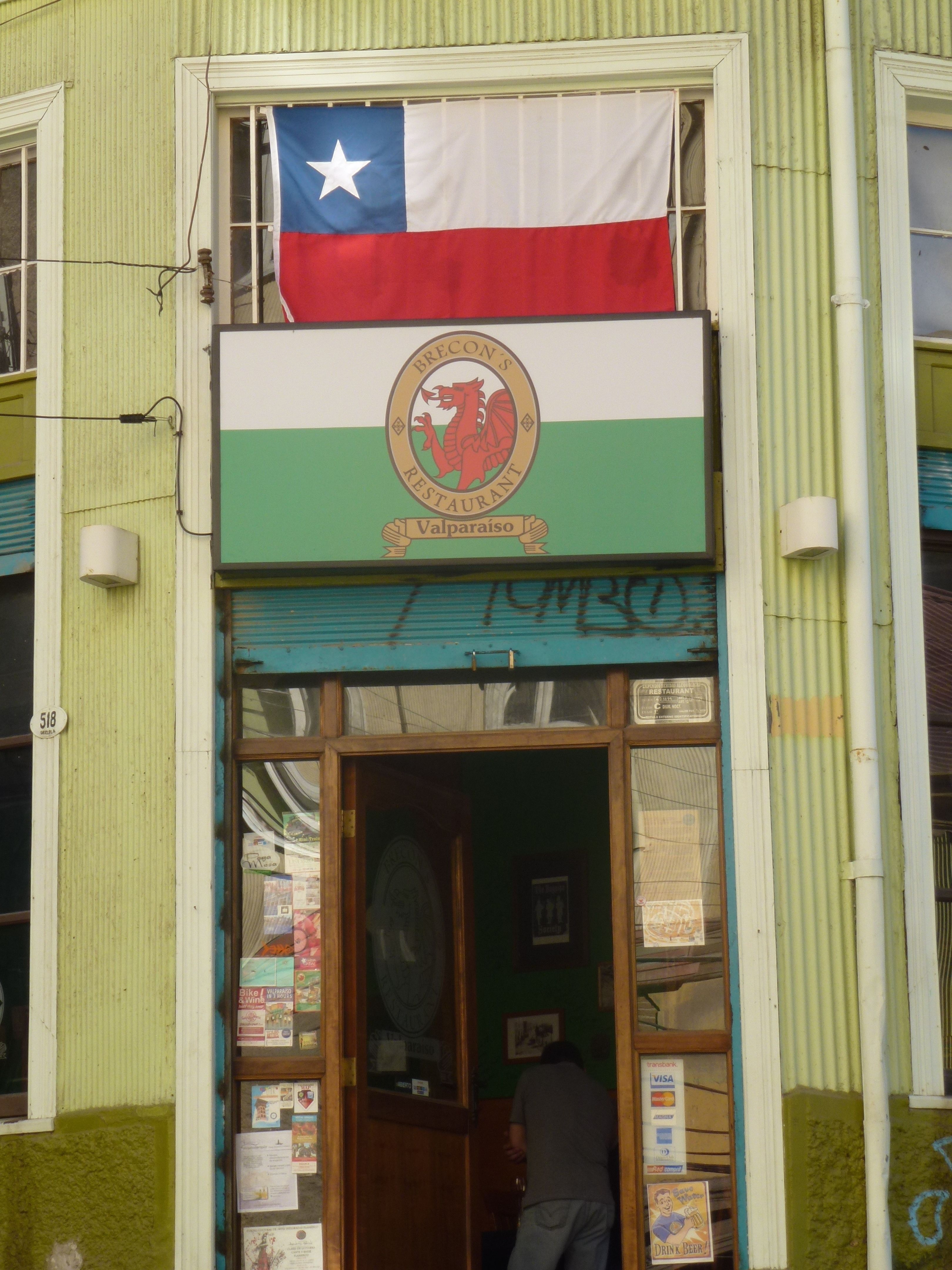
Valparaíso is a slice of paradise, however obvious the statement. Even the French TV crew could be forgiven. Later yesterday evening, back in Santiago, we were invited to a party in a swish part of town and I ended up having a long chat with the film director Miguel Littín, subject of the Gabriel García Márquez book Clandestine in Chile. His opinion was different. ‘French TV film crews’, he confided, ‘they are the worst.’
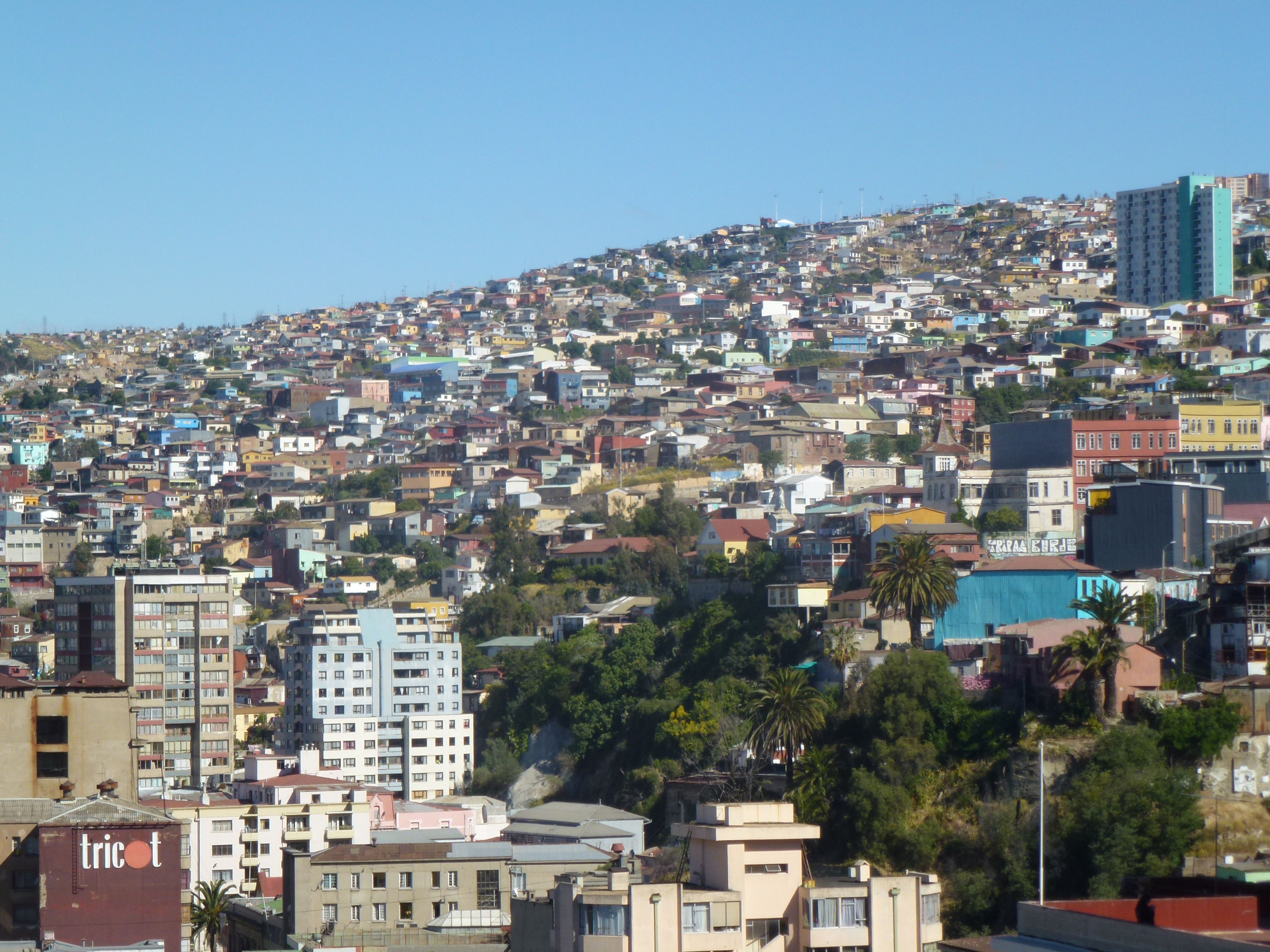
The things we leave behind
The things we leave behind, or set apart, are usually left behind or set apart because they serve a purpose different from the one we have currently in mind. A walk around Santiago’s La Vega and Central markets yesterday morning, followed by a stroll in the Yungay district confirmed this notion. An illuminating and educational way of passing the morning before the arduous business of attending the city’s annual book fair.
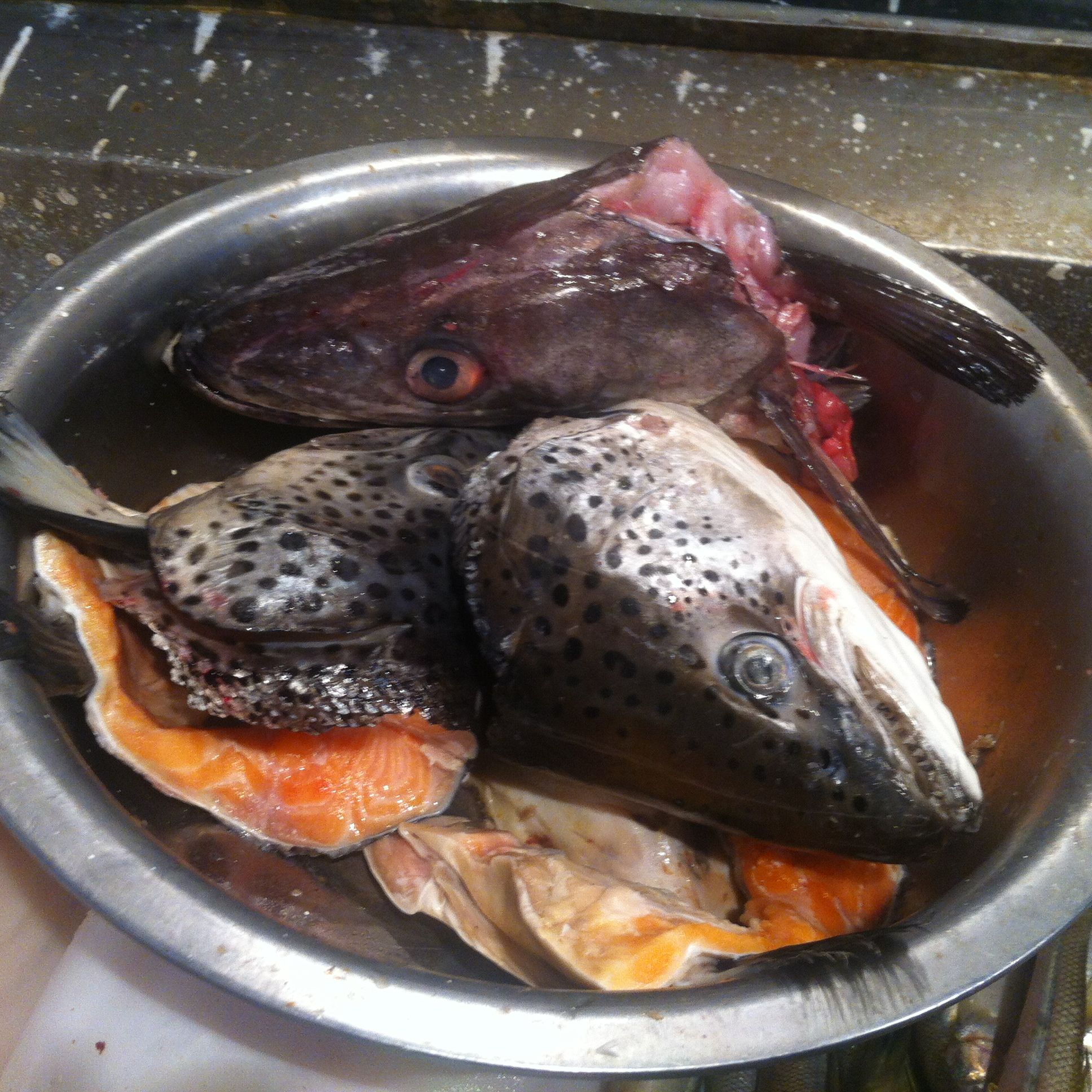
- Fish heads are left behind because people often feel as though they are not intrinsic to the preparation and cooking of said fish, since, unless they are very small fish, the heads are unlikely to be eaten. However this does not take into consideration the aesthetic qualities of presentation. If you are going to bake a large fish and place it on a serving dish in the middle of a table, you want it with its head attached, surely? Many people, nevertheless, leave their fish heads with the fishmonger, who will display them in a basin or bucket.
- Pigs have been known to lose their heads. Or, put another way, the heads get left behind in the general process of butchery. The three unfortunate specimens in this photograph, snouts pressed up against the glass of their cold grave, are sad examples of human carnivorousness. But if the situation were reversed, and pigs were left in charge, would humans fare any better? If the HBO series Deadwood is any guide, decidedly not.

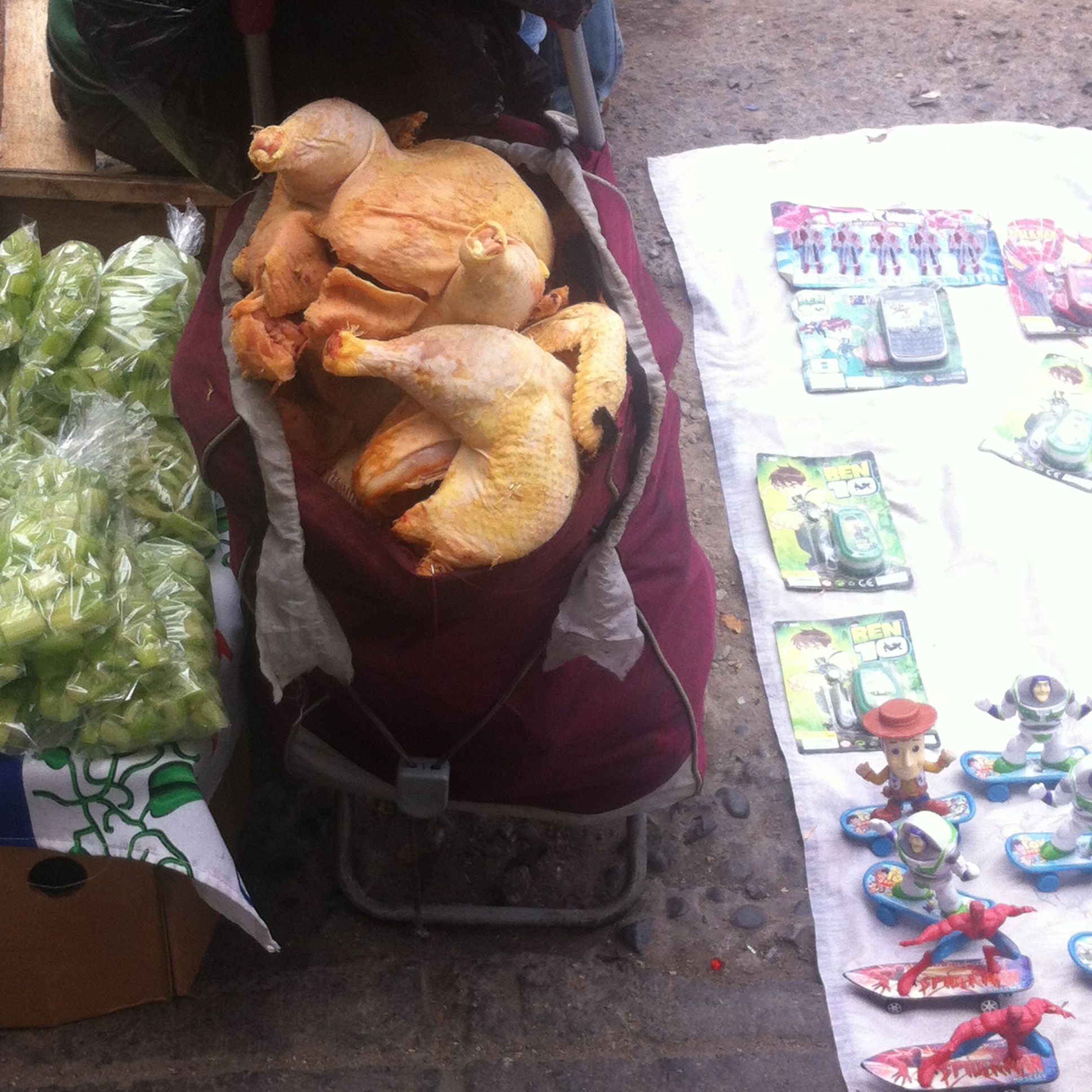
3. Someone seems to have left a backpack filled with dead chickens on the pavement. This questionable practice is apparently an acceptable way to dispose of one’s unwanted chickens in Santiago.
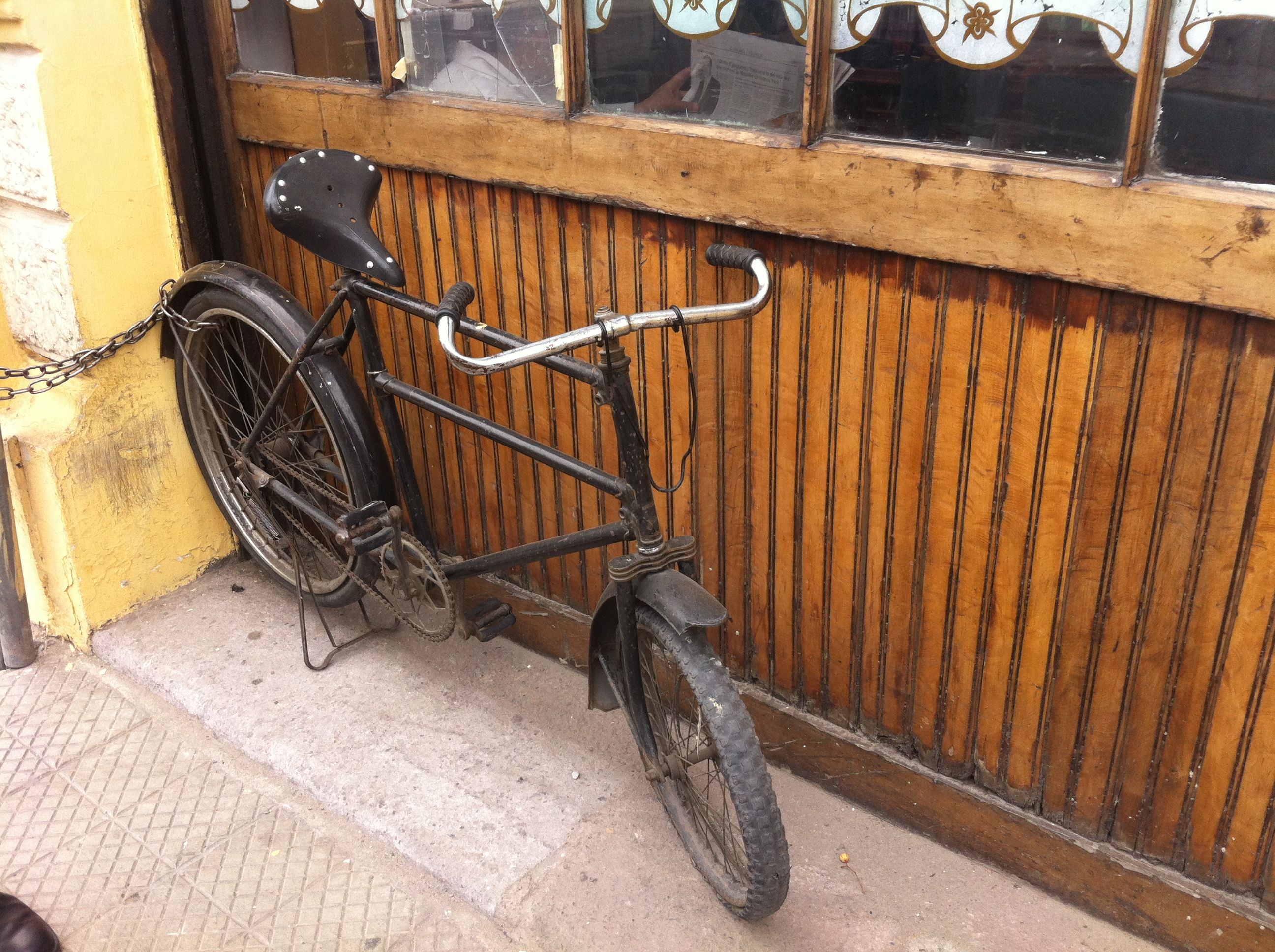
- Bicycles are left outside the barber’s or the restaurant as they would be an encumbrance inside. There would be no space. However, they are far more likely to be stolen if left outside. Therefore their owners attach the bicycle to a fixed object by the use of a chain or similar locking device.
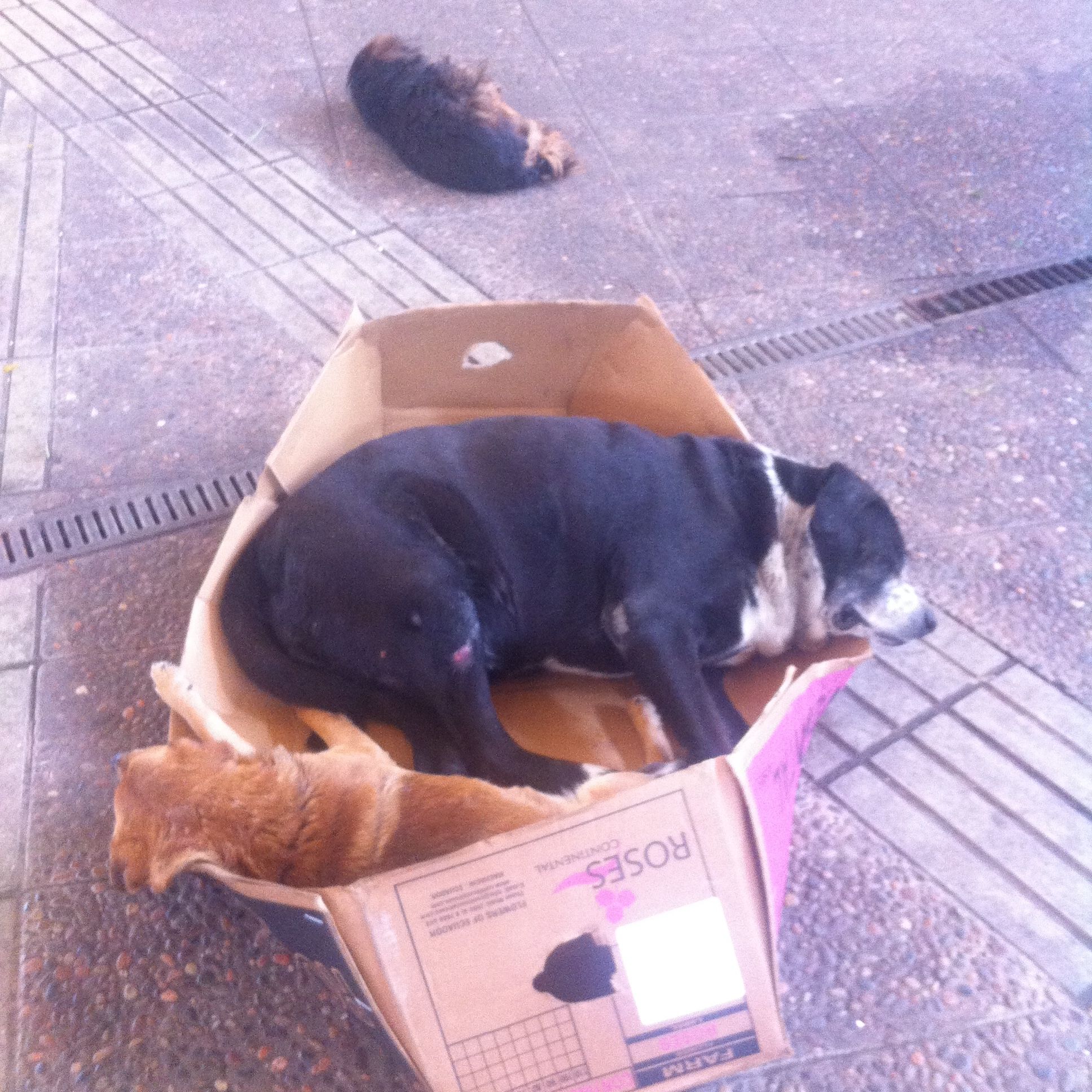
- A cardboard box, once used for the packaging of roses, is left out in the flower market, and provides a handy resting place for a couple of market dogs. Dogs, it should be noted, are everywhere in Santiago de Chile. They are often quite large specimens, such as the black one here, and roam the streets with a marked sense of propriety. People appear to be generally indulgent of them, and consequently the dogs are a constant presence: a Santiago street scene is not complete without a canine in view.
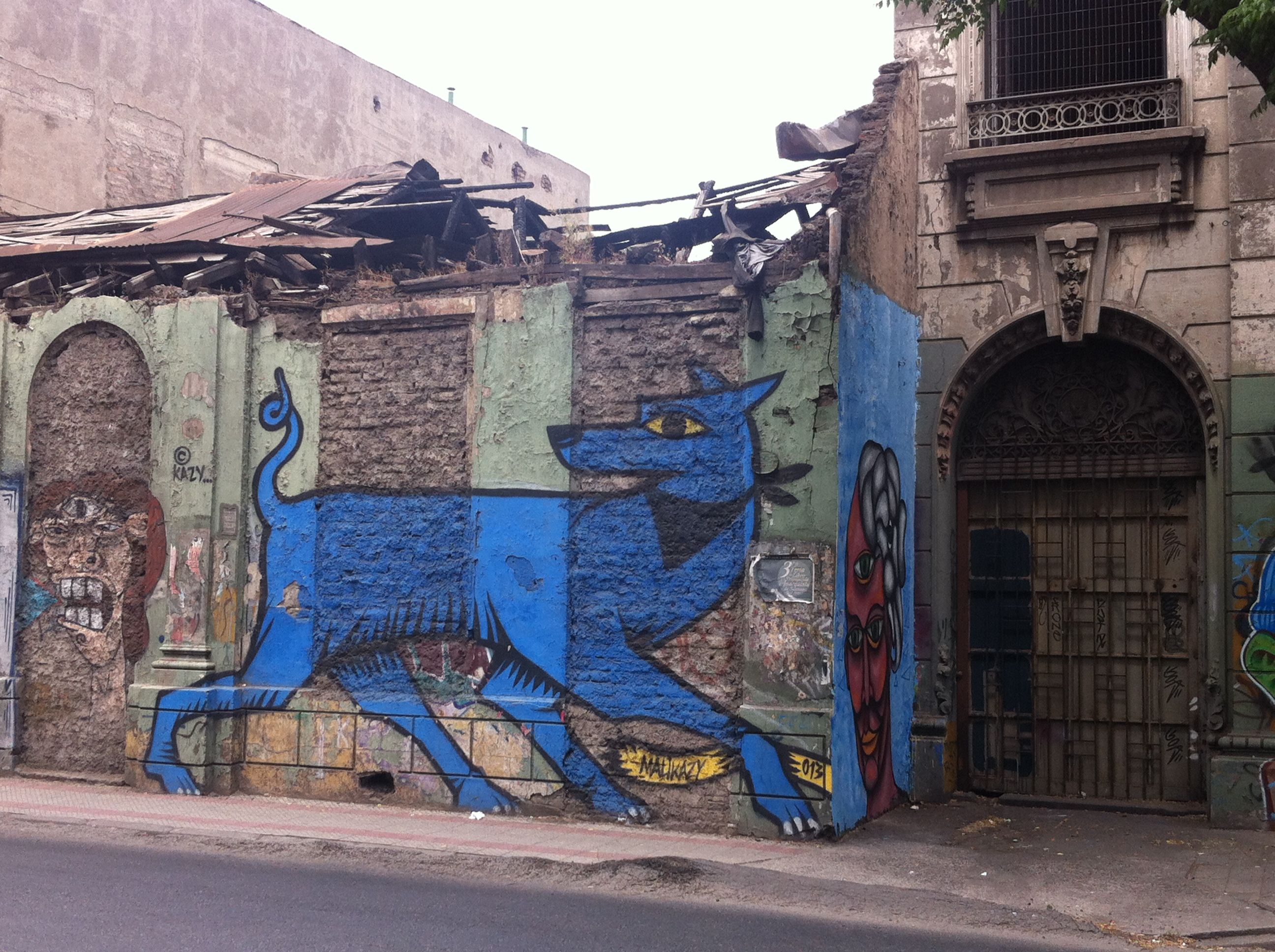
5a. Sometimes a clever street dog overcomes the lack of manual dexterity that affects species without an opposable thumb, and learns to paint. Below is a self portrait by ‘Blue Dog’, in the barrio of Yungay.
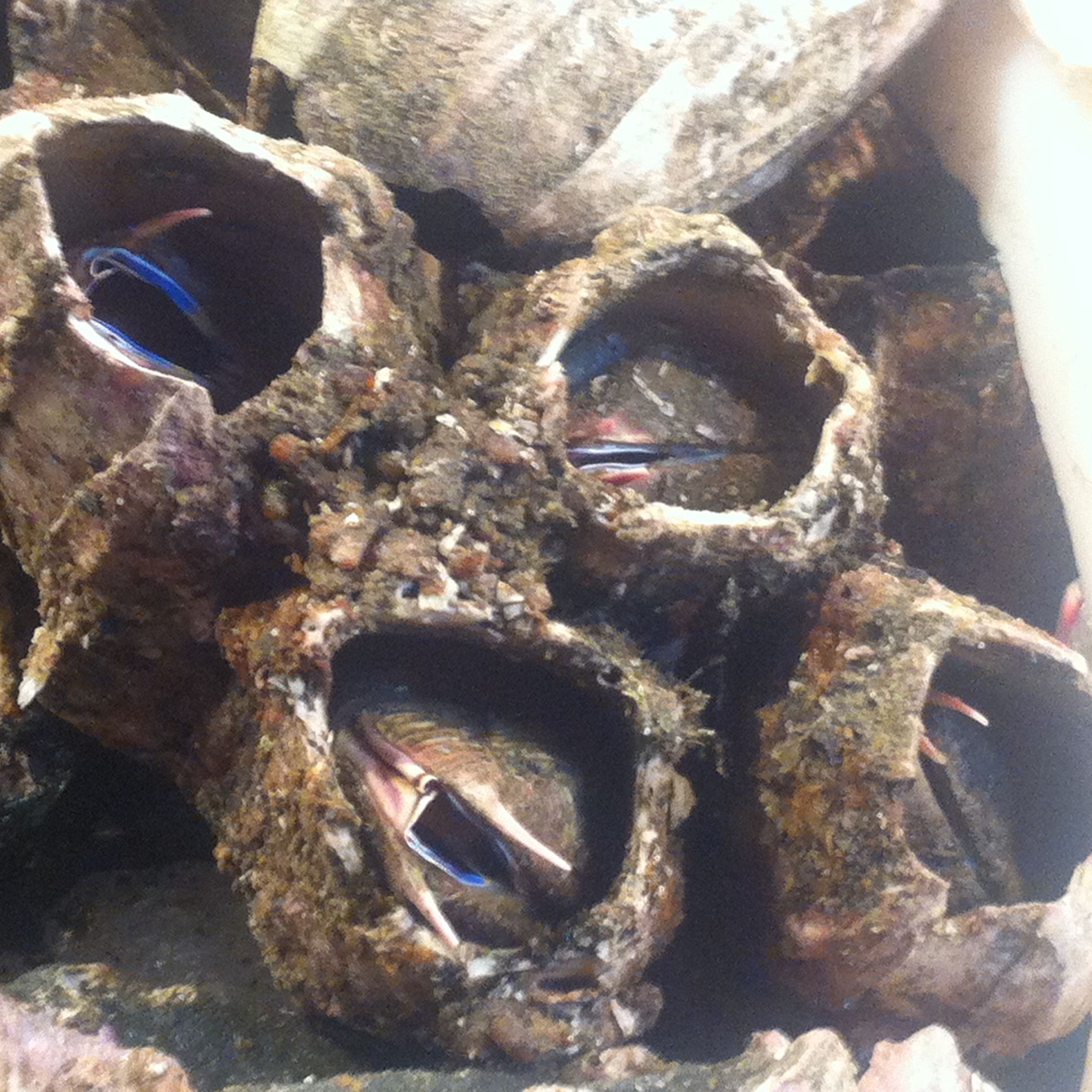
- Back in the fish market, I discover the most bizarre species of seafood I have yet encountered: picorocos. They are pictured below, their little claws gesturing feebly in the blind air. They live inside their tunnel-like log homes (not logs, but crumbly rocks), and they wait. They wait, their little claws gesturing blindly in the empty air. And they wait . . .
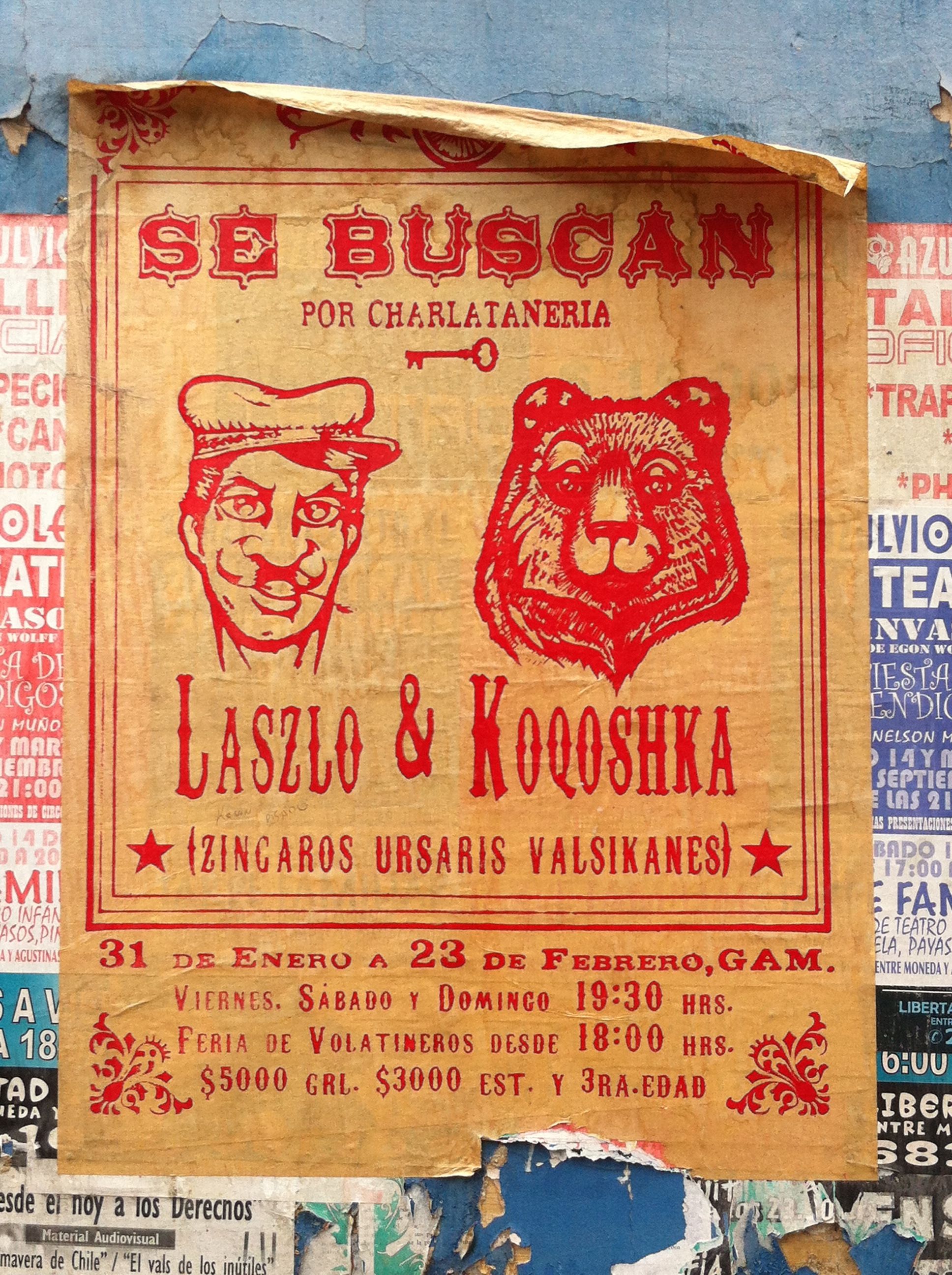
- Finally, Laszlo and Koqoshka, who got left behind when the circus moved on, and are wanted for charlatanry. One wonders what particular crimes this offence entails, but Laszlo’s moustache certainly gives the impression that he might not be a chap to whom one would entrust the family silver. Koqoshka, as I have just now been reminded, bears a distinct resemblance to W.N. Herbert’s Murder Bear. But did he really get left behind? And. as this is a ‘Wanted’ poster, would any sane booty-hunter really wish to find Koqoshka and his ‘keeper’?
Bolívar Square
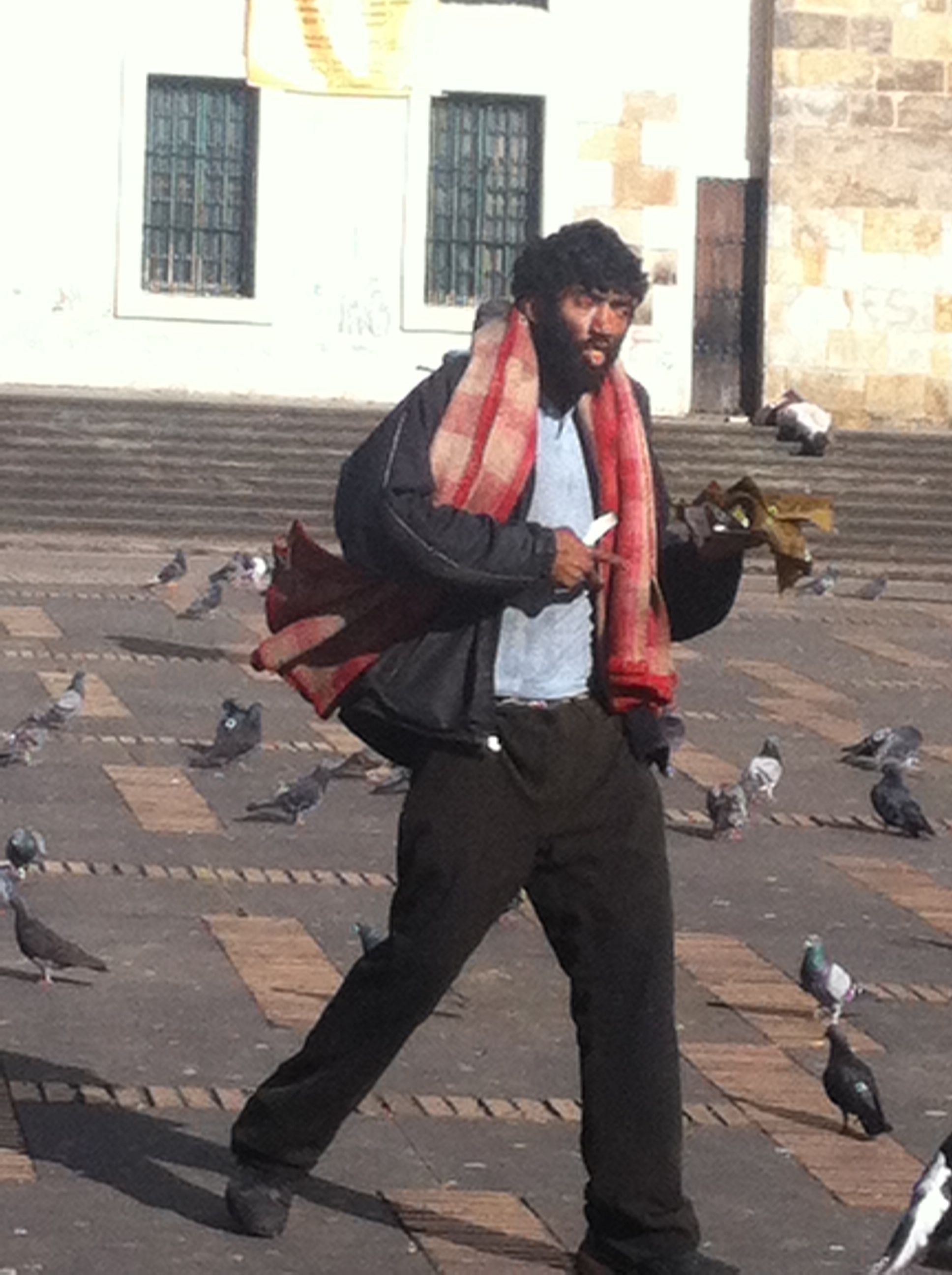
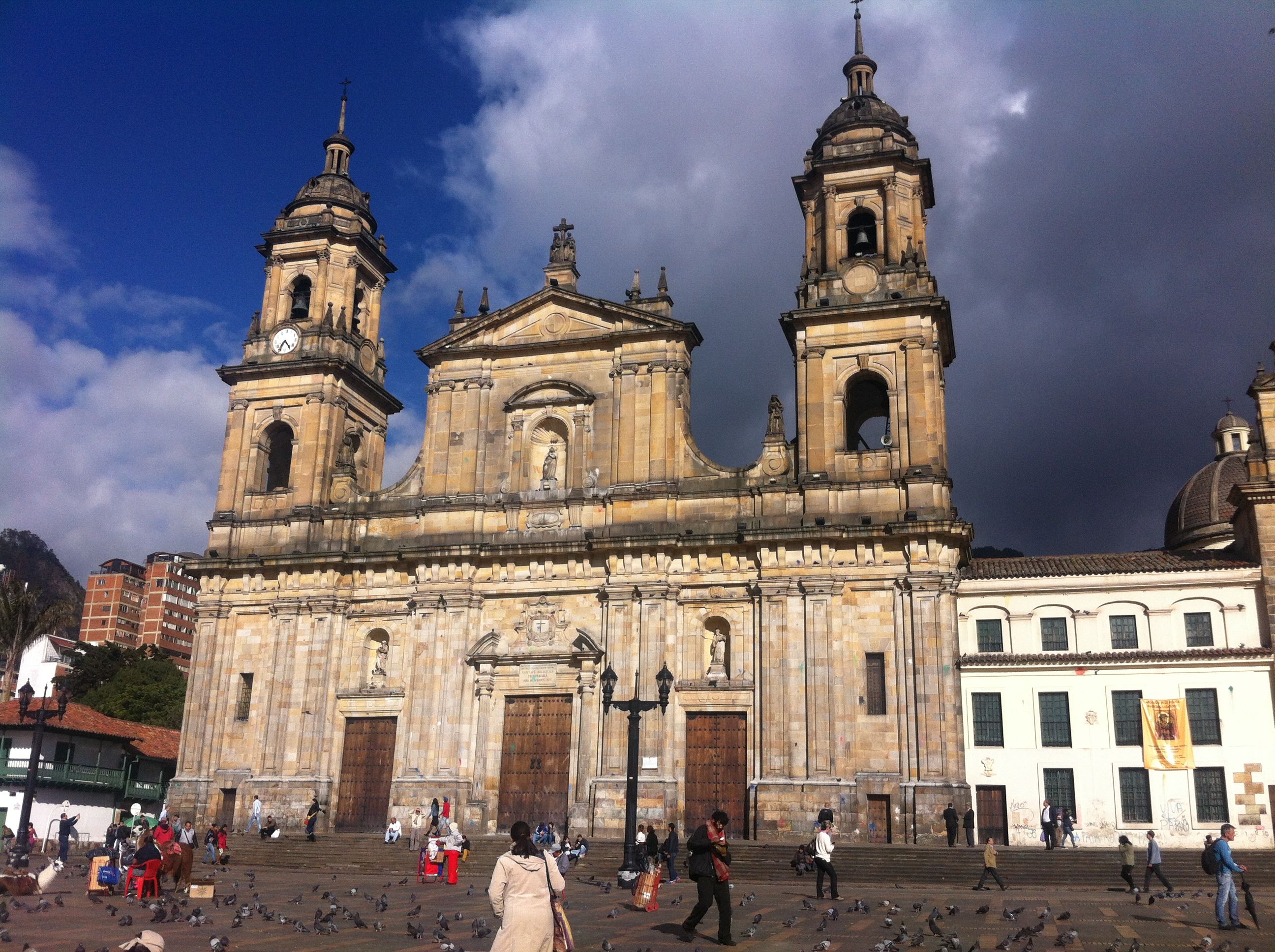
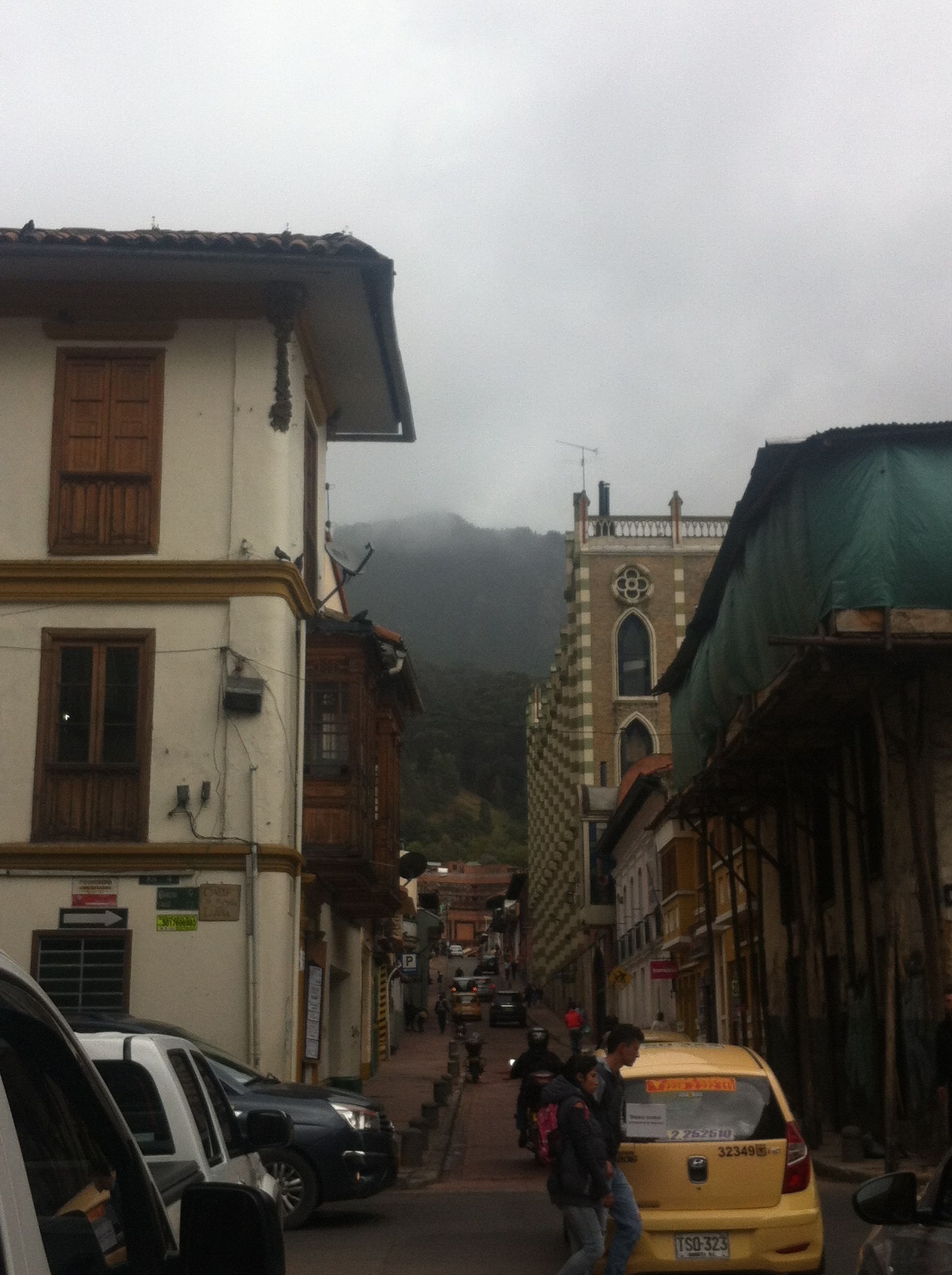
I caught sight of this man crossing the Plaza de Bolívar, and from a distance something looked very wrong. He had a strange loping gait, and was clutching a small white ticket in his right hand, and what looked like sheets of parchment in his left. I am sure they were not sheets of parchment, but they could have been, in another story. His eyes were gone, into the lost territories of the crack addict or the madman. I had the sensation that something or someone was speaking to him, and he was attempting to respond, talking aloud, although not shouting, and waving the sheets of parchment as though they had a particular meaning. He seemed accustomed to the fact that people turn away from in the street, and dogs follow him nervously, but no longer paid it any mind. Like many homeless people in Bogotá he lives mainly off the things he finds in refuse bins, eating food that people have thrown away, searching the same street or group of streets again and again in the course of the day, occasionally confronting an intruder on his territory, at which point the two will face off, possibly come to blows, and then one will shuffle off. I saw this happen earlier in a park at the top of Avenida Jímenez, where the San Francisco river once came down from the mountain and is now channelled via a concrete waterway, where it accumulates debris and rubbish and plastic bags, and is left that way. The mountain beyond is nearly always covered in mist. The weather is complicated, and the late afternoon and evening, inexplicably, is colder than the night.
On getting lost
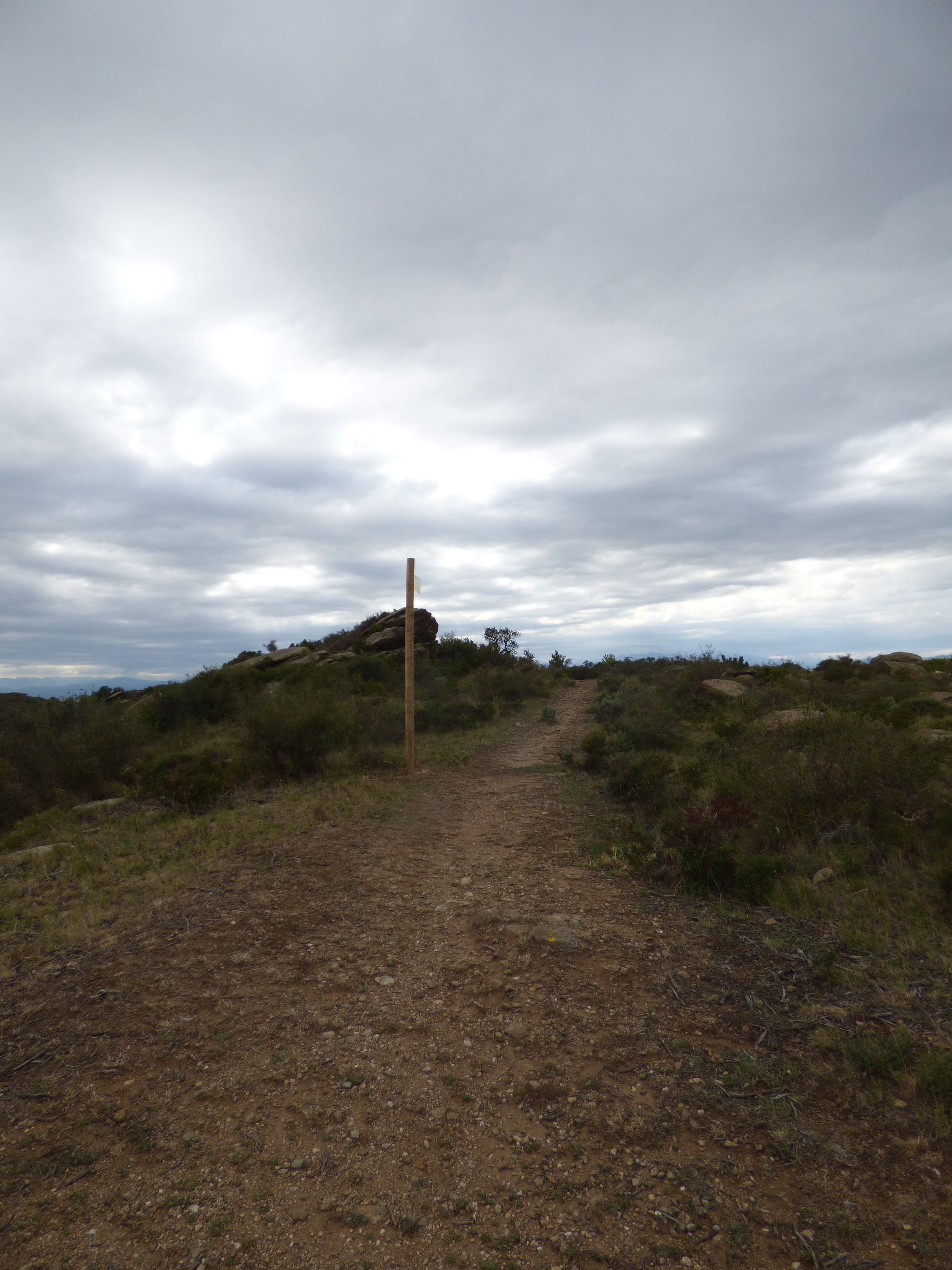
‘For [Virginia] Woolf, getting lost was not a matter of geography so much as identity, a passionate desire, even an urgent need, to become no one and anyone, to shake off the shackles that remind you who you are, who others think you are.’
Having finally got around to reading Rebecca Solnit’s fine book A Field Guide to Getting Lost, I am left wondering how come it took me so long. Not only to find the book, but to find a writer who has reached conclusions – or striven towards them, because a conclusion closes things off and Solnit likes to leave things open to mutation and redirection – that are so much in harmony with my own. I am reminded of that sense of excitement described (in an earlier post) by Patrick Leigh Fermor of ‘realising that nobody in the world knew where he was’, echoed in Solnit’s words: ‘Nights alone in motels in remote western towns where I know no one and no one I know knows where I am’. This is not solipsism, nor even a desire to escape; it is, properly speaking, a contentment merely to be where one is, when one is, without roots, without identity, without destination. Something very attractive to anyone who has ever suffered inclinations for the state that Buddhism calls unbeing, but wants to get there without putting in the long hours of back-straining, balls-breaking meditation.
Wandering, being lost, is a way of losing yourself. As Solnit reminds us, it’s not about being lost but about trying to lose yourself:
‘“Not to find one’s way in a city may well be uninteresting and banal. It requires ignorance – nothing more,” says . . . Walter Benjamin. “But to lose oneself in a city – as one loses oneself in a forest – that calls for quite a different schooling.” To lose oneself: a voluptuous surrender, lost in your arms, lost to the world, utterly immersed in what is present so that its surroundings fade away. In Benjamin’s terms, to be lost is to be fully present, and to be fully present is to be capable of being in uncertainty and mystery. And one does not get lost but loses oneself, with the implication that it is a conscious choice, a chosen surrender, a psychic state achievable through geography.’
Storms, eggs, everyday corruption, and the Consul’s approaching end
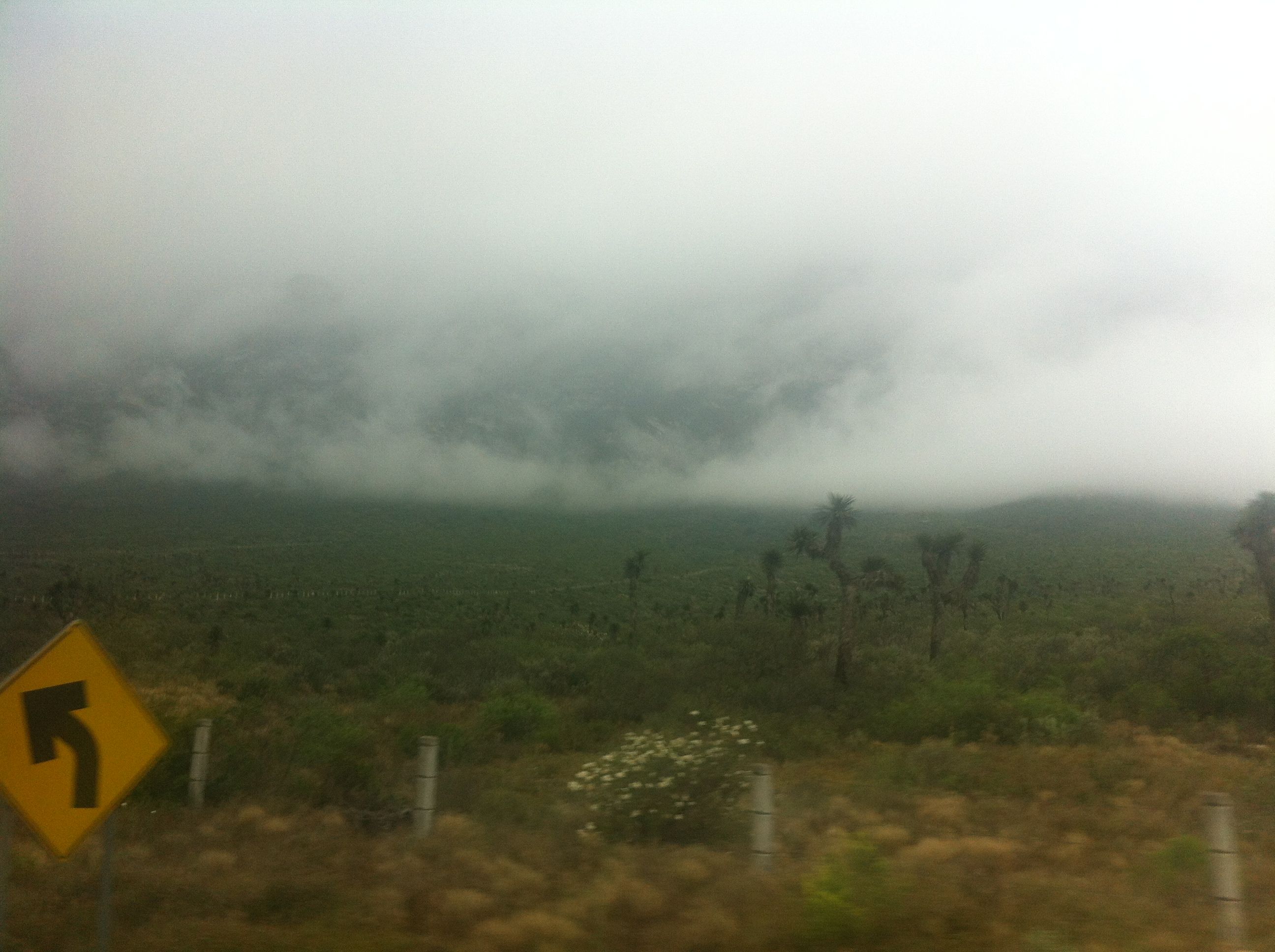
Another blurry picture taken from a bus and featuring mist and cactus, on the road from Saltillo to Monterrey.
The airport in Saltillo closes because of the fog, so I miss my lunchtime flight back to Mexico City. Julián is laid low by a mystery bug and Mónica offers to drive me to the airport, after picking up little Leo from nursery. We exchange my plane ticket for another, from Monterrey airport, and then set off to the bus station for the two hour journey to Mexico’s third biggest city – and according to Wikipedia the ninth biggest city in the world. I don’t see much of it, however big the place is. The plane leaves at 6.20 pm and I am back into Under the Volcano, picking up with the hideous bull-baiting in Tomalín and the Consul’s vicious set-to with Hugh and Yvonne in the Salón Ofelia (todos contentos y yo también), owned by Señor Cervantes, who carries a black cockerel under his arm: “Nobody come here, only those who have nobody them with.”
Outside the plane passes through a good deal of disturbance as we approach Mexico City, a blood-red sun falling over the mountains and a big storm brooding close by to the north-west, the sky black there with jagged flashes of lightning. The pilot announces – I swear – “With the resounding egg, we make the descent to Mexico City” – and when we are leaving the plane another announcement reminds us: “Please ensure you take with you all your obsessions on leaving the plane.”
At ground level (of course Mexico City is nowhere near sea level, at 2,500 metres) I find a taxi easily enough and we drive through the hammering rain. As usual we overshoot the hotel: this happens all the time, not out of a desire to cheat the customer – the price is arranged beforehand – but because the layout of the streets in this area is pretty complicated and because no taxista can be expected to know his way around a metropolitan area containing twenty-five million inhabitants. So my driver, who is one of those very correct and well turned-out Mexican gentlemen of a certain age does a rather indiscrete U-turn at a big junction, and we are immediately pulled over by a pair of traffic cops, who were lurking under nearby trees.
The driver is asked to step out and negotiations begin. I can hear the young cop citing the precise name and number of the traffic regulation we have infringed, but I suspect that this is an irrelevance. After some discussion the driver returns inside the cab and reaches inside the glove compartment for money. How much? I ask him. One hundred and fifty, he replies (just under seven pounds sterling). Here, I say, take a hundred. After all, I am at least partly responsible for this, as I allowed him to take a wrong turning. He thanks me, pays the cop and gets back in the cab.
This is not a fine, but a pay-off. Most drivers pay the police rather than go through the rigmarole of following through with an infraction of a minor kind. The police officers’ argument goes like this: it’s easier for both of us if you just cough up. In fact I’m doing you a favour, because you’d have to pay more if we went through the proper process. When I ask the taxi driver if he ever refuses to pay a bribe he says something about the pervasiveness of corruption and shrugs. This is how the law works in this country, he says.
Back at the hotel and back into Lowry. Cervantes, the owner of the Ofelia is offering the Consul, Yvonne and Hugh some dinner – eggs is evidently a recurring theme of the evening: “ . . . You like eggs, señora? Stepped on eggs. Muy sabrosos. Divorced eggs? For fish, sliced of filet with peas. Vol-au-vent à la reine. Somersaults for the queen. Or you like poxy eggs, poxy in toast. Or veal liver tavernman? Pimesan chike chup? Or spectral chicken of the house? Youn’ pigeon. Red snappers with a fried tartar, you like?”
Hungry now, I borrow an umbrella and head for the nearest restaurant, El Califa, in Condesa, where the waiter, who seems to know me, greets me warmly. They are not serving spectral chicken, and nor do I order poxy eggs, but a bowl of broth and a couple of veal tacos. At the table in front of me two young people – he in a very shiny suit, she laughing too enthusiastically at everything he says – share a dessert, spooning ice cream into each others’ faces. On the way back the sky cracks with thunder and the heavens open once again. In El Califa they have given me some little sweets with my bill. I open the packet with difficulty and am confronted by some tiny things that resemble hundreds and thousands. I have not met with these before, so I give them a try. There is an explosion of sugar and chilli pepper inside my mouth, which is not at all agreeable. I throw the remaining sweets in a bin and head back to the hotel, prepared for the Consul’s disastrous denouement.
Veracruz by night
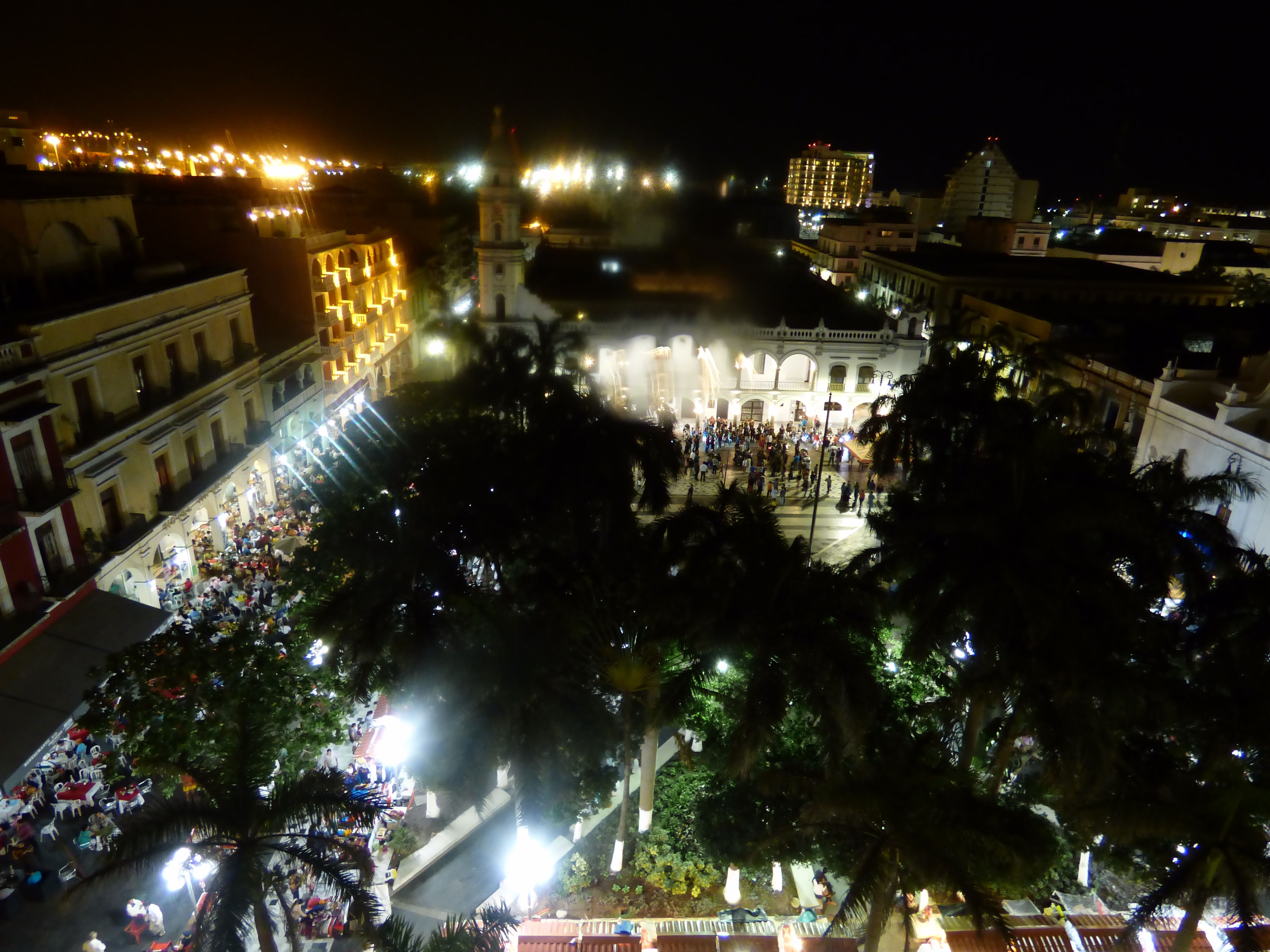
Leaning over the balcony of my room in Veracruz on a Saturday night. It is hot and the air is dense, the sky laden with clouds that have not broken all day, suggesting, to me at least, some faintly tragic element– as if a foreboding – to the festive sounds emanating at full blast five floors down. Why foreboding? Because this much noise must be a cover for something, full-blooded defiance of some kind. The son band has started up, and couples are dancing in the Zócalo, moving with slow steps, a synchronised animal of multi-hued and diverse features. And all of a sudden I turn around, almost certain someone has entered the room behind me. Of course, there is no one there. The door is locked. But I am in a strange hotel, in this noisy, sweaty city, after the relative quiet and familiarity of the coffee-growing uplands in Coatepec and Xalapa. I venture downstairs and sit outside the bar attached to my hotel.
When I say the band has started, I am not being strictly accurate, as if implying there is only one band. There are currently several bands playing in the square, which, to use a common analogy, is the size of a couple of football pitches. In addition there is a group of bikers from San Luis de Potosí, who have parked their machines in the southwest corner of the square and planted massive speakers alongside them, from which blasts heavy metal at a volume which overrides most of the other sources of sound, the throbbing bass lines producing a physical response in the pit of the belly. As in the UK the bikers are predominantly middle-aged men wearing inscribed black t-shirts barely covering bulging bellies. They rev the engines of their Harleys, sending out a direct challenge to the mariachi band playing closest to their patch. There are at least four other mariachi bands playing, and a larger band for the dancers. To add to the cacophony hundreds of birds, occupying the many trees around the plaza maintain a shrill and manic chirping, flitting frantically from perch to perch, sometimes singly, other times en masse, dislodging a rival group from a neighbouring tree, who fly away squawking to find another haven. Police sirens and an unremitting blasting of horns from the bumper-to-bumper traffic add to the great noise. A fresh contingent of mariachi trumpeters arrives to my right, offering a more local assault to the eardrums.
This is, quite simply, the noisiest place I have ever been, its orchestral totality rendering the Plaza Castillo in Pamplona on the opening night of the San Fermines into sedate chamber music by comparison. But here there is no fiesta, it’s just a normal Saturday night in Veracruz.
I was told to expect a lot of noise, but nothing could have prepared me for this aural onslaught. It is beyond sound, it is a dense, geological layering of noise upon noise, of massive dimensions.
Outside in the street, a big red Ford truck pulls up, and six very fat men pile in. I look around to see if anyone else has noticed this strange occurrence, but perhaps in Veracruz this kind of thing happens all the time. At the table in front of me, a smartly dressed man with European features is writing in an A4 pad. What is he writing? Amid all this noisome, somewhat seedy racket, could there be a second scribe, a cover version of Blanco, doing exactly what Blanco does? Could he, at this very moment, be describing how there is this person seated behind him, who is a cover version of his own alter-ego?
There is always the other one, doing exactly what you are doing, thinking your thoughts, writing your story, singing your song.
At the table to my right sits a small, slight gringo who bears a certain resemblance to Stan Laurel and wears a forlorn moustache and camouflage cargo shorts and a t-shirt with an inscription that I can’t quite make out without standing in front of him and peering, which I have no intention of doing. He is talking to his Mexican friend, in English. The Mexican begins every other sentence with the words ‘one day’. One day I this one day I that. Esto y esto y esto. The other tables are filled with Mexican holiday-makers or weekenders.
My other gets up to leave. He reaches down and fetches from the floor a hard hat, of the kind worn on building sites. I see. He is probably a surveyor or building site manager, and he was filling out a report. Never mind.
The Mexican who is sitting with the gringo is doing most of the talking. He says, or I think he says, ‘one day you will see where went the elephant’. Then he says, I think, ‘one day you want talk up the history of conscious memory’ – but that cannot possibly be right. Then he says, especially loudly: ‘One day she will say I work every day every day every day. Shit! Some days I don’t give passion. Shit!’
The bikers amble by in a group. They are wearing a uniform: sky blue shirts and black leather waistcoats, or vests as they say in the U.S. In the square itself I can see jugglers and clowns and drag artists and con artists and little stalls selling cigars and wooden toys and junk of every possible description.
A very young woman, attractive and haunted-looking, with a sweet child in a sling on her back comes by selling knick-knacks made from woven thread. The pair to my right, who are both quite drunk by now, each give her a twenty peso note (about £1), the gringo pointing to the child insistently as he hands it to her, as if to say, it’s because of her, your child, that I am bestowing such munificence on you. Alcohol-driven largesse. The woman in the group directly in front of me hisses loudly to catch the waiter’s attention. He ignores her. She tries calling ‘Joven!’ (Young Man!) instead, which works, and he half-turns, careful not to dislodge any of the bottles and glasses he carries on a tray high above head-level. The light on the black wooden surface of my table is refracted by the revolving overhead fan above me, turning the shiny table-top into a swirling vortex, inviting me in. I realise at this instant – with the gratification that accompanies every minor epiphany – that I don’t truly know anything, and probably never will. But at least I have the salvation of continuity, and the exquisite tension of the unfinished journey.
The gringo and his friend leave. When I get up to pay, I notice that the gringo has left his small backpack leaning against the wall beside his table. I tell the waiter, so he can keep it behind the bar for when the poor fellow realises he has left it somewhere.
I take a last turn around the square. An old man with no shoes, extremely drunk, takes a slim bottle of cane rum from his back pocket, swigs the remaining dregs and slings the plastic bottle away with an angry gesture. He is so drunk that he is taking part in one of those hallucinatory boxing matches that certain drunks get into, and he staggers on, fighting his imaginary enemy.
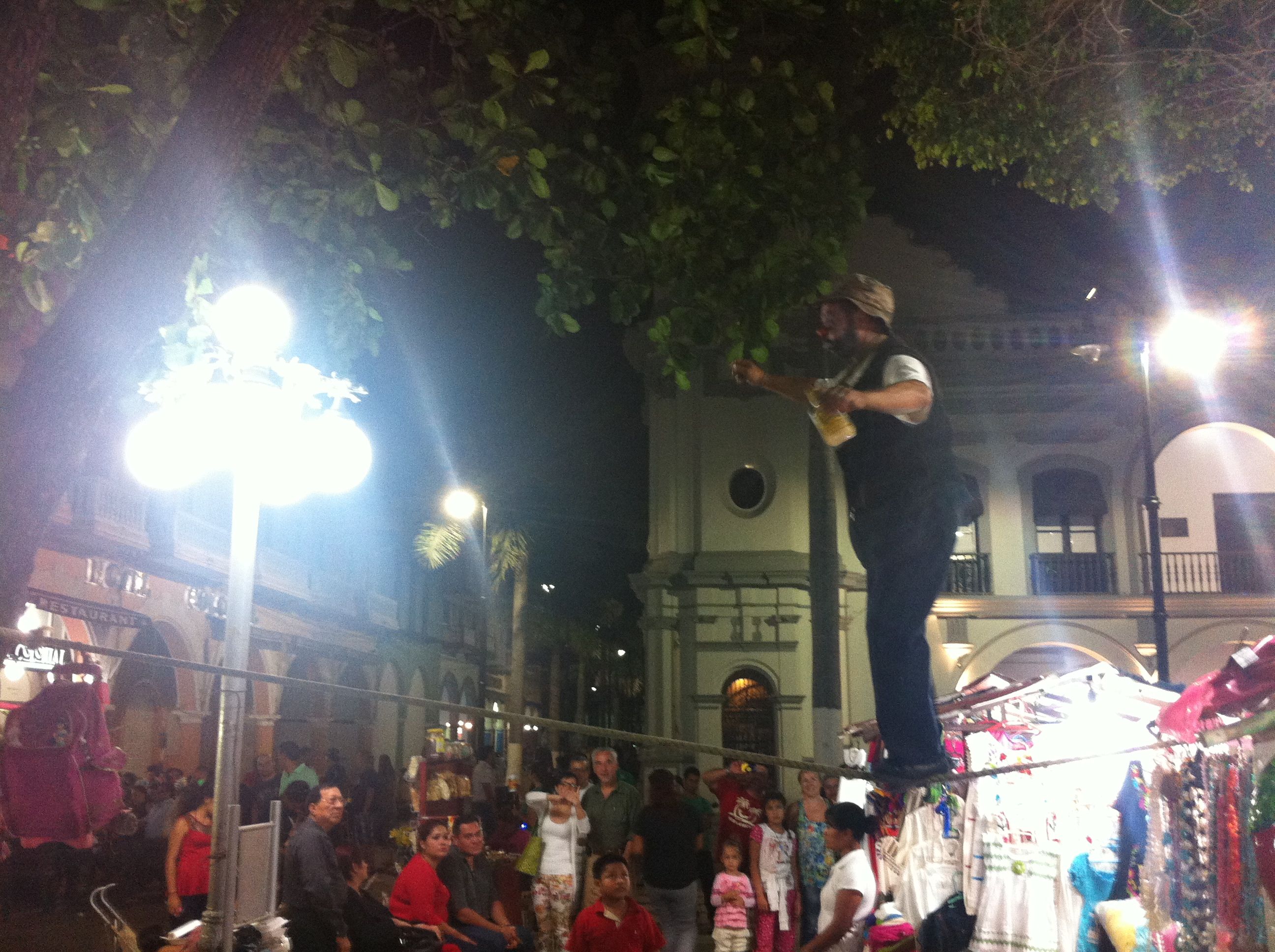
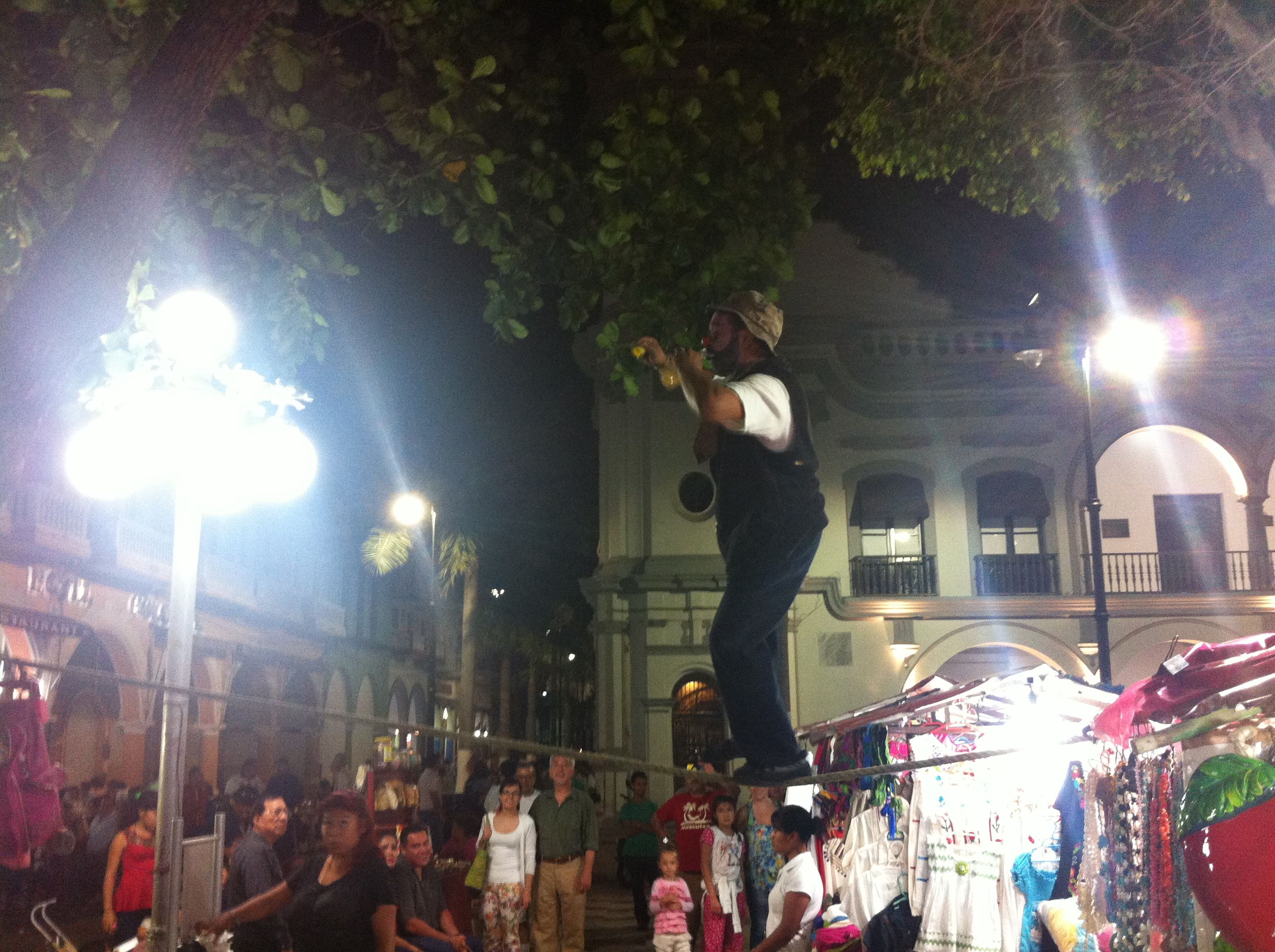
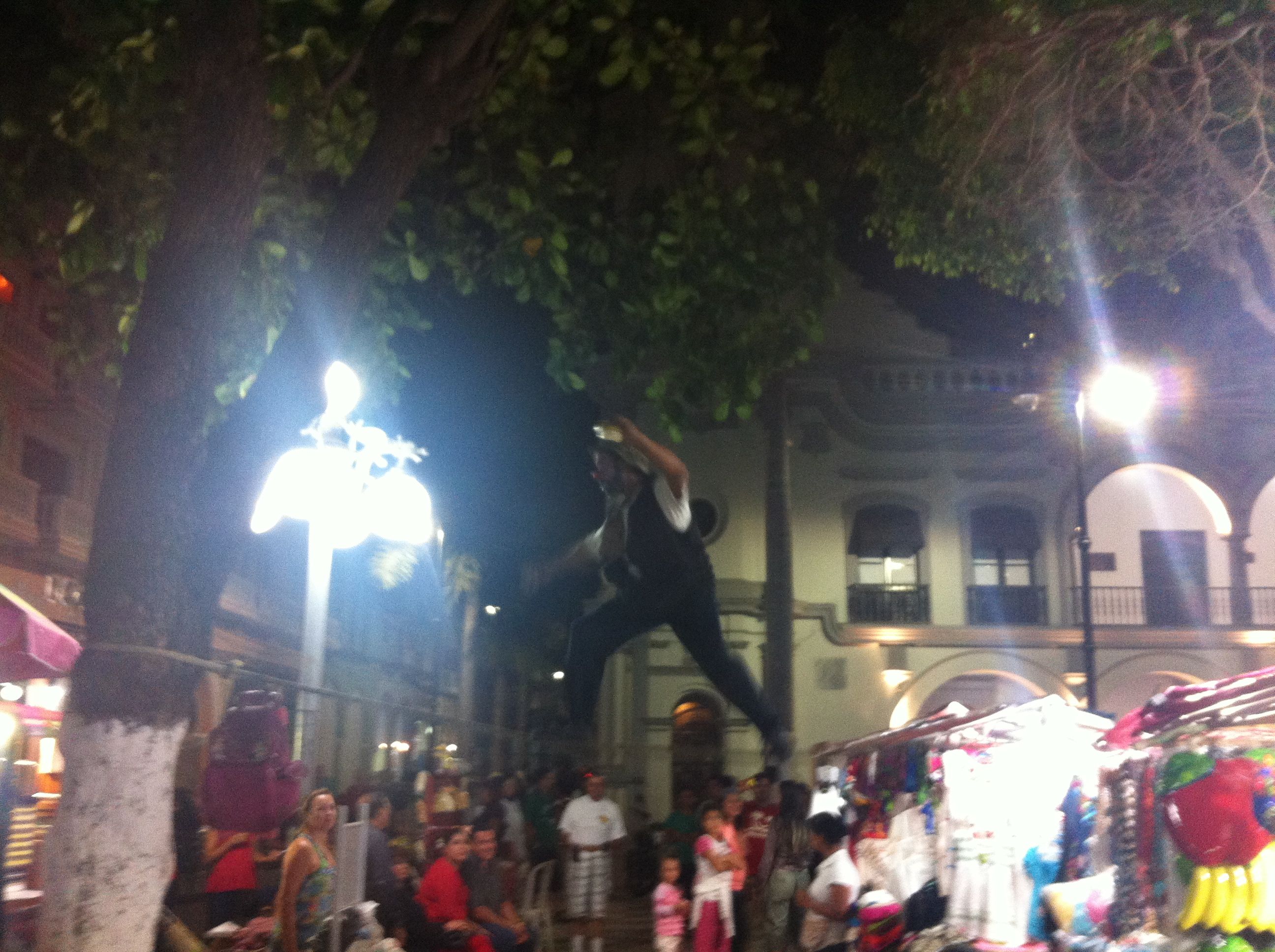
One of the last performances of the night – it is after 3.a.m. by now – is underway: a tight-rope walker, who has planted his rope between a tree and a lamp-post. He is pretending to be drunk, and is supping from an identical bottle of cane rum to the one the man with no shoes just threw away. The man with no shoes abruptly stops his shadow-boxing, and stares in evident confusion at the tight-rope walker for a few seconds, before letting loose a string of profanities, and stumbles on his way across the square.
Jaguars, snakes, rabbits
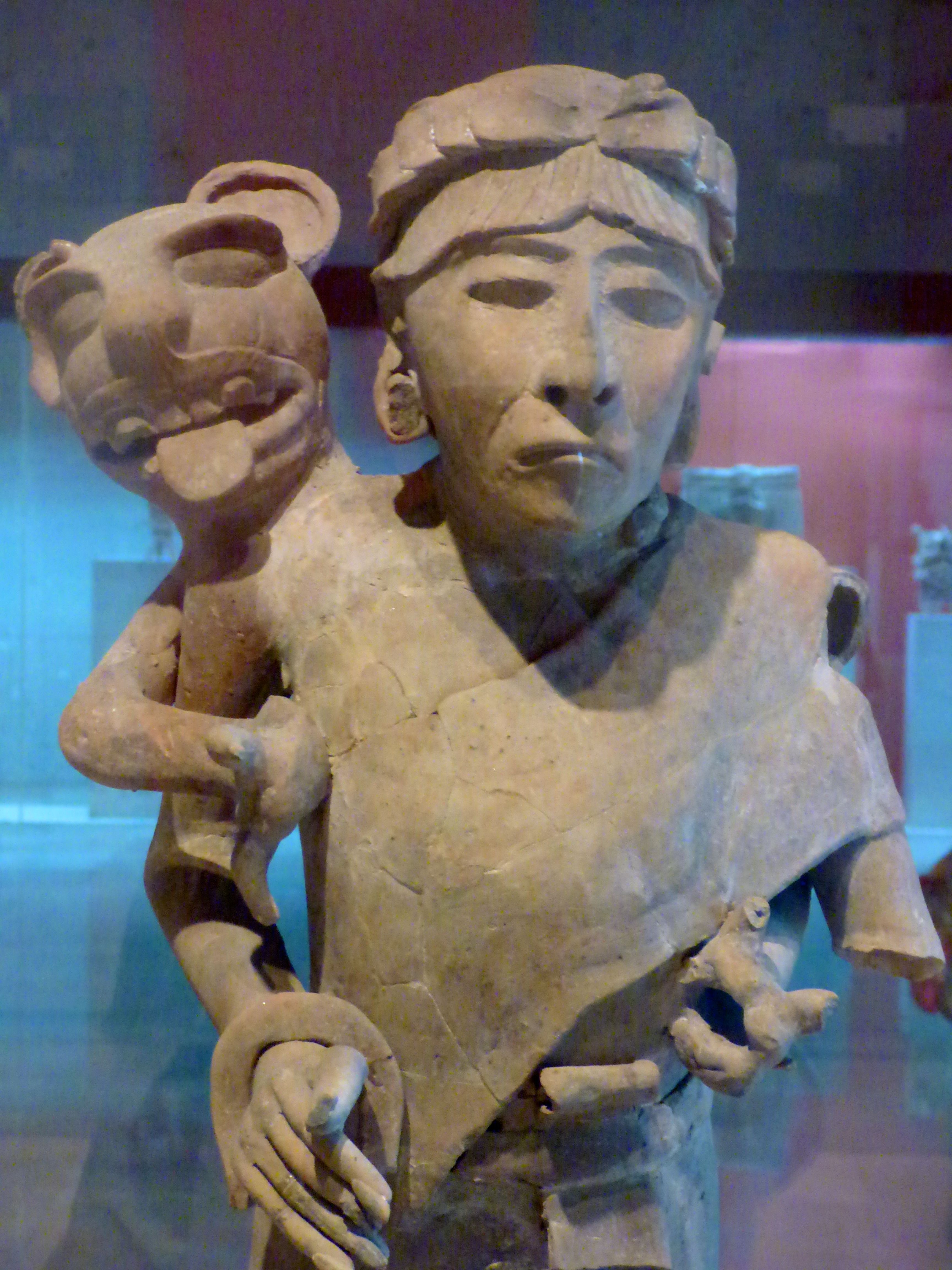
Jaguar duality
If you travel, Blanco thinks, if you just travel, go from place to place, walk around, you should never get bored and you should never lack for things to do or write about, if this happens to be your thing. At least that is the theory. Blanco has a minor epiphany: he must go to Coatepec (the accent is on the at): it fulfils the single major criterion he has always employed when deciding whether or not to visit a place: he likes the sound of it; it carries the resonance of something remote – in time and culture – and yet somehow reassuring. He is walking down the hill from the Xalapa museum of anthropology, and after an entire morning within its confines he has become saturated with Olmec images of human figures and jaguars and serpents, and he flags down a taxi driven by a man with stupendously fleshy earlobes; earlobes that remind him of small whoopee cushions or rolled dough or moulded plasticine. The taxi driver chats about corruption in Mexican politics. It is raining. It has been raining all morning and all last night, and throughout the previous evening, and as far as we know it has never not been raining. Outside of Xalapa there is a roadblock. The young policeman carries an automatic rifle and wears black body armour, leg armour, the works. He inspects the taxi-driver’s I.D. and stares at Blanco for several seconds. It continues to rain.
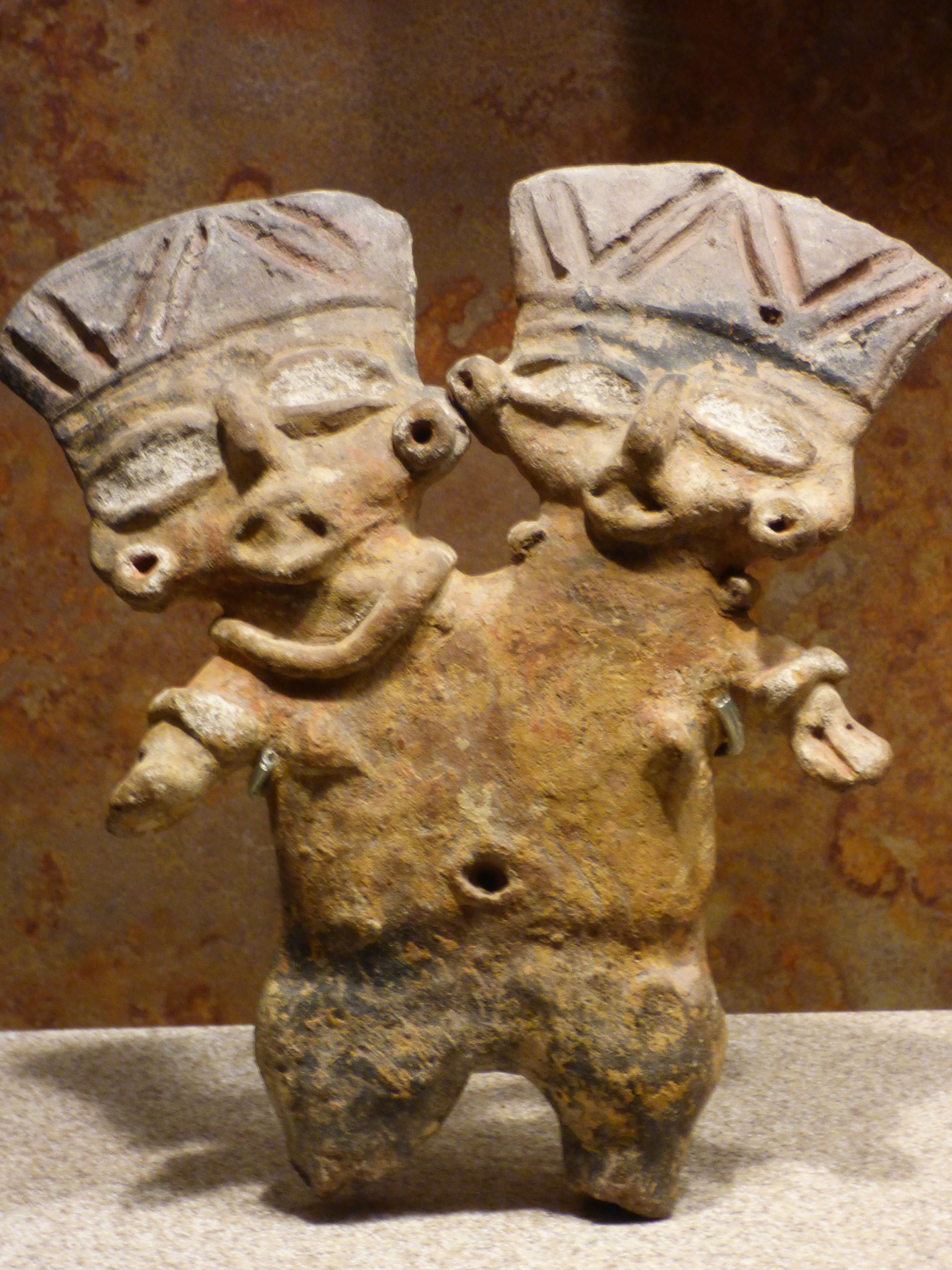
More duality
We arrive in Coataepec and get stuck in a traffic jam. Nothing moves. The taxi driver asks directions, but that doesn’t help the traffic move. Blanco spots an interesting-looking restaurant, pays the taxista, and gets out. The restaurant has a nice inner patio with a garden area, and tables around it, out of the rain. In the garden there are roses and other flowers. A large family group are finishing their meal and then spend at least twenty minutes taking photos of each other in every possible combination of individuals, so that no one has not been photographed with everybody else. They have commandeered the only waiter in order to help them in this task. Every time Blanco thinks they are about to leave and release the waiter they reconvene for a new set of photos. One of the men (a Mexican) has very little hair but a long grey ponytail, which cannot be right. One of the women – I suspect Ponytail’s sister – is married to a gringo, it would seem. He has long hair also, but not arranged in a ponytail. He speaks Spanish well, with a gringo accent. Blanco orders tortilla soup and starts leafing through a magazine he bought at the anthropology museum. His phone makes a noise that tells him he has received a message. It informs him, in Spanish: Health: Adults who sleep too little or too much in middle age are at risk of suffering memory loss, according to a recent study. He looks at the message in consternation. Too little or too much? So, hey– you’re bolloxed either way. Who sends this stuff? The screen says 2225. Then another one: Japanese fans of Godzilla were very upset with the news trailer of this film to find that Godzilla is very big and fat: read more! 3788. Then a link. Blanco shakes his head sadly.
Coatepec is full of interesting buildings with courtyards. Blanco heads down to the Posada de Coatepec, a nice hotel in the colonial style, and goes in for a coffee. A slim man with fine features, a neat little moustache, dressed in polo gear, greets him in a friendly fashion, and Blanco greets him back, once again under the impression that he has been mistaken for someone he is not. A blonde woman, also in white jodhpurs, follows the man. There must have been a polo match. How strange. The hotel offers a nice shady patio, but we don’t need shade, we just need to be out of the rain. Blanco sits on the terrace outside the hotel cafe and writes in his notebook. Before long, the man who was in riding gear comes and sits on the terrace also. Immediately three waiters attend him, bowing and scraping, one of them is even rubbing his hands together in anticipatory glee at the opportunity to serve this evidently Very Important Person. Mr Important takes off his sleeveless jacket, his gilet, and immediately one of the waiters – like a magician with a bunny – produces what appears to be a hat-stand for midgets, but is, presumably a coat-stand. Clearly the Important Person cannot do anything as vulgar as sling his coat over the back of a chair. Another waiter opens a can of diet coke at a very safe distance, and only then brings it to the table, along with a glass filled with ice. He is bending almost double, as if to ensure that his body doesn’t come into too close and offensive a proximity to the Important Person. It is one of the most extraordinary displays of deference I have witnessed in my life. Then all three waiters – the one who brought the coat-stand, the one with the coke, and the one who was rubbing his hands, a kind of maître d’ – vanish inside like happily whipped dogs. Left alone, the Important Person makes a phone call in a loud voice. He is barking instructions to some underling. He is clearly someone who is used to being obeyed, like an old school Caudillo. Must be a politician. When he has finished his call, he looks around and gets up to go inside the restaurant, where his company – family and friends, I guess – are seated. He walks inside with his drink, and within seconds one of the waiters appears out of nowhere, grabs the coat-stand, and follows him in with it.
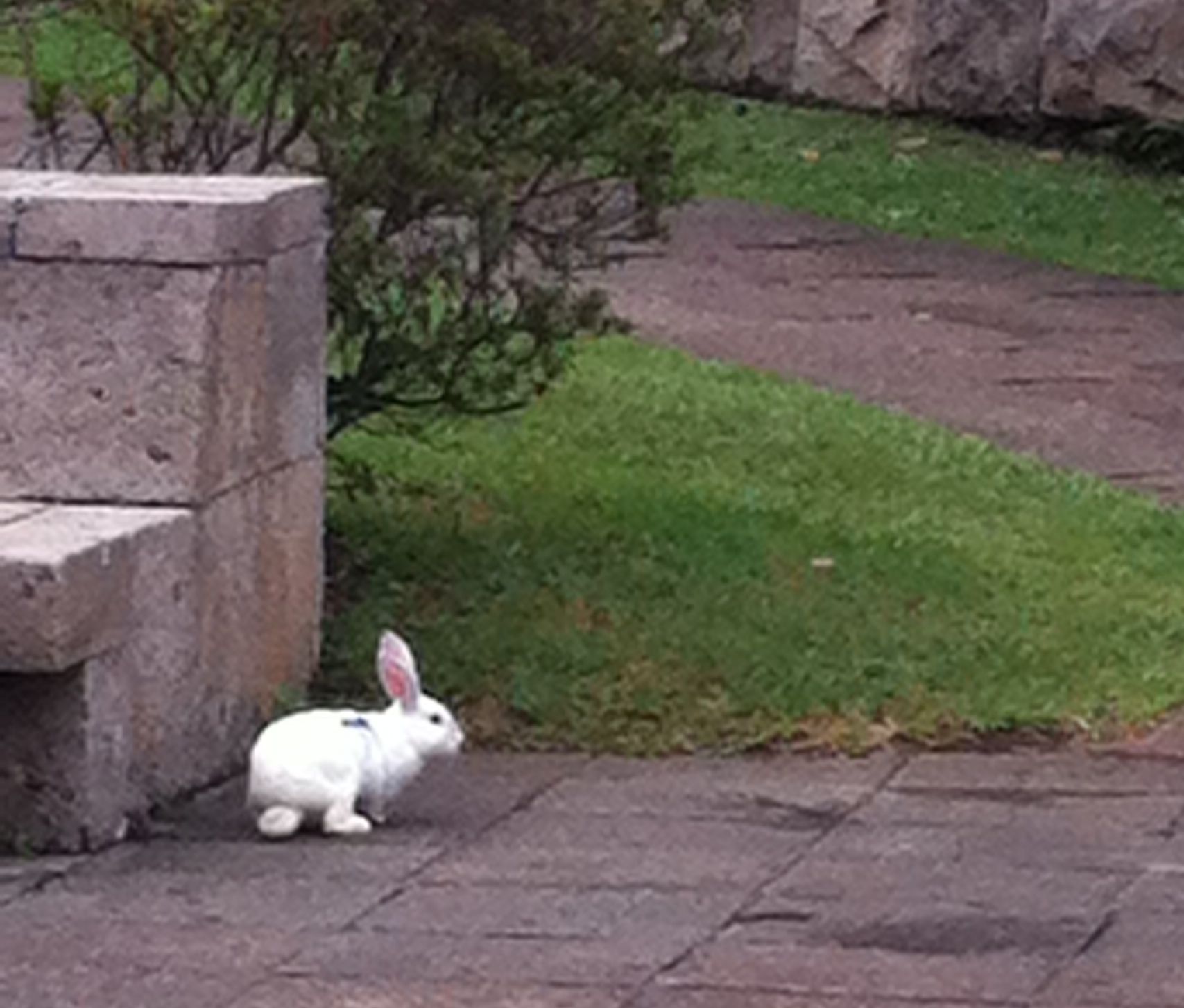
A white rabbit
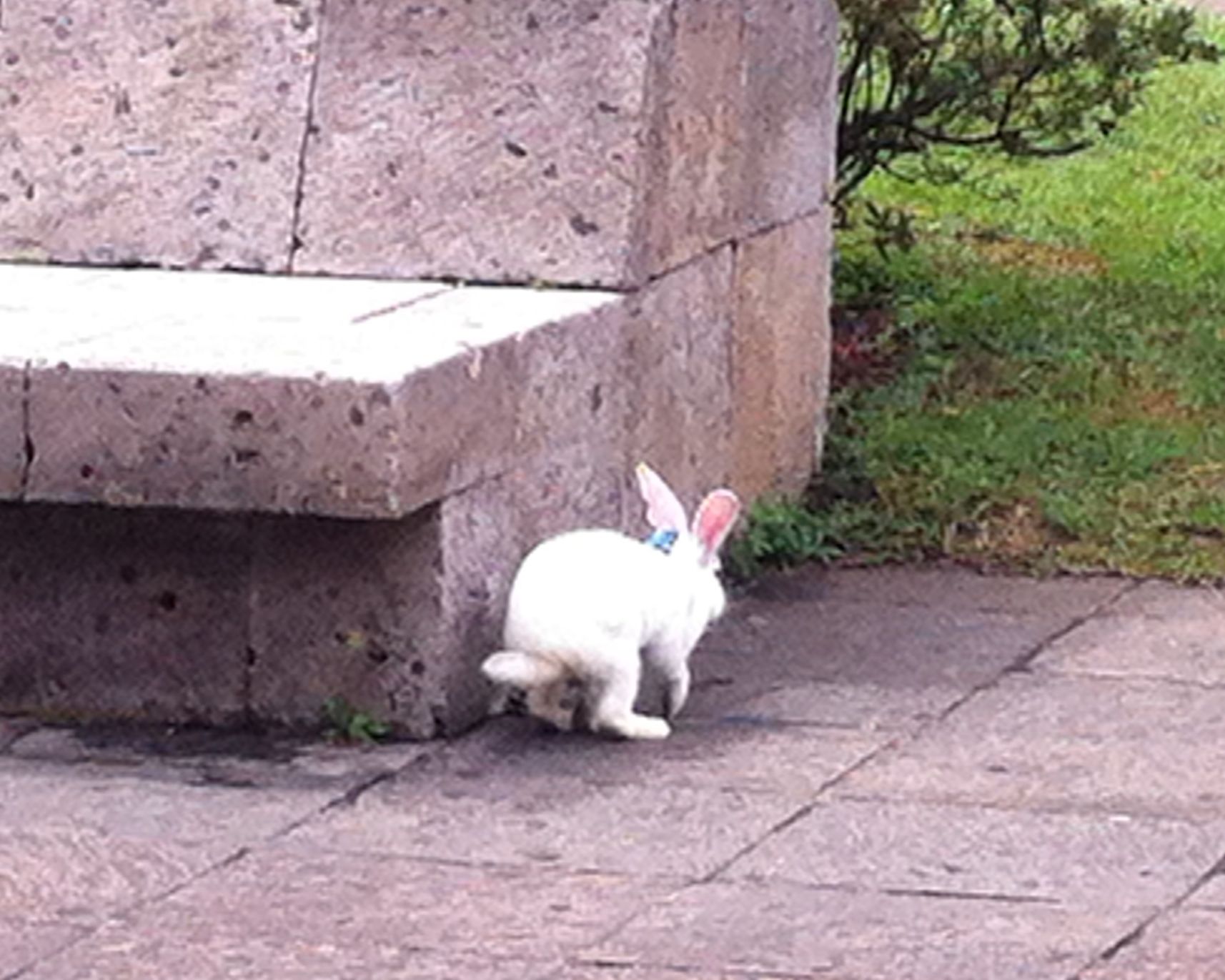
A white rabbit taking his leave
We have to go. I have arranged to meet a poet back in Xalapa and discuss literary matters. He is called José Luis Rivas and has translated T.S. Eliot and Derek Walcott into Spanish.
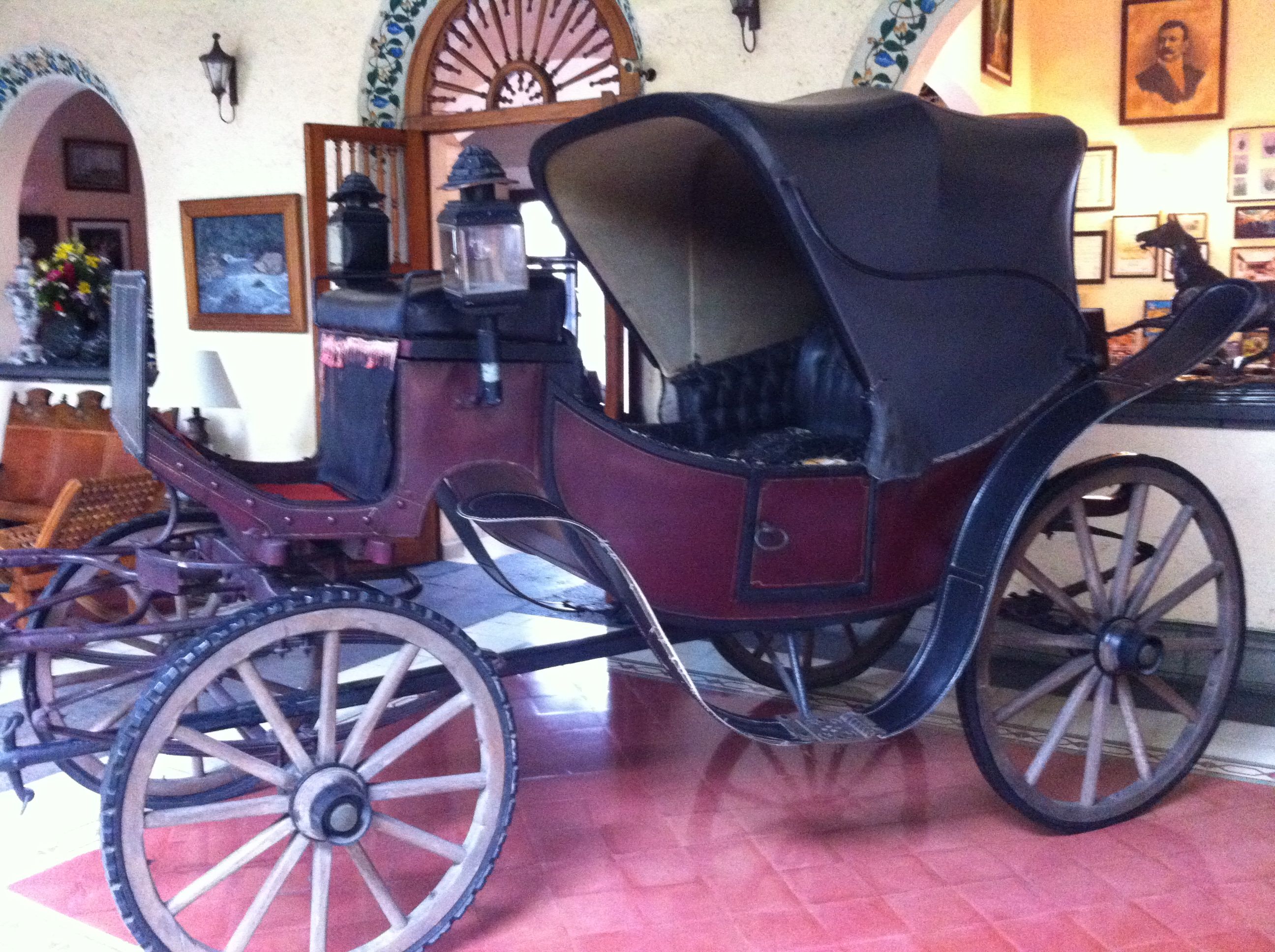
Carriage in foyer of the Posada de Coatepec, used by formerly Important People.
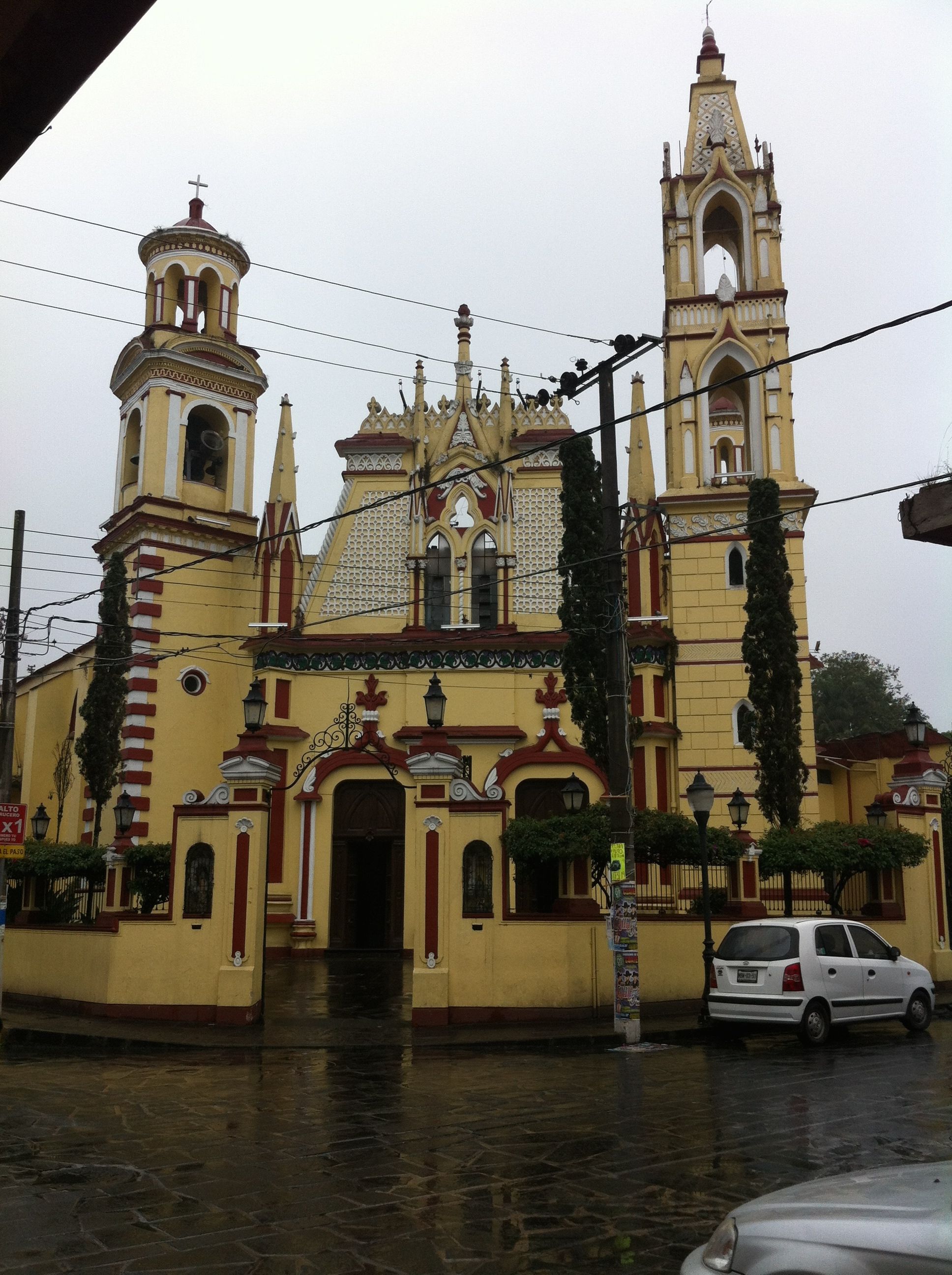
Coatepec Church.
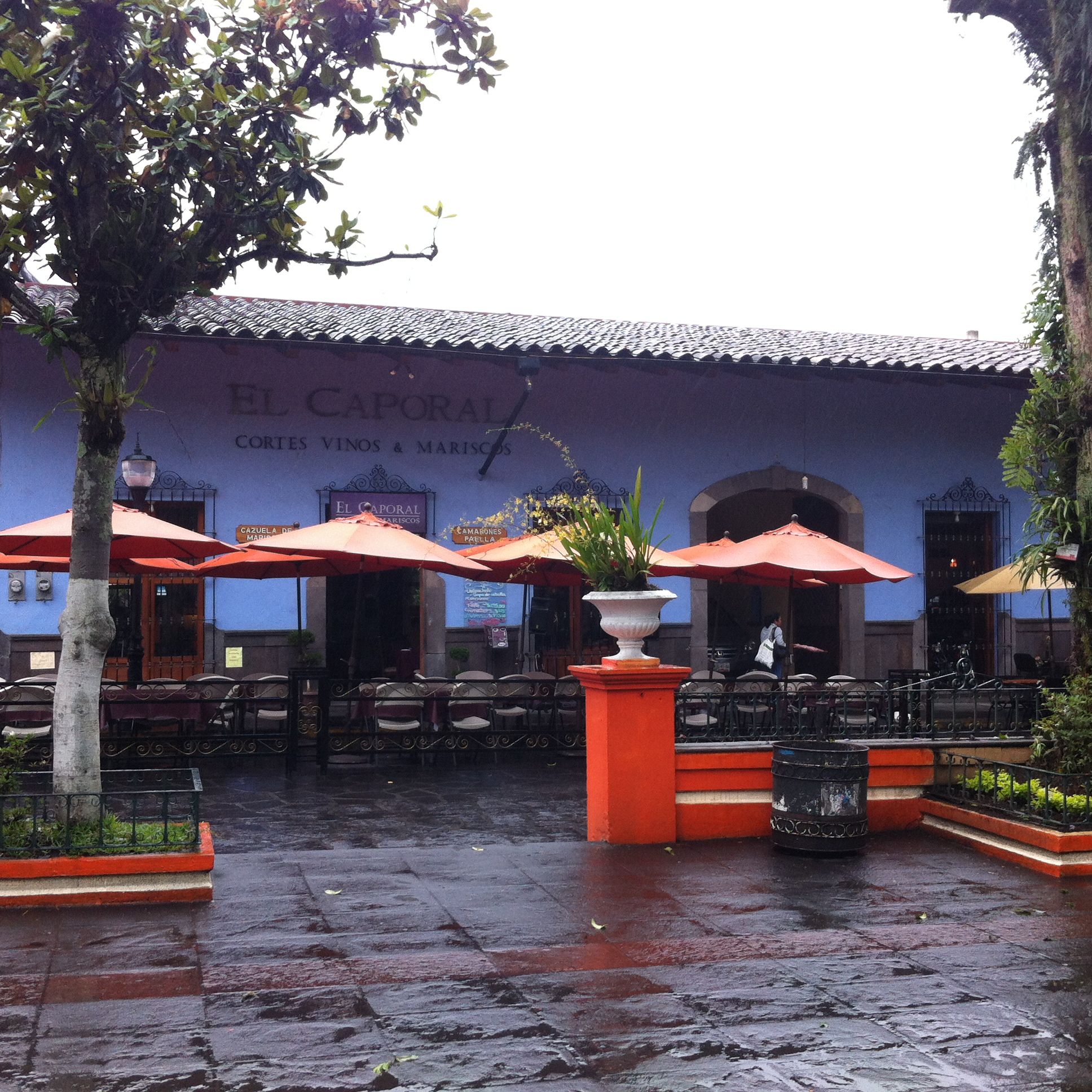
El Caporal, Coatepec.
In Xalapa

Leaving behind the poets of the monstrous metropolis that is Mexico City, Blanco catches a bus and crosses the wide plain strewn with cacti upon which perch enormous dark birds. Did he actually see them, those birds? It is so hard to distinguish at times between the things we see and the things we remember and the things we think we remember and the things we never saw but read about and the things we wish we had seen and so retrospectively invent, and the things we will never see but have experienced vicariously in a story recounted by someone else, a friend, or possibly a stranger. And then a mist falls upon the plain and the next time he looks there is a forest, barely visible through the thick cloak of fog, and the windows of the bus have steamed up with the change in temperature.
He arrives at Xalapa in the rain, catches a taxi, and finds that the route across town is cordoned off for a Mayday demonstration. The taxi driver curses, finds a way around, drops him off. He is hungry and sets out up the street, finds the Callejon Diamante, though it has been renamed, and enters La Sopa canteen. An older man with a white moustache, white shirt and white cowboy hat is playing the harp. Blanco clocks the harpist clocking him. He heads towards the back of the cantina and orders food; chickpea soup, pork in salsa verde with pasta, and a beer. The food arrives, along with tortillas wrapped in a cloth. The cowboy harpist stops playing the harp and makes his way down to the washroom. When he passes Blanco’s table he nods and says buenas tardes, as though he has known him for years. This is not so strange, thinks Blanco, a friendly old fellow who plays the harp in a cowboy hat. He finishes the chickpea soup and awaits the arrival of the second course. The harpist comes out of the men’s room, stops by Blanco’s table and says in Spanish, ‘Around here they call me the ambassador.’ Now this Blanco does find odd, as he is under the impression that he, Blanco, is the Ambassador, or at the very least a variety or version or improvisation upon the theme of Ambassadorship. Perhaps ‘The Ambassador’ is the harpist’s stage name, he thinks. Or perhaps he is a retired drug baron nicknamed ‘The Ambassador’ for his talent in negotiating his associates’ passage to the next life, and who has since mended his ways and taken up playing the harp in Xalapa cantinas, where no one knows of his sinister past and his reputation for dealing out summary justice. Nonsense, I reply, he is a nice old man who plays the harp. Don’t be fooled, says Blanco. He has dangerous contacts, just consider those birds perched on the cacti, back on the plain. Who do you think you’re kidding?
When we leave the cantina it is still raining.
Feet

A taster from Mexican poet Pedro Serrano’s collection, Peatlands, translated by Anna Crowe and fresh off the press from Arc, who are to be congratulated, yet again, for bringing another fine writer to the attention of the English language reader.
There is also an introduction by W.N. Herbert, where we find these lines, which seem so apposite with regard to the poem I have chosen: “The intention [is] to transform us through language, compelling us to rethink, re-imagine and re-envision the world and our place in it; and to break down our unconsidered assumptions about opposed categories like thought and feeling, human and animal, by continually returning us to the matrix of the body . . .”
FEET
Feet clench, make themselves small, run away,
creasing their wretchedness and fear in lines
identical to those on our palms and different.
Feet are extensions of God
(which is why they are low down),
hence their distress, their rounded bulk, their lack of balance.
Feet are like startled crayfish.
Such vulnerable things, feet.
When they make love they clench and huddle together
as though they were their own subjects.
So feet are not made, then,
to cling, like wasps
to every pine-needle pin,
to every branch of the soul that makes them there.
They are more wings than feet,
tiny and fragile and human.
However much we overlook them.
LOS PIES
Los pies se doblan, empequeñecen, huyen,
curvan su miseria y su miedo en unas líneas
que son las de la mano y no lo son.
Los pies son extensiones de Dios
(por eso están abajo),
de allí su angustia, su volumen redondo, su desajuste.
Los pies son como crustáceos asustados.
Tan sensibles los pies.
Se doblan y apeñuscan al hacer el amor
como si ellos fueran sus sujetos.
Los pies, así, no están hechos ahora
para prenderse como avispas
a cada aguja,
a cada rama del alma que allí los haga.
Son más alas que pies,
chiquititos y frágiles y humanos.
Tan desconsiderados que los tenemos.
Hanif Kureishi and the ongoing but tedious debate on Creative Writing courses

“It’s a real nightmare trying to make a living as a writer”. Er . . right, mate. I’ll take your word for it (but not your course).
As someone who makes his living from the teaching of creative writing I watched warily as the Hanif Kureishi story from the Bath Literature Festival unfolded last week. I had really begun to think that the argument about ‘whether you can teach creative writing’ was dead in the ground, but I was wrong. And the tremors that began in the staid and elegant streets of Bath have even rippled over the South Atlantic.
This morning I receive an email from Jorge Fondebrider in Argentina with a link to Ñ, the magazine supplement to the newspaper Clarín, and the most important cultural weekly in the country. The article suggests that ‘Kureishi’s bitter declarations belong to the hateful species of writers who go to literary festivals in order to spend their time complaining about how much they hate having to do publicity for their books.’ Indeed, perhaps Hanif was bored, and wanted to get something off his chest, or just rile someone. And that’s understandable, although not very professional. But he certainly knew that his outburst would get him publicity for his new novel, The Last Word. I don’t wish to add to that publicity, but do feel the need to make a contribution, as I am getting tired of the argument he has resurrected. Kureishi has frequently been outspoken in a heavy-handed, bombastic way and he is a didactic writer – which to my mind is at odds with being a good novelist. But he has also –and this might come as a surprise to many – written extremely lucidly on the practice of creative writing.
What shocked most people about Kureishi’s rant was the sheer, brazen hypocrisy of it all. Here is someone who makes his living from an activity that he evidently despises – much as he appears to despise the students he teaches – and yet is content to pocket the salary that accompanies this fruitless endeavour, without any consideration for either the people who have paid big fees to study at the university where he teaches (Kingston) or the consequences for the rest of us in having to pick up the broken crockery after this moribund and incredibly tedious domestic turbulence, once again. I am not even convinced how much of Kureishi’s polemic was for real, nor do I really care. The fact is that we have all had thoughts like Kureishi’s on a bad day, but we get over it. The evidence, as Tim Clare’s entertaining response to Kureishi: Can Creative Writing Be Taught? Not If Your Teacher’s A Prick – is that many people get quite a lot from a Creative Writing course. From my own experience (I teach at Cardiff University) I would venture that MA students are not so naïve as to expect to make it into the upper zones of the literary stratosphere simply by gaining a qualification in Creative Writing. Most of them would accept that we, their tutors, cannot ‘teach them to write’, but that we can make them aware of certain techniques and strategies by which they can help themselves towards becoming better writers. Most of them would also accept that real talent – whatever that is – is rare (though whether the figure of 99.9% figure cited by Kureishi is relevant or not, I rather doubt: it reeks of the old prejudice about ‘genius’ and a ‘God-given gift’, or the equally defunct and baffling notion of inspiration from the muse). Those who do succeed (whatever the measure of success), and who possess a modicum of talent, begin with a strong urge to write – which often takes on the characteristics of an obsession – and they persevere through rewriting and rewriting until they get a result. Much as I suspect Kureishi did.
One of the modules on the Cardiff MA, taught by a colleague (Shelagh Weeks), is ‘The Teaching of Creative Writing’ (Module SET203). The assessment comes in the form of a 3,000 word essay, submitted after the students have spent some weeks working with aspiring writers in schools and with our own undergraduates. Here is a sample quotation:
‘Some students have considerable phantasies about becoming a writer, of what they think being a writer will do for them. This quickens their desire, and helps them get started. But when the student begins to get an idea of how difficult it is to complete a considerable piece of work – to write fifteen thousand good words, while becoming aware of the more or less impossibility of making significant money from writing – she will experience a dip, or ‘crash’ and become discouraged and feel helpless. The loss of a phantasy can be painful, but if the student can get through it – if the teacher can show the student that there’s something good in her work and help her endure the frustration of learning to do something difficult – the student will make better progress.’
In marking this, I would have pointed out the clumsy repetition of ‘considerable’. Nor do I much care for ‘the more or less impossibility’, but the argument being made seems sound enough.
In fact, the piece was written by Hanif Kureishi and published in issue 37 of The Reader (Spring 2010). Much more helpful than the Kureishi who tells us that creative writing courses are simply a waste of time.


 Richard Gwyn