Richard Gwyn

The Two Worlds of Bogotá
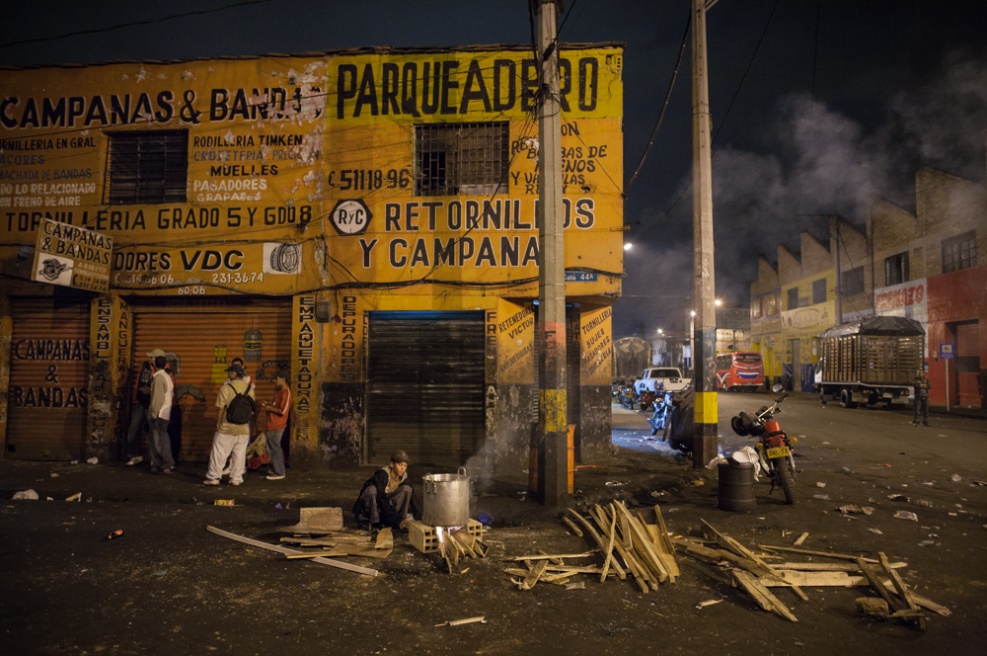
 

homless

Photo by Juan Arredono


Navigating Bogotá can be an exasperating business, on several levels. Certain aspects of life in the city are perplexing. The street system – while appearing quite logical on paper – is practically incomprehensible. Yesterday we spent over an hour in a taxi whose good-natured but confused driver was unable to find the address we had been directed to in the elite outreaches of the city. We took so long arriving our hosts had begun to worry we might have been abducted. The city sprawls upward and outward, housing the upper reaches of society in the north, while to the south dismal shanty towns, without fresh water, sanitation or electricity and spewing sewage into the muddy streets, have been occupied over the years by a stream of refugees from the violence and poverty in other parts of the country. This was a violence that claimed so many lives that it makes the losses of other countries on the continent that suffered brutal regimes in the 70s and 80s look almost paltry in comparison: two million certified dead, several million more disappeared or displaced The number of refugees has swollen the population of the city – officially around 8 million, but generally acknowledged to be well in excess of that figure.

Meanwhile, as in so many other cities, the comfort and privilege of the few are considerable. If you walk or drive around these smarter streets, you will, however, come across the most desperate beggars imaginable. I don’t know why that is: the homeless shouldn’t be on a sliding scale of depravity and wretchedness, but somehow the street-dwellers of Bogotá seem more lamentable than anywhere I have been. They are often so moribund that they are too far gone to put out a hand, or mutter a supplication: many of them just sprawl flat out on the pavement, or hang onto a railing, gurning toothlessly as the world passes them by. The victims of poverty, rampant drug abuse and despair, these sorry individuals, caked with grime, shoeless and utterly beyond concern, stagger around the streets as though returning visions from hell. And today, as I pass by a newly opened Dunkin Donuts, one of them stares at me briefly, glazed, uncomprehending, covered in the filth of centuries, clothed in colourless rags, and to my shock I realise that this ancient vision is actually a young man, probably still in his twenties, and I shudder.



Cities Unvisited

Although he never lived in Alexandria, he had read all the books. As a young man, he visited enough of the Levant to think he knew what to expect, and concocted the rest from Cavafy, Forster, Durrell and Pynchon. Sitting outside a café in the port of Paros he fell into conversation with a specialist in unforeseen events and together they dreamed up a delivery of illicit merchandise from Lebanon to Piraeus, with a storage facility on Cyprus. His interlocutor, a Russian who in former times had skippered a cruise liner, ordered champagne. It started to grow dark. Was it there, or somewhere else, that he decided he was never happier than in an island port, as the sun goes down? Later, when he was the international figure of intrigue he was destined to become, he finally visited the city he had fantasized about so many years before. His disappointment was both intense and contradictory. Suffering suicidal thoughts, he experienced an epiphany: it was not Alexandria he was looking for, but another city, a place that he would have to invent. This almost came as a relief.


First published in New Welsh Review 103, Spring 2014

The Cure, ‘Killing an Arab’, and The Others


Sometimes the past just won’t leave you alone.

When I lived in London – a long, long time ago – I went to a lot of gigs and occasionally had walk-on roles as a ‘poet’ with bands at insalubrious venues in the punk and immediate post-punk era. My most stellar performance took place alongside The Cure at a gig in Walthamstow. I don’t have a clear memory of the circumstances – in those days most social interactions took place in a frantic haze of amphetamines and alcohol – and so I am unclear now whether the things that I remember are the things that actually took place, or whether some other version of events has taken their place, perhaps a version enacted or modified by the person I refer to as my Other, who has been responsible for many of the things I would rather not remember over the years.

Because I foolishly mentioned it in a blurb when I was short of ideas, the ‘Cure gig’ has become a recurrent incident about which I am required to give an account at various events in different places in the world where, for reasons quite beyond my understanding, I happen to be interviewed by a Cure fan. This morning was possibly the worst example yet.

I was introduced to the sound of ‘Killing an Arab’ pounding over the speakers, in front of over a hundred Colombian schoolchildren, who, I was almost certain, would have no idea who The Cure were, and a few jaded poets of my own generation, who probably did. I was then asked to give an account of what happened that fateful night in 1980 when somebody introduced me to Robert Smith, and I ended up on stage spouting all kinds of drivel dressed up as performance poetry (and was, I seem to recall, asked back by Mr Smith to do another set).

I then have to talk to the kids about How to Be a Writer. I am in the process of delivering my usual reply, of reading a lot and learning to lie with impunity, when it occurs to me that the whole Cure story might just as well be a lie. Did I in fact make this story up? Perhaps it would be easier to claim that I have, and then I wouldn’t need to recount what happened when I can’t really remember. I could just say Sorry guys, that was just a lie. I made it up. Or else I could recount it anyway, on the understanding that what I was saying was not necessarily the truth; that these things happened, but happened to my Other.

However, after the event, these beautifully turned out and well-behaved Colombian school kids, to whom I assumed I was talking of matters as remote as The Magna Carta, turned out to know as much about the British punk scene of the late 1970s as I do (or can remember). Did I know the Sex Pistols? How about The Clash? Was I friends with Johnny Rotten? Johnny, I tell them, makes commercials for a popular brand of butter these days. They seem a little bewildered by this reply.

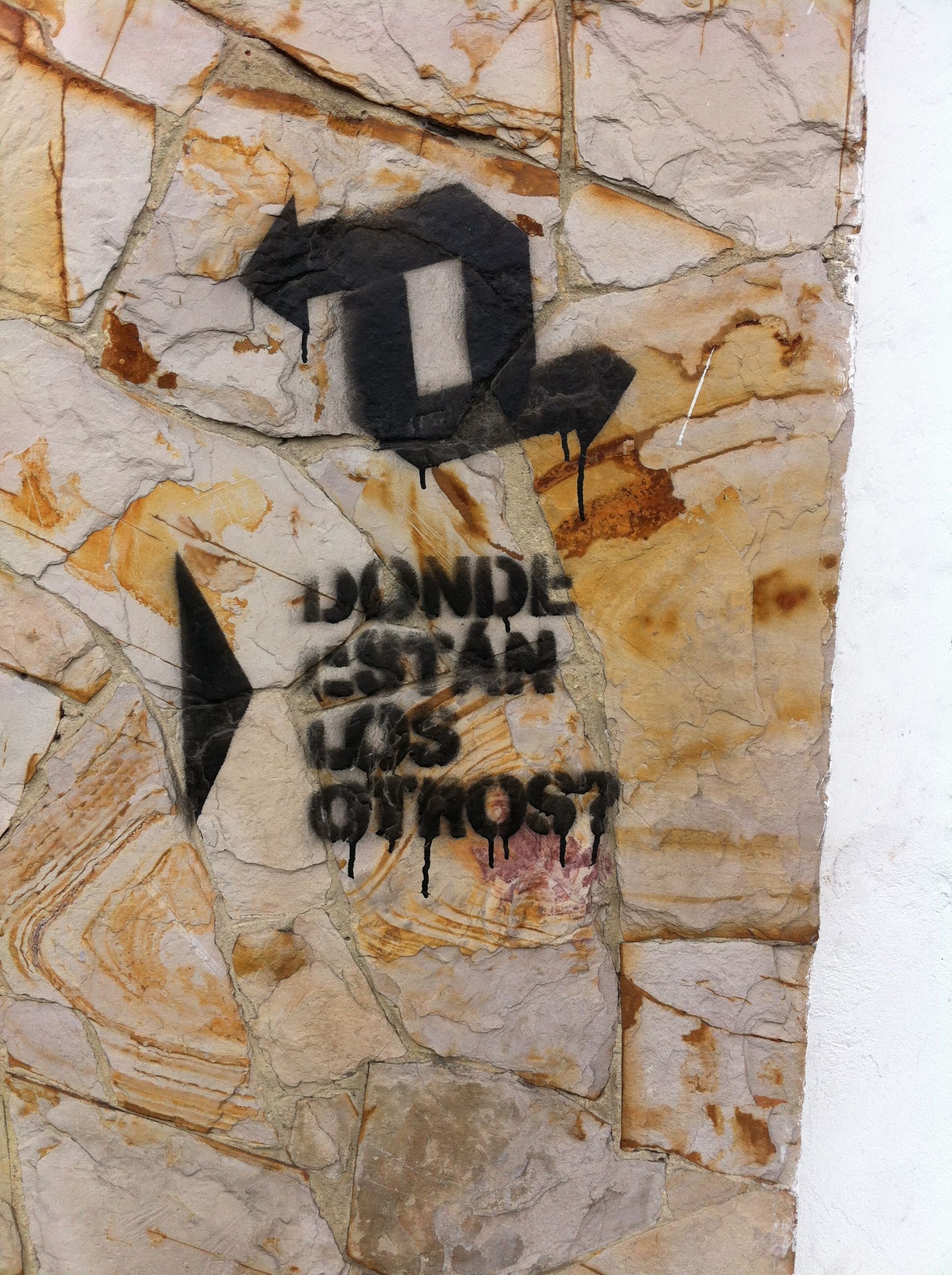
Which brings me to the post of two days ago: ¿Donde están los otros? ‘Where are the others?’ I have a feeling this graffiti is going to pursue me for the duration of my Colombian trip. And I wonder if there is another wall, in a parallel Bogotá, in which the others have written an identical message, referring of course to the ones who put the graffiti there in the first place, making them the others’ others.

And as I watch the TV after the reading, with its footage of mass shootings in Iraq, I begin to imagine how this question, ‘Where are the others?’ could keep recurring in an infinite series of parallel Bogotás, to the soundtrack of The Cure playing a song with a horribly contemporary title.


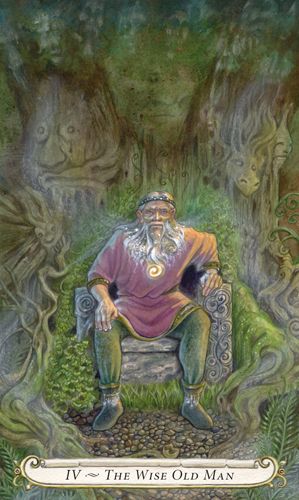
Deconstructing the Wise Old Man

The Wise Old Man


Lord, protect us from the wise old men of literature

Though in fact, the Lord may be the last person to do this protecting. At the literary festival I am currently attending, and at every such conference or festival I have attended to date in various parts of the world there has been a celebration of some great writer, living or dead. All, with a single exception, have been men.

Last night, a Mexican poet was celebrated here in Bogotá. During the sycophantic introduction to this venerable and ancient poet, I was alarmed to be told that he was responsible for one of ‘the three great works of misogyny’ of the 20th century.

How can it be acceptable to make a statement of that kind, especially in the context of a society like Mexico, in which violence against women is of epidemic proportions? (You do not need to have ploughed through Bolaño’s 2666 to be aware of this fact, although it helps). How can it be acceptable for educated men to make jokes about this, and to laugh amongst themselves, as they did at the event last night? Would it be OK to laugh at an announcement that such and such a book was one of the ‘great racist novels of the twentieth century’? And yet somehow, in too many places, it is perfectly OK to derogate women in a way that would be considered unacceptable if a similar derogatory comment were directed at people of another race or colour.

And here is where we get to the ‘maestro’, the great man of literature, whose sonorous tones must be heard, whose opinions must be listened to, even if those opinions are self-regarding pap and without conceivable value. It is one of the dangers associated with the prestige given to writers in certain societies, as compared, say, with Great Britain, where no one gives a toss what writers think, and where the prestige of the poet is somewhere on a par with that of a refuse collector – but well beneath that of a pest control operative.

European writers might at first be impressed or flattered by the respect afforded writers elsewhere, and the bowing and scraping that goes on in the presence of so-called ‘great’ writers, especially old ones, however decrepit, lecherous or boring they might be. However, the problem is that the stereotype of the wise old man is, to put it crudely, a bit of a bollocks.

The fact of the matter is that many people simply get stupider as they get older; their prejudices atrophy, their most disagreeable characteristics come to the forefront, and they are only interested in talking (or hearing) about themselves.


Where are the others, Señor British Citizen?

Britich Citizen

Landing at Bogotá must be quite challenging for an airline pilot. The city is on a plane high in the Andes, and both times I’ve landed here we’ve come down with a bump. Lonely Planet online warns its readers: “Bogotá is at 2640 meters, slightly above 8300 feet. Altitude adaptation takes time – the first day or two, take it easy.” By taking it easy, do they mean one should walk more slowly than usual? I will attempt a slow walk up to the shopping centre from my hotel, where I am being hosted by the cultural programme entitled Las Líneas de su Mano – where we will perform our work and discuss translation. But first I must get a cheap phone. As I leave the hotel a bicycle courier crashes his bike into the kerb and falls headfirst over his handlebars. He looks shaken, but claims to be OK. In the phone shop the young man with the complicated haircut takes my passport and photocopies it. When he returns with my purchase order, I have a new name: Richard British Citizen. Since Spanish surnames are composed of two parts: the father’s and the mother’s surnames respectively, I guess they must have thought my dad was called British and my mother, Citizen. It kind of makes sense. As much as anything makes sense. Walking back from the phone shop a youth darts into the traffic without looking, causing a truck to brake and swerve across the road. The weather is cloudy and the air is thin. It rains for ten minutes, then stops. The sun is far away, behind the clouds, beyond the mountain peaks.

Donde estan los otros


Walking back to the hotel I see a piece of graffiti: ¿Donde están los otros? Where are the others? Indeed, where are they? Have they crashed their bikes, or been run over by a truck? Or are they just late in arriving, because they have to walk so very slowly. Just as well we are not in La Paz, whose altitude is over 4,000 metres. People there would walk really slowly, were it not for the fact that there is always a helpful street vendor to hand, selling coca leaves, which, I am assured, help with respiration.


Murder Bear

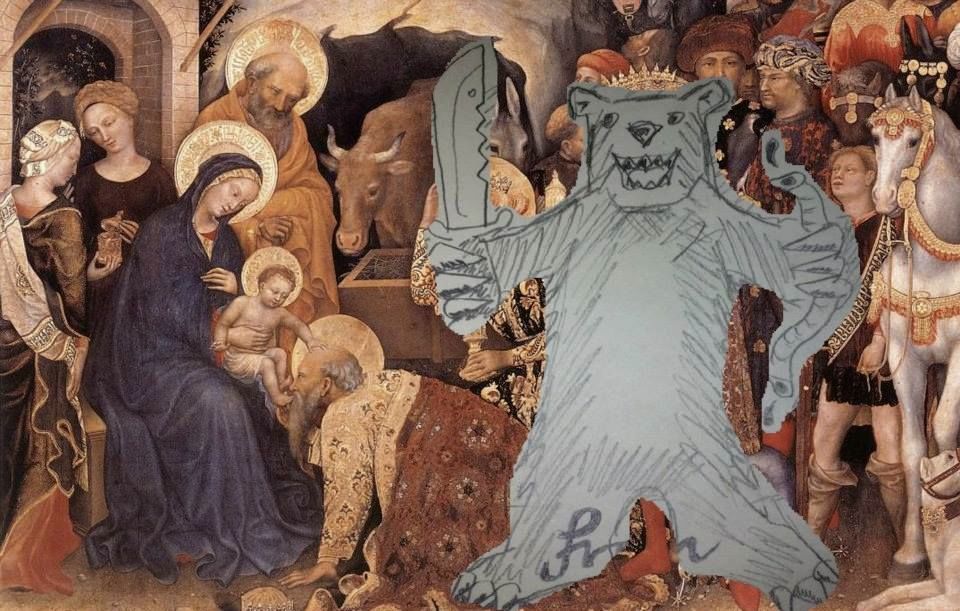
murder bear


I dreamed last night that American intelligence operatives were investigating the poet WN Herbert, allegedly because, according to dream-logic, he was responsible for – dream quotation marks – ‘blocking up areas of cyberspace that the US security forces deemed particularly sensitive’. In the dream a homeland security spokesman announced on television that the subversive Prof was under suspicion because his online activity was in danger of provoking a conflict with Russia. Bill was in trouble. I decided I had better call him, although I can hardly imagine he would need warning when the CIA had already made such a meal of announcing their investigation on TV. And besides, according to the previous day’s FB posts, Bill was in Crete: would he have signal there? And his phone was bound to be bugged. Perhaps I had better email. Same problem. Poor Bill. What would he do? What could I do to help?

On waking, I wonder where this particular dream has come from. I suspect it may relate to Murder Bear, Herbert’s horrifying ursine trope, perhaps interpreted by the spooks as a code matrix relating to Russian mobilisation on the Ukrainian border. But more likely, on reflection, would be Dogbot Borstal. This bizarre online association, or secret society, clearly harbours individuals of dangerously paranoid leanings, such as Goat Dog, Dumbo Octopus, and other cyphers.

goat dog


Eduardo Halfon’s Monasterio and those salacious Romans

Eduardo

Eduardo Halfon, Tintern, May 2013.

The problem with reading so many books at a time, so many, indeed, that the piles beside the bedside totter and sway; the problem, I think to myself in one of those everyday moments of realisation that seem to link up everything in the universe in a sublime act of synthesis, is that the themes, the plots, the characters, all start to form a single continuous entity, and one’s reading begins to resemble the world, infinite in association and connotation . . .

Reading Eduardo Halfon’s sublimely nuanced new offering, the novella – for want of a better word – Monasterio, I am struck once again by the simple fluency of Halfon’s prose, indeed slightly envious that he carries off acts of complex suggestivity with such grace and clarity of expression. I do not wish to get bogged down in a fallacious argument about the meaning of ‘clarity’ or ‘simplicity’ in prose writing: readers of Spanish will already have the opportunity to sample what I mean, and the author’s growing legion of English readers have a real treat to look forward to when the book appears in that language. The story follows Eduardo Halfon, a cypher, or perhaps a version, of Eduardo Halfon, but one who smokes a lot of cigarettes, whereas the real Halfon ‘seldom smokes’ (as my uncle once remarked to a German parachute officer surrendering to him at Monte Cassino, while simultaneously offering him a fat cigar). Not smoking is not the only difference between Eduardo and Eduardo, but let’s not confuse perception and representation. For a long time I thought this particular author was magnificently moustachioed, whereas in reality it is the way his little finger nestles to the side of his mouth on the sleeve photo of his books . . . but let’s move on . . .

The book begins with Eduardo and his brother arriving at Tel Aviv airport to attend the wedding of their sister, who has joined a fundamentalist Zionist group and is due to be married off to a fellow fanatic selected for her by the Rabbi. It is hot and our protagonists are not in the best of moods. Neither of them are practising Jews and they have serious reservations, to say the least, about both their sister’s faith and her prospective spouse, whom none of the family has met. A man who was on the flight with them, and is waiting by the carrousel, is suddenly set upon by security and bundled away. It happens in an instant. Eduardo thinks he recognises one of the Lufthansa flight attendants near the man as an ex-flame, Tamara, but he is not certain . . . Within the seven opening pages the essential matrix of the story is laid out. But the mastery of Halfon’s style lies in the way the story unfolds. He takes his time. There is nothing wasted in his prose. Everything counts, and everything holds our attention.

Late in the book (it is only 120 pages, but its density makes it seem longer) we go for a dip in the Dead Sea, and there is an extended discussion on the theme of salt. One of the most interesting nuggets to come out of this passage is that “the Romans called a man in love ‘salax’, which means to be in a salty state, and which is . . . . the origin of the word salacious.”

A salty dog, anyone?


On getting lost

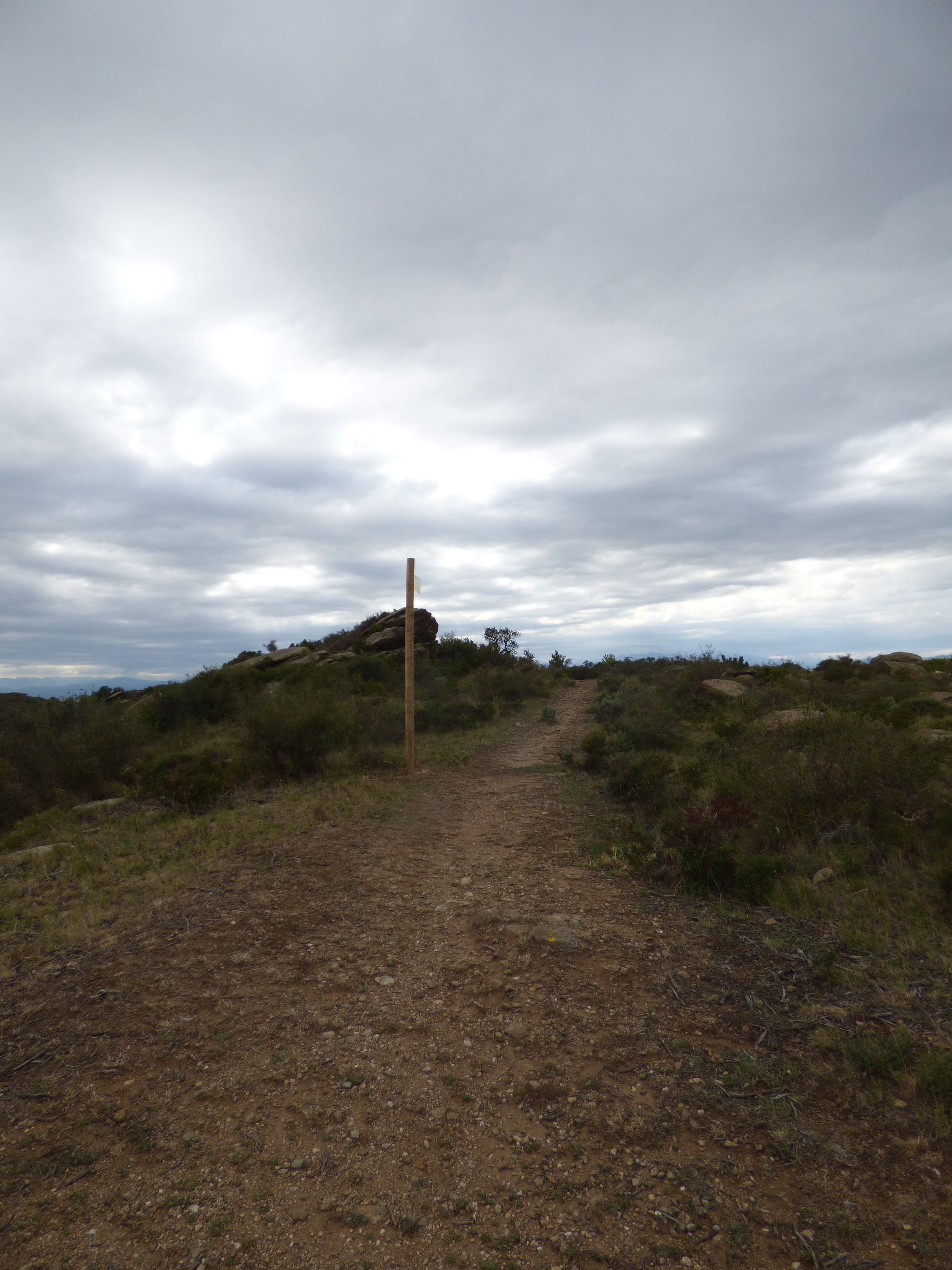
wandering

‘For [Virginia] Woolf, getting lost was not a matter of geography so much as identity, a passionate desire, even an urgent need, to become no one and anyone, to shake off the shackles that remind you who you are, who others think you are.’

Having finally got around to reading Rebecca Solnit’s fine book A Field Guide to Getting Lost, I am left wondering how come it took me so long. Not only to find the book, but to find a writer who has reached conclusions – or striven towards them, because a conclusion closes things off and Solnit likes to leave things open to mutation and redirection – that are so much in harmony with my own. I am reminded of that sense of excitement described (in an earlier post) by Patrick Leigh Fermor of ‘realising that nobody in the world knew where he was’, echoed in Solnit’s words: ‘Nights alone in motels in remote western towns where I know no one and no one I know knows where I am’. This is not solipsism, nor even a desire to escape; it is, properly speaking, a contentment merely to be where one is, when one is, without roots, without identity, without destination. Something very attractive to anyone who has ever suffered inclinations for the state that Buddhism calls unbeing, but wants to get there without putting in the long hours of back-straining, balls-breaking meditation.

Wandering, being lost, is a way of losing yourself. As Solnit reminds us, it’s not about being lost but about trying to lose yourself:

‘“Not to find one’s way in a city may well be uninteresting and banal. It requires ignorance – nothing more,” says . . . Walter Benjamin. “But to lose oneself in a city – as one loses oneself in a forest – that calls for quite a different schooling.” To lose oneself: a voluptuous surrender, lost in your arms, lost to the world, utterly immersed in what is present so that its surroundings fade away. In Benjamin’s terms, to be lost is to be fully present, and to be fully present is to be capable of being in uncertainty and mystery. And one does not get lost but loses oneself, with the implication that it is a conscious choice, a chosen surrender, a psychic state achievable through geography.’


Fictions and Foreigners: Borges and Alastair Reid

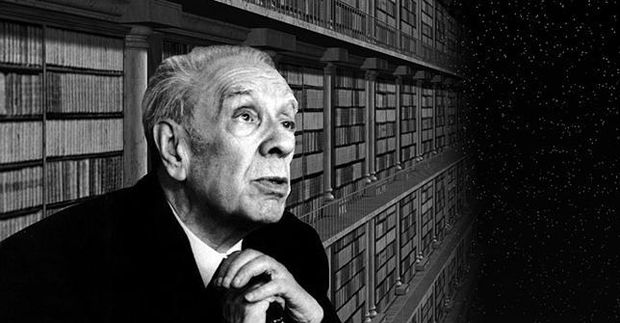
borges in library

The first story I read by Borges, at the age of eighteen, was Tlön, Uqbar, Tertius Orbis. Although the name would have meant nothing to me at the time, the translation was by Alastair Reid. Forty years later, I get to meet the man, now 88 years of age, a little frayed around the edges, but alert and bright eyed as a moorland bird. He lives in New York but spends part of every summer in the Dumfries and Galloway region where he was born and raised. I have been advised that Alastair would prove an invaluable repository of experiences and anecdotes for my researches into Latin American literature, concerning, among others, Borges, Neruda and Gabriel García Márquez, all of whom he knew well – Borges, best of all. And so it was that one bright July morning I set out with my friend Tom Pow across the Dumfries countryside towards our rendezvous.

I have yet to transcribe the recording, but two things stood out in our conversation. Neither of them will be surprising to those who are familiar with the work of Borges, but they are fascinating to me nonetheless.

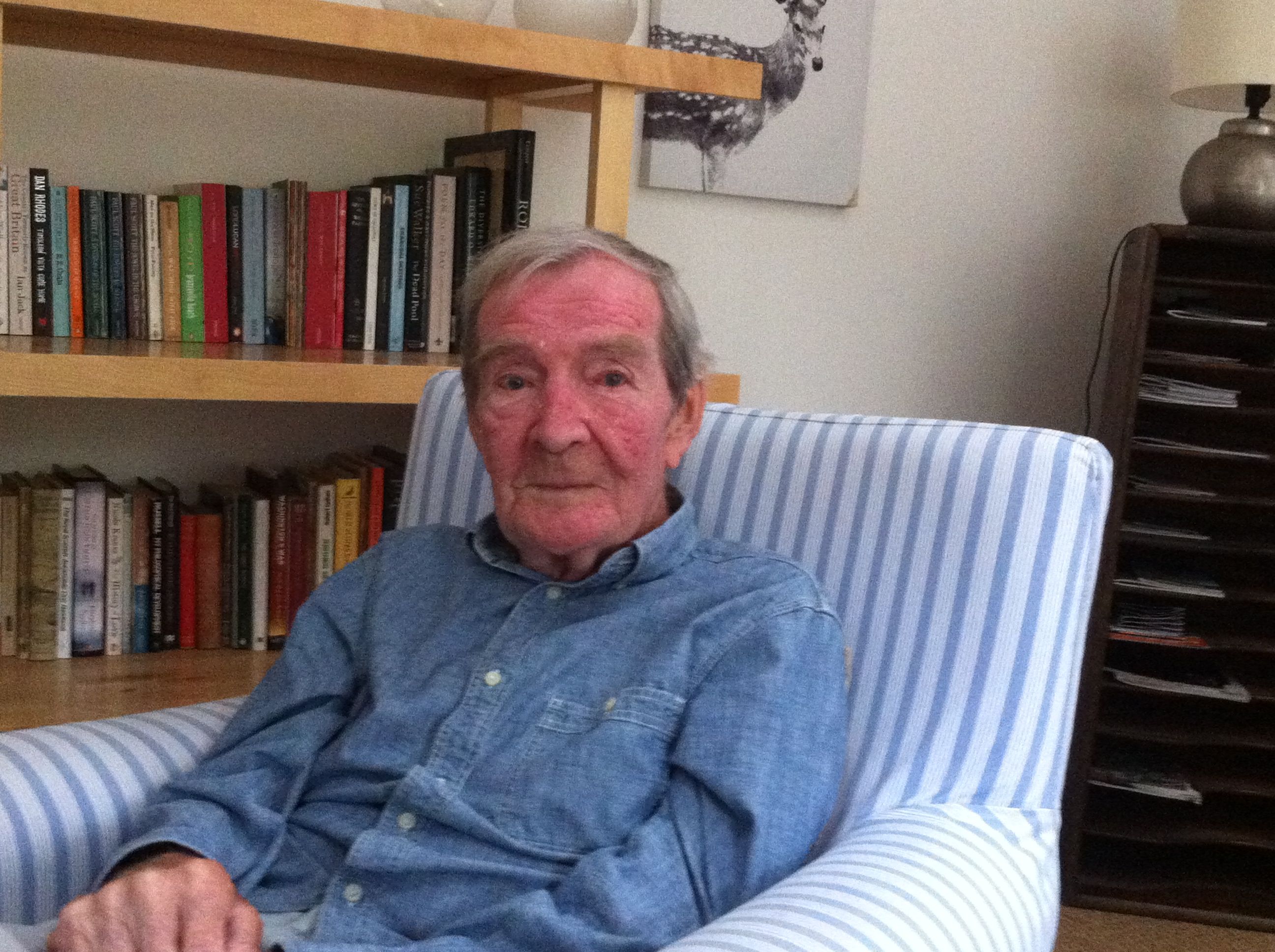
Alastair Reid

Alastair Reid, July 2014.

Translating Borges was, according to Alastair Reid, at times like re-translating something that had originally been written in English, and subsequently translated into Spanish. This, apparently, was due to Borges’ own familiarity and long use of the English language (he had an English grandmother, was brought up bilingual, and learned to read in English at an early age). The task of the translator, then, felt like rendering the story back into its original language, which Alastair described as a somewhat unsettling or daunting experience, and quite unlike translating other Spanish language writers.

The other thing that stood out for me in our talk was Alastair’s insistence that for Borges everything was a ficción, a fiction. As he puts it in his essay ‘Fictions’ (in the wonderful collection Outside In): ‘Borges referred to all his writings – essays, stories, poems, reviews – as fictions. He never propounded any particular theory of fictions, yet it is the key to his particular lucid, keen, and ironic view of existence.’ I was dimly aware of this, but not to the extent that this infiltrated his approach to literature and the world. In his essay, Alastair Reid elaborates:

A fiction is any construct of language – a story, an explanation, a plan, a theory, a dogma – that gives a certain shape to reality.

Reality, that which is beyond language, functions by mainly indecipherable laws, which we do not understand, and over which we have limited control. To give some form to reality, we bring into being a variety of fictions.

A fiction, it is understood, can never be true, since the nature of language is utterly different from the nature of reality.

And so on.

Alastair Reid’s essays contain so many observations and aperçus about the writers he has worked with (the 1976 essay ‘Basilisk’s Eggs’ is another gem) it would do them little justice to summarize. And that is only half the story: some of Reid’s most impressive writing concerns his own reflections on travel and identity: on the one side his Scottish beginnings, or ‘roots’ (a word he treats with caution), on the other the years of wandering. Perhaps my favourite is ‘Notes on being a Foreigner’ in which the author makes astute and (to my mind) accurate observations on that state or condition – one that a person is probably born to – as opposed to, say, a tourist or an expatriate.

‘Tourists are to foreigners as occasional tipplers are to alcoholics – they take strangeness and alienation in small, exciting doses, and besides, they are well fortified against loneliness . . .

. . . An expatriate shifts uncomfortably, because he still retains, at the back of his mind, the awareness that he has a true country, more real to him than any other he happens to have selected. Thus he is only at ease with other expatriates . . .

. . . The foreigner’s involvement is with where he is. He has no other home. There is no secret landscape claiming him, no roots tugging at him. He is, if you like, properly lost, and so in a position to rediscover the world, form outside in.’

As for being ‘properly lost’ – this is a theme to be continued ( if I make it back to Wales).

The Dictator’s Ghost

Yesterday, intending to do my civic duties and pay my annual dues (known as the Xaloc) at the village ajuntament, I plodded up the hill, Thursday being one of the two days on which the village hall opens its office to deal with citizens and their affairs. Once inside the ajuntament complex, I notice that on the door of the office itself, a scrap of paper is pinned to the woodwork, declaring that during the months of July and August, office hours will take place on Monday afternoons and Friday mornings instead of Monday mornings and Thursday afternoons. Fair enough.

So today I take myself up the hill, and once again the office is closed. A friendly face at the village shop tells me that today is the assumption of the most Holy Virgin, the day on which the Virgin Mary was allegedly scooped up to heaven. For this reason the whole country must stop in its tracks. However, as a regular visitor to Spain and other Latin countries, I am used to this, and do not so much as flinch a northern European muscle.

Digression: Xaloc, the name of the tax, sounds like a Mexican god, but is in fact, I recall, the Catalan name of one of the sea winds (it comes from the Arabic word shaluq, meaning south-east). A Catalan fisherman’s saying goes: Vent de Xaloc, mar molta i peix poc / Xaloc wind: big sea and few fish. Is this how the term came to be adopted to refer to a form of taxation?

My adventure in trying to pay my civic dues could be represented as a flow chart, or else in bullet points, as follows:

i. Ajuntament office hours are on Mondays 10-12 and Thursdays 16-18.30,

except:

ii. in July and August, when they will take place between 14.30-16.30 on Mondays and 10-12.30 on Fridays,

except:

iii. on Fiesta days during those months, when they will be cancelled altogether.

These are the kinds of qualifications that would send Angela Merkel and any self-respecting northern European Eurocrat into palpitations. It is exactly this kind of thing, don’t you know, which causes these idle Mediterranean countries to crash their economies. No sense of civic duty, no sense of Hard Graft.

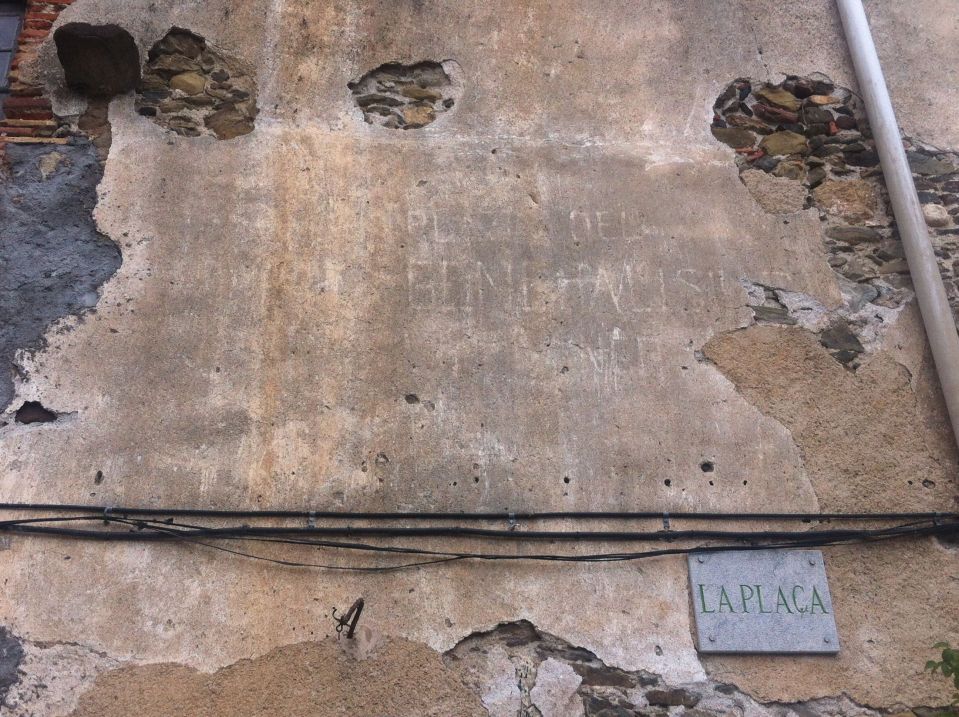
On my way down through the village, I see something on the wall that I have never before noticed (and I have been coming to this village, on and off, since 1988). Now, the changing of place names is a well known phenomenon in all countries with an historical tendency to regime change: we once spent an afternoon in La Línea de la Concepción trying to track down my mother-in-law’s birthplace, before realising that the street names had undergone at least two revisions since 1926. Here is what I saw:

What would the Generalisimo have made of it all? Well, the answer is clear: it was with the dictatorship that my little tale begins. Franco was directly responsible for both maintaining a crippling adherence to Catholic dogma and a ludicrously top-heavy bureaucracy that Spain has been struggling to free itself from over the past 40 years. And the more feast days, clearly, the more devout your subjects.

Plus ça change, plus c’est la même chose.

A Journey into Memory


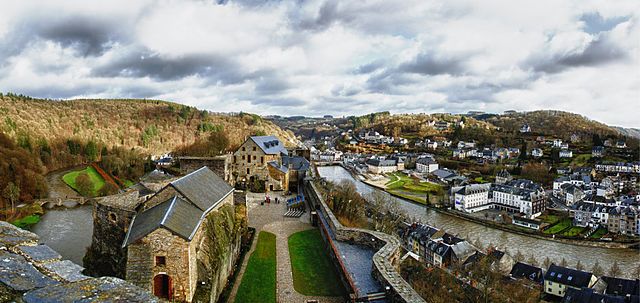
Bouillon: Panorama

Bouillon: Panorama

When I remember things from childhood or early adulthood, it often feels as though I am a passive subject, a receptacle or vessel, and the process of remembering becomes one in which memory is seeking me out, digging its way into my sense-making apparatus, rather than there being any sort of ‘I’ trying to make sense of the things remembered.

I am all too aware that as far as memories are concerned, it is the act of construction (more accurately reconstruction) that matters, of making the bits fit our self-narrativisation. In other words, as Gabriel García Márquez put it: ‘Life is not what one lived, but what one remembers and how one remembers it in order to recount it.’

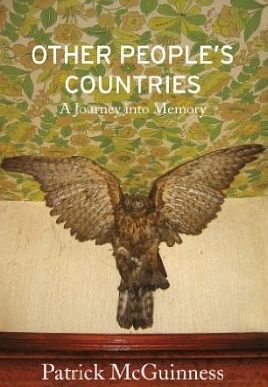
Other People's CountriesIn his memoir, Other People’s Countries (subtitled A Journey into Memory), Patrick McGuinness asks fascinating questions about the way that identity is rooted in memory, more specifically in the way that we remember. “Trying to remember is itself a shock, a kind of detonation in the shadows, like dropping a stone into silt at the bottom of a pond: the water that had seemed clear is now turbid (that’s the first time I’ve ever used that word) and enswirled.” On reading this passage, which comes on Page 7 of the book, I found it noteworthy that McGuinness comments on the fact that he has not used the word ‘turbid’ before, which immediately casts suspicion on the observation, because one wonders whether, by commenting on memory’s cloudiness and turbidity, he has merely dislodged an existing memory, and is therefore, perhaps, not ‘using the word for the first time’ at all. And how telling that his use of the word ‘turbid’, and his comment on that usage, should immediately be followed by a neologism, ‘enswirled’.

These are nice illustrations of the way that language, our use of it, and its use of us, can be an element in the process of remembering. I am thinking in particular of those laden words which, when they crop up, immediately bring with them a sequence of memories and associations. I remember reading somewhere that our memory of language is the best reason why one should not translate into a language that is not our mother tongue. Words carry their own baggage with them: when you hear certain words, they spark off a whole sequence of associative meanings and memories, stretching back to childhood, that would simply not be available to an individual who has learned a language as an adult.

Childhood is the source of many of these word-memories. Like smells or taste (Proust’s oft-cited madeleine), words, long forgotten or unused, are capable of eliciting entire submerged worlds. But is it the memory of the word itself that achieves this, or the memory of a memory? As McGuinness speculates:

‘And as with so much of that childhood, I seem to remember not the things themselves but the memories of the things, as if the present I experienced them in was already slowing up and treacling over, fixing itself in a sepia wash.’

There are so many good things in this book, things that make you reach for a pencil, or else just stop in your tracks and reflect about the words you have just read. You can dip in, pick a page at random, and come out with some crystallized memory, or some jewel of detailed observation.

Other People’s Countries is, on one level, about a house in Bouillon, in the Ardennes region of Belgium. The house belonged to McGuinness’ family (his mother was Belgian) and was the author’s own childhood home. The book is divided into many short chapters: in this way they resemble the rooms of a large house, perhaps Quintilian’s House of Memory. I’ll conclude with one of my favourite chapters, titled ‘Keys’, which follows in its entirety:

‘Watching an old police procedural, probably a Maigret, sometime in the early eighties while convalescing from glandular fever (an illness I experienced more as convalescence than as actual illness: I felt as if I was simply recovering from something, rather than actually having the something to recover from in the first place), it came to me: a thief pushing a key into putty so that it’s outline would be caught in the relief and he could copy it, then burgle the house.

That was memory, I realised: a putty with which you make another key, which would open the same door, but never quite as well. In no time, you’d be burgling your own past with the slightly off-key key that always got you in though there was less and less to take.’


The last digression of Patrick Leigh Fermor


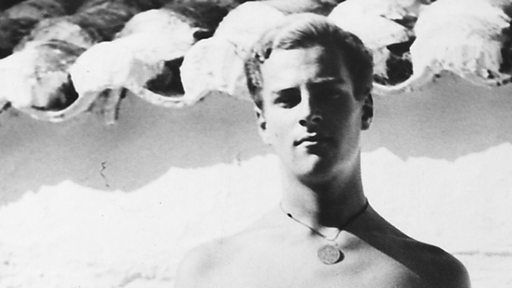
Patrick Leigh Fermor, circa 1934

Patrick Leigh Fermor, circa 1934


Reading the final ‘long awaited’ – which in this instance meant waiting for the Death of the Author in 2011 at the age of 96 – third volume of Patrick Leigh Fermor’s account of his 1934 trek across Europe, three questions occur to me about the inability of PLF to complete and publish the book while still alive.

1)   the accumulation of digressions (both of writing and in life); indeed what amounted to PLF’s compulsion to digress (of itself no bad thing);

2)   his failure of memory, aided and abetted by the loss of certain of the relevant notebooks;

3)   an inability to contemplate the end of his journey which must, by some not-so-strange interior logic, also mean the end of his life.

An article by Daniel Mendelsohn in the current issue of The New York Review of Books also suggests a combination of factors, most particularly the digressions that formed such a substantial part of Paddy’s life and work. “We shall never get to Constantinople like this,” the author announces in a meta-textual aside, which constitutes “a humorous acknowledgement . . of a helpless penchant for digressions literal and figurative . . .”

Indeed, “the author’s chattiness, his inexhaustible willingness to be distracted, his susceptibility to detours geographical, intellectual, aesthetic, and occasionally amorous constitute, if anything, an essential and self-conscious component of the style that has won him such an avid following.”

The naivety and sheer joy of unfettered travel; the “ecstasy” that Paddy describes on “realising that nobody in the world knew where he was” – a sensation, as Mendelssohn points out, that would be practically impossible for travellers today, but which I recall from my own wanderings in the 1980s as having provoked a similarly feverish sense of total liberation; the wonderful lists that pepper his writing, eliciting new tastes and new sensations and a constant hunger to celebrate life as fully as possible; his unerring ability to stir in the reader a desire to write – which to me constitutes a failsafe criterion of all good writing; and finally – almost because of its flaws – and certainly because of what we know to have transpired in the two earlier volumes, and the unbearable anticipation of the thing – which was like a Sword of Damocles for PLF in later years – all of these help to make this book one of the most enjoyable reading experiences of the year thus far. While reading it too, I am more conscious than I was during the preceding two volumes of Paddy’s tendency to confabulate. At more than one point Paddy confesses that he cannot truly remember what happened next, but continues anyway, and even interjects passages of outrageous fantasy to spice up the story. A quotation from Javier Marías’ novel, The Infatuations, comes to mind:

“Everything becomes a story and ends up drifting about in the same sphere, and then it’s hard to differentiate between what really happened and what is pure invention. Everything becomes a narrative and sounds fictitious even if it’s true.”

Like Mendelsohn, I found The Broken Road’s incompleteness, paradoxically, to be more fitting than any neatly circumscribed ending that the author might have engineered. After so much deep description, after so many early mornings waking by the roadside with a sense of the sheer limitless possibility of the unfinished journey, after so much continuous pointless peregrination, any kind of ‘arrival’ would only have been a let-down.

While listing, above, the three reasons for the unfinished nature of the trilogy, a fourth, not entirely facetious option came to mind. Paddy famously never referred to the ultimate destination of his journey as Istanbul, but as Constantinople. Since ‘Constantinople’ did not exist under that name (nor had it, strictly speaking, since 1453), Paddy was never going to arrive. Instead we are allowed to share with him the nostalgia (which he shares with Cavafy) for a broken Hellenic world, for the ghosts of Byzantium, and a burgeoning sense of the terror that was about to descend on Europe in the years immediately following his journey.