Richard Gwyn

Fiction Fiesta 2015

Preview | Fiction Fiesta 2015

PREVIEW | FICTION FIESTA 2015

Fiction Fiesta started out three years ago as a conversation in a pub between myself and Nick Davidson, landlord of the now defunct Promised Land in Windsor Place, Cardiff. I was expecting a visit from two Argentinian writers, Andrés Neuman and Jorge Fondebrider, and Nick and I decided to hold a small celebration to welcome them to Wales. However, we got a little excited and ended up inviting all kinds of people, including the publishers Christopher MacLehose and Charles Boyle, and the literary editor of The Independent, Boyd Tonkin, and then a load of people from closer to home got involved. Nick got some money from the San Miguel brewery and I managed to secure some from Cardiff University and the thing was on. We followed up in 2013, with an Arts Council of Wales small festivals grant, inviting Eduardo Halfon from Guatemala and Inés Garland from Argentina to join several writers from Wales and elsewhere, and The Independent again covered the event, which attracted some attention.
My idea for Fiction Fiesta was simple: to team up writers in both the languages of Wales with writers from Latin America, and initiate a discourse between us and them, with the aim – among other things – of dismantling such notions as ‘us’ and ‘them’. The way we set out to approach this was to pay particular attention to literature in translation, and explore the whole idea of translation as a concept that to some degree governs our lives. After all, we are translating from the moment we are born: early childhood is the acute phase of translation, and of being translated. Those moments in which every gaze, every enraged instinct on the part of the infant meets with either incomprehension or else with a tentative, and then a more assured translation. As parents we are constantly engaged in acts of translation, as are friends and lovers and enemies and strangers of all variety. In literature, even without being translated into other languages, we are translating emotions and thoughts into words. ‘Reading poetry is itself a kind of translation,’ commented Andrés Neuman during a discussion at Fiction Fiesta in 2013. We are all translators, just as we are all, to some degree, writers. ff-e-flyer 2015
The novelist and essayist Ali Smith, in her preface to English PEN’s report on literary translation, Taking Flight, wrote:  ‘If we value literature at all, we know the worth of literary translation. If we want language to be as subtle and supple and layered and resonant as language can be, we know the worth and the work and the subtlety of literary translation. If we care at all about looking beyond our back yard and our own dominant narratives, we know the worth, the work, the open border, open mind, open eyes and ears of literary translation. If we belong to a culture which rates the word literary, we know the value, the scope, the touchstone, the creativity, the generosity that exist in this fusion of literary and translation.’
Engaging with the literature of another country, another culture, enables us to understand not only the world as it is now, but also the shared history that brought us here, which will be our legacy.
As Edith Grossman, the modern translator of Cervantes’ Don Quixote puts it: ‘[Translation] permits us to savor the transformation of the foreign into the familiar and for a brief time to live outside our own skins, our own preconceptions and misconceptions. It expands and deepens our world, our consciousness, in countless, indescribable ways.’
It was never our intention to put on a big festival. We always wanted Fiction Fiesta to retain a sense of intimacy that came from holding the first edition of the fiesta in the upstairs room of a local pub. And we wanted to keep a sense of celebration, of literature as something to be savoured and enjoyed, like food and drink, which the large-scale corporate festivals cannot provide. Above all, we wanted Fiction Fiesta to help develop contacts and friendships between Welsh writers and writers from Latin America, which is where a lot of my own literary interests happen to have sprung from.
I was fortunate enough to spend some time in Mexico last year on an Arts Council of Wales project, and part of my task was to familiarise myself with the wide expanse of literary culture there as well as trying – within a month – to gauge as much as I could of the wider cultural climate within that country. I came away with my head filled to bursting, but enthusiastic about the task of developing closer relationships with individual Mexican writers, of translating the poems of some, and of reading the work of many others.
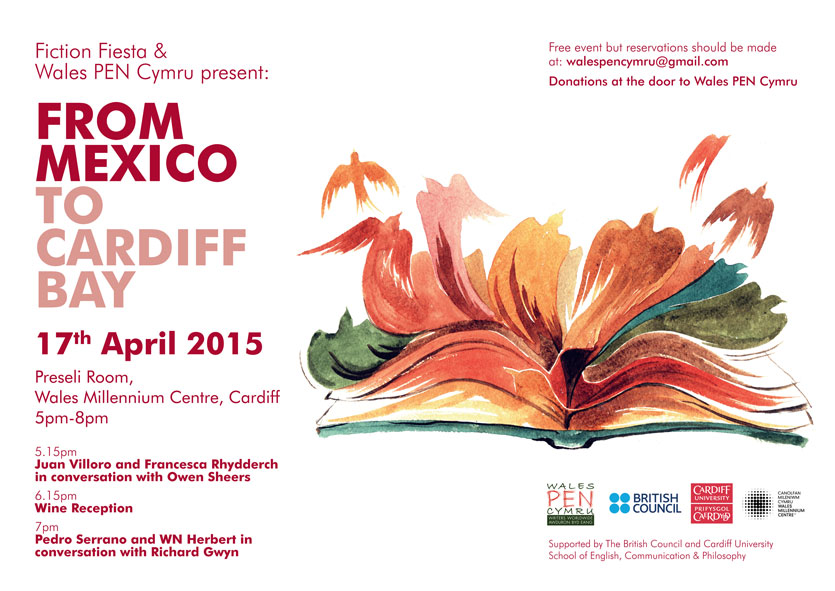
This year Mexico and the UK are teaming up for two big events: the London Book Fair, running this week from Tuesday to Thursday, where Mexico is the guest nation, and at the Guadalajara Book Fair, in November, where the UK is the invited country. We thought that Cardiff should see a slice of the action, so together with the newly formed Wales PEN Cymru, and with the support of the British Council, we decided to hold a small event here with two of the Mexican writers whose work I discovered last year, and who are visiting for the Book Fair. As is the usual pattern with FF, we teamed them up with local writers – or in this instance a Welsh writer and a Scottish Poet – to see what happens.
file-page1
The event takes place on a Friday night, at the Wales Millennium Centre. In the first session, which begins at 5 pm, Owen Sheers will be in conversation with Juan Villoro, a contemporary and friend of Roberto Bolaño, and an extraordinary writer of short stories in the broad lineage of Borges, alongside Francesca Rhydderch, who achieved widespread recognition last November with her shortlisting for the BBC Short Story Award. In the second half, following a wine reception, I will be talking with Pedro Serrano along with the Scottish poet WN Herbert, and they will be reading from their work. The event takes place in the Preseli Room at WMC and entry is free of charge, with donations to Wales PEN Cymru welcome.
This year Fiction Fiesta is supported by the British Council and Cardiff University School of English, Communication and Philosophy.

This post also appears on the website of WALES ARTS REVIEW today. The new re-vamped Wales Arts Review serves as a media platform where a new generation of critics and arts lovers can meet to engage in a robust and inclusive discussion about books, theatre, film, music, the visual arts, politics, and the media.
To Reiterate

Lydia Davis, in inimitable style, consolidates the elements of reading, writing and travel in a short piece from her 1997 collection, Almost no Memory:

Michel Butor says that to travel is to write, because to travel is to read. This can be developed further: To write is to travel, to write is to read, to read is to write, and to read is to travel. But George Steiner says that to translate is also to read, and to translate is to write, as to write is to translate and to read is to translate. So that we may say: To translate is to travel and to travel is to translate. To translate a travel writing, for example, is to read a travel writing, to write a travel writing, to read a writing, to write a writing, and to travel. But if because you are translating you read, and because writing translate, because traveling write, because traveling read, and because translating travel; that is, if to read is to translate, and to translate is to write, to write to travel, to read to travel, to write to read, to read to write, and to travel to translate; then to write is also to write, and to read is also to read, and even more, because when you read you read, but also travel, and because traveling read, therefore read and read; and when reading also write, therefore read; and reading also translate, therefore read; therefore read, read, read and read. The same argument may be made for translating, traveling and writing.


More notes on being a foreigner (III)

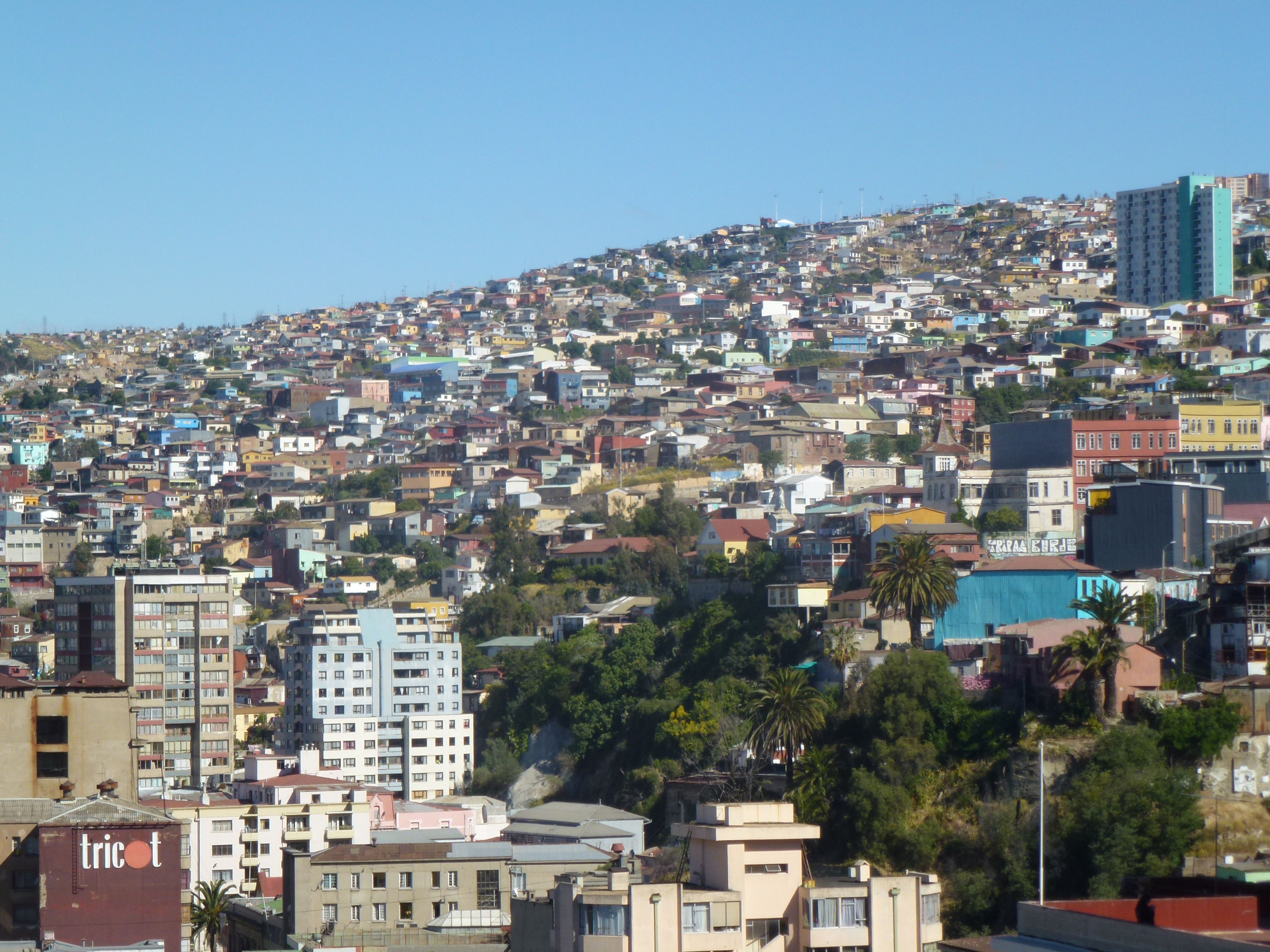
Valparaíso skyline

Valparaíso skyline

More translation – literary and the other, everyday kind – and more thoughts on being a foreigner: “Foreigners are, if you like, curable romantics” writes Alastair Reid. “The illusion they retain, perhaps left over from their mysterious childhood epiphanies, is that there might be a place – and a self – instantly recognisable, into which they will be able to sink with a single, timeless, contented sigh. In the curious region between that illusion and the faint terror of being utterly nowhere and anonymous, foreigners live. From there, if they are lucky, they smuggle back occasional undaunted notes, like messages in a bottle, or glimmers from the other side of the mirror.”

He wonders whether Valaparaíso might be that place into which he could “sink with a single, timeless, contented sigh”. He suspects it might be. And yet.

The foreigner walks for an hour in the vicinity of the bus station looking for a comfortable place to sit and scribble: something like a café, or a clean well-lighted place that might offer up a drink and a sandwich, one of those sandwiches that contain a variety of colourful food: a completo or an italiano.

He does not much care for his current state of mind. He has returned to Valparaíso, after a brief visit to the capital. In Santiago the temperature was 35 degrees centigrade; here it has dropped to around 19, and is overcast. He came dressed for the sun, and looks ridiculous. To make matters worse, he has a suitcase, albeit a small one, which he does not wish to lug around. He wonders if he should check into a hotel, but it is a weekend in high summer, and the two he has called are full (and expensive). He has killed the first hour in pointless perambulation, so leaves his case at the left luggage office of the bus station and tries again to orient himself, calmly. He sets off towards a covered market, often useful places for one in search of food, but the stalls are shutting up and the little shacks selling food also, and the place has the forlorn aspect of closing time, and the street outside smells of fish, urine and rotting fruit.

He continues further out of his way before finding a more promising street and following it. Something about the open-fronted shops selling herbs and fruit and meat reminds him of Greece, specifically the smell of Chania market. He tries to identify precisely what the smell is, and fails to name it, the ingredient tantalisingly out of memory’s reach. It is a smell that combines thyme, coffee and something else, something that will not be recalled. He begins to feel nostalgia for people and places he will never recover, but that too fades. Eventually he spots a likely café and crosses the road. He takes a table half way down the room. When he orders, the waitress turns her head to one side, as some people do when confronted by a foreigner, as though the presumption of their foreignness will necessarily involve not understanding them. When she realises that there are no imminent communication issues, she smiles. Despite his command of the language, he is still a foreigner, and perhaps she feels a degree of pity, or something approximating it to it. He has seen the other waitress carrying a plate with the kind of sandwich he requires: meat, tomato, avocado, mayonnaise. He requests the same. It doesn’t take long to clock the fact that not only is he the only non-Chilean in the place; he seems also to be the only person not personally known to the staff. The sandwich arrives. It is pretty much what it sets out to be, and settles threateningly in his stomach.

The following night, by which time he has shed the tourist garb of shorts and brightly coloured shirt and put on a disguise of tracksuit trousers, black tee shirt and cardigan, he goes downtown with his friend, Enrique, who remarks afterwards that to any onlooker they might just have appeared to be father and son, taking a turn out to the bar together. His foreigner identity has briefly been supplanted – to the outside world, at least – by another. He wonders how much longer it would take for his identity to be usurped forever. He thinks, probably, never. But he suspects there is always another, his other, or his other’s other, in waiting, biding its time.

But that thing about the place into which he could sink with a single, timeless, contented sigh? That has receded again; that, he fears, will always be an illusion.

day4 view from terrace

Cerro Alegre, with sea

The writer Enrique Winter

Chilean writer Enrique Winter

Exhibit B in Santiago de Chile

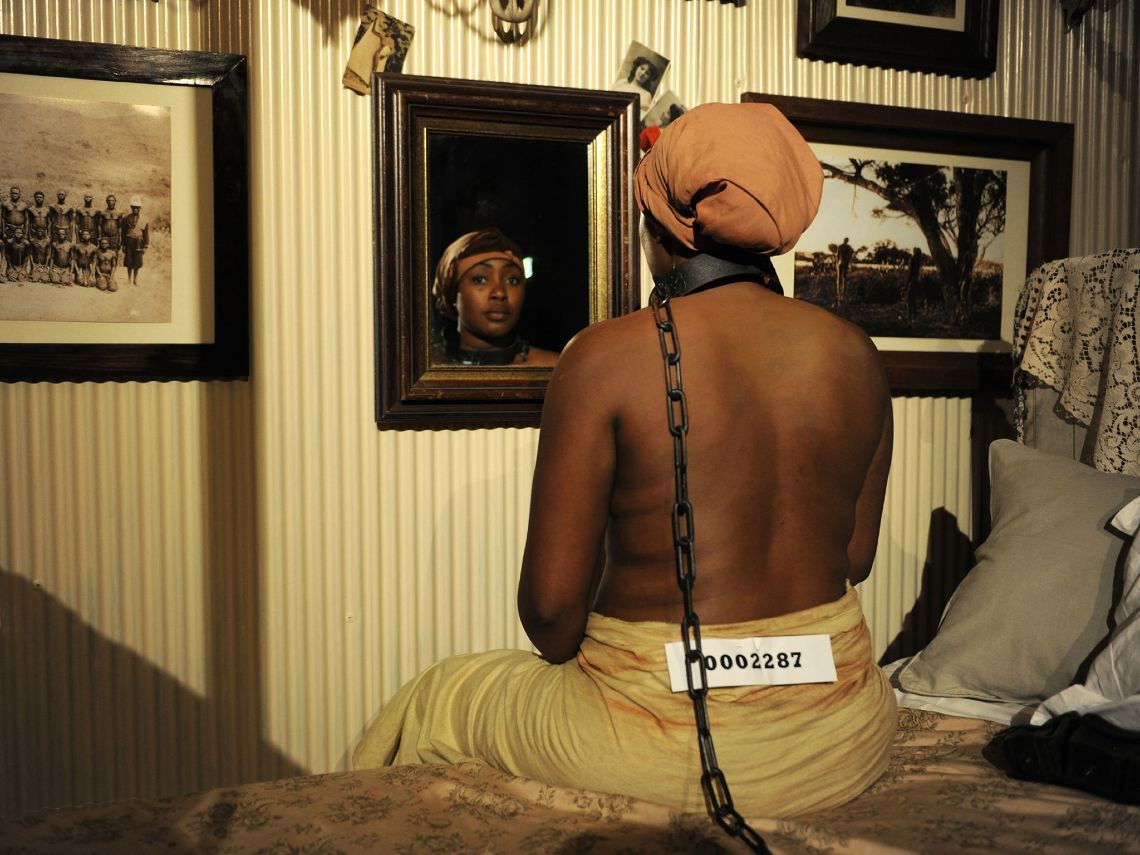
A Place in the Sun, from Brett Bailey’s “Exhibit B”. This installation was based on an account of a French colonial officer who kept black women chained to his bed, exchanging food for sexual services.

From Brett Bailey’s “Exhibit B”. This installation was based on an account of a French colonial officer who kept black women chained to his bed, exchanging food for sexual services.


Continuing my readings of Alastair Reid, while travelling in Chile, I find the following: “The fictions we make are ways of ordering and dominating the disorders of reality, even though they in no way change it. The ‘truth’ of a fiction is less important than its effectiveness; and since reality is shifting and changing, our fictions must constantly be revised.”

‘Fictions’ here has the broadest meaning possible, and should not be confined to those things that are written down and sold in the Fiction Section. Fictions, following Borges, are anything – a story, an explanation, a plan, a theory, a dogma – that gives a certain shape to reality. A piece of theatre, for example.

Arriving in Santiago from the south of Chile yesterday evening, I was invited by friends to attend a performance of Exhibit B, showing as part of the Santiago a Mil theatre festival. Exhibit B is a theatre installation that replicates the grotesque phenomenon of the human zoo during the 19th Century, in which Africans were put on display like circus freaks “for the titillation of European and American audiences under the guise of ‘ethnological enlightenment.’” The show created something of an outrage when performed at the Edinburgh Festival last year. There were complaints that the actors were being to subjected to a similar form of exploitation as the people whose lives they were reproducing, and its run at the Barbican in London was cancelled, on the grounds – according to the sociologist and activist Kehinde Andrews, writing in The Guardian “that it reinforces, rather than challenges the racism it stands as a commentary on.”

Holding the performance in the baroque and excessive setting of the nineteenth century Cousiño Palace in central Santiago was a stroke of genius. The Cousiño Goyenechea family owned coal and silver mines, as well as the Cousiño-Macul Vineyards. The nouveau riche glitz of the palace set off by classical music, provided a sinister but peculiarly fitting locale.

The experience of Exhibit B was painful, as I expected it to be, and my emotions as I walked slowly round the exhibits were complex, and included a degree of shame in experiencing discomfort of any kind, given the extremes of discomfort, abuse and torture suffered by the subjects whose pained existences were being recreated by the actors. I was confused, as I was doubtless meant to be: should I make eye contact with the exhibits, for instance? Would I not be replicating the white man’s gaze that the performance so vehemently questions? The actors weren’t avoiding my gaze, that was for sure, and even on occasion followed my passage across the space in front of them, especially the replica of the man adopted by some Austrian prince in the 18th century who, when he died, had been skinned and stuffed (and blanched) and put out on display for visitors to admire.

My confusion – and the residual sense of shame which I had no power to resist – was exacerbated by a string of questions to which I had no answers. I think the most powerful message to come from this important work is that the objectification and exploitation of society’s others – and our continuing projection of otherness onto immigrants and asylum seekers – continues and will continue. We cannot change the past, but we can at least help shape the future. That is why I cannot support the position taken by the protesters who forced the closure of the Barbican show. A discussion between one of the black performers, Stella Odunlami, and Kehane Andrews (who was active in getting the show shut down, despite never having seen it) provides valuable arguments on both sides. Essentially though, I feel that censorship cannot be justified simply because a work of art chooses a difficult subject and questions reality in a way that some might find offensive.

By the criteria presented at the start of this post, that the fictions we make are ways of ordering and dominating the disorders of reality, even though they in no way change it, and that the ‘truth’ of a fiction is less important than its effectiveness, I can only say that in the case of Exhibit B, its effectiveness was not in doubt. It was both effective and a deeply moving testament to human cruelty and human suffering. As the performer Stella Odunlami writes in response to Kehane Andrews : “my fellow performers and I chose to be part of a production that exposed racism then and now. We have had to defend our decision to exercise our freedom of creativity to those who call us puppets. It is not your job to decide what is or isn’t good for me; I am capable of doing so for myself.” Brett Bailey’s own defence of the work can be found here.

At the very end, when we were standing around in the courtyard about to leave, I caught sight of the actors smoking and chatting by the side entrance of the palace. I was relieved that the company included the taxidermically conserved dead man whose gaze I had failed to meet. It was as if, with the actors out of role, no longer being the people they represented in fiction, their humanity had been restored to them, and with theirs, my own.


More notes on being a foreigner (II)

“Anonymity is peculiarly appealing to a foreigner: he is always trying to live in a nowhere, in the complex of his present.” With this thought in mind I come to the end of re-reading Alastair Reid’s essay, and start on the next one,  called ‘Other People’s Houses.’ Despite the fact that to the outside world, my foreigner-status remains intact, with friends in Chile, my confused identity is – peculiarly – tolerated with extreme goodwill.

It is with particular interest that I read the opening of ‘Other People’s Houses’, the next essay in Reid’s excellent collection. It is worth citing the first paragraph is full:

“Having been, for many years, an itinerant, living in an alarming number of countries and places, I am no stranger to other people’s houses. I am aware of a certain disreputable cast to this admission; I can almost feel my wizened little ancestors shaking their heads and wringing their hands, for in Scotland, people tend to go from the stark stone house where they first see the light to another such fortress, where they sink roots and prepare dutifully for death, their possessions encrusted around them like barnacles. Anyone who did not seem to be following the stone script was looked on as somewhat raffish, rather like the tinkers and traveling people who sometimes passed through the village where I grew up. I would watch them leave, on foot, over the horizon, pulling their worldly belongings behind them in a handcart; and one of my earliest fantasies was to run away with them, for I felt oppressed by permanence and rootedness, and my childhood eyes strayed always to the horizon, which promised other ways of being, a life less stony and predictable.”

Alastair Reid, then, prepared himself for his life as a foreigner, by aspiring to the strange life of the transients who passed through his village. This rings a bell for me, also.

Sometimes a person’s foreignness is something that can be put on or removed, like a second skin. Sometimes, too, the façade of foreignness can be a convenience. Take as a hypothetical example my friend, K. He has resided in Chile for thirty years, enjoys citizenship, and takes a keen interest in the culture and politics of his adopted country, but as a true foreigner he would not be so facile as to believe that his identity has somehow been re-calibrated as Chilean. Negotiating the fragmentary landscape of foreignness, only an idiot would claim a national identity on such spurious grounds.

For a certain class of foreigner, foreignness is something that can be deployed strategically. One can even turn it into a kind of game, or make oneself the  butt of jokes on account of one’s own foreignness. One can intentionally mislead, intentionally mispronounce, intentionally misunderstand. But these are beginners’ tricks, at the amateur end of Being a Foreigner. People like K. are adepts, and have decades of practice, sidestepping their interlocutor by playing the foreigner card to their own advantage. It doesn’t always work of course, especially with policemen and parking attendants, but it is a strategy to which I have at times reverted myself.

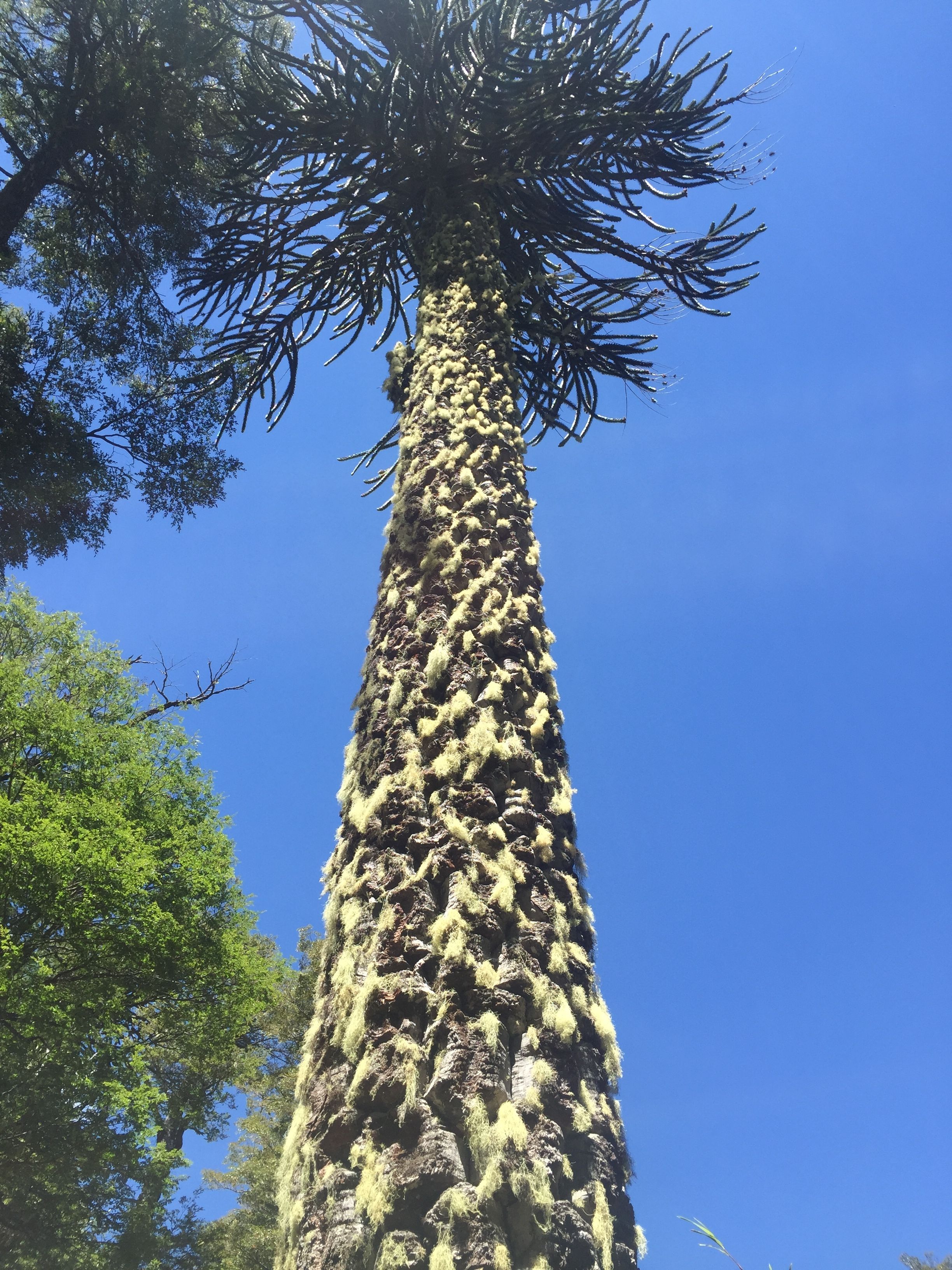
So, my stay in Valdivia is coming to an end: pleasant days of working on translation of Chilean poets; a weekend spent walking in the coastal reserve at Chaihuín, and yesterday a long hike through the spectacular Huerquehue park to the north, where we climbed, sweating, through temperate rainforest until we reached the zone of the Araucaria araucana (monkey puzzle trees) – which only grow above 1,000 metres – amid bursts of outlandish birdsong from the chucao and the huet-huet (or hued hued).

I will miss this place, but, as a foreigner, I will not dwell on the insubstantiality of belonging here, even if, as places go, there are few I would rather stay. I will haul my big blue suitcase – laden with books of poetry that I need for the journey but would rather carry in my head – and move on to the next place.


Araucaria araucana

Araucaria araucana


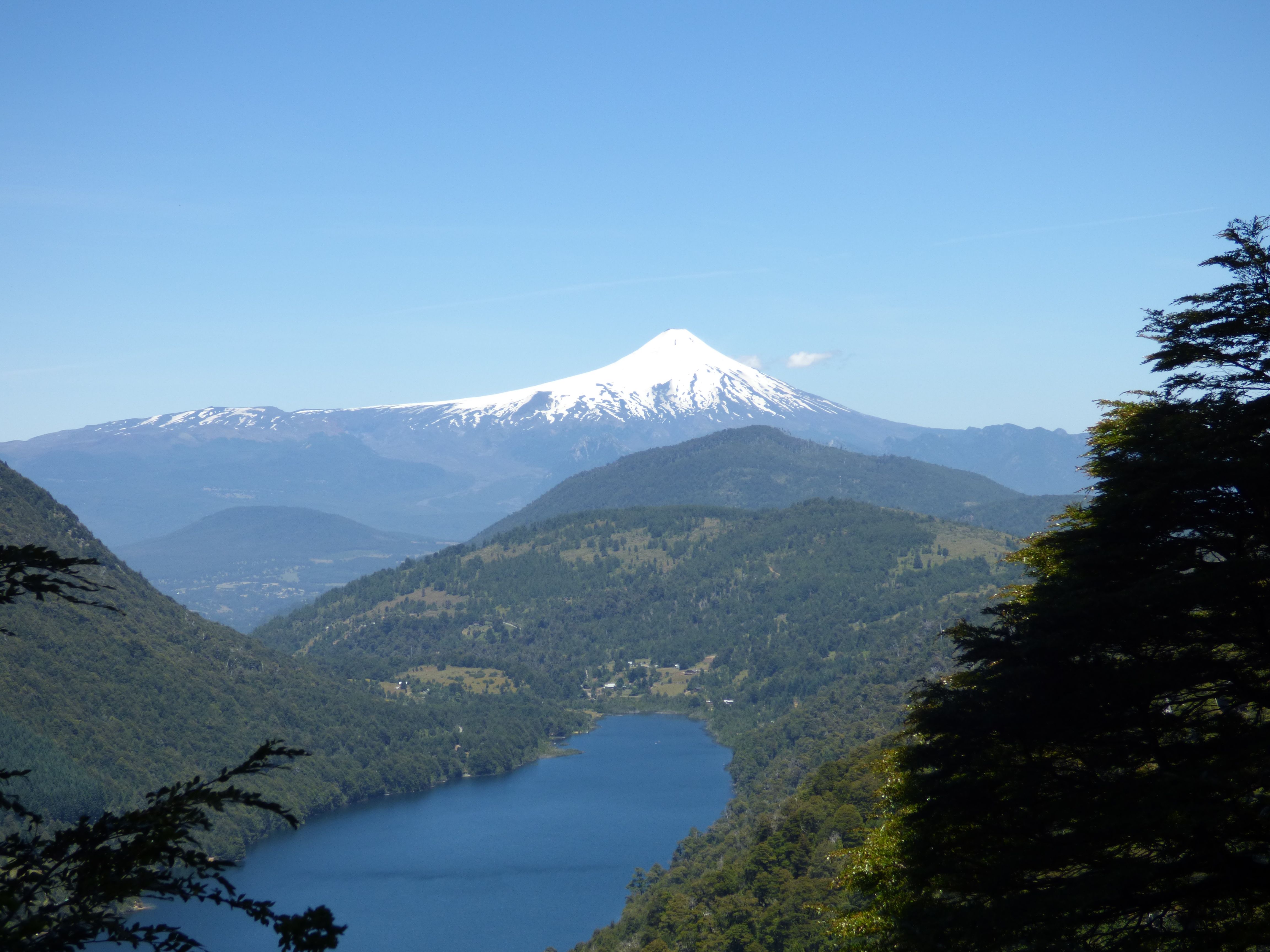
day3 villarica

Volcano of Villaricca with Lake Tinquilco


More notes on being a foreigner (I)

foreigner

Staying for any extended period of time in a country where one is obliged to speak a language other than one’s own inevitably results in reflection about core identity. Core identity, if there is such a thing, presumes that there is an ideal and comfortable state of mind, in which one is most fully at home, inside his or her own in-group, probably speaking an idiomatic form of the mother tongue among fellow-speakers, who follow the contours and references of conversation in a more or less fluent fashion, and with whom one shares beliefs, principles and occasionally political beliefs.

The foreigner, as Alastair Reid so succinctly observed, does not share this happy resource – the true foreigner, it could be argued, will feel as much a foreigner at home as anywhere else, but that is a discussion for another day – and today I returned to Reid’s essay with renewed insights. Living almost entirely within another language for most of the day, the foreigner begins to notice how language carries with it such a quantity of associative and historical luggage that merely understanding the words only accounts for a part of the fascinating, and at times frustrating problem of making oneself understood. Some of this can be accounted for by the fact that every word of a language has a personal history of association that a native speaker can trace back to childhood. Every phrase or idiom has a personal history, is laden with a particular taste or smell or music for the native speaker, and though the learner – even the fluent speaker – may acquire a series of associations of their own with the individual words of a language, it will never contain an entire universe, as does the memory of a native speaker. Moreover, the problem does not end there: as Reid wrote, “I am . . . aware of having, in Spanish . . . a personality entirely different from my English-speaking one – nor is it simply me-in-translation . . . I have often listened to simultaneous translation between two languages I know well. The meaning? Oh yes, the meaning is there; but it is just not the same experience.”

In the end, we have to arm ourselves with the anonymity of the foreigner, to prepare for disappointments and misunderstandings, and to accept that very rarely are these simply linguistic. To allow the late lamented Mr Reid the final word: “To travel far and often tends to make us experts in anonymity – but never quite, for we always carry too much, prepare for too many eventualities. One bag could have been left behind. We are too afraid of unknowns to ignore them.”

Caca de Duende

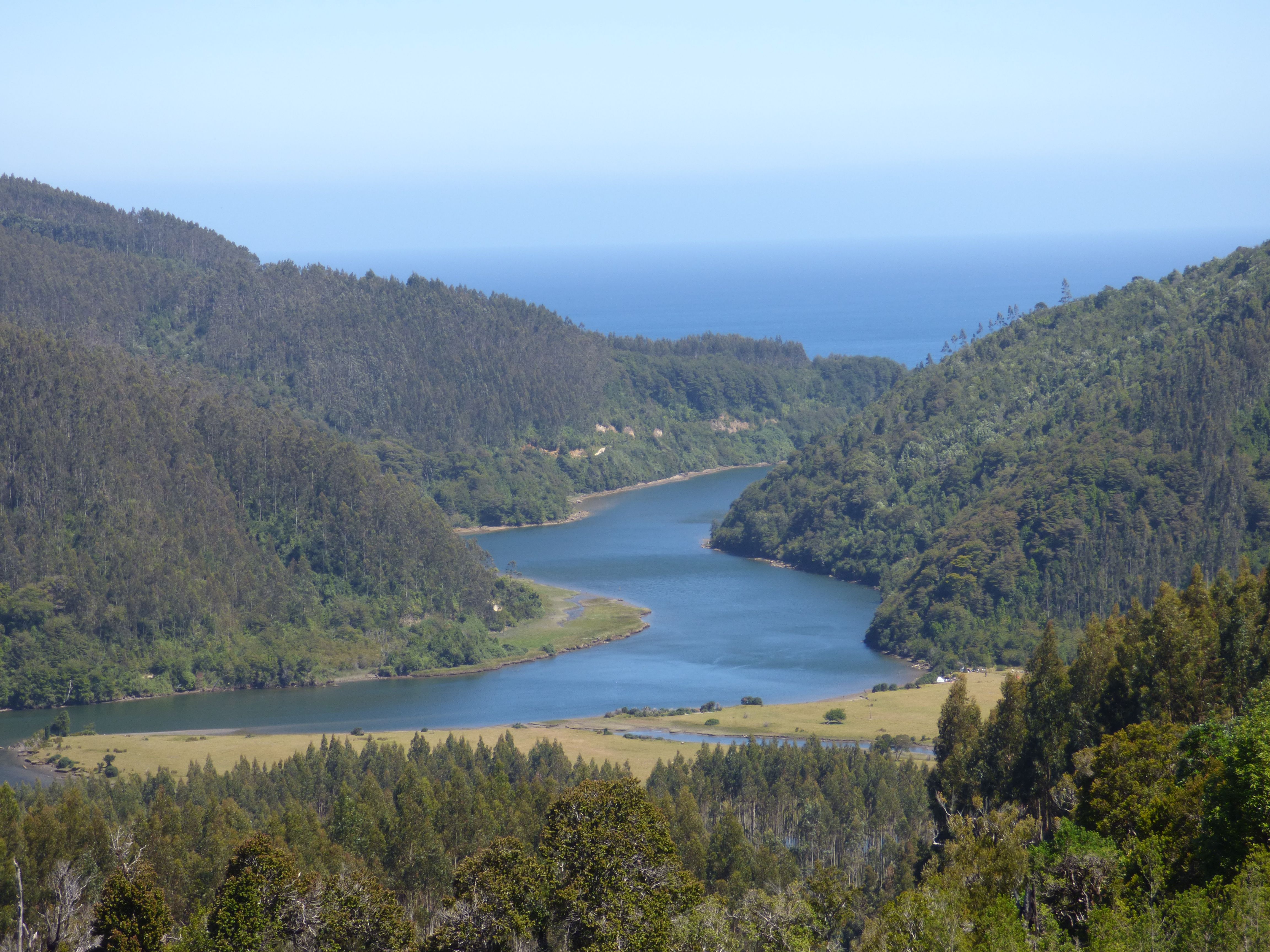
day2 estuary Chiuhain

On Sunday we visit Los Colmillos de Chaihuín, which contain, among other trees, canelo, alerce (larch) and eucalyptus. The first two are indigenous, the last a moisture-hogging outsider, the villain of the piece in the local ecology, imported from Australia and now being slowly replaced by the older indigenous varieties. The eucalyptus grows very quickly and apparently self-regenerates once it has been chopped down. It can do this five times, and, given the chance, will grow to full height between each growth. South America’s only marsupial, the monito del monte (little mountain monkey) may be found here but we are unlikely to see one as they are very shy, as is the pudú, a squat deer-like creature with a cute face.

Monito del monte

Monito del monte

day2 pudu

A pudú, looking a little surprised.

day2 alerce

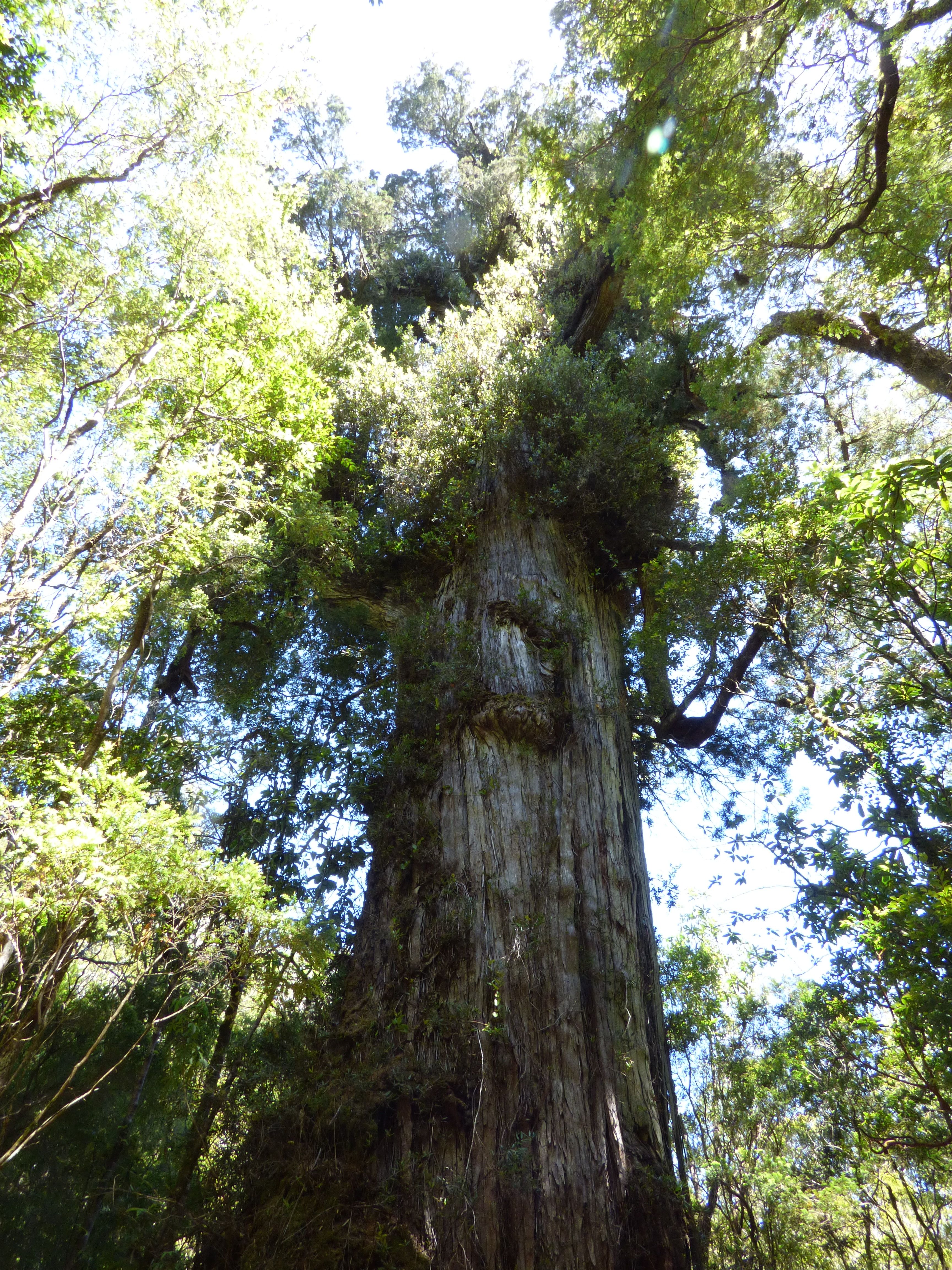
The big larch in the photo is 3,500 years old. They calculate this by the girth and of the tree, which is three and half metres in diameter (and 45 metres tall). The oldest recorded alerce was four and a half thousand years old, according to our guide, although Wikipedia establishes the age as 3,622 years. This is some achievement when we consider that the Minoan civilization was still intact when the tree was young. The forests hereabout were once filled with these trees, but the wood is good for making boats and houses, and when the Spanish came they cut a whole lot down to furnish their navy. Now the trees are protected by law, but they grow so slowly that it will be a long time before they ever repopulate the forests of Valdivia.
caca de duende

caca de duende

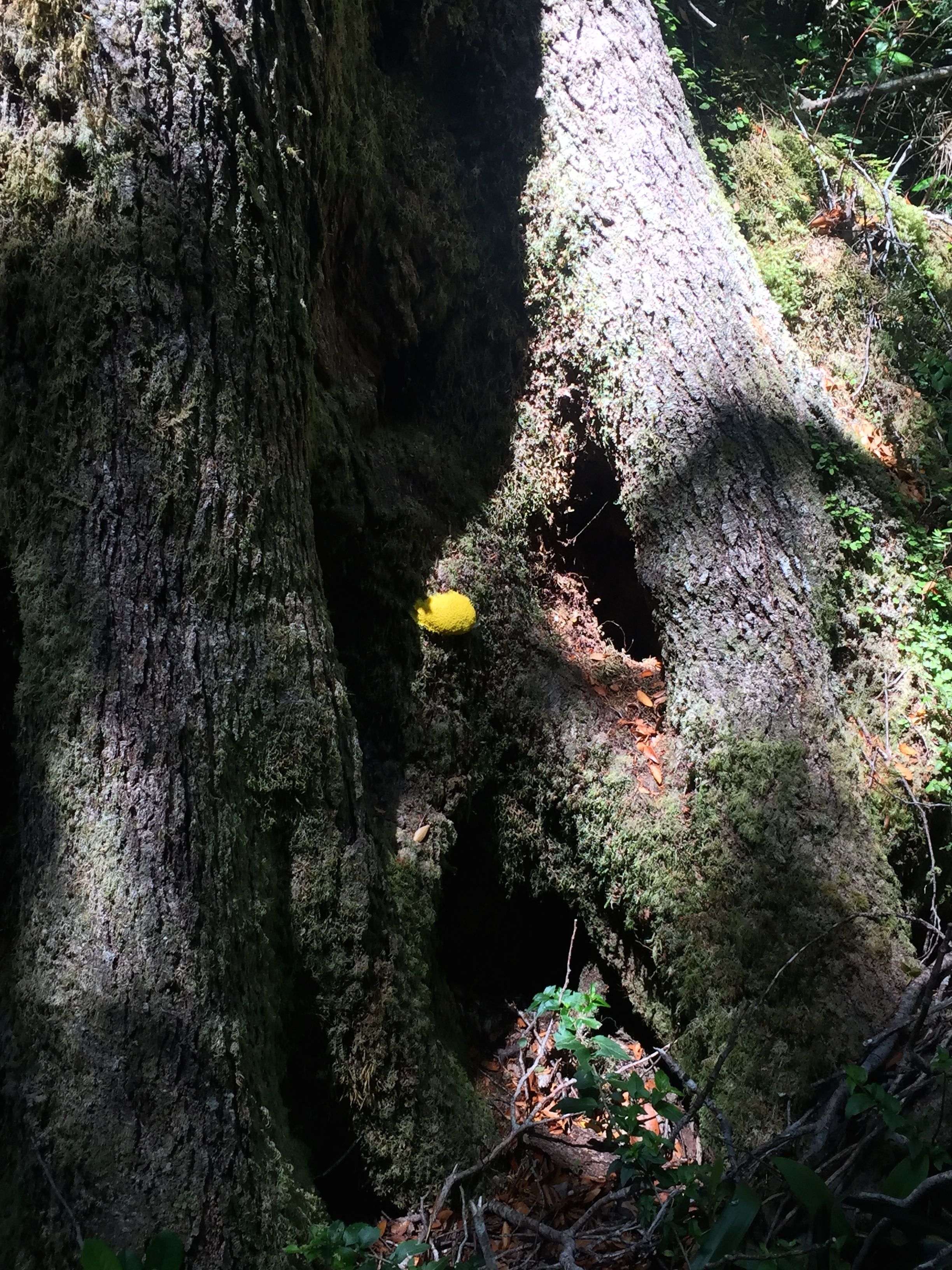
Walking through the forest I notice a bright yellow fungus, the size of a tennis ball, growing at the base of a tree, almost luminous in the dark of the woods. It is known, I am told, as caca de duende. Of course there is some difficulty in rendering ‘duende’ into English, as translators of Lorca have discovered over the years: it can mean ‘spirit’, or ‘creative force’ as well as referring to a sprite, fairy or elf. Elf shit sounds the most evocative, so I’ll go along with that.

day2 candelo w guide better

day2 candelo

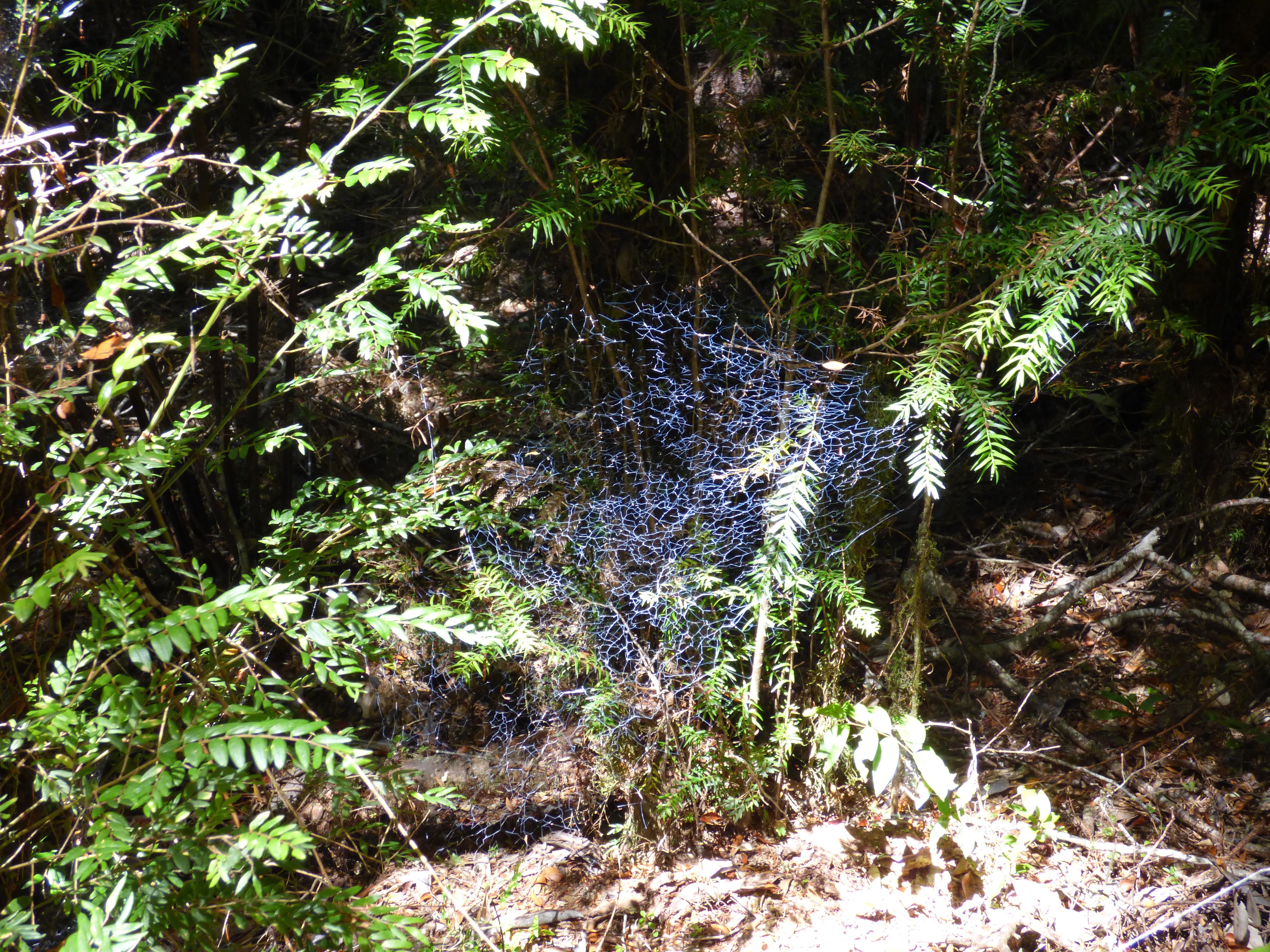
day2 web

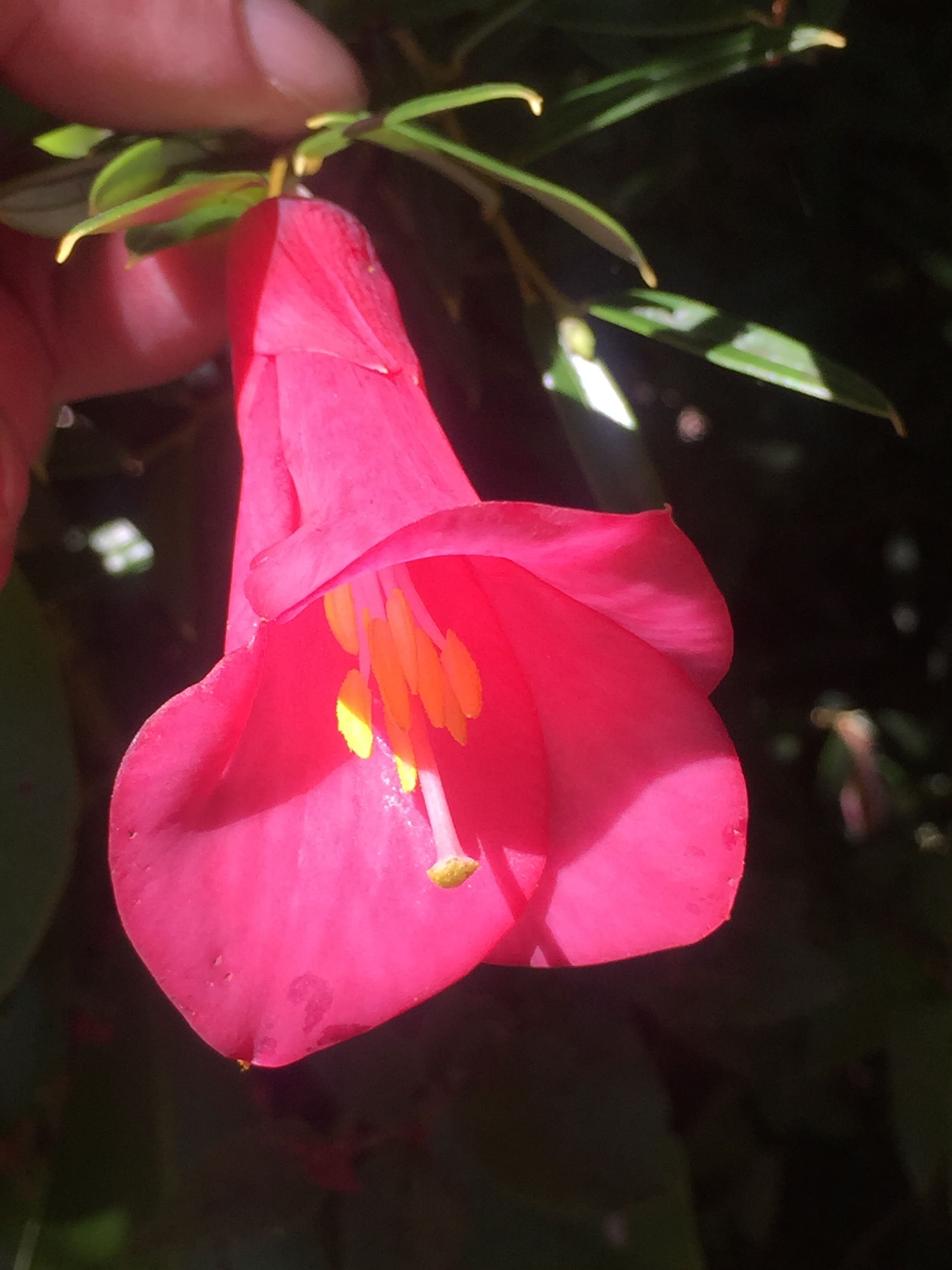
day2 copihue

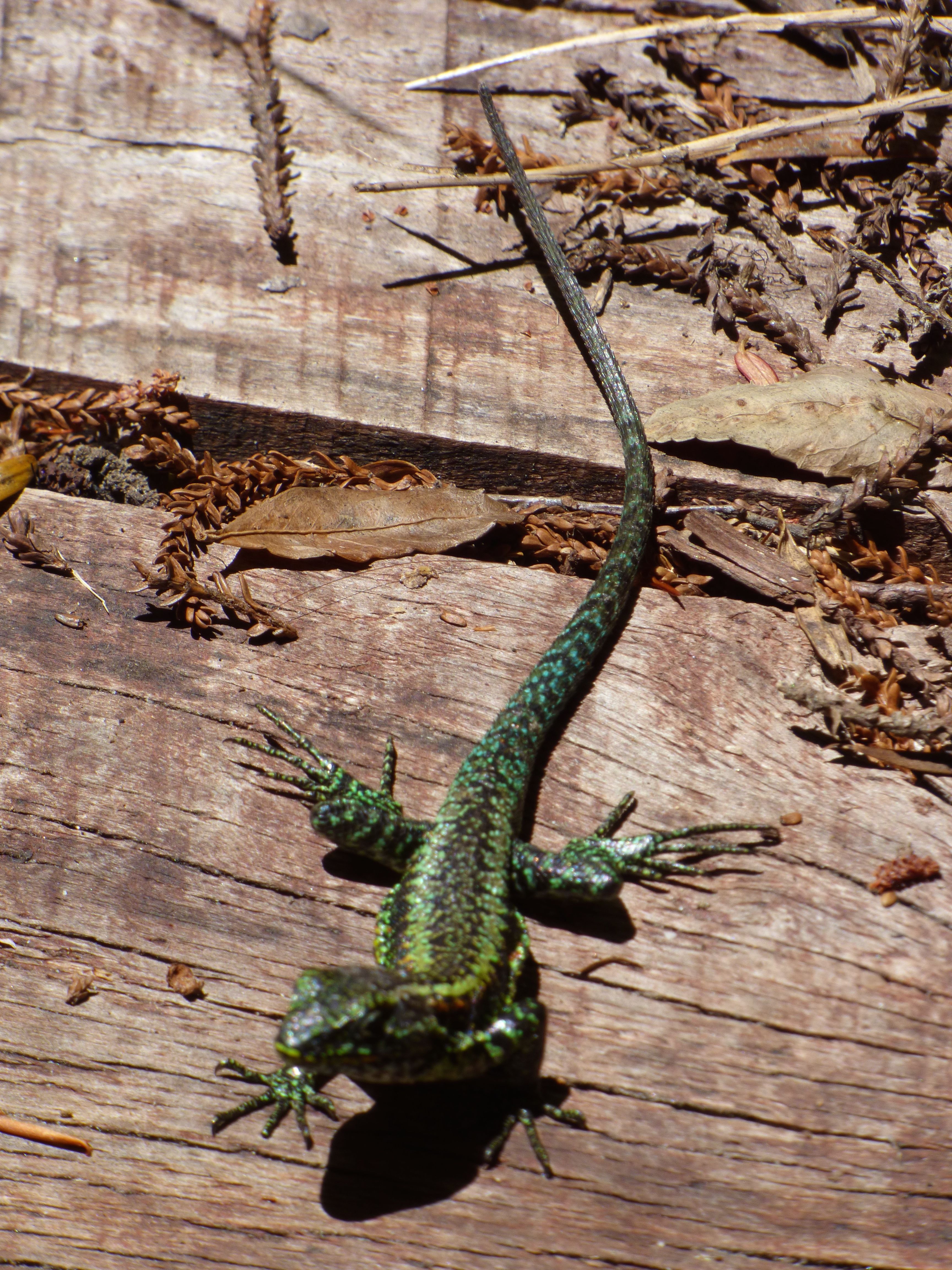
day2 lizard

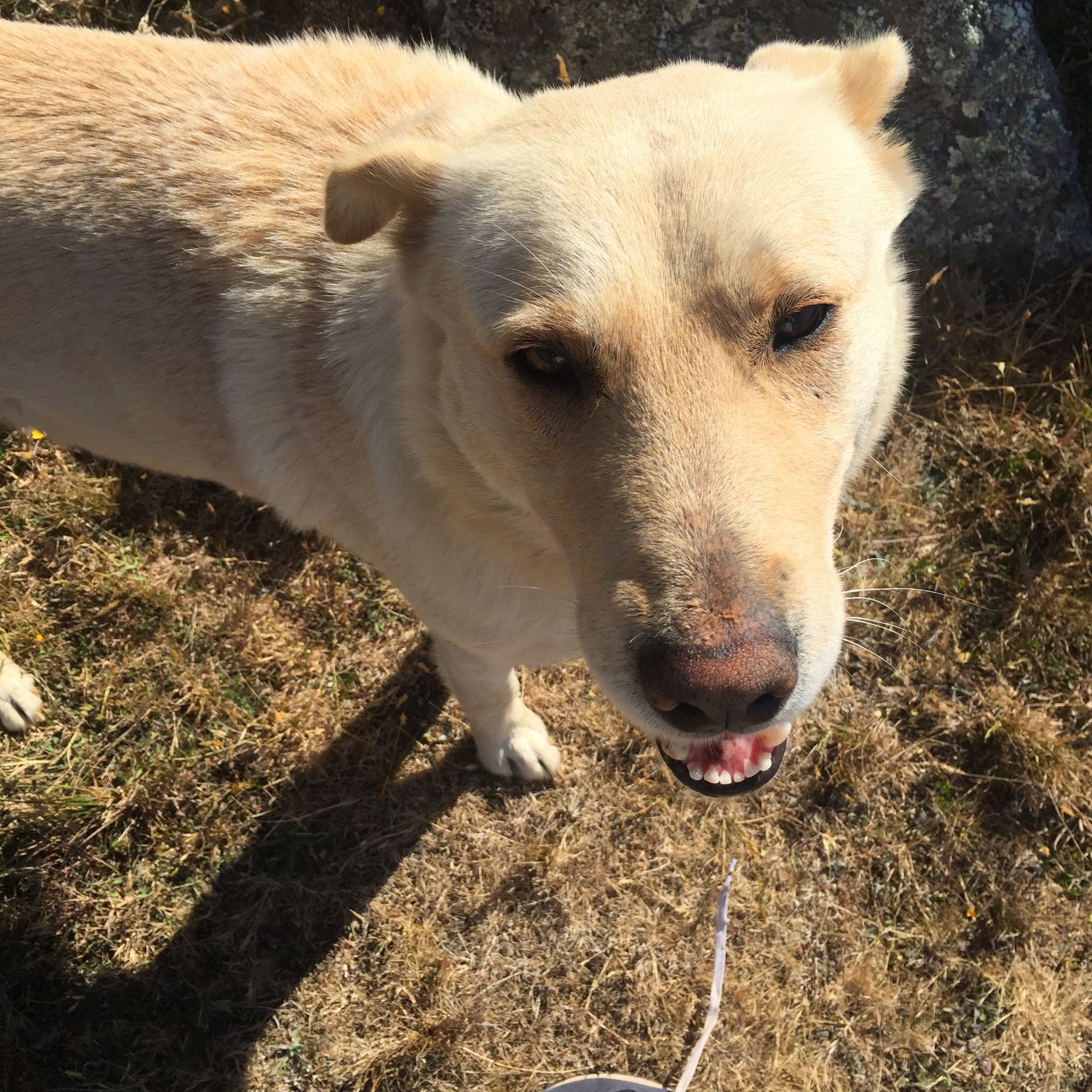
day2 dog

Life as an act of translation

day1 black cow on beach

Many and varied are the approaches to translation, and numerous its unsought consequences. There are those who become obsessed by the process even at the cost of progressing to the end of a piece of work. It doesn’t matter: before very long, everything becomes an act of translation.

So, after four days, we translate ourselves to the coastal park, the Reserva Costera Valdiviana, for the weekend. The land is given over to the Mapuche people and building is prohibited within the park zone. There are eight of us on the trip, and the plan is to rent cabins for the weekend. We arrive on Friday evening where we are greeted by our hosts, Teodora and Julio, who prepare pulmay, a dish cooked in layers of pork, chicken, sausage, chorizo, potatoes, and topped off with a thick layer of a shellfish called cholgas and choritos. This is a very good start.

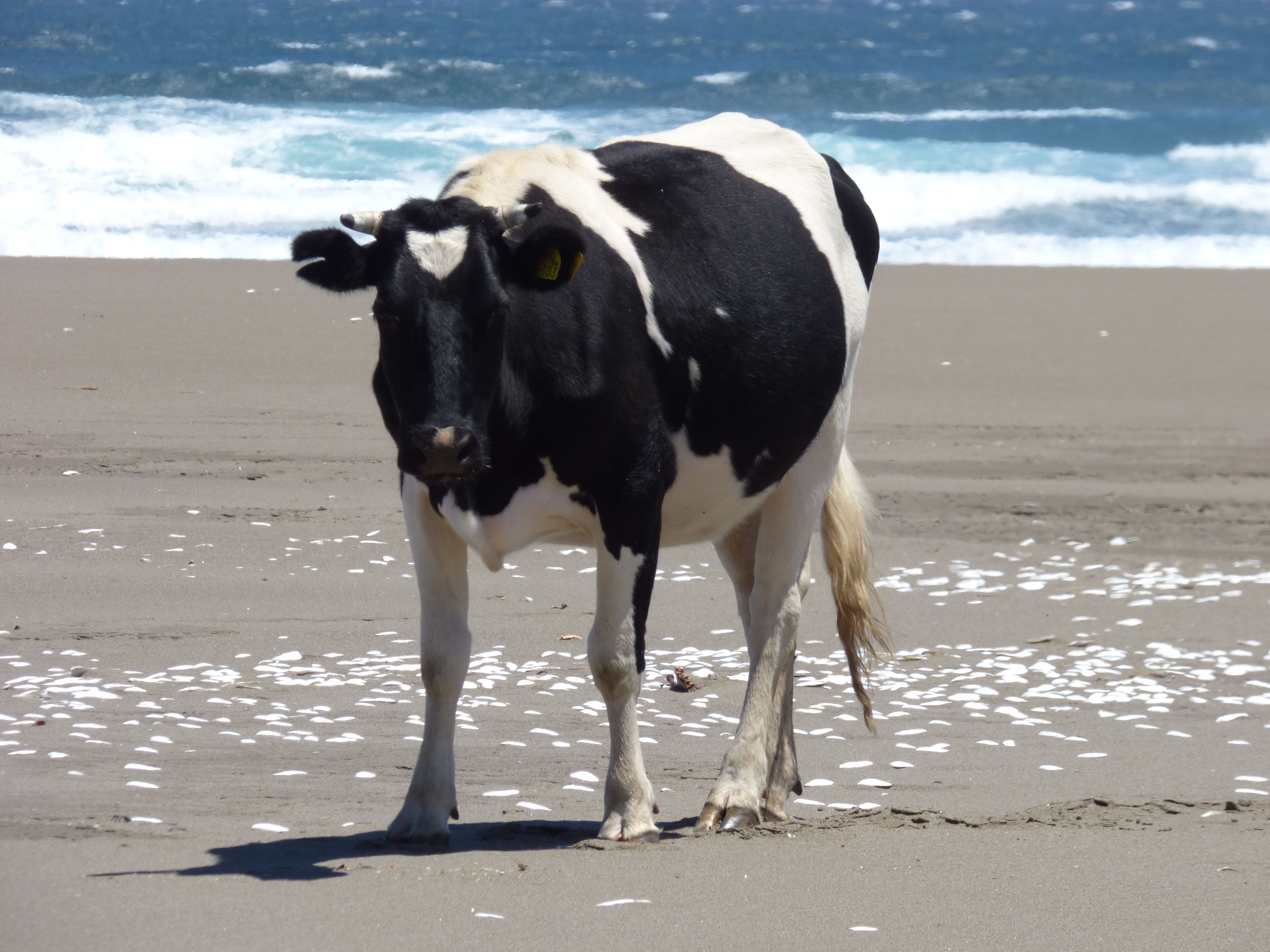
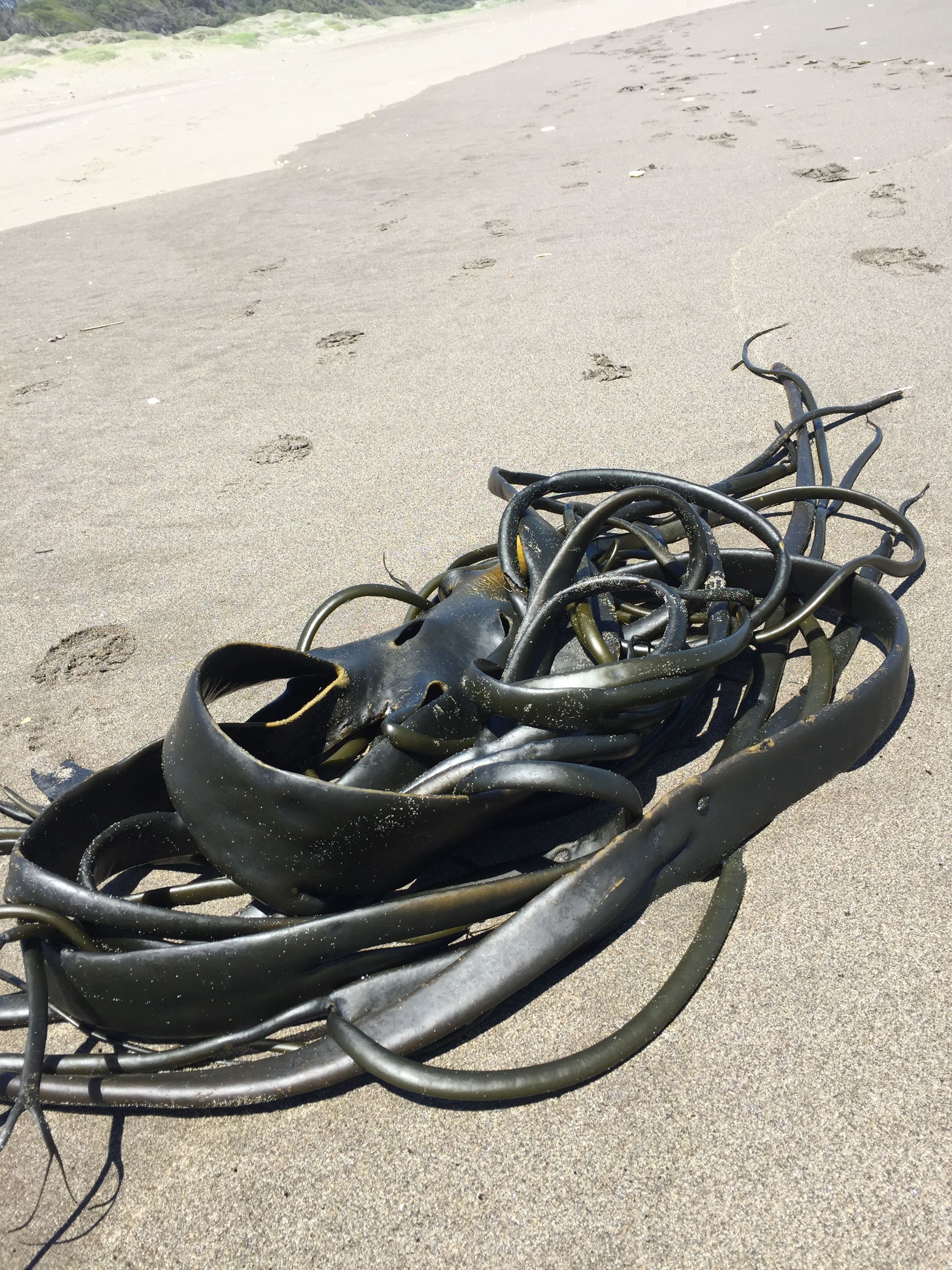
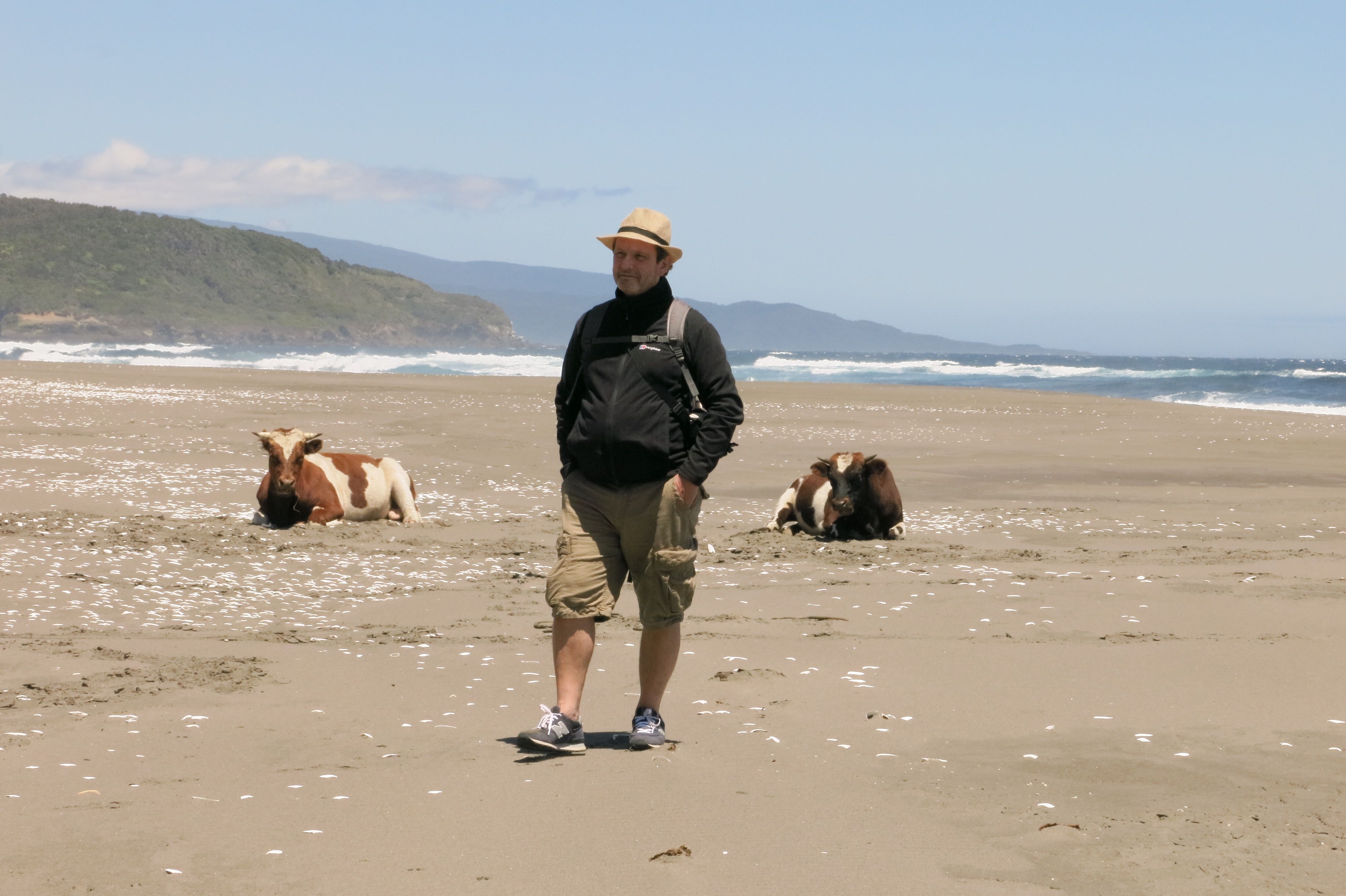
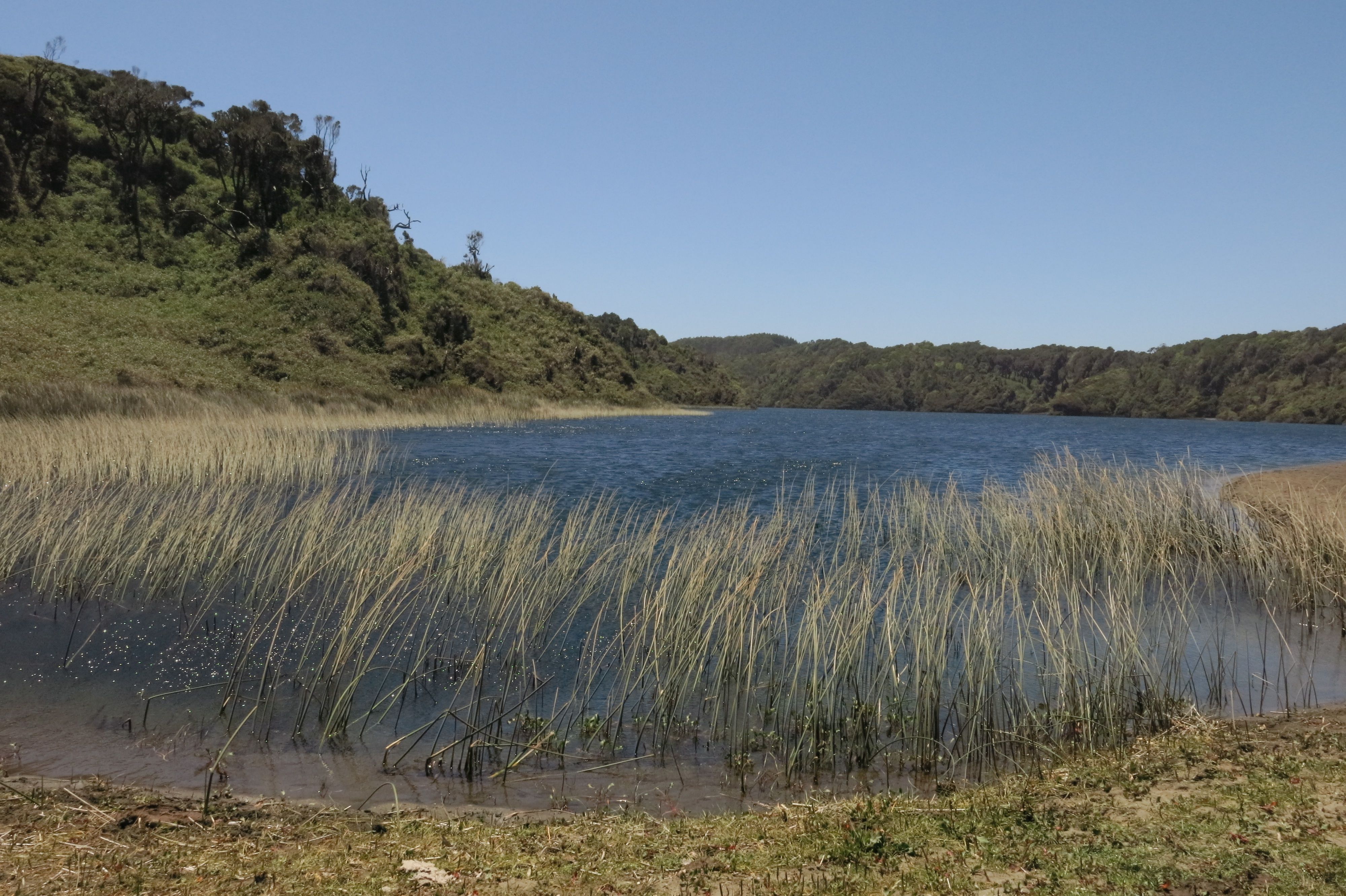
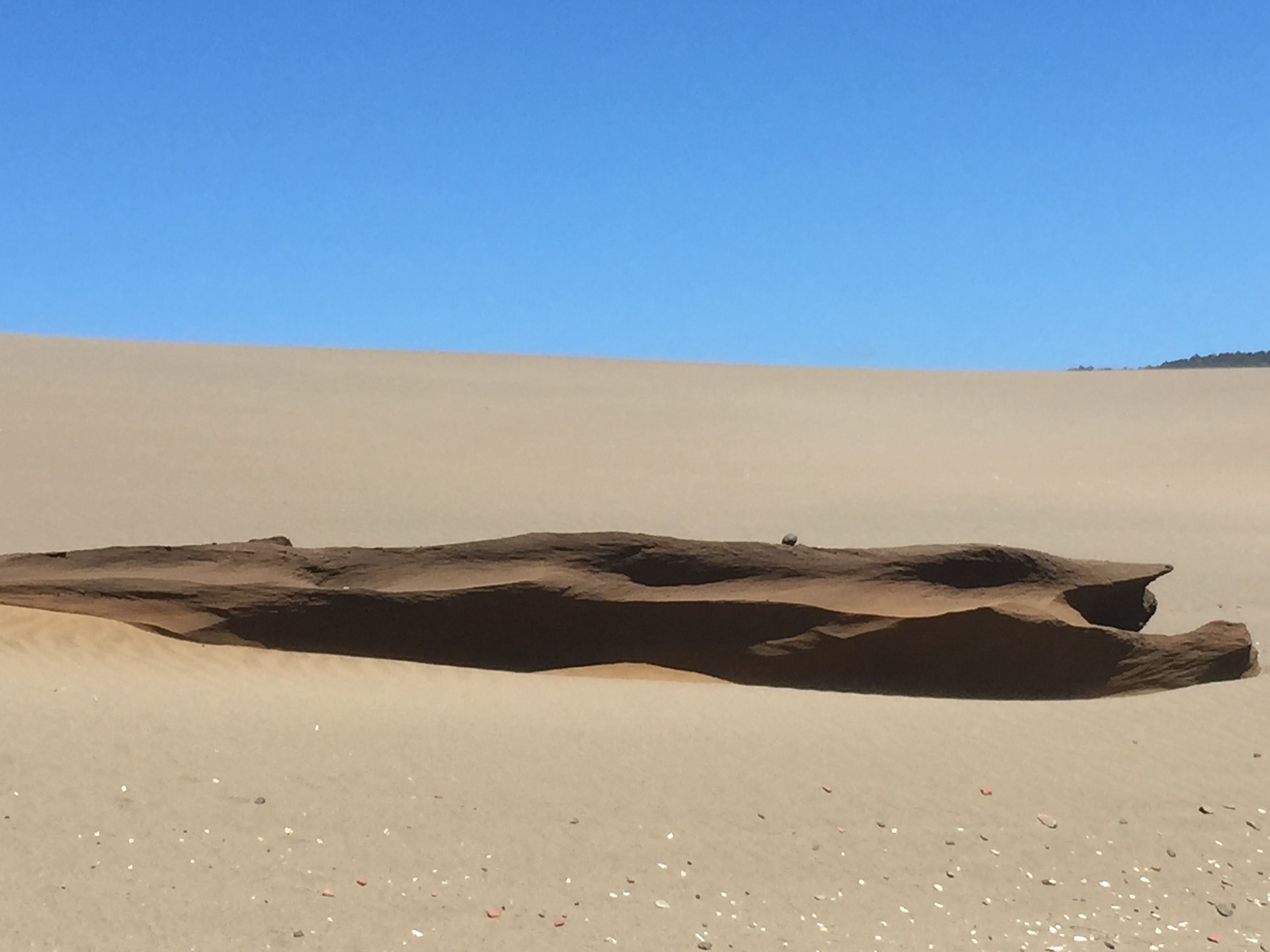
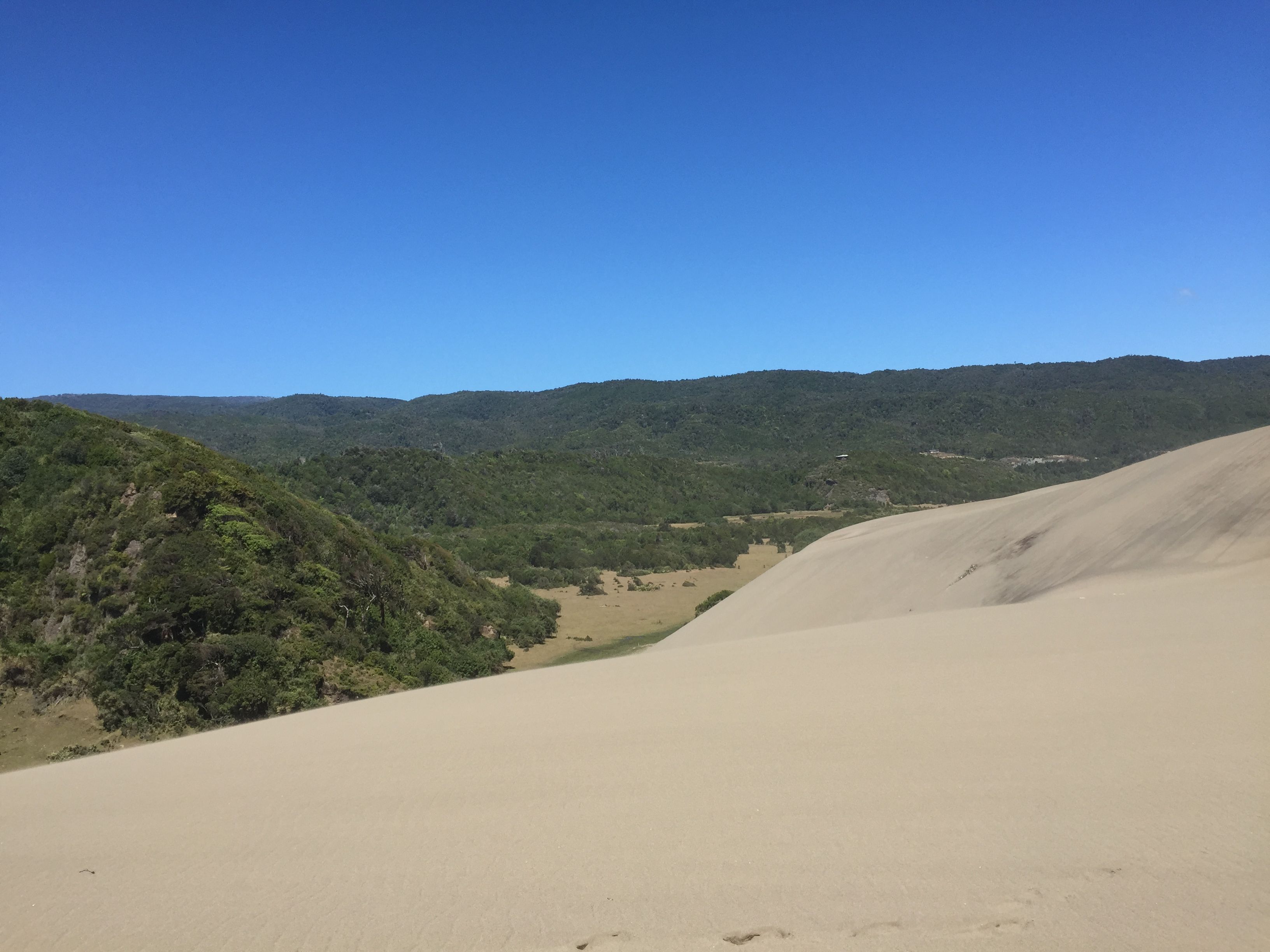
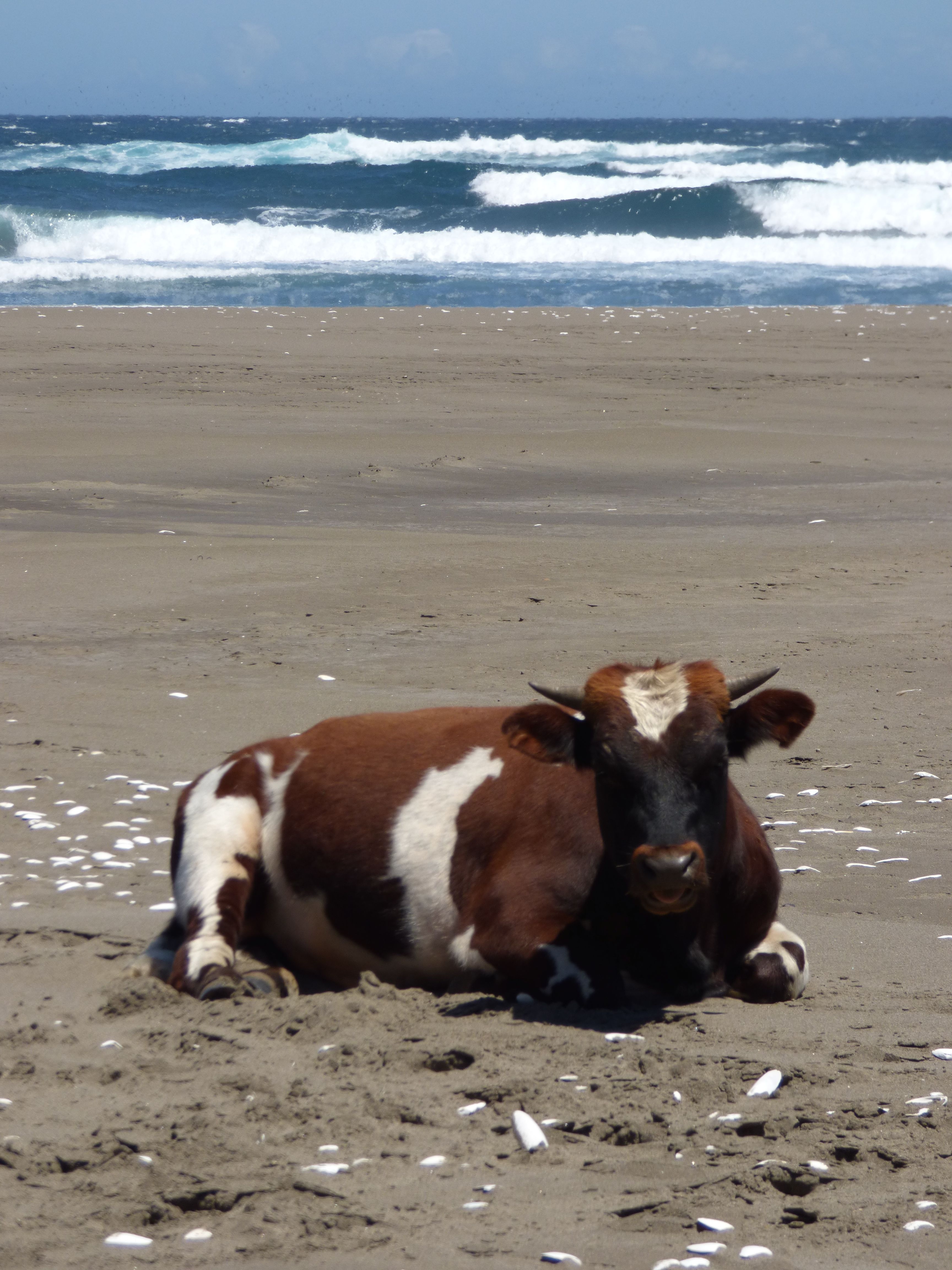
In the morning we drive to Chaihuín, then south towards Laguna Colún along an unmade forest road for an hour, having to stop several times to move logs across the track, where the mud has piled thick. When the road runs out we walk through the forest, curving down towards a broad expanse of high dunes, overlooking the sea. There is practically no one here. Miles of unspoiled, empty beach. But what I hadn’t counted on were the cows, grazing, it would seem, on the beach, except that there is no grass, only sand. They come there for the algae, of which there are two main kinds hereabouts, cochayuyo (the large octopus kind) and lugo. The cows look pretty relaxed on the beach, even though they don’t seem to be making much effort to find the seaweed, of which there is plenty along the shore.
day1 octopus

Cuchaluyo seaweed disguised as an octopus to distract the cows

Blanco with bored cattle on beach

Blanco with bored cattle on beach

The only inconvenience is the flying insect known as the  tábano negro, and colloquially as coliguacho. You must not wear dark clothes: if you do they will hunt you down and harass you for the whole journey. If you wear white, they will ignore you altogether. Almost every beautiful place seems to harbour some resident bug whose only purpose is to persecute and sting people. I have foolishly brought a navy blue fleece, but I take it off soon enough, and my pale t-shirt holds no interest for them.

day1 coliguacho

Coliguacho or Tabano Negro (Scaptia lata).

day1 lagoon

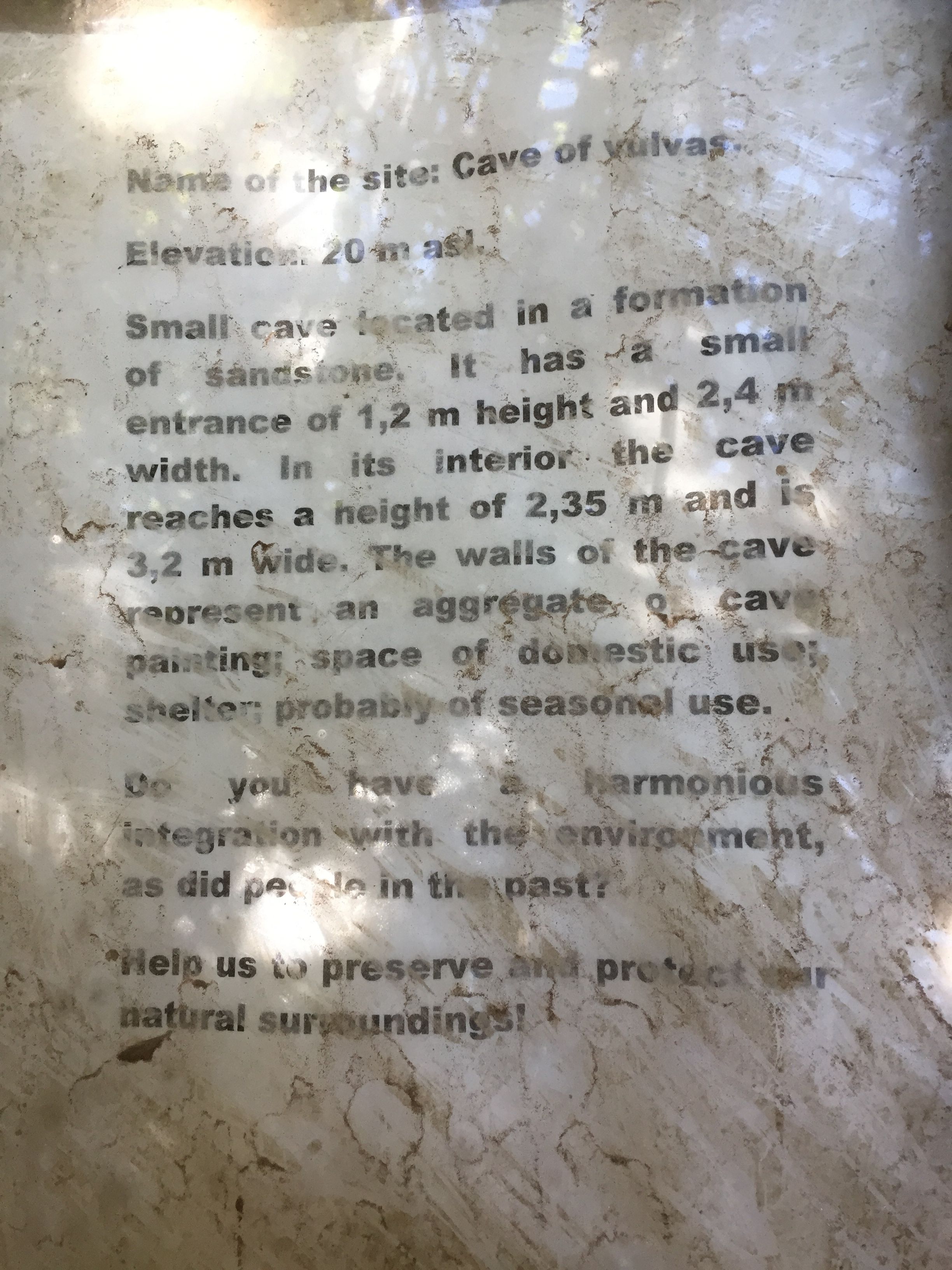
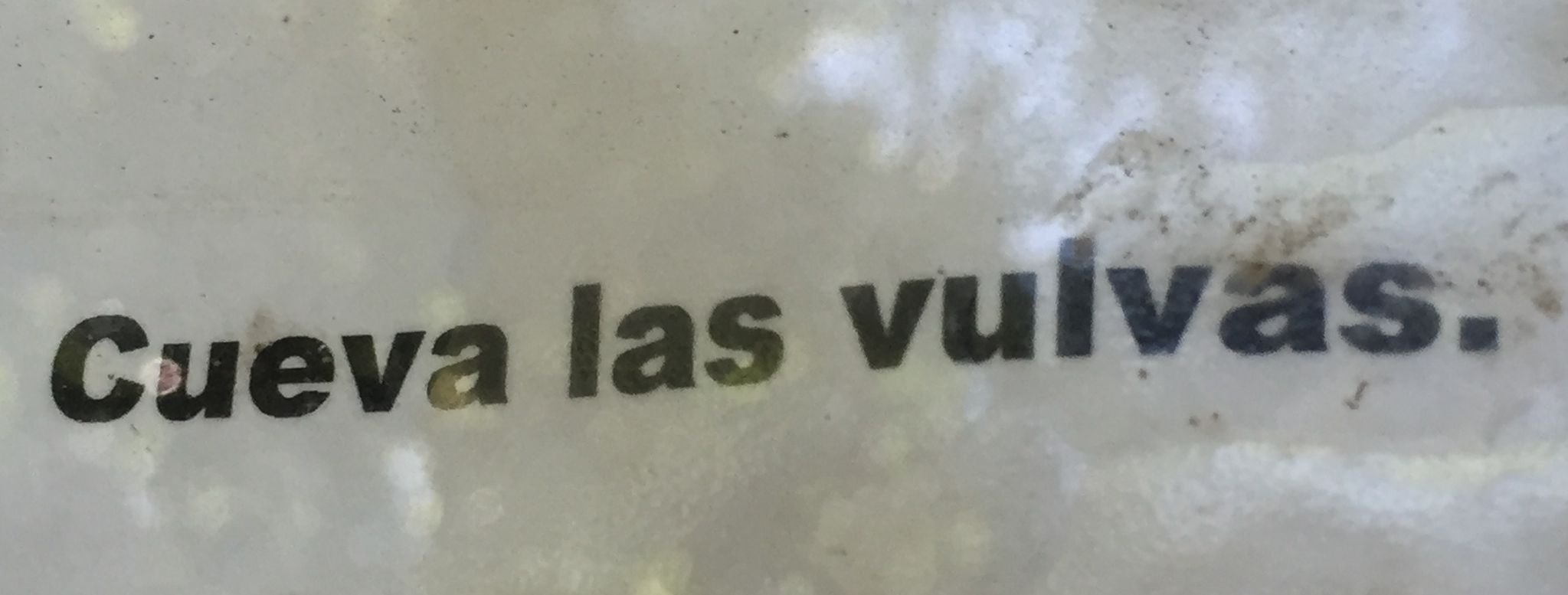
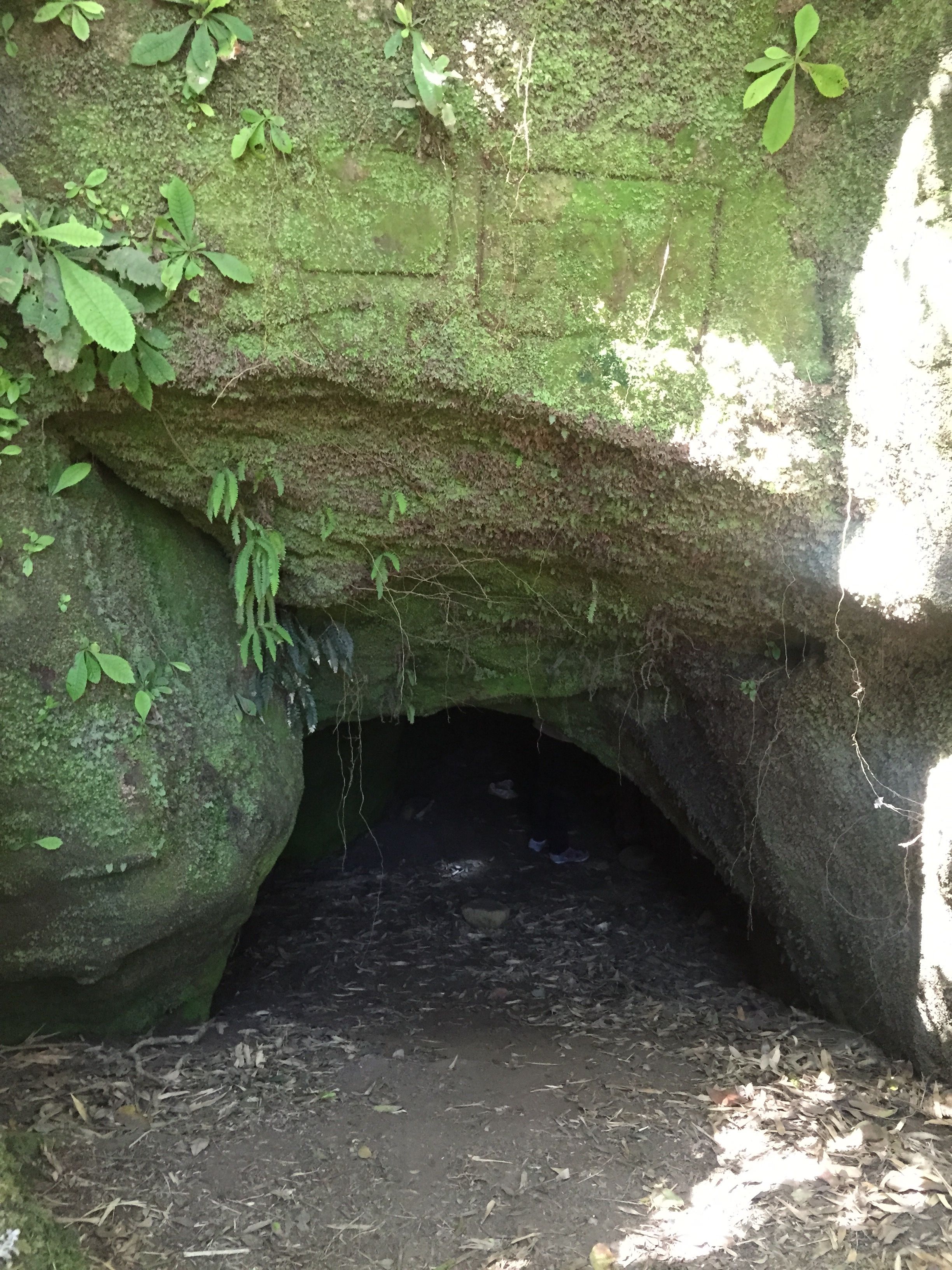
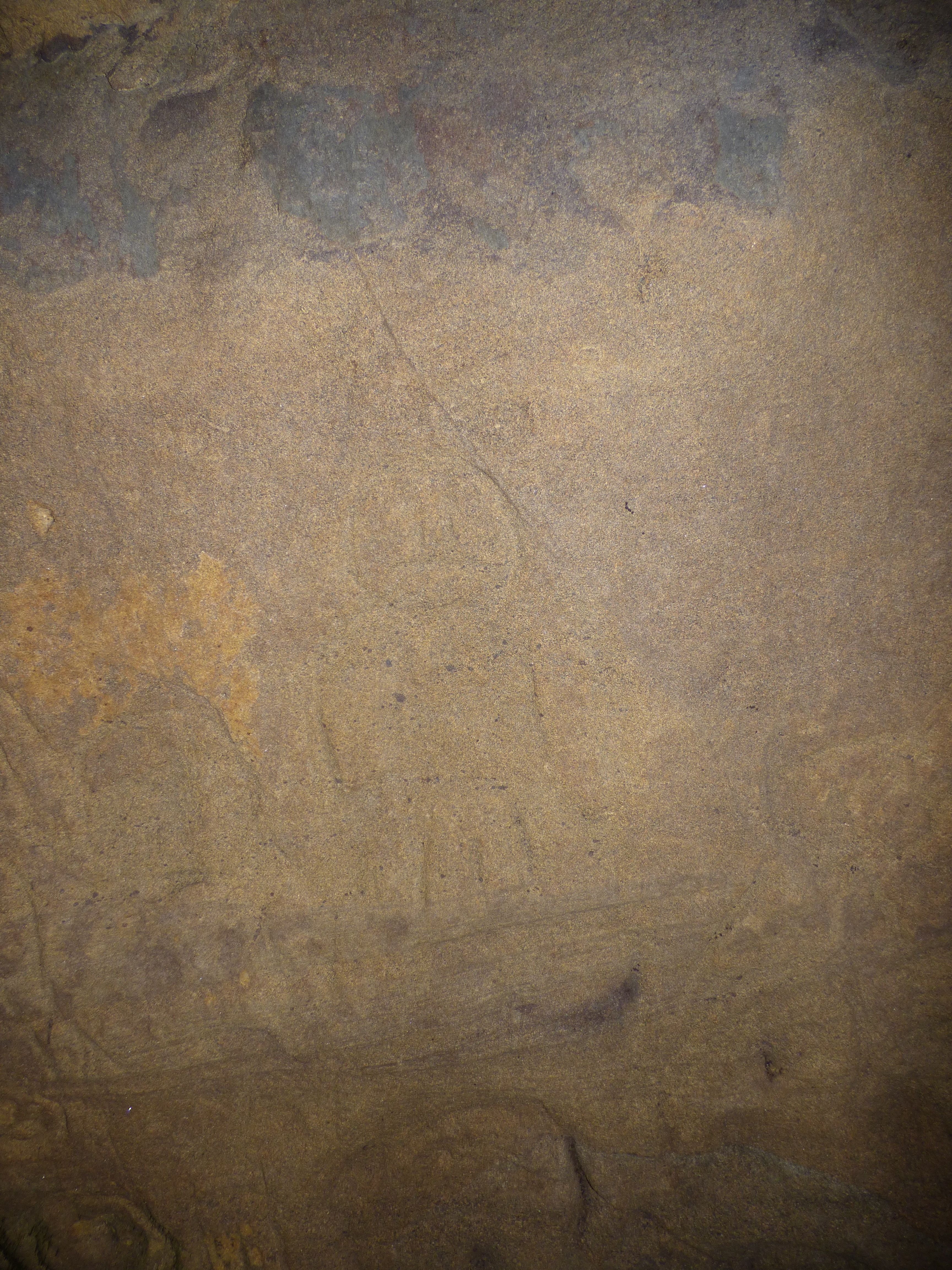
We turn inland in the direction of an inland lagoon named Colún, where the plan is to swim, although, in the event, it is far too cold and windy. So our self-appointed guide tells us we have to cross more dunes – a frustrating and exhausting venture in which you slide down two metres for every one you climb, then – after a traipse along the summit of the dunes – towards green pastures; in fact, towards a grotto, somewhat alarmingly called the cave of the vulvas. The cave turns out to be more or less what it says on the label: a dark cavern filled with fissures carved into the rock and some aboriginal art. A battered lectern outside surprisingly provides information in both Spanish and English translation, but omits to inform who originally made the drawings and carvings inside the cave, or why. The place has not yet been properly researched or carbon dated. One of my companions says it was used as an initiation chamber by the indigenous people of these parts in pre-Hispanic times, but I no longer know what to believe. Climbing the dunes and sliding down the other side only to enter the cave of vulvas has made me dizzy. And there is still a long walk back, past the still motionless cows.

day1 dunes

day 1 dunes and green 2

day1 cave sign

day1 cueva sign spanish

day1 cueva

day1 cave paintings

day1 brown cow beach

day1 sea

At the bottom of all this sleeps a horse

horse Rojas


At the bottom of all this sleeps a horse

by Gonzalo Rojas (1917-2011)


At the bottom of all this sleeps

a white horse, an old horse

long in the ear, lacking in

brainpower, worried

by the situation, the pulse

running through him is speed: the children

mount him as if here were a ghost, mock him, and he sleeps

sleeping as he stands there in the rain, hears

everything while I sketch out these eleven

lines. He has the look of a thing crazed,

he knows that he is king.


Al fondo de esto duerme un caballo


Al fondo de todo esto duerme un caballo

blanco, un viejo caballo

largo de oído, estrecho de

entendederas, preocupado

por la situación, el pulso

de la velocidad es la madre que lo habita: lo montan

los niños como a un fantasma, lo escarnecen, y él duerme

durmiendo parado ahí en la lluvia, lo

oye todo mientras pinto estas once

líneas. Facha de loco, sabe

que es el rey.


From El alumbrado.


The collapsing world

Shaman Davi Kopenawa

Shaman Davi Kopenawa

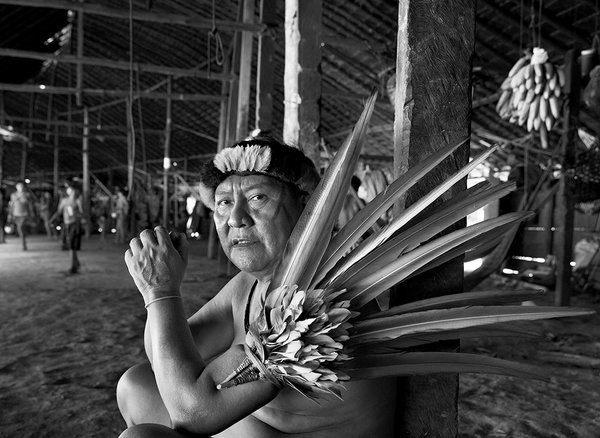
In a recent review of The Falling Sky: Words of a Yanomami Shaman, I learn that in a creation myth of the Yanomami people, the original world – the world that was here before – was “crushed by the collapse of the sky, hurling its inhabitants into the underworld. The exposed ‘back’ of the previous sky became the forest where the Yanomami emerged.” A new sky was set up and “held in place by metal foundations set deep in the ground by the demiurge Omama. Yet the new sky is under constant assault by the forces of chaos, and Yanomami shamans work tirelessly with their spirit allies, the xapiri, to avert a new apocalypse. A diaphanous third sky already lies waiting, high above, in case the current one collapses and the world once again comes to an end.”

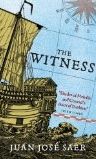
The fragility of the known world is a theme that emerges also in Juan José Saer’s book The Witness (see post from 30 November). The nameless cabin boy who is adopted by a tribe living on the banks of a South American river is returned to the invading Spaniards ten years after his capture. Eschewing public attention, he holes up in a Spanish monastery for several years, under the tutelage of a sagacious monk, who teaches him Latin, Greek and Hebrew. On his protector’s death, he leaves the monastery and lives as a vagrant, before eventually he joins up with a group of actors, and – to great public acclaim – tours the cities of Europe, performing a drama of his ‘life among the savages’, in which he acts himself. It is only in his old age that he settles down to write his account of those years.

And here he returns to the theme of the precariousness of the world, and all that is in it. The Indians among whom he lived all those years ago considered themselves and the world they inhabited to be coterminous. Outside they do not feel on safe ground.

“Even though they [the Indians] took for granted the non-existence of others, their own existence was in no way irrefutable . . . For them the main attribute of all things was precariousness.” This belief has a linguistic base: there is no equivalent word in their language for ‘to be’. The closest equivalent they have means ‘to seem’. “But ‘seems’ has more of a feeling of untrustworthiness than sameness. It is more a negative than a positive. It implies an objection rather than a comparison. It does not refer to a known image but rather tends to erode perception and diminish its force. The word used to designate appearance also means exteriority, a lie, an eclipse, enemy. Everything that presented itself clearly to the sense was for them formless and had a vague and sticky underside against which the darkness beat.” The people among whom our narrator lives, nevertheless, regard themselves as the custodians of this fragile and terrifyingly insubstantial world. “In their hands lay the precarious fate of all perishable life. It would take only a moment’s inattention for it all to collapse, taking them with it.”

I do not regard this attitude towards the imminent collapse of all reality to be that unreasonable. After all, those of us who grew up in the sixties came to consciousness under a not entirely dissimilar mythology of imminent extinction: in our case it was thermonuclear war. Now it is the destruction of the ozone layer and climate change. It is no surprise that environmentalists have adopted the Shaman Davi Kopenawa, co-author of The Falling Sky, as a spokesperson for those many peoples whose habitat is under constant environmental threat from loggers and miners, or from the effects of climate change. Davi Kopenawa has taken on this mantle, appearing at events worldwide on behalf of his people, and others like them. According to the New York Review article, “he finds echoes of Yanomami notions in Western environmental thought, but with an important caveat: “Since the beginning of time, Omama has been the center of what the white people call ecology…. In the forest, we human beings are the ‘ecology.’”

Spanish Gold

Yesterday evening in my native town, or village, as I still think of it (although it has grown since my departure to something more town-sized), I went into the corner shop that I used throughout my childhood for buying sweets –fruit salads and blackjacks (four a penny); barley sugar sticks; and best of all, those thin wormlike strands of sweet coconut-flavoured pretend tobacco, wrapped in waxy paper, called Spanish Gold –which I am certain could not be sold to children today. Old Mr J, the shopkeeper, had very bad teeth and no doubt had been on the Spanish Gold all his life. But the stuff obsessed me, and moreover fitted in perfectly with my career plans: to be a pirate, to ride wooden ships on the Spanish Main and do other exciting pirate stuff. Spanish GoldSpanish GoldSo yesterday, after the Wales-South Africa rugby match, which I have watched at his home with my elderly father, I go back to the shop for the first time in many years, to be served by a man a little younger than myself (the original Mr J’s grandson), and I am at once inside a time warp. I am six years old and using up my entire shilling allowance on sweeties. Old Mr J is leaning over me with his blackened stumps and national health specs and calling me ‘the young doctor’, while stuffing a white paper bag with teeth-rotting goodies. Driving back to Cardiff I am in a kind of self-induced trance, in which I am trying to distinguish between the things that actually happened in that (by now mythical) sweet shop, and the things that my memory has conferred upon it over the interceding years. I realise then that the shop has also entered my personal dreamscape.

And later, as so often happens, a kind of answer arises in the book that I am reading. Or else, I contrive to find a corresponding thesis in what I am reading that maps almost perfectly onto my experiences in my childhood home town.   witness1Propped up in bed on Sunday morning, reading The Witness, a novel by Juan José Saer originally published in Spanish as El Entenado, or ‘The Stepson’ – and beautifully translated by Margaret Jull Costa – I follow the hazardous experiences of the young narrator, an unnamed cabin boy on a sixteenth century Spanish expedition, who is captured by Native Americans on the River Plate. The Native Americans (or Indians, as they prefer to call themselves in Latin America), while exceptionally courteous to the cabin boy himself, are about to cook and eat his shipmates, when he experiences a moment of clarity:

I think that was the first time – aged all of fifteen – that an idea with which I am now familiar first occurred to me: namely that the memory of an event is not sufficient proof that it actually happened, just as the memory of a dream that we believe we had in the past, many years or months before the moment in which we remember it, is not sufficient proof that the dream took place in the distant past rather than the night before the day on which we recall it, or even that it occurred before the precise moment we state that it has occurred.

And how often has that happened? You dream a dream, and are certain that you have dreamed it before: or else, even as you are dreaming it, you have the sensation that you are re-dreaming a dream you had many years before? It then seems almost as if the world you enter in dreamtime is a continuum that exists with or without your participation, and when you dream you simply dip into it, witness (that word again) whatever happens to be occurring at that precise moment. But – and this is important – you remember part of the dream landscape from previous dreams, and you waken with a feeling of déjà vu that makes you feel as if you had just returned from a familiar place. Sometimes, like yesterday evening in the sweetshop, it is as if that place exists neither in reality nor in dream, but some place in between.

A short walk in Valparaíso

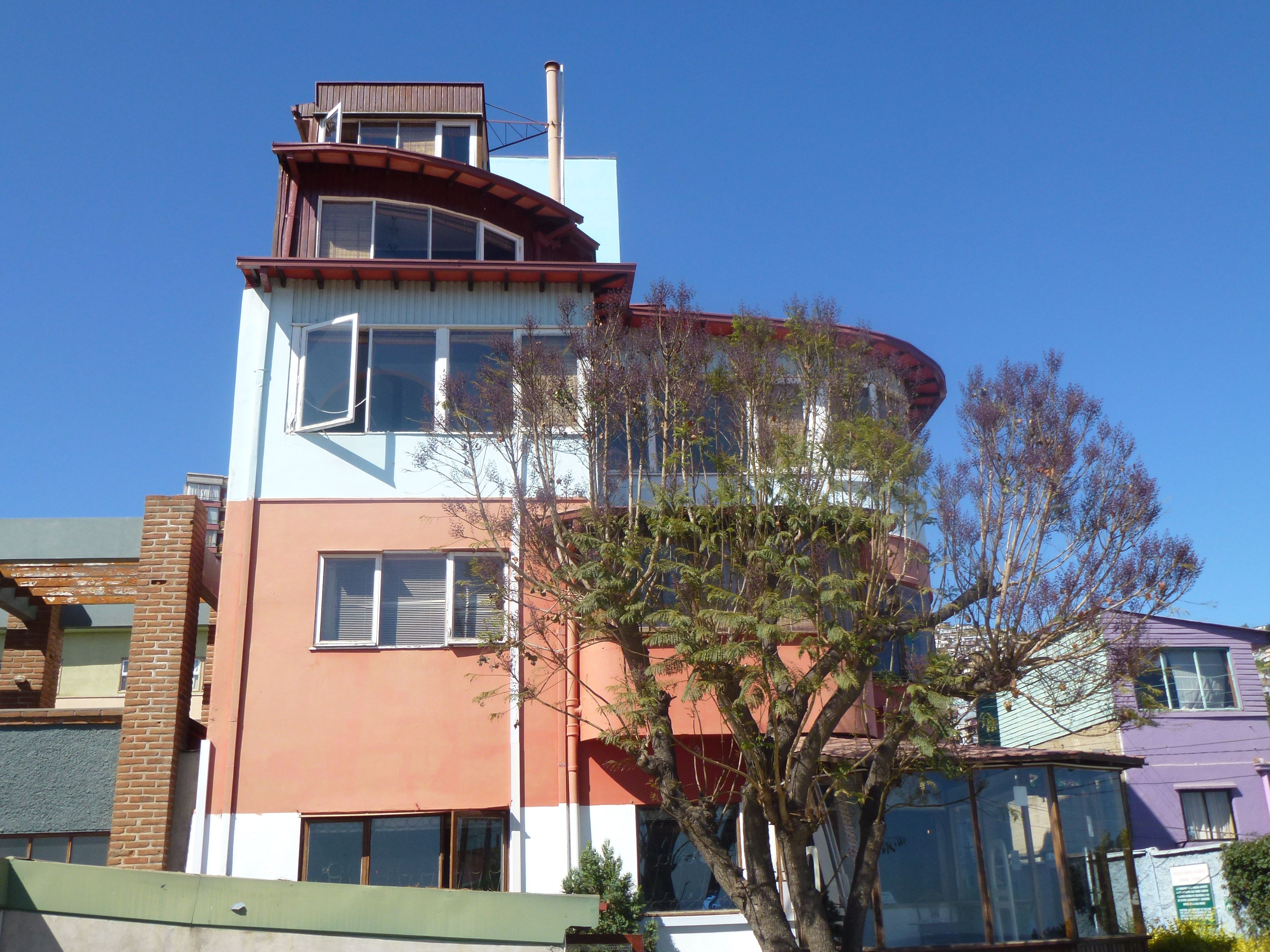
Neruda's house, 'La Sebastiana'.

Neruda’s house, ‘La Sebastiana’.

I first came across the name Valparaíso via Neruda’s poem dedicated to Don Asterio Alarcón, the clockmaker of that city, many years ago. Neruda’s house is a fabulous creation, built on five stories, most of the rooms having large windows that look out over the bay. Not to be missed, whatever you think of the poet (or bis personal life).

val seaview

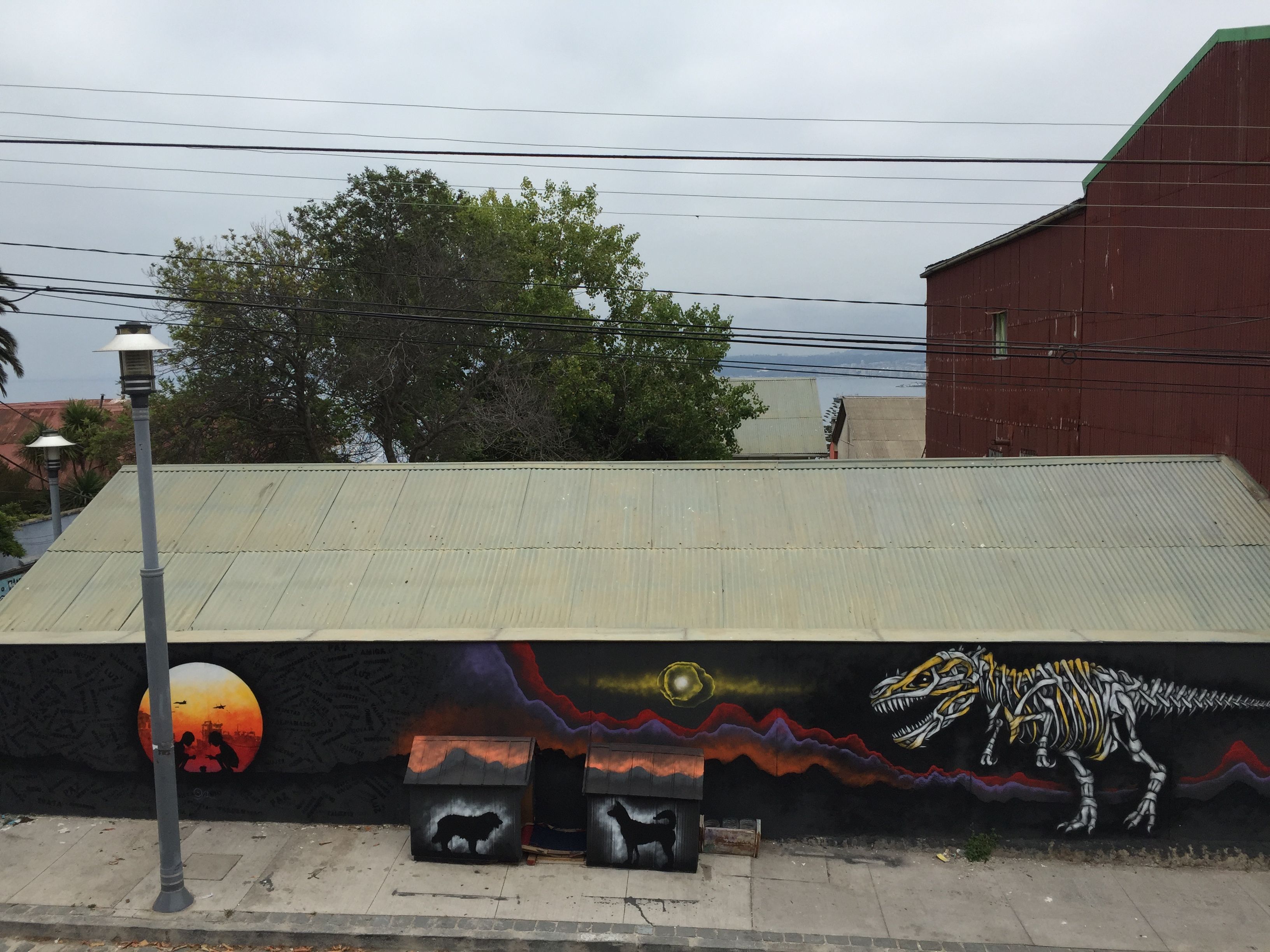
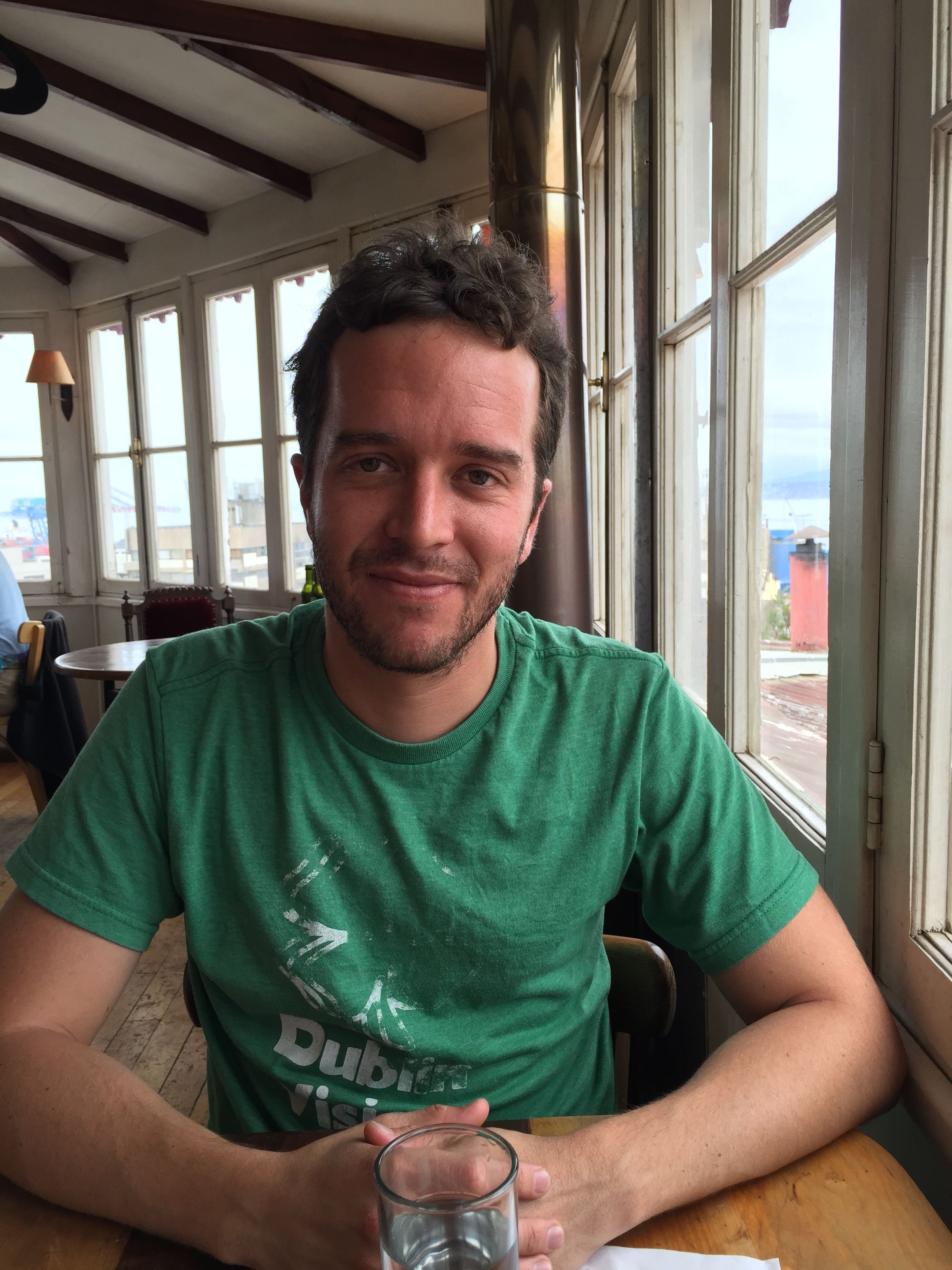
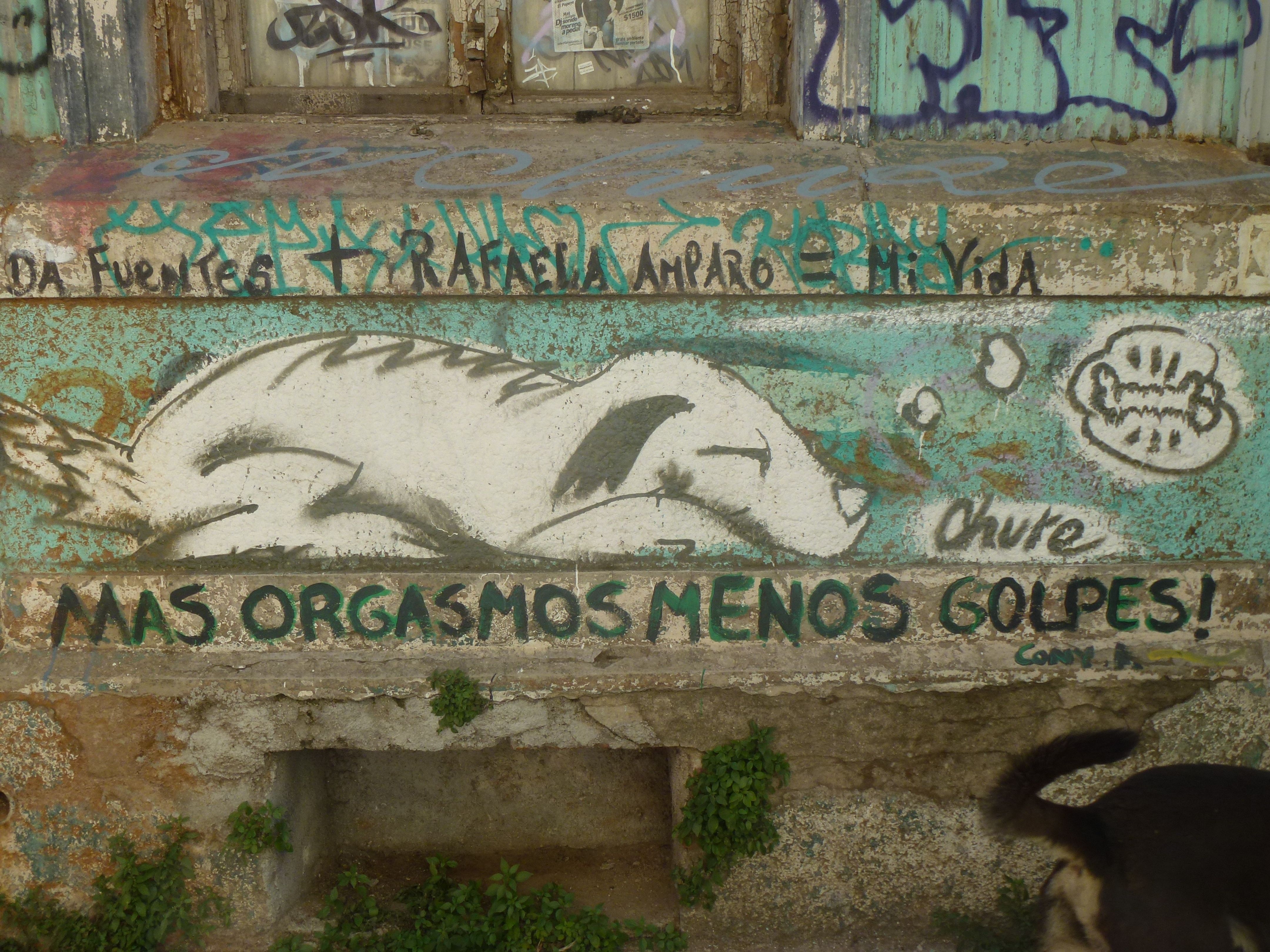
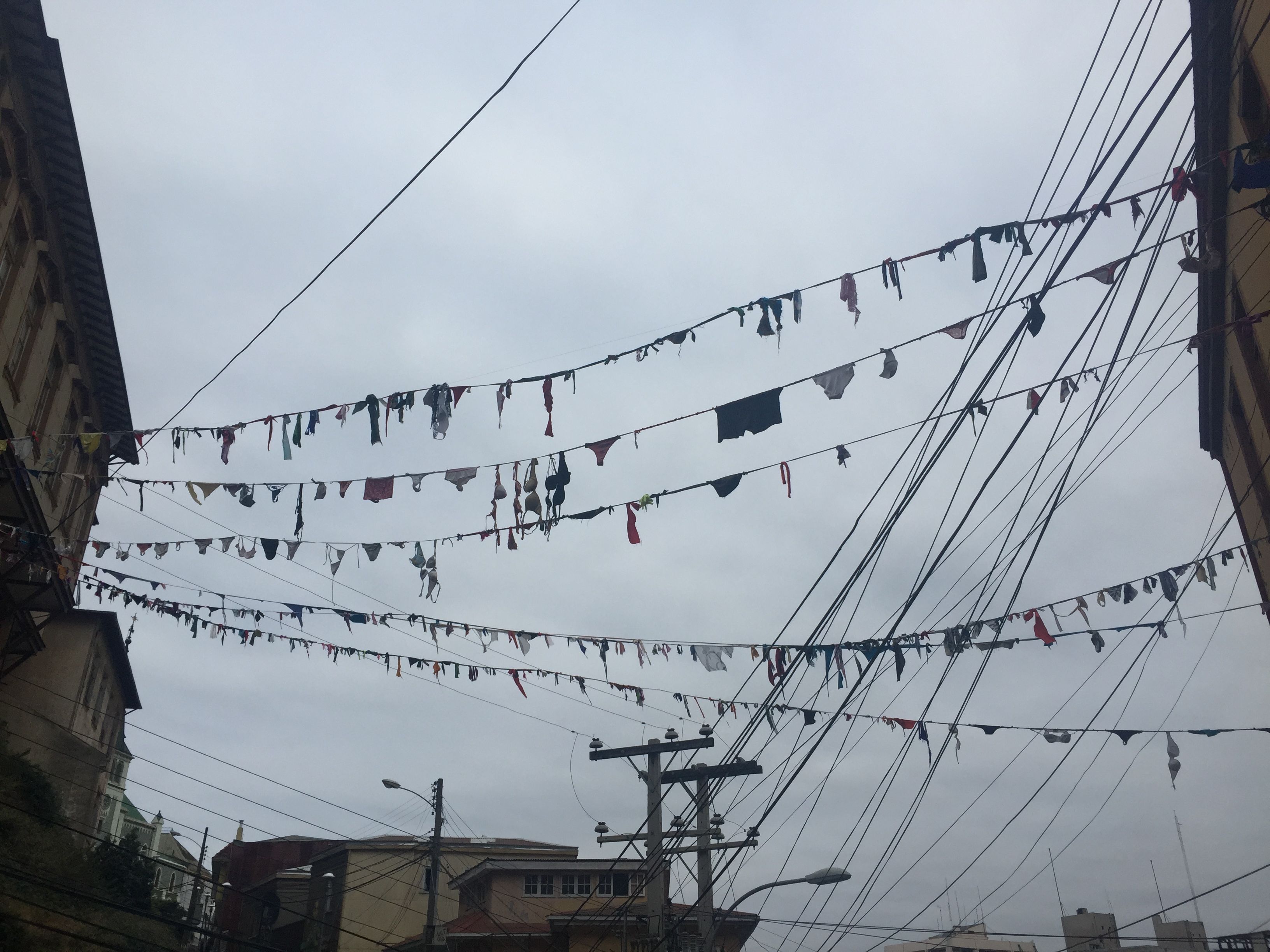
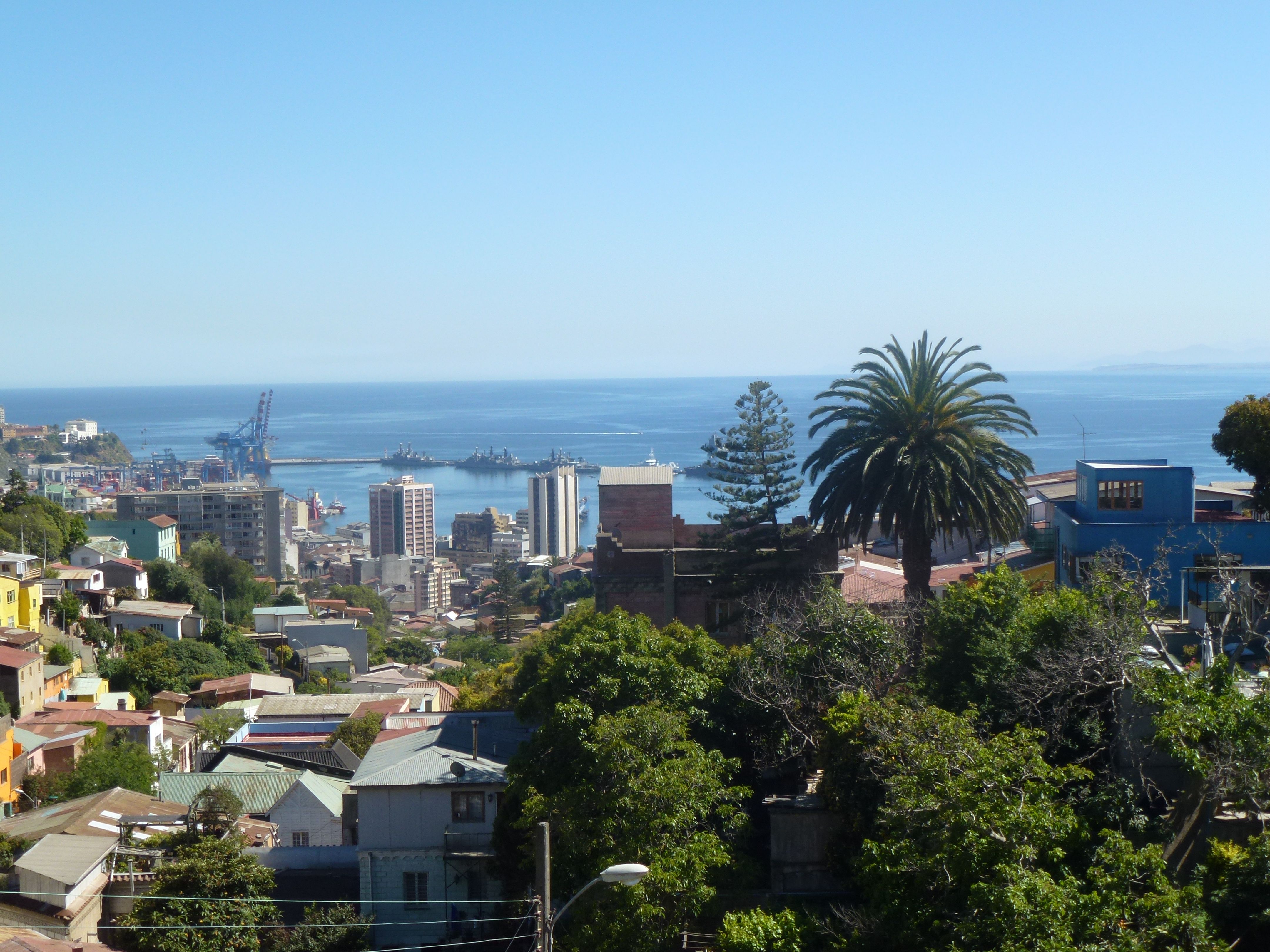
Valparaíso was the most important port on the Pacific seaboard of the Americas until the creation of the Panama canal. It lies on several hill, or cerros, cluttered with houses of every shape, many of them built from adobe covered with tin sheeting salvaged from ships, and painted in bright colours. I had the good fortune to be shown around town by the young poet Enrique Winter, and walking is the only way to see Valparaíso as it is a labyrinth of alleys and stairways – and also boasts a series of antique lift or elevators, some of them actually working.

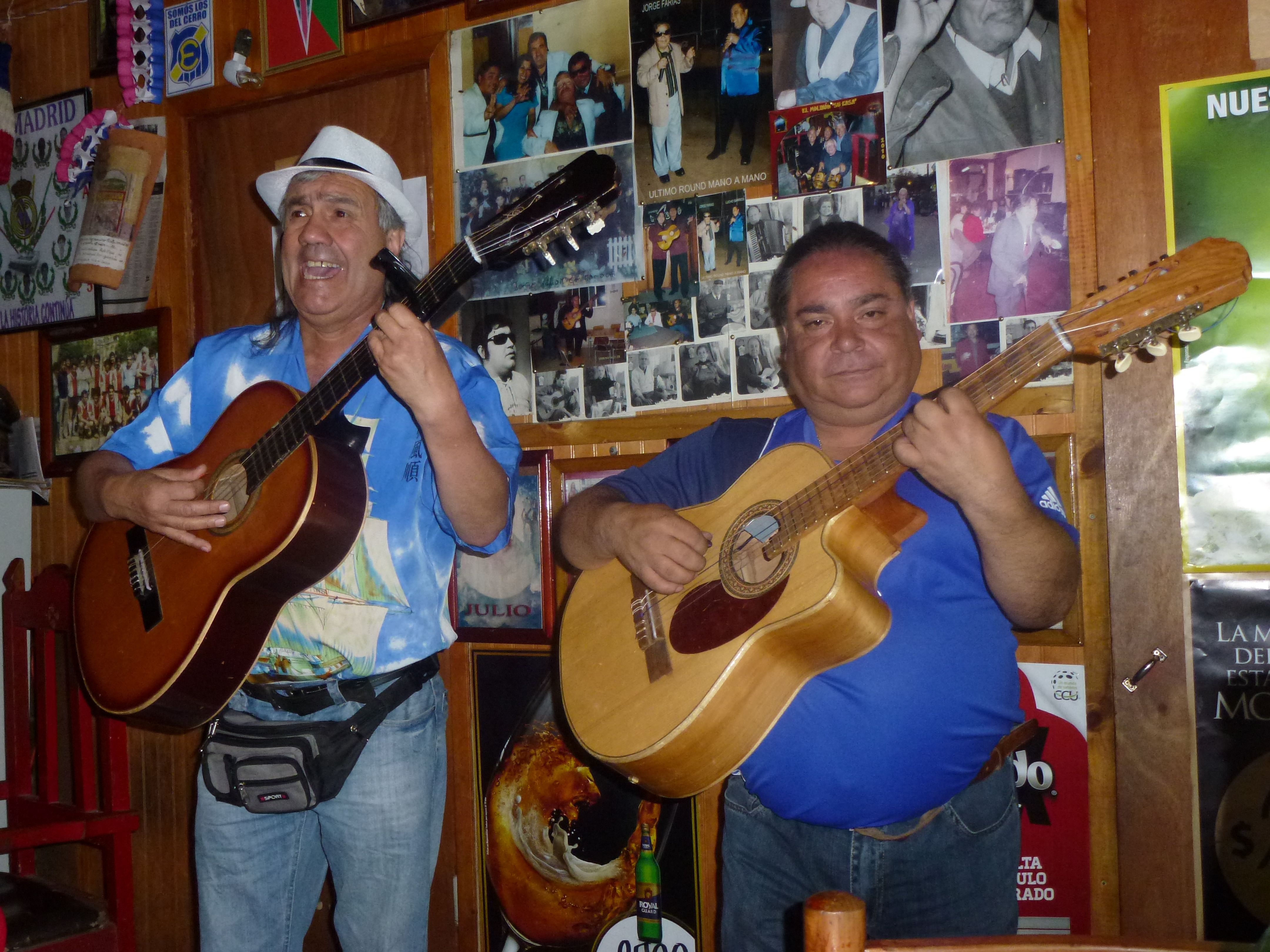
Valaparaíso is still a working port, and the main base of the Chilean navy. In the early evening we visited a place where old sailors come to die, called Liberty. We had not been there long when a French TV film crew came in and wanted to film two gentlemen (depicted below) sing a couple of songs. They wanted us to move tables. ‘Why’, asked Enrique, ‘don’t we look Chilean enough for you?’ The French TV producer very kindly offered to pay our bill, so we acceded to his request and moved to another table. When the music ended there was a lot of hooting and rowdy behaviour from the local clientele, which included a 1970s football star from the town’s once glorious team (football was introduced to the city by British sailors).

val libert 2

After dinner, returning to Enrique’s house, I acquired an escort of four black dogs, of varying sizes. All I needed was a cape and I could have stepped straight out of an Iron Maiden song.

Val kennels

Valparaíso is a slice of paradise, however obvious the statement. Even the French TV crew could be forgiven. Later yesterday evening, back in Santiago, we were invited to a party in a swish part of town and I ended up having a long chat with the film director Miguel Littín, subject of the Gabriel García Márquez book Clandestine in Chile.  His opinion was different.French TV film crews’, he confided, ‘they are the worst.’

Val orgasmos


val brecon


val view